





TL;DR
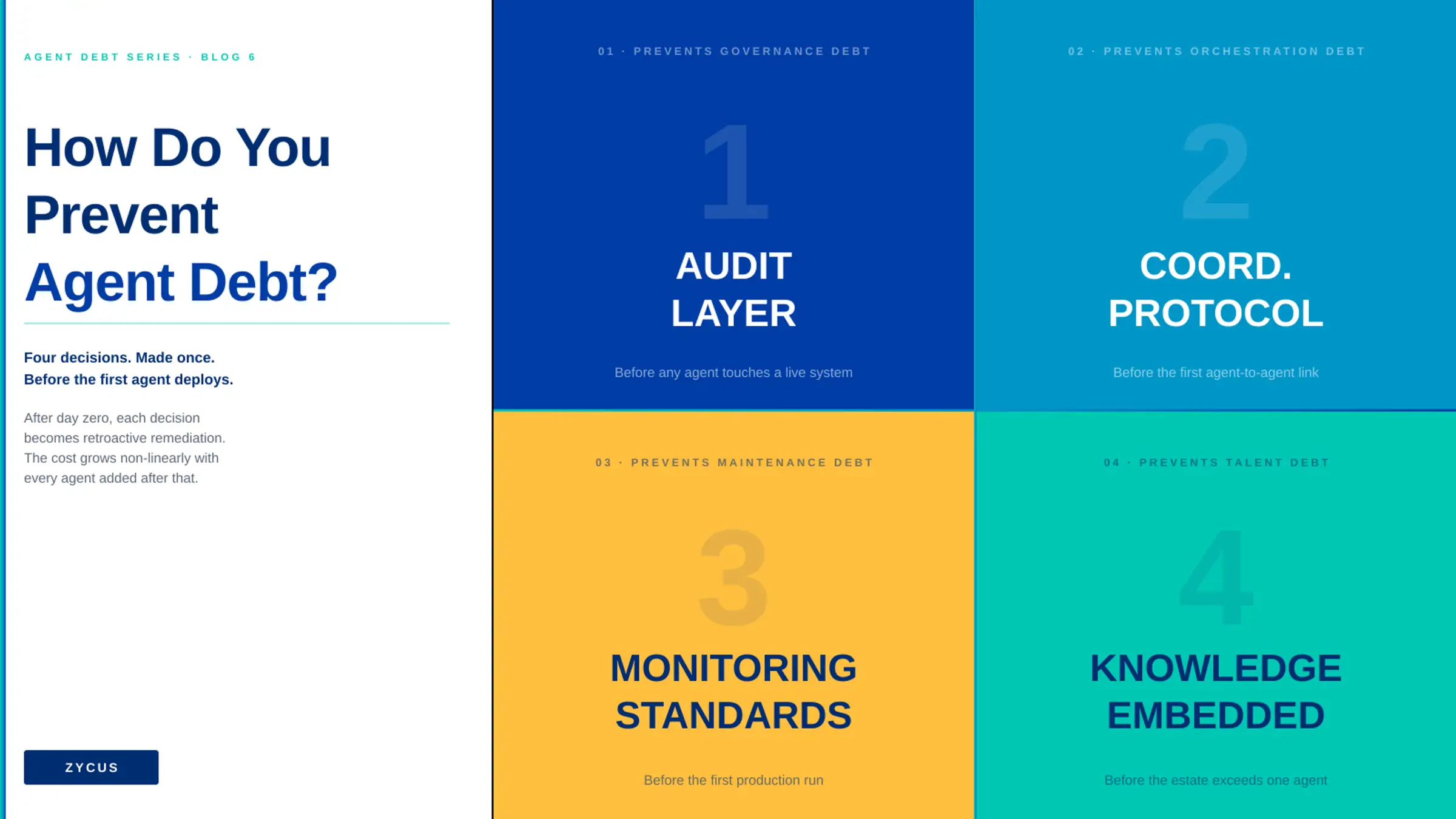
- Agent Debt prevention is not a practice: it is a moment. Four decisions made before the first agent deploys determine whether the estate generates debt or avoids it.
- Decision 1 (prevents Governance Debt): deploy a centralized audit layer before any agent touches a live system.
- Decision 2 (prevents Orchestration Debt): define the coordination protocol before the first agent-to-agent interaction.
- Decision 3 (prevents Maintenance Debt): establish monitoring and alerting standards before any agent goes to production.
- Decision 4 (prevents Talent Debt): embed operating logic in the platform before the estate exceeds one agent.
- After day zero the decisions become retroactive remediation. See how the Merlin Agentic AI Platform makes all four decisions structural by design.
Agent Debt prevention is not a practice. It is a moment. Four architectural decisions, made before the first agent touches a live system, determine whether the estate generates debt or avoids it. After that moment, the options change from prevention to remediation, and the cost changes with them.
The foundational Agent Debt piece established the concept. The CPO self-assessment provided the diagnostic. The studio teardown identified the source. The four debt types named the dimensions. The technical debt comparison explained the rate. The metric analysis identified what to measure. This blog closes the loop with the question that precedes all of them: how do you prevent the debt from forming in the first place?
Agent Debt is the compounding operational liability an enterprise takes on when it deploys task-doing AI agents faster than it can govern, orchestrate, and tie them to business outcomes. Prevention means making the architectural decisions that eliminate the conditions under which that liability forms.
Why is Agent Debt prevention a day-zero problem rather than an ongoing one?
Most enterprise governance frameworks treat governance as an ongoing practice: periodic reviews, quarterly audits, annual risk assessments. This approach works for liabilities that accumulate slowly and visibly. Agent Debt does not work that way.
The four types of Agent Debt are easier and cheaper to prevent before they form than to pay down after they accumulate. More importantly, the architectural decisions that prevent each type lose their effectiveness rapidly after the first agent is deployed, because each subsequent agent creates dependencies that make retroactive governance more complex and less complete.
Only 17% of organizations have deployed AI agents to date, yet more than 60% expect to do so within the next two years, the most aggressive adoption curve among all emerging technologies measured in the survey.
Gartner 2026 CIO and Technology Executive Survey (via 2026 Hype Cycle for Agentic AI)
That adoption curve means the day-zero window is open for most enterprises right now. It narrows with every agent added, and the cost of these decisions grows non-linearly at each stage.
What is the first decision, and what does it prevent?
Decision 1: Deploy a centralized audit layer before any agent touches a live system.
A centralized audit layer records every agent action at the platform level: what input state the agent received, what decision logic it applied, what output it produced, and when. This prevents Governance Debt by ensuring that the question “why did this agent make that decision” has a documented answer that does not require the engineer who built the agent to reconstruct it from memory. The decision to implement this layer must be made before the first agent goes live, because retrofitting it into a live estate requires modifying every agent already in production. The cost of this decision at day zero is primarily time: the architecture must support it. The cost at day 100 is an engineering project applied against a production system with live data dependencies.
What is the second decision, and what does it prevent?
Decision 2: Define the coordination protocol before the first agent-to-agent interaction is designed.
A coordination protocol specifies how agents communicate with each other: what context they share, who owns exception handling when a handoff fails, and what the defined interface is for inter-agent communication. This prevents Orchestration Debt by ensuring that every agent-to-agent relationship in the estate uses a common, platform-mediated interface rather than a custom integration specific to those two agents. The decision must be made before the first multi-agent interaction, because each custom integration that forms before the protocol exists becomes a proprietary dependency that is costly to migrate to a standard interface later.
New AI deployments introduce additional operating burden including models to maintain, platforms to govern, and controls to manage, without reducing the legacy footprint underneath. This increases rather than decreases technical debt.
McKinsey, “Recalibrating Technology Budgets for the AI Era” (Mar 2026)
What is the third decision, and what does it prevent?
Decision 3: Establish monitoring and alerting standards before any agent goes to production.
Monitoring standards define the baseline performance of each agent before it goes live: what decision quality looks like at deployment, what drift thresholds trigger an alert, and who receives that alert. This prevents Maintenance Debt by ensuring that performance degradation is detected and routed automatically rather than discovered when a category manager notices an anomaly. The decision must be made before the first production deployment because performance baselines can only be established at the point when the agent’s behavior is defined. Retroactive baselining against a live agent that has already been making decisions is comparing against a moving target.
What is the fourth decision, and what does it prevent?
Decision 4: Document operating logic in the platform before the estate exceeds one agent.
Platform-embedded knowledge means that the configuration decisions, constraint definitions, and exception handling logic for every agent exist as structured records in the platform, not in the memory of the person who built it. This prevents Talent Debt by ensuring that operating knowledge is a platform output rather than a human deliverable. The decision is most straightforward when the estate has one agent: there is exactly one agent’s worth of logic to document. Each additional agent makes the retroactive documentation task proportionally larger, and the risk of knowledge loss grows with every agent added without documentation.
What does it cost to make these decisions late rather than on time?
The cost gradient of these four decisions is steep and non-linear.
At day zero, before any agent is deployed, all four decisions are primarily a time investment. The architecture must support them, but no existing systems need to be modified. At five agents in production, two of the four decisions can still be applied cleanly, but the other two require coordination across live systems. At 50 agents, none of the four can be applied without an engineering project of meaningful size, and the retrofit is rarely complete. At 500 agents, the architectural reset may be the only path to clean governance of all four dimensions.
The decisions themselves do not become more complex as the estate grows. The work of applying them to an estate that was not built to support them does.
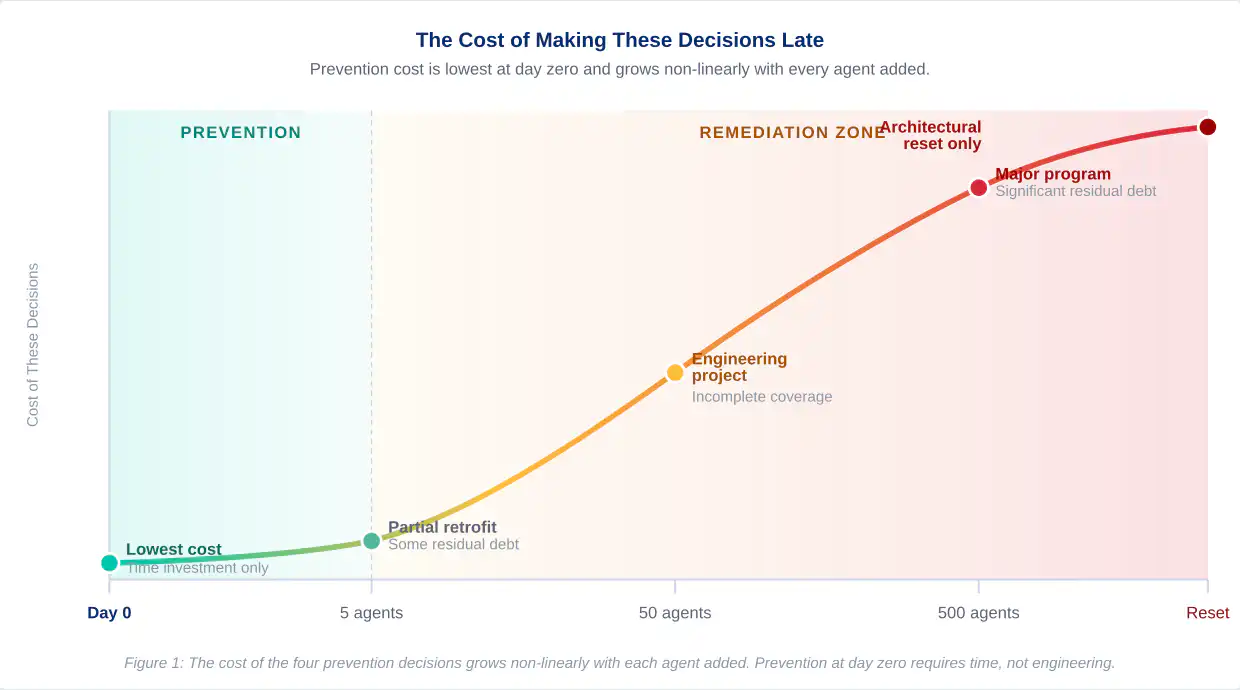
Figure 1: The cost of the four prevention decisions grows non-linearly with every agent added after day zero. Prevention requires time; remediation requires engineering projects against a live estate.
How does the Merlin Agentic AI Platform make all four decisions structural rather than deliberate?
The Merlin Agentic AI Platform embeds all four decisions in its architecture rather than treating them as configuration options the CPO must remember to enable. The audit layer is not a module: it is how the platform records every agent action by default. The coordination protocol is the orchestration layer itself: agents communicate through platform-mediated interfaces, not through custom integrations. Monitoring standards are platform defaults applied at deployment. Operating knowledge is a structured platform output, not a documentation task assigned to the agent developer.
The result is that prevention is structural. The Intake-to-Outcomes architecture does not permit the conditions under which Agent Debt forms, because the four decisions are made once, at the platform level, and applied to every agent in the estate by design.
Published by Zycus
Agent Debt is preventable. The Merlin Agentic AI Platform makes prevention structural: the four architectural decisions are embedded in the platform, not left to the CPO to configure before each deployment.
Read the series: What is Agent Debt? · The CPO Self-Assessment · What 50+ Agents Actually Means · The Four Types · Agent Debt vs Technical Debt · Why Agent Count Is Wrong · Beyond the Hype (Whitepaper)
FAQs
Q1. Why is Agent Debt prevention a day-zero problem rather than an ongoing governance issue?
Because the four architectural decisions that prevent each type of Agent Debt become retroactive remediation after the first agent is deployed. Governance Debt prevention requires a centralized audit layer before any agent touches a live system; retrofitting that layer after 20 agents are in production is an engineering project, not a configuration. Orchestration Debt prevention requires a coordination protocol before the first agent-to-agent interaction; defining that protocol after agents are already communicating is a redesign. The cost and completeness of these decisions change fundamentally at day zero.
Q2. What exactly is a ‘centralized audit layer’ in practice?
A centralized audit layer is an architectural capability that records every agent action at the platform level, not at the individual agent level. It means that when an auditor asks why a particular sourcing decision was made last Tuesday, the answer exists in a platform record that does not require the engineer who built that specific agent to reconstruct it. In practice, it is a decision log that captures the input state, the decision logic applied, the output produced, and the timestamp, for every agent action, automatically and without requiring the agent developer to implement logging as an afterthought.
Q3. What happens when the coordination protocol is not defined before the first multi-agent interaction?
Each agent-to-agent interaction that occurs before a coordination protocol is defined becomes a custom integration. Custom integrations create proprietary dependencies between specific agents. Those dependencies mean that modifying one agent requires understanding and often modifying the agents it interacts with. As the estate grows, these custom dependencies create the exact Orchestration Debt the series has described: adding the next agent becomes harder than adding the first one was, and the coordination overhead grows faster than the estate does.
Q4. Can Agent Debt prevention decisions be made incrementally rather than all at once?
The four decisions can be sequenced but not skipped. Decision 1 (centralized audit) must be made before any agent touches a live system. Decision 2 (coordination protocol) must be made before any two agents interact. Decision 3 (monitoring standards) must be made before any agent goes to production. Decision 4 (platform-embedded knowledge) should be made before the estate exceeds one agent, though it is the most recoverable of the four if delayed slightly. Skipping any of these decisions permanently does not mean they go away: it means they become remediation work rather than prevention work.
Q5. How does day-zero prevention differ from what most enterprises actually do?
Most enterprises make governance decisions reactively: they deploy agents until a trigger event (an audit request, an exception cascade, a departure) forces the issue. At that point, the architectural decisions are being made against a live, production estate with real data dependencies and business workflows running through it. Prevention means making the same decisions before any of those dependencies exist, when the cost is lowest and the optionality is highest. The enterprise that prevents Agent Debt does not have an easier technical task; it has a smaller estate when it makes the decisions.
Q6. What does platform-embedded knowledge look like compared to individual knowledge?
Platform-embedded knowledge means that the operating logic of every agent, including why it was configured a particular way, what constraints apply to its decision-making, and what the exception handling procedures are, exists as structured records in the platform rather than in the memory of the person who built it. Individual knowledge means the opposite: the logic exists in a Confluence page, a Slack thread, or a person’s head. The practical test is straightforward: if the person who configured your most complex agent left tomorrow, would the platform contain enough documentation to reconstruct what they knew?
Q7. How does the cost of Agent Debt prevention compare to the cost of remediation?
The cost gradient is steep. At day zero, prevention is primarily a time investment: the decisions require careful thinking but minimal engineering work. At five agents, partial retrofitting is possible but some residual debt remains. At 50 agents, significant engineering work is required and the retrofit is rarely complete. At 500 agents, a full architectural reset may be the only path to clean governance. The decisions themselves do not become more complex as the estate grows; the work of applying them retroactively does.
Q8. How does the Merlin Agentic AI Platform make the four decisions structural rather than requiring deliberate choice?
The Merlin Agentic AI Platform embeds all four decisions in its architecture rather than treating them as configuration options. The audit layer is not a module to enable: it is how the platform records every agent action by default. The coordination protocol is the orchestration layer itself: agents communicate through the platform’s coordination infrastructure, not through custom integrations. Monitoring standards are platform defaults, not agent-level configurations. And operating knowledge is captured as a platform output, not as a documentation task assigned to the agent developer. Prevention is structural because the architecture does not permit the conditions under which Agent Debt forms.
Q9. We have already deployed agents. Is Agent Debt prevention still possible?
Yes, though the options narrow at each stage. The day-zero cost gradient applies in reverse: decisions made at five agents in production are more expensive but still achievable. Decisions made at 50 agents require a meaningful engineering project and leave some residual debt. Decisions made at 500 agents may require a full architectural reset. The starting point for an estate that is already in production is the CPO self-assessment in the first blog in this series: it diagnoses which of the four debt types are present and at what severity. That diagnostic determines which decisions can be applied incrementally and which require architectural remediation rather than configuration. Prevention may be closed, but structured paydown is still available.
Related Reads:
- Agent Debt: The Tech Debt of the Agentic Era
- Do You Have Agent Debt? A CPO’s Self-Assessment
- What Does “50+ Agents Out of the Box” Actually Mean for Procurement AI?
- What Are the Four Types of Agent Debt, and When Does Each One Surface?
- Whitepaper: Beyond the Hype: Agent Studio vs. Enterprise Agentic AI
- From Co-Pilots to Commanders: How Agentic AI is Redefining Procurement Transformation
- AI Agents in Procurement: A Comprehensive Guide
- Why Is Agent Count the Wrong Metric for Procurement AI, and What Should Replace It?