





TL;DR
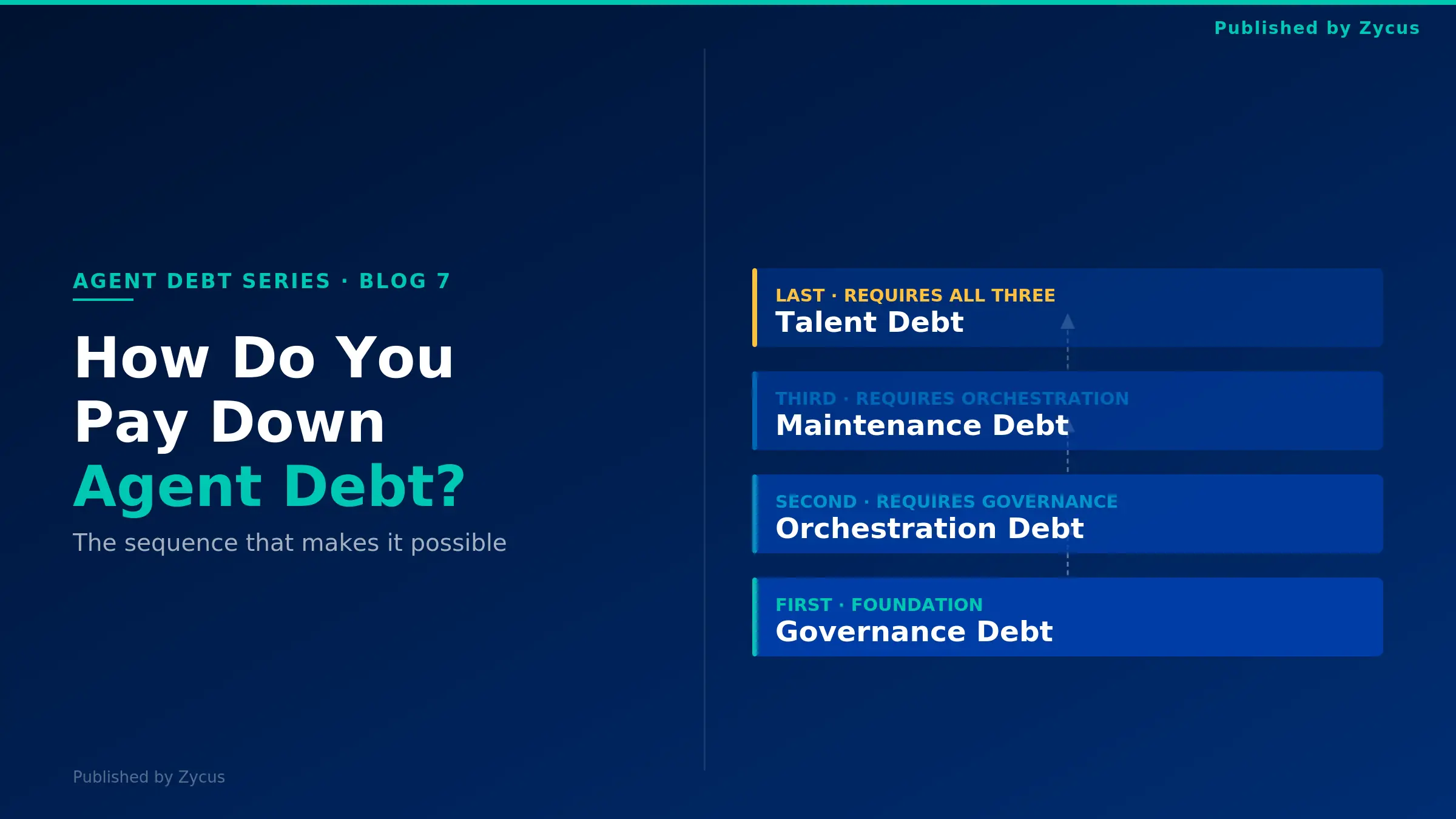
- Agent Debt can be paid down without a platform reset, but only in the right sequence, determined by the dependency chain the four types share.
- Governance Debt is always first: without visibility into what agents are deciding, no other paydown action is auditable or accurate.
- Orchestration Debt cannot precede Governance: the coordination audit requires a decision log to identify which connections carry the highest risk.
- Maintenance Debt requires stable orchestration: monitoring baselines set against a chaotic coordination layer detect noise, not genuine agent drift.
- Talent Debt is last: knowledge documentation is only complete when the platform is stable enough for its operating logic to be accurately captured.
- See how the Merlin Agentic AI Platform makes each paydown step structural rather than a remediation project.
The foundational Agent Debt piece established the mechanism. The CPO self-assessment provided the diagnostic. The studio teardown identified where Governance and Orchestration Debt originate. The four debt types named the dimensions. The technical debt comparison explained why Agent Debt compounds faster and without visibility. The agent count metric identified what drives accumulation. The prevention blog showed how to stop Agent Debt forming. This blog addresses what to do when it has already formed.
Agent Debt is the compounding operational liability an enterprise takes on when it deploys task-doing AI agents faster than it can govern, orchestrate, and tie them to business outcomes. Once accumulated, the question is not whether to address it, but in what order.
Is it possible to pay down Agent Debt once it has formed, or does it require a full platform reset?
The instinct, when a diagnosis is structural, is to reach for a structural solution: a platform swap, a vendor change, a wholesale rebuild. That instinct misreads the problem. Agent Debt can be paid down in place, against a running estate, without taking agents offline. What paydown requires is not a replacement but a sequence. The four Agent Debt types are not independent. Each type’s remediation requires the visibility and stability that the prior type’s remediation creates. Attempting to pay down all four simultaneously distributes effort without completing any. The sequence runs from Governance to Orchestration to Maintenance to Talent.
Why does the paydown sequence matter, and what determines it?
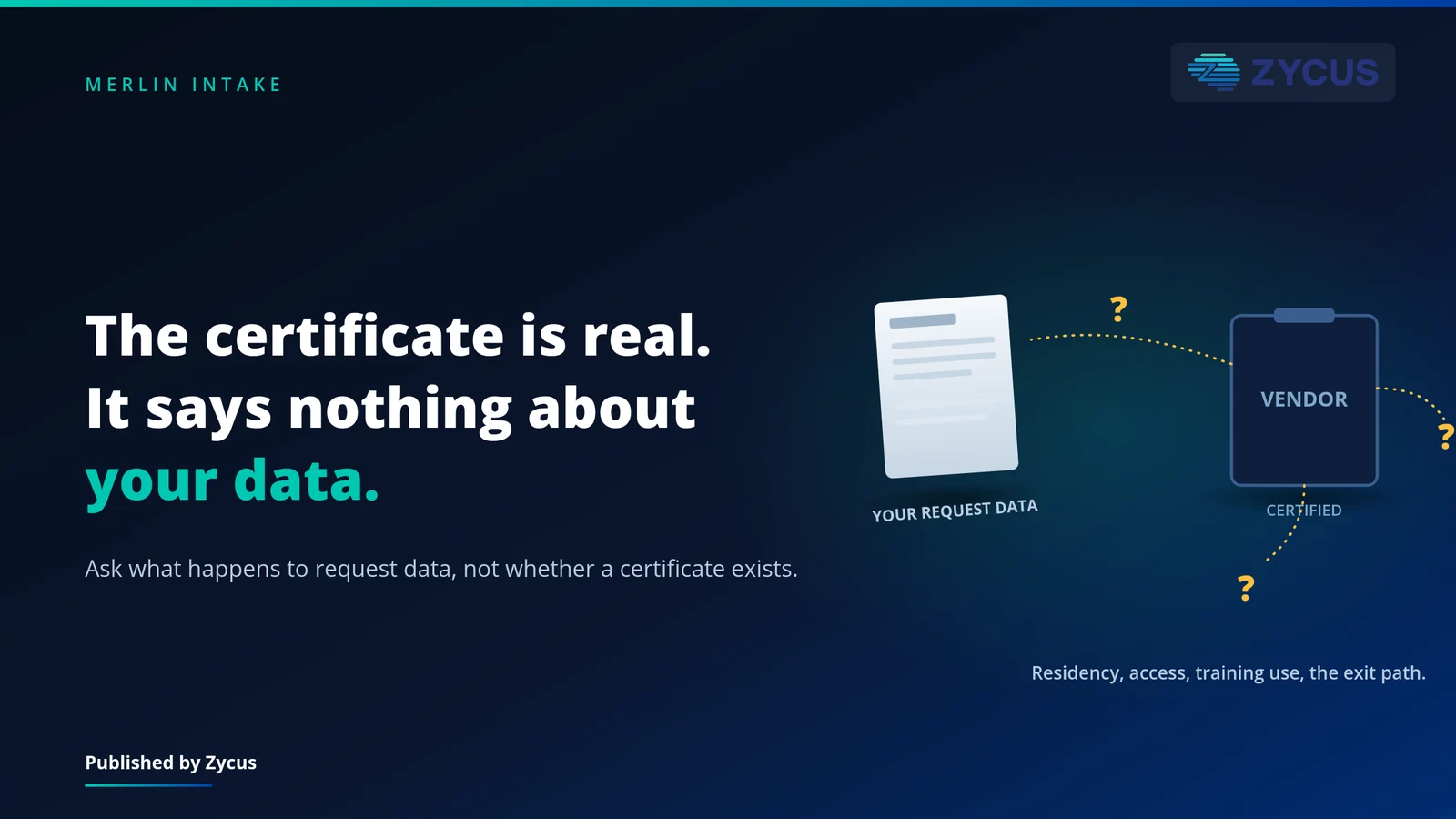
Governance Debt sits at the base because it is the visibility problem. Without a record of what agents are deciding, no other paydown action is auditable. A coordination audit run without a decision log maps to a moving target. A monitoring baseline set without decision visibility cannot distinguish agent drift from coordination noise. A knowledge documentation sprint run against an unaudited estate records the configuration, not the operating logic. Every downstream paydown depends on Governance being in place first.
Nearly three-quarters of Chief Procurement Officers believe artificial intelligence is moving from experimental use cases to core operational capability.
CPO Rising 2025, Ardent Partners
Organizations making that move without a Governance paydown underway are scaling on accumulating debt. Paydown is not a precondition for AI investment; it is a precondition for AI investment that delivers. (Zycus co-sponsors this research.)
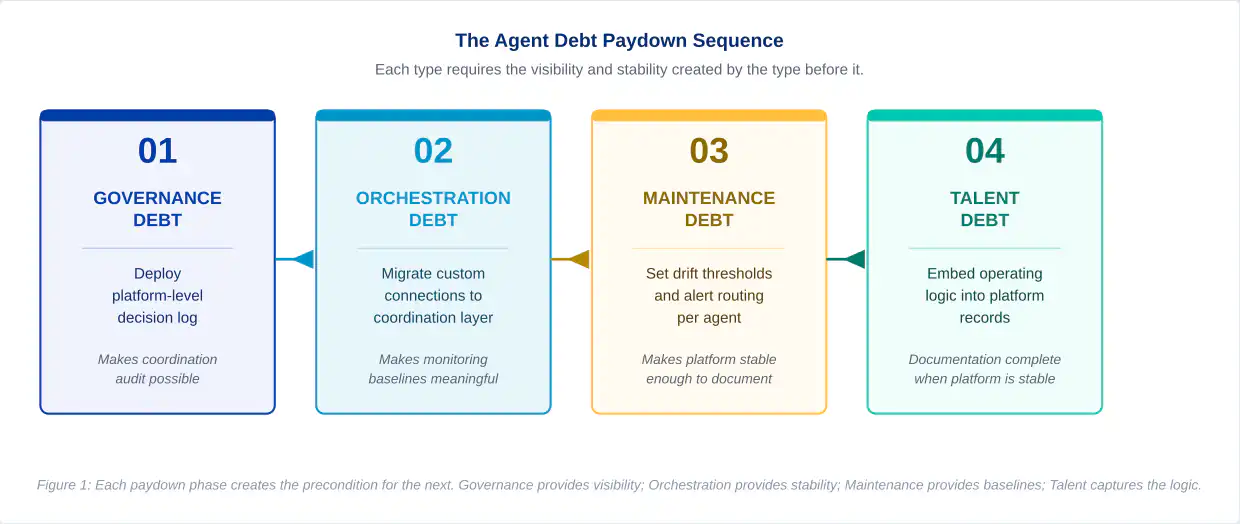
Figure 1. The Four-Phase Agent Debt Paydown Sequence: each type creates the precondition for the next.
How do you pay down Governance Debt?
The technical debt translation from B4 applies directly: code review becomes agent decision review. Three paydown actions in order: reconstruct a representative sample of past decisions from agent output records to establish what the estate has been deciding; deploy a forward-going platform-level decision log that captures every agent action without engineering access; and institute a decision review gate before any new agent deploys. The residual after this paydown is bounded: decisions made before the log was established remain unauditable. What changes is that compounding stops. Every new agent action is visible from this point forward.
Eighty percent of procurement executives identify AI-enabled technology as the most transformational trend affecting the function over the next five years.
Hackett 2026 Procurement Key Issues Study
That transformation is built on agent decisions. Governance Debt means those decisions are not recorded. Paydown closes the gap between the transformation organizations have committed to and the visibility they need to sustain it.
How do you pay down Orchestration Debt, and why can it not precede Governance?
The translation: static analysis becomes coordination mapping. Three paydown actions: audit all existing agent-to-agent interactions and classify each as platform-mediated or custom point-to-point; migrate the highest-risk point-to-point connections to platform-mediated coordination, starting with those touching live supplier data or high-value decisions; and institute a coordination protocol gate before any new agent-to-agent interaction goes live.
Orchestration paydown requires Governance to precede it because the coordination audit requires a decision log to be accurate. Without visibility into what each agent is deciding, the risk classification of each connection is incomplete, and the gaps identified do not represent the full picture. Remediation built on an incomplete map leaves the highest-risk connections unaddressed.
How do you pay down Maintenance Debt, and why does it require Orchestration first?
The translation: sprint-based debt accounting becomes four-dimension Agent Debt tracking. Three paydown actions: extract historical performance data from the estate to establish pre-paydown baselines; set drift thresholds for each agent against those baselines; and establish alert routing so deviations trigger the right owner without an engineering ticket.
Maintenance paydown requires stable orchestration because baselines only mean something against a consistent coordination layer. An agent whose coordination is chaotic produces variable outputs regardless of its own performance. A drift threshold set against chaotic output detects coordination noise, not agent degradation. Maintenance paydown on unstable orchestration generates false positives and misses real drift.
If enterprises orchestrate agents better and thoughtfully address the associated challenges and risks, the autonomous AI agent market projection could increase by 15 to 30 percent, reaching as high as $45 billion by 2030.
Deloitte TMT Predictions 2026
That differential is a value gap. Maintenance paydown is one of the structural actions that makes orchestration stable enough for it to close.
How do you pay down Talent Debt, and why is it last?
The translation: architectural debt audits become estate-level knowledge documentation. Three paydown actions: documentation sprints where operating logic is extracted from individuals and formalized as structured platform assets; runbook migration from personal files and informal channels to shared platform records; and progressive embedding of operating knowledge into the platform so it does not require a specific person to access or maintain.
Talent Debt is last because documentation is only complete when the platform is stable enough for its operating logic to be accurately captured. Documenting an unstable estate records the configuration, not the logic. Each subsequent stability change made during Governance, Orchestration, and Maintenance paydown would require the documentation to be redone. The sequence ensures the platform is ready to hold the knowledge before the transfer begins.
How does the Merlin Agentic AI Platform make paydown structural rather than a project?
When the architecture already contains audit-ready decision records, a centralized coordination layer, proactive monitoring with drift detection, and platform-embedded operating knowledge, each paydown action becomes a migration rather than a build. The Merlin Agentic AI Platform is built on this starting point. The paydown sequence still applies. What changes is that each step completes faster and with less residual debt because the platform is designed to hold the outcome.
Published by Zycus
The CPO does not need to repeat three decades of technical debt learning. The sequence is documented. The frameworks exist. The Merlin Agentic AI Platform makes each paydown step structural rather than a project.
Read the series: What is Agent Debt? · The CPO Self-Assessment · What 50+ Agents Actually Means · The Four Types · Agent Debt vs Technical Debt · Why Agent Count Is Wrong · How to Prevent Agent Debt · Beyond the Hype (Whitepaper)
FAQs
Q1. Can you pay down one type of Agent Debt without addressing the others?
You can start with any single type, but partial paydown produces partial results. Governance paydown without Orchestration paydown creates a decision log that reveals coordination gaps without closing them. Orchestration paydown without Governance produces a coordination map that is incomplete. Each type’s paydown is more effective when the prior type has been addressed. The sequence is not a strict gate; it is the order in which effort produces the most durable outcome.
Q2. How long does the Governance Debt paydown take?
The forward-going decision log can be established in days to weeks, depending on whether the platform already has audit infrastructure. The retrospective audit is never fully complete; the practical approach is to establish the forward log first, run the retrospective as a scoped parallel project, and disclose the residual gap. The forward log stops compounding immediately. The retrospective closes the historical gap progressively.
Q3. What if the estate is too large to audit all at once?
Prioritize by risk, not by size. The agents whose decisions touch live supplier data, financial commitments, or regulatory records create the highest exposure if unauditable. Start the coordination audit with those agents. The lower-risk parts of the estate can follow on a rolling cadence once the highest-risk connections are under the coordination layer. Partial paydown completed systematically is more durable than a comprehensive paydown attempted all at once and abandoned.
Q4. What does “residual debt” mean after a paydown phase?
Residual debt is the portion of a debt type that cannot be eliminated without taking the estate offline or replacing it. For Governance Debt, the residual is decisions made before the log was established; those decisions remain unauditable unless the full historical record exists. Residual debt is disclosed, bounded, and monitored. The goal of paydown is to stop accumulation and reduce the active stock. Residual that cannot be closed is managed, not ignored.
Q5. How does Talent Debt paydown interact with personnel changes?
Personnel changes make Talent Debt visible, but they should not be the trigger for paydown. Documentation sprints and runbook migrations are most effective when the people holding the operating knowledge are available to contribute to the transfer. Paydown after a departure is remediation of what has been lost. Paydown before a departure is prevention. Both are valid; prevention produces more complete records at lower cost.
Q6. Can paydown run in parallel with continued agent deployment?
Yes, with a condition. Paydown is most effective when it runs ahead of new deployment. Each new agent added during a paydown cycle extends the scope of the coordination audit and adds new monitoring baseline entries before prior entries are stable. The practical approach: pause net-new agent deployment for the duration of the Governance and Orchestration paydown phases. Resume once the coordination layer is in place. The pause is not indefinite; Governance paydown typically completes in weeks, not months.
Q7. How do you measure progress on Agent Debt paydown?
Four metrics, one per type. For Governance: percentage of agent actions covered by the decision log, targeting 100 percent of forward actions within 30 days. For Orchestration: percentage of agent-to-agent connections mediated by the coordination protocol rather than custom integrations, targeting highest-risk connections first. For Maintenance: number of agents with defined drift thresholds and alert routing, measured against total estate size. For Talent: percentage of operating logic documented in the platform rather than held by individuals, measured per agent and per function.
Q8. How does the Merlin Agentic AI Platform accelerate each paydown phase?
Each phase becomes a configuration or migration rather than a build. Governance: the decision log already exists at the platform level; paydown is configuring access and scope. Orchestration: the coordination layer already mediates agent interactions; paydown is migrating custom connections into the existing protocol. Maintenance: monitoring infrastructure already exists; paydown is setting thresholds and routing. Talent: operating knowledge is already captured in platform workflow definitions; paydown is extending documentation coverage. What each phase requires is setup, not construction.
Related Reads:
- Agent Debt: The Tech Debt of the Agentic Era
- Do You Have Agent Debt? A CPO’s Self-Assessment
- What Does “50+ Agents Out of the Box” Actually Mean for Procurement AI?
- What Are the Four Types of Agent Debt, and When Does Each One Surface?
- Whitepaper: Beyond the Hype: Agent Studio vs. Enterprise Agentic AI
- From Co-Pilots to Commanders: How Agentic AI is Redefining Procurement Transformation
- AI Agents in Procurement: A Comprehensive Guide
- Why Is Agent Count the Wrong Metric for Procurement AI, and What Should Replace It?