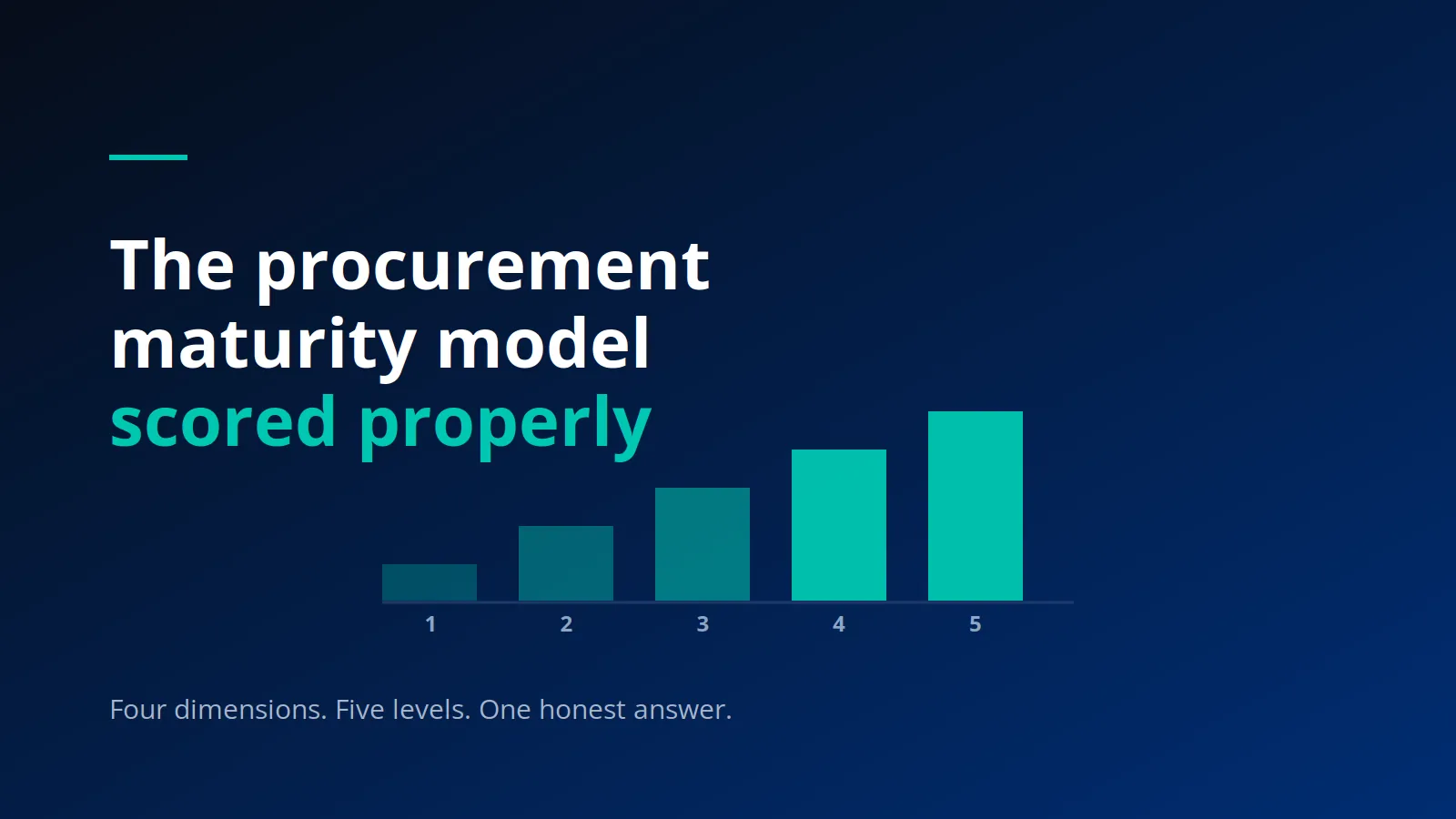






For CPOs and procurement directors managing deployed AI agents: nine questions across four dimensions. Your score places you in one of three brackets, each with a specific next step.
TL;DR
- Every agent in your procurement estate probably passes its own test. This assessment answers the question your dashboards don’t: are those passing agents delivering outcomes, or accumulating debt?
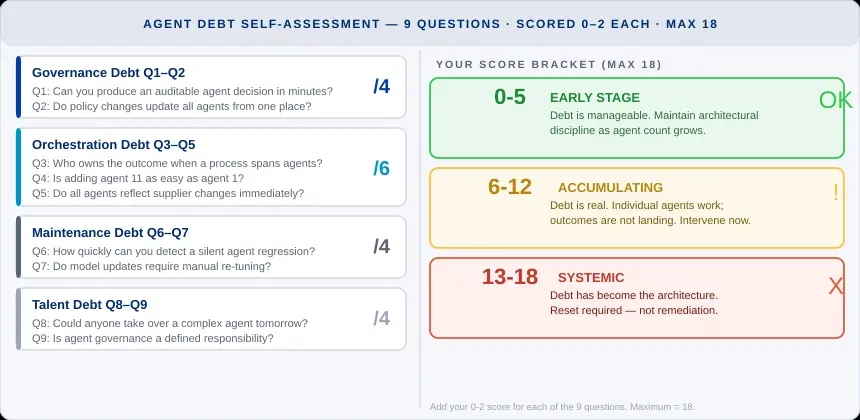
- Agent Debt compounds across four dimensions: Governance, Orchestration, Maintenance, and Talent. This assessment covers Governance (2 questions), Orchestration (3 questions), Maintenance (2 questions), and Talent (2 questions).
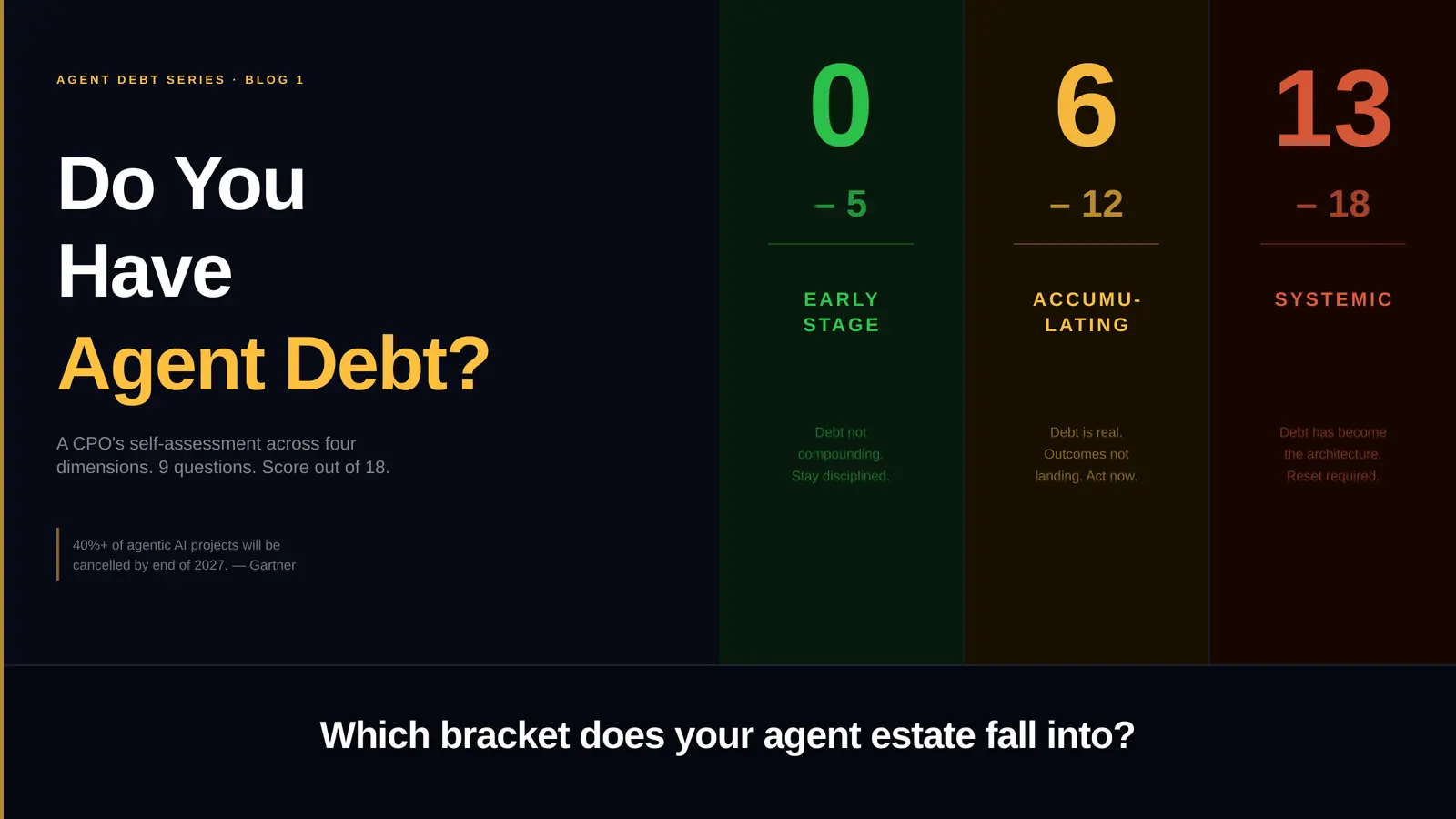
- Score each question 0, 1, or 2. Your total out of 18 places you in one of three brackets: early stage (0–5), accumulating (6–12), or systemic (13–18).
- Fewer than 10% of enterprises have scaled AI agents to tangible value despite two-thirds experimenting. This assessment helps you understand which side of that gap your estate sits on.
- Each bracket carries a specific action recommendation. The systemic bracket requires an architectural reset, not remediation.
- For the full architectural analysis of what prevents Agent Debt from accumulating, read Beyond the Hype: Agent Studios vs. Enterprise Agentic AI →
What is Agent Debt?
Agent Debt is the compounding operational liability an enterprise takes on when it deploys task-doing AI agents faster than it can govern, orchestrate, and tie them to business outcomes. It is the procurement-and-operations equivalent of technical debt in software: it compounds faster, hides better, and sends its bill to a different department.
Why does every agent pass its test while outcomes fail?
Use the nine questions below to find out. Each covers one of the four structural conditions that produce Agent Debt: Governance, Orchestration, Maintenance, and Talent. Score each 0 to 2 and your total tells you whether your estate is early-stage, accumulating, or systemic, with a specific next step for each.
The urgency is real: fewer than 10% of enterprises have scaled AI agents to tangible value, despite two-thirds experimenting, what McKinsey describes as the gen AI paradox: widespread experimentation, minimal measurable impact. The gap is architectural, not technological.
The foundational Agent Debt piece on this site named the pattern precisely: every agent passes its own test. The invoice agent is correct, the payment agent is correct. The outcome, a compliant payment at the contracted rate, doesn’t happen. There is no single broken thing to point at.
How do you score your Agent Debt?
Designed for teams with two or more agents in production or late-stage pilot. Organizations earlier in the journey should start with the foundational Agent Debt piece first.
Score each question 0, 1, or 2:
0 =: This condition is not present in your estate. The system handles this dimension well.
1 =: This condition occurs occasionally or inconsistently. It is not yet systemic but it is not under control.
2 =: This condition is persistent and compounding. It is a structural property of how your agent estate operates.
Do your agents leave an auditable trail?
Governance Debt is the most auditor-visible form. Deloitte’s 2026 survey found that only 21% of organizations have a mature governance model for agentic AI, meaning most procurement decisions are already outpacing the structures designed to answer for them.
Question 1: When you need to explain a specific agent decision (why a supplier was approved, why a PO was routed this way), how long does it take to produce a clear, auditable answer?
0: Every action logged and replayable in minutes.
1: Logs exist but require manual assembly across systems.
2: Answering requires engineering effort, and the answer may be incomplete.
Question 2: When a procurement policy changes, such as a new approval threshold or supplier category restriction, do all affected agents reflect the change from a single update?
0: One policy layer. Changes propagate immediately to all agents.
1: Most agents update promptly. Known exceptions are managed manually.
2: Each agent requires a separate update. Inconsistent interpretation is common.
Does your orchestration layer own the outcome?
Orchestration Debt is the failure mode every agent demo conceals: individual agents pass; the outcome in the handoff between them does not. Three questions cover this dimension.
Question 3: When a process spans more than one agent (intake to sourcing, sourcing to contract, contract to payment), who owns the outcome of the full chain if something goes wrong?
0: One place to look. Ownership is documented.
1: A team usually catches failures. Ownership is not defined.
2: Failures discovered reactively, after the business notices.
Question 4: How difficult is it to add the next agent to your estate compared to the first?
0: Each new agent extends the existing orchestration layer.
1: Integration patterns help, but each agent requires meaningful effort.
2: Integration queue grows. The estate is described internally as brittle.
Question 5: When a supplier record changes (new contract, pricing update, or status change) do all agents that touch that supplier immediately reflect the new state?
0: Shared live data. Consistent state across all agents.
1: Most update promptly. Known lag windows exist.
2: Agents hold different assumptions about the same supplier. Drift is a known problem.
Are your agents drifting silently?
Maintenance Debt accumulates through silent regressions and re-tuning burden. The agents keep running; output quality degrades. No single failure announces it.
Question 6: When a key agent in your estate starts producing inconsistent outputs, how long does it typically take to detect and diagnose the problem?
0: Monitoring surfaces anomalies automatically. Alerts fire in real time.
1: Issues caught through manual checks or downstream business feedback.
2: Silent regressions go undetected until the business reports an outcome failure.
Question 7: How often do you manually re-tune, re-prompt, or re-test agents because model updates or policy changes have degraded their performance?
0: The platform manages updates. Agents are stable across versions.
1: A few times per quarter, caught before outcomes are affected.
2: Ongoing engineering attention required. Manual correction is routine.
Could your agent estate survive a key departure?
Talent Debt is the least visible type: it accrues when critical knowledge concentrates in one person, or when vendor engineers become the permanent ops team for an estate the platform was supposed to govern.
Question 8: If the team member who built your most complex agent left tomorrow, how quickly could someone else take over full ownership?
0: Documented, governed, maintainable by anyone on the team.
1: Partially captured. Transition would require meaningful effort.
2: Critical knowledge lives with one person. Departure is a material risk.
Question 9: Is managing your AI agent estate a defined responsibility in your organization, or is it absorbed into existing roles?
0: Agent governance is a defined role. Responsibilities documented.
1: Some responsibilities defined. Others absorbed into existing roles.
2: Addressed reactively when something breaks. No proactive ownership.
What does your Agent Debt score mean?
Total your scores. Your result falls into one of three brackets.
0–5 EARLY STAGE Architecturally sound, or early enough that debt is not compounding. The risk is complacency: a score of 4 can reach 12 in 12 months without architectural discipline.
6–12 ACCUMULATING Debt is real and growing. Individual agents work; outcomes are not landing. Gartner predicts 40%+ of agentic AI projects will be canceled by end of 2027, due to escalating costs, unclear business value, and inadequate risk controls.
13–18 SYSTEMIC The debt has become the architecture. Adding agents makes it worse. Remediation will not work. An architectural reset means identifying the absent orchestration layer, absent shared context, and governance that was retrofitted rather than built in. Rebuilding from there is the path forward.
How do you start paying down Agent Debt?
The four debt dimensions are symptoms of one condition: agents deployed before governance.
Platforms that embed agents into governed Intake-to-Outcomes workflows from day one prevent Governance, Orchestration, and Maintenance Debt from accumulating by design. The Merlin Agentic AI Platform is built on that architecture.
Beyond the Hype: Agent Studios vs. Enterprise Agentic AI. The architectural case for governed agentic AI in procurement. Published by Zycus. → Download the whitepaper
FAQs
Q1. What is Agent Debt and how is it different from technical debt?
Technical debt sits still until you touch it. Agent Debt compounds autonomously because the agents keep acting, keep drifting, keep making decisions inside a flawed structure whether or not anyone is watching. Technical debt slows engineers. Agent Debt erodes procurement outcomes and lands on the CPO’s desk as savings leakage or a compliance finding.
Q2. Can an organization with only a few agents still have significant Agent Debt?
Yes. Two agents with no shared context, no defined ownership of the handoff between them, and no audit trail for their combined output can accumulate more structural debt than a dozen well-orchestrated agents. The score is not about how many agents you have. It is about whether the architecture the agents live in can answer for outcomes.
Q3. What does a healthy agentic AI estate look like compared to one with Agent Debt?
A healthy estate has a defined orchestration layer that answers for end-to-end outcomes, shared context that all agents operate on, policy changes that propagate from one place, and agent governance owned by a named person or team. A debt-laden estate has correct individual agents and no one who can explain what the system as a whole did last Tuesday.
Q4. What should a CPO do first if they score in the systemic range (13-18)?
Stop adding agents. One more agent is one more point of failure in a structure that is already too brittle to reason about. The first action is architectural: map what you have, identify where the orchestration layer is absent, and determine whether the platform underlying your agents was designed for governed workflows or for agent proliferation. Platforms built on governed Intake-to-Outcomes workflows resolve Orchestration Debt by design. See the whitepaper for the architectural comparison.
Q5. Is Agent Debt inevitable when deploying AI agents in procurement?
No. It is the predictable outcome of a specific architectural choice: starting with agents and adding governance later. Organizations that start with governed Intake-to-Outcomes workflows and embed agents into them structurally avoid accumulating debt because governance is not retrofitted; it is the foundation the agents operate inside from day one.
Q6. How does the DIY agent studio model accelerate Agent Debt accumulation?
A DIY studio optimizes for one metric: agents created. Each team builds its own narrow, task-shaped agents, point-wired to source systems, stateless, owned by different people. The vendor counts this as success. Governance Debt, Orchestration Debt, Maintenance Debt, and Talent Debt all compound in parallel. The business pays in outcomes the dashboard never shows.
Q7. What is the difference between Agent Debt and agent sprawl?
Agent sprawl is what you can see on the dashboard: too many agents, too many integrations, growing complexity. Agent Debt is what that sprawl costs over time: the governance gaps, orchestration failures, maintenance overhead, and talent dependency that accumulate inside the sprawl. You can have sprawl without significant debt if the underlying architecture is governed. You cannot have systemic debt without the sprawl that precedes it.
Q8. My score is in the systemic range. Does that mean I need to change platforms?
A systemic score means your current architecture is accumulating Agent Debt faster than you can pay it down. That is an architectural diagnosis, not automatically a platform replacement decision. The question to ask is whether your current platform was designed for governed workflows from the ground up, or whether it starts with a blank canvas of user-created agents and adds governance later. Platforms built on the agent studio model structurally cannot prevent the conditions this assessment measures. The Merlin Agentic AI Platform embeds agents into governed Intake-to-Outcomes workflows by design. That is the architectural difference between preventing debt and managing it.
Q9. How does Agent Debt affect procurement compliance and audit readiness?
The Governance Debt dimension maps directly to audit exposure. When agents make decisions without auditable logs, when policy changes require manual updates across multiple agents, and when who changed what and when cannot be answered without engineering effort, the organization is exposed at every audit cycle. Procurement carries real compliance obligations across 3-way match, spend thresholds, and supplier approval workflows. Agent Debt surfaces those obligations as audit findings rather than established controls.
Related Reads: