







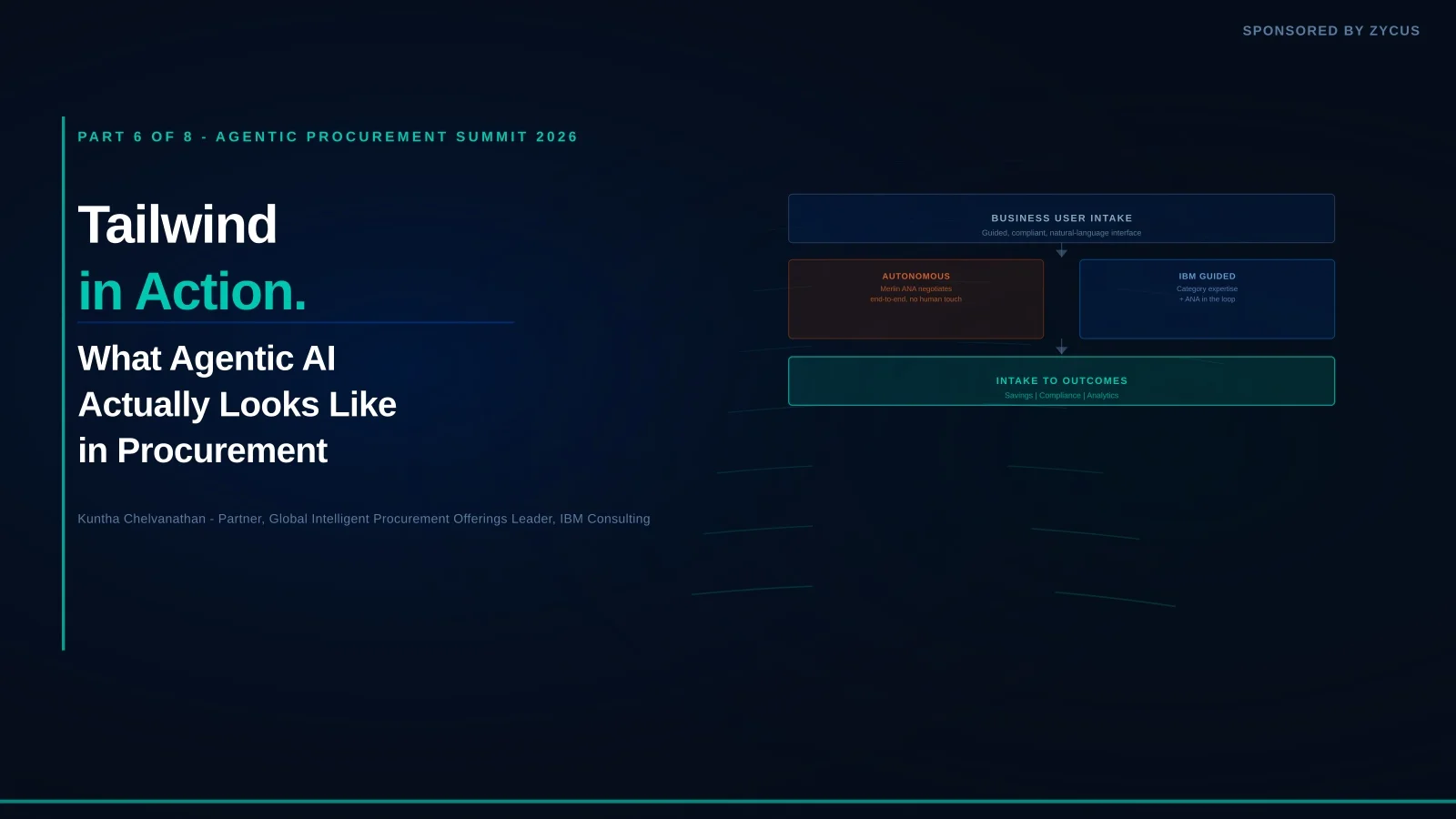

The session that moved from theory to deployment. How IBM and Zycus built a joint offering for tail spend, where the autonomous versus human line gets drawn, and what makes the difference between agentic AI programs that scale and those that stall.
From the Agentic Procurement Summit 2026 · Session 6 · Kuntha Chelvanathan, Partner, Global Intelligent Procurement Operations Offering Leader, IBM Consulting
TL;DR
- This blog covers what it looks like when a procurement organization actually executes on the decisions the previous sessions described, starting with tail spend, the most pragmatic first deployment for agentic AI.
- Despite years of procurement maturity, tail spend remains underserved: distributed across the organization, spontaneous in nature, and hard for category managers to govern at scale. This blog explains why that pattern persists and why it is changing now.
- The Tailwind offering combines IBM managed services with the platform’s autonomous negotiation capability. This blog explains how both work together and where the agent-only versus human-in-the-loop line is drawn.
- For lower-value spend, the agent negotiates end-to-end without human intervention. For higher-value spend, IBM category expertise guides the strategy while the agent executes. This blog covers both tracks.
- Joint governance, shared KPIs, and IBM change management underpin the technology. This blog covers why adoption is built in from the start.
- Kuntha Chelvanathan, Partner at IBM Consulting, presents the full Tailwind model at APS 2026. → Watch the session
From Theory to Deployment
The previous session in this series established what CPOs must own and what three decisions they must make before their first agentic AI deployment. This session moves from what to own to what it looks like when those decisions are executed. Across live client environments globally.
Kuntha Chelvanathan, Partner and Global Intelligent Procurement Operations Offering Leader at IBM Consulting, opened with a question that anchors the session: despite years of procurement maturity, why does tail spend remain such a persistent challenge? Her answer, drawn from two decades of procurement transformation across 120 clients globally, is precise.
The Structural Challenge with Tail Spend
Tail spend resists conventional management for three reasons. It is distributed: a consumer products company may have tail spend at every factory site, a retailer across every store. Category managers cannot govern it from the center.
Second, it is spontaneous: spot buying, outside the formal process. Third, low value per transaction but high volume overall. The Hackett Group’s 2025 Procurement Key Issues Study found that procurement workloads are projected to increase by 10% while budgets grow by just 1%, creating a 9% efficiency gap. That gap lands hardest on the high-volume, low-value work that tail spend represents. McKinsey’s 2025 State of AI found that more than one-third of AI high performers commit over 20% of their digital budgets to AI technologies.
The problem compounds in one specific way: most organizations have existing contracts and catalogs that cover tail spend items, but business users, who are not professional procurement staff, often cannot find them. A business user buying something once a year does not know where the contracted price lives. They go outside the system. The spend escapes the system.
Why Tail Spend is Now Strategic
The macro environment has changed the calculus. Flat revenues, supply chain disruptions, and rising input costs from trade uncertainty have pushed organizations into aggressive cost reduction. Tail spend, long treated as too distributed and too small to prioritize, is now being reconsidered. Ardent Partners’ CPO Rising 2025 found that just 61.1% of enterprise spend sits under active procurement management. The remaining spend is uncontrolled, representing savings that cost pressure is now making impossible to leave untouched.
Compliance is the second driver. Sanctioned-country sourcing, ESG supplier requirements, and due diligence obligations mean who organizations buy from matters more than it did five years ago. Tail spend is now a regulatory exposure if not managed. Chelvanathan at APS 2026: every savings dollar and every compliance risk is now making tail spend a board-level conversation.
The Tailwind Model: Managed Services Meets Autonomous Negotiation
Tailwind is a joint offering from IBM and Zycus built to address both problems simultaneously. IBM brings the services layer: 120 clients globally, twenty years of transformation experience, category management expertise, and change management. The platform provides the autonomous negotiation technology: Merlin ANA, the Autonomous Negotiation Agent, handles supplier negotiations end-to-end without requiring a human in the loop for each transaction.
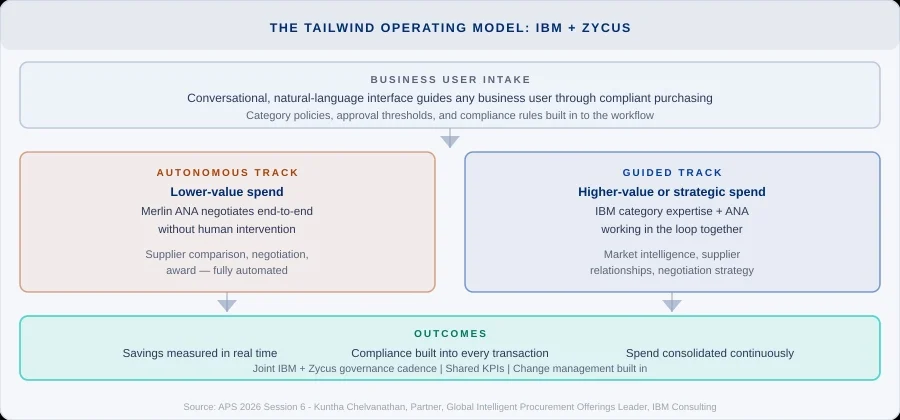
Chelvanathan’s description at APS 2026 was precise: compliance is built into the workflow, not added afterward. The business user follows a guided process, and the platform applies category policies, threshold approvals, and supplier qualification rules automatically. Workflow design and supplier relationships are right from the start. Execution is fast, consistent, and scalable without adding headcount.
Where the Autonomous and Human Lines are Drawn
The Tailwind model operates on two tracks, and knowing which spend belongs on which track is a governance decision made before deployment, not during.
For lower-value, repetitive spend with defined supplier pools, Merlin ANA operates end-to-end: it identifies suppliers, sends negotiation requests, evaluates responses, and awards the order. The buyer receives the outcome. The agent compares suppliers against each other, creating competitive pricing pressure across thousands of simultaneous transactions.
For higher-value or strategic spend, IBM category experts work alongside the autonomous engine, bringing market intelligence and negotiation tactics the agent draws on to execute. The split is not about technology capability. It is about where human judgment adds the most value.
The Shift From Effort-Driven to Outcome-Driven
The framing that emerged from the APS 2026 conversation was direct: a shift from effort-driven service delivery to outcome-driven execution. The Hackett Group’s 2025 Digital World Class Procurement research quantifies what outcome-driven looks like at the top: Digital World Class procurement teams deliver 2.6X greater return on investment than peers while operating with 31% fewer full-time employees and at 19% lower cost. The Tailwind model is an execution path toward that performance profile.
The analytics layer makes the shift visible in real time. Category managers can see who is buying, at what pricing, where savings are captured, and how savings methodology is applied. Spend consolidation opportunities are identified continuously. Where a large volume of similar tail spend transactions clusters in specific locations, the platform surfaces it. That is the data that creates the next level of optimization: from autonomous spot buying to catalog contracts and structured supplier agreements. Intake-to-Outcomes in action: from the first request to the delivered saving.
What Makes Deployments Scale Rather than Stall
Chelvanathan’s answer to the deployment question at APS 2026 was not about the technology. It was about the operating model that sits around it: a joint governance cadence, shared KPIs, and IBM’s change management methodology working alongside the platform. Change management is not left to the client alone. IBM brings its transformation capability. The platform reinforces adoption. Both teams are accountable to the same outcome metrics. The power of two, not the power of one.
What this Means for CPOs Planning their First Deployment
Tail spend is the right starting point for agentic AI for reasons this session made concrete: hard to manage manually (autonomous is clearly superior), repetitive (data quality is achievable), and measurable (proof of value is fast).
The Tailwind model is the execution answer to the question Blog 5 left open: the CPO has decided to own the agenda, has chosen the beachhead, and has written the mandate. The next session at APS 2026 moves to the architecture behind the autonomous negotiation technology itself: what the Merlin Agentic Platform is built on, why built-in beats bolt-on in practice, and what Intake-to-Outcomes looks like at the platform architecture level.
Agentic Procurement Summit 2026. On-Demand Access. Kuntha Chelvanathan, Partner, Global Intelligent Procurement Operations Offering Leader at IBM Consulting, presents the full Tailwind session at APS 2026. Sponsored by Zycus. → Watch the session
Previous blog in the series: Don’t Delegate AI: Three Decisions Every CPO Must Make on Agentic AI
Next Blog in the series: Built-In Beats Bolt-On: The Architecture of Autonomous Procurement in Production
FAQs
Q1. What makes tail spend different from strategic spend categories?
Volume and distribution. Tail spend is thousands of low-value, infrequent transactions spread across the organization. Strategic categories are high-value, centrally managed. The challenge with tail spend is governance at scale, not negotiation complexity.
Q2. What does autonomous negotiation actually mean in practice?
The agent receives a purchase request, identifies qualified suppliers, sends a negotiation request, receives responses, evaluates them on predefined criteria, and awards the order. The buyer receives the result. No human involved in the middle steps.
Q3. How does Tailwind handle compliance requirements?
Compliance rules are embedded directly in the intake workflow. Category policies, supplier qualification requirements, threshold approvals, and sanctioned-country restrictions are applied automatically before any negotiation begins.
Q4. What is the first thing an organization should do to prepare for a Tailwind deployment?
Define the beachhead category: one area with repetitive, data-rich transactions and a measurable savings outcome. Confirm the spend threshold boundaries for the autonomous versus guided track. Then map the approval and escalation paths.
Q5. How do IBM and Zycus measure success jointly on a Tailwind deployment?
Through shared KPIs committed to the client at deployment. A joint governance cadence tracks savings, compliance, user adoption, and supplier performance. Both teams are accountable to the same metrics, not to their own separate reports.
Q6. Can Tailwind work alongside an existing procurement system?
Yes. Tailwind is designed to operate within the client’s existing procurement environment. IBM’s managed services layer sits above the existing system. The Zycus platform integrates at the negotiation layer without requiring a full system replacement.