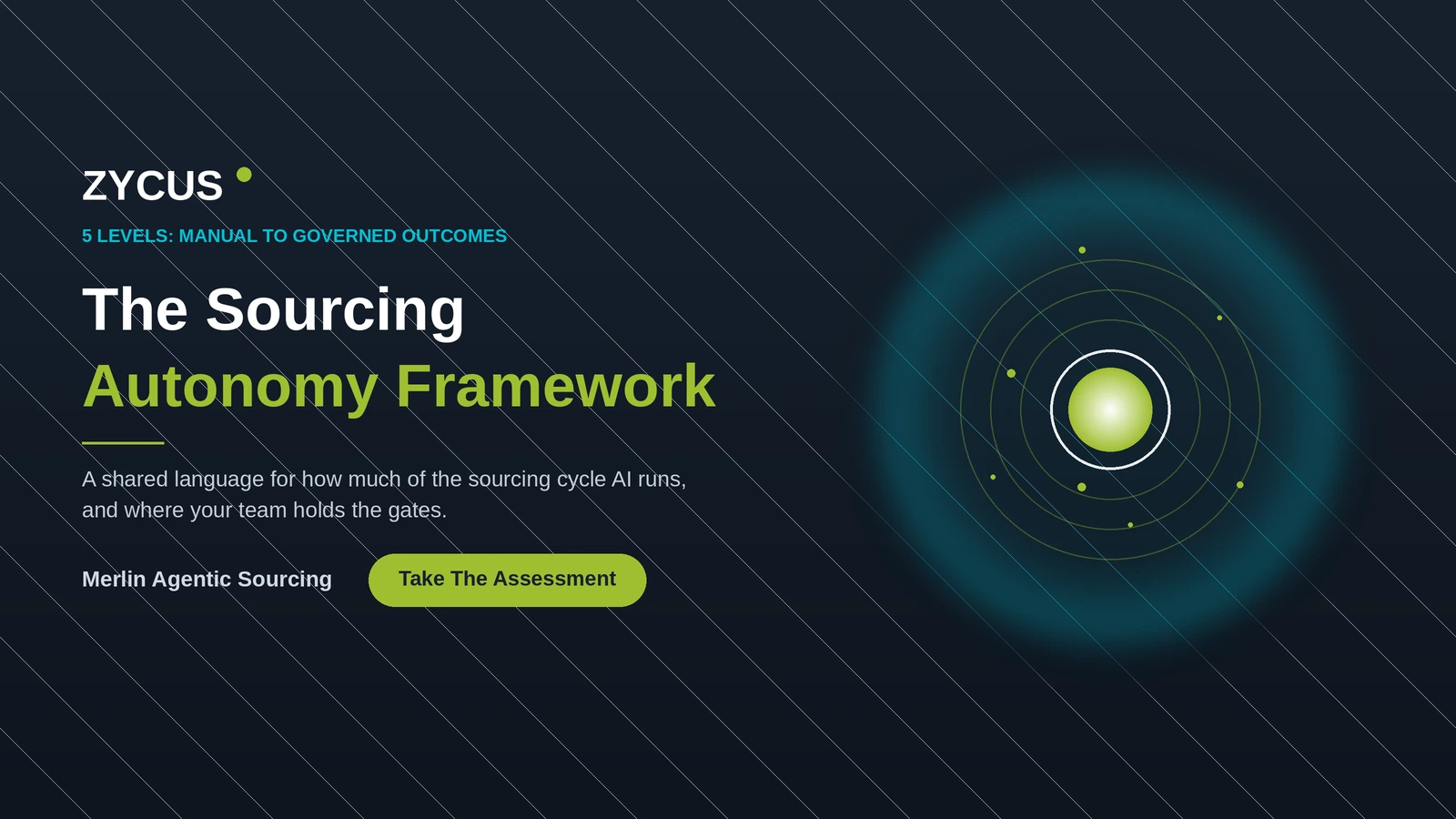








Mapping the Autonomy Spectrum — From AP Automation to Strategic Sourcing — So CPOs Can Scale AI Without Losing Control
Based on insights from the Forrester Opportunity Snapshot: “Don’t Delegate AI,” commissioned by Zycus, February 2026 | Survey of 261 procurement leaders (director-plus)
In a previous article, Why CPOs Must Own the AI Strategy — Not Delegate It to IT, we argued that CPOs must personally own their organization’s AI strategy rather than delegate it to IT. The data from Forrester’s February 2026 study of 261 procurement leaders made the case clearly: fragmented ownership between IT and procurement creates a structural gap that undermines strategic value as organizations scale agentic AI.
But owning the strategy is only the starting point. The harder question is deciding where to grant AI autonomy and where to retain human oversight. Get this wrong, and organizations either stifle AI’s potential by over-constraining it, or expose themselves to risk by letting agents operate in domains that demand human judgment. The Forrester research provides a detailed map of where agentic AI performs well with high autonomy and where procurement leaders are rightly keeping humans in the loop.
The Current Deployment Landscape: Low-Risk Leads
Agentic AI adoption in procurement is not evenly distributed. The Forrester data reveals a clear pattern: deployment concentrates in high-volume, rules-driven processes where the cost of error is manageable and the rules of engagement are well-defined. Spend-cost analysis leads at 48% deployment, followed by accounts payable automation at 39% and procure-to-pay workflows at 38%.
This is not an accident. These are domains where transaction volumes are high, decision logic is codifiable, and exceptions follow predictable patterns. AP automation shows the highest autonomy levels in the study at 63%, because invoice matching, duplicate detection, and payment routing lend themselves to algorithmic precision. Organizations are finding measurable returns — reduced cycle times, fewer manual errors, and captured early-payment discounts.
Zycus’s eProcurement solution exemplifies this approach, embedding AI agents that automate requisitions, enforce policy compliance in real time, and route approvals intelligently — turning high-volume transactional work into an area where autonomy delivers immediate, low-risk value.
Where Human Judgment Remains Non-Negotiable
The same Forrester study shows a sharp contrast at the strategic end of the procurement lifecycle. Seventy-five percent of leaders expect high-value or strategic sourcing activities to remain under CPO and procurement team stewardship. Decision escalation and exception handling follows at 69%, and enterprise planning and budgeting at 67%. These areas involve ambiguity, relationship dynamics, and consequences that extend well beyond any single transaction.
Consider strategic sourcing. A supplier selection decision for a critical category involves evaluating financial stability, geopolitical exposure, innovation potential, and long-term partnership viability — factors that resist clean quantification. Contract lifecycle management similarly requires nuanced interpretation of risk clauses, regulatory shifts, and counterparty intent. These are domains where AI can inform but should not decide.
This reflects a recognition that the consequences of autonomous errors in strategic domains are qualitatively different from transactional ones. A misclassified invoice generates rework. A misguided sourcing decision can compromise an entire supply chain. Procurement orchestration, transaction validation, and contract negotiations remain predominantly human-led because the downside of algorithmic misjudgment is too severe.
The Gray Zone: Where Value Leaks and AI Needs Procurement-Defined Rules
Between the clearly transactional and the clearly strategic lies a critical gray zone where much of procurement’s value actually erodes. The Forrester research identifies three areas with identical leakage rates of 48% each: requirement scoping and scope creep, post-award compliance, and obligation tracking. Procurement leaders simultaneously believe agentic AI can have the highest impact here — 75% for requirement scoping, 69% for post-award compliance, and 68% for obligation tracking.
This convergence of high leakage and high AI potential makes the gray zone the most consequential battleground for CPO-led governance. These processes are too complex for full automation but too voluminous for manual oversight. They require procurement-defined rules of engagement: clear parameters for what gets flagged, what triggers escalation, and what the AI can resolve independently.
For instance, Zycus’s Merlin for Contracts applies AI to automate metadata extraction, identify risk across contract stages, and surface compliance gaps — allowing procurement teams to focus on strategic negotiation and risk mitigation rather than manually sifting through contract libraries. Similarly, Zycus’s AI-powered Spend Analysis continuously classifies spend, flags anomalies, and predicts trends in real time, turning what was historically a quarterly reporting exercise into an always-on governance capability. In both cases, the AI handles the volume while the CPO’s rules define the boundaries.
Tail Spend: The Strongest Case for Governed Autonomy
If any single domain makes the case for expanding AI autonomy under CPO-defined guardrails, it is tail spend. The Forrester data shows that 46% of CPOs want AI to own tail spend execution, and 52% are comfortable granting high autonomy. Yet only 18% have actually deployed it, revealing a 34-point gap between intent and action. Tail spend is high-volume, fragmented, and persistently leaky — and it follows rule-based patterns that make it structurally ideal for autonomous execution.
Zycus’s Merlin Autonomous Negotiation Agent (ANA) is designed precisely for this opportunity. It recommends suppliers and autonomously runs tail-spend negotiations in parallel across price and non-price parameters like payment terms, warranties, and discounts. This is governed autonomy in practice: the CPO defines the negotiation parameters and compliance thresholds, and the AI executes at a scale no human team could match.
Building the Autonomy Spectrum Into Governance
The lesson from the Forrester data is not that some areas deserve AI and others do not. It is that autonomy must be calibrated by domain, governed by procurement, and reviewed continuously. Organizations that treat this as a one-time design exercise will find their boundaries outdated within a quarter as AI capabilities evolve.
The preferred operating model among respondents confirms this direction: 43% favor central governance with decentralized execution, allowing domain teams to innovate within enterprise guardrails. To operationalize this, CPOs need an integrated platform that connects governance to execution across the entire lifecycle. Zycus’s Merlin Agentic AI Platform enables exactly this: a low-code orchestration environment with over 1,100 APIs where procurement admins configure agents, define workflows, and set guardrails — ensuring that autonomy scales under procurement’s terms, not IT’s defaults.
Complementing this, Zycus’s Agentic AI for Supplier Management transforms supplier oversight from static monitoring into autonomous orchestration, synthesizing risk signals, performance metrics, and compliance data into a single control tower. And its Procurement Analytics agents surface real-time, actionable intelligence, automatically triggering sourcing events and compliance alerts when thresholds are met.
The Right Question Is Not “How Much AI?” — It’s “Where and Under Whose Rules?”
The autonomy spectrum in procurement is not a binary between full automation and full human control. It is a gradient shaped by risk profile, data maturity, and governance readiness that must be defined and continuously refined by the CPO. High-volume transactional work like AP automation and tail spend can run with high autonomy today. The gray zone of compliance, obligation tracking, and scope management needs AI operating under explicit procurement rules. And strategic sourcing, escalation, and planning must remain firmly in human hands.
As we discussed in our companion piece, Why CPOs Must Own the AI Strategy, the critical risk is not over-adoption of AI. It is losing control of how AI operates across the procurement lifecycle. Mapping the autonomy spectrum — and embedding it into a living governance model — is how procurement leaders turn that risk into strategic advantage.
Source: Forrester Opportunity Snapshot, “Don’t Delegate AI: Why Procurement Leaders Must Personally Shape, Not Surrender, AI-Driven Decisions,” a custom study commissioned by Zycus, February 2026. Based on a survey of 261 procurement leaders (director-plus) across the US, Europe, and Asia Pacific.
Explore Zycus Solutions:
- eProcurement Software
- Merlin for Contracts
- AI-Powered Spend Analysis
- Merlin Autonomous Negotiation Agent (ANA)
- Merlin Agentic AI Platform
- Agentic AI for Supplier Management
- Agentic AI for Procurement Analytics
Related Reads:
- Why CPOs Must Own the AI Strategy — Not Delegate It to IT
- Transform Strategic Sourcing with Agentic AI
- Why Agentic AI Is the Future of Source-to-Pay Automation by 2026
- Beyond Basic KPIs: Agentic AI Transforms IT Vendor Performance Tracking
- From Excel to Autonomy: Why Agentic AI in Procurement Is the Future
- The 38-Point Readiness Gap: Why Procurement’s AI Vision Outpaces Execution
- Top 5 Procurement Priorities for 2026 — And Why They All Point to AI Readiness
- How to Prevent Over-Delegation of AI in Procurement: A Governance Playbook