





TL;DR
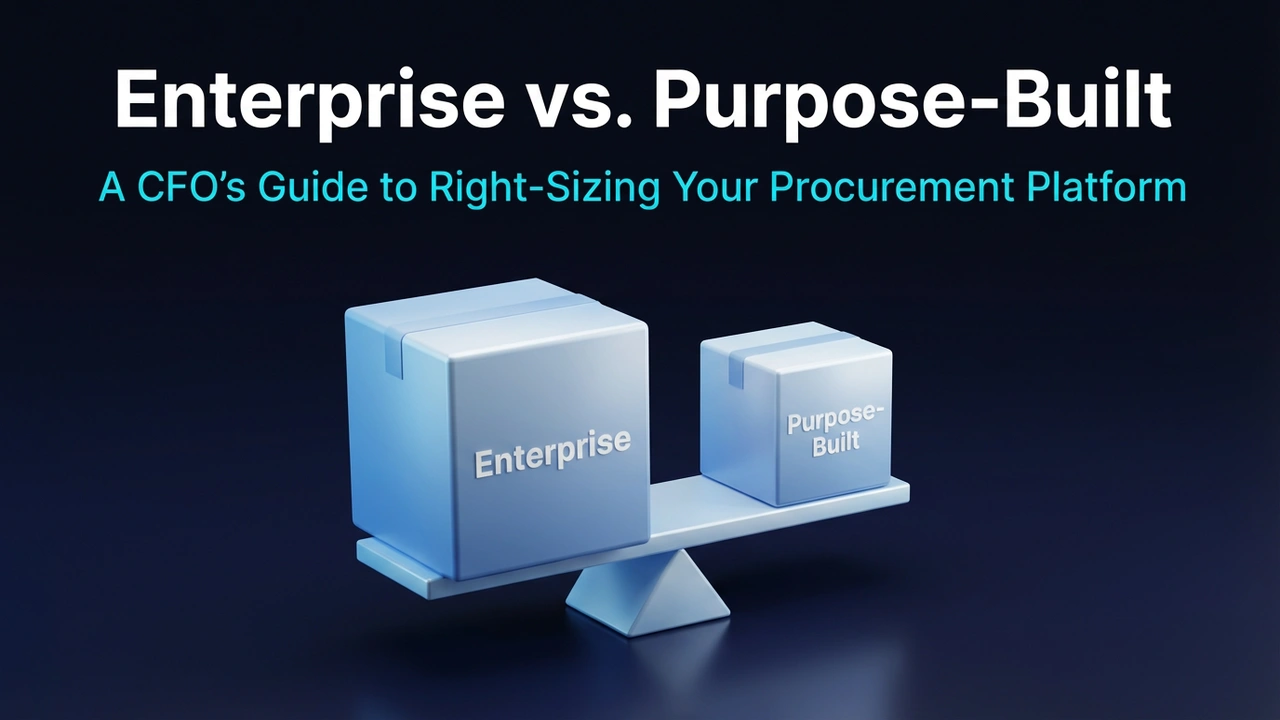
- Enterprise vs purpose-built procurement for NetSuite often comes down to cost and speed — enterprise platforms typically cost ~$300K+ and take 6–9 months to implement.
- That level of investment is usually unnecessary for mid-market NetSuite companies with lean procurement teams and straightforward requirements.
- Purpose-built NetSuite procurement solutions integrate faster, using pre-built connectors that deliver value in weeks, not months.
- Mid-market companies use only about 30% of enterprise features, yet pay for the entire suite.
- Purpose-built platforms focus on core NetSuite procurement needs like P2P, sourcing, contract management, and spend analytics.
- For $100M–$500M NetSuite organizations, purpose-built procurement wins on cost efficiency, speed, and faster ROI.
We got quoted $300K and 6 months for an enterprise platform. Is that normal?”
Short answer: Yes, that’s normal for enterprise procurement platforms.
Longer answer: It’s also unnecessary for most NetSuite companies.
Let me explain.
The Enterprise Procurement Trap
Enterprise procurement platforms are excellent solutions, if you’re a Fortune 500 company with:
- $5B+ in annual revenue
- 50+ person procurement team
- 10,000+ suppliers
- Global operations across 30+ countries
- Dedicated procurement technology team
If that’s you, stop reading. Go buy an enterprise platform.
But if you’re a $100M-$500M company running NetSuite with a 4-8 person procurement team?
You’re about to overpay by 60-80% for features you’ll never use.
Read more: Why Process Orchestration Matters in Mid-Market Procurement
The Real Comparison: What CFOs Need to Know
Let’s break down the actual costs, timelines, and ROI of each approach.
Total Cost of Ownership (5 Years)
Difference: $600K-$1.3M over 5 years.
That’s real money, even for profitable mid-market companies.
Implementation Timeline
Why the difference?
Enterprise platforms were built for SAP and Oracle first. NetSuite integration is an afterthought requiring custom API development.
Purpose-built platforms have pre-built NetSuite connectors that handle 90% of integration out-of-the-box.
Feature Utilization
Enterprise platforms have 400+ features. Most mid-market companies use about 30% of them.
Features you’ll likely never touch:
- Global trade compliance modules
- Multi-currency hedging tools
- Supplier network access (requires suppliers to join proprietary networks)
- Advanced analytics for $10B+ spend datasets
- Country-specific tax and regulatory modules for 50+ countries
You’re paying for:
- Procurement features built for enterprises
- Global supplier collaboration networks
- Advanced analytics for massive datasets
You actually need:
- Strategic sourcing (RFx, e-auctions)
- Contract management
- P2P workflow automation
- Spend analytics
- NetSuite integration
Purpose-built platforms focus on the 20% of features that drive 80% of value for the mid-market.
When Enterprise Platforms Actually Make Sense
Don’t get me wrong, enterprise platforms aren’t bad. They’re just overkill for most NetSuite companies.
Choose an enterprise platform if:
- You’re $500M+ in revenue and growing to $1B+
- You have 15+ person procurement team
- You operate in 10+ countries with complex compliance needs
- You need a supplier collaboration network (and can get suppliers to join)
- You’re eventually moving off NetSuite to SAP/Oracle
- You have dedicated procurement technology admins
Choose purpose-built if:
- You’re $100M-$500M in revenue
- You have 4-10 person procurement team
- NetSuite is your long-term ERP
- You need ROI in quarters, not years
- You want modular deployment (start small, scale fast)
- You don’t have dedicated procurement IT staff
Read more: Procurement KPIs That Matter for Fast-Growing Companies
Real-World Example: Why One Company Chose Differently
Company: $240M manufacturing company
Situation: Outgrowing NetSuite’s native procurement, evaluating options
The Enterprise Platform Proposal:
- Cost: $320K implementation + $220K/year licensing
- Timeline: 7-month integration
- Scope: Full suite (even though they only needed P2P and CLM)
- Integration: Custom API development required
- Ongoing: Dedicated admin needed
5-year TCO: $1.74M
The Purpose-Built Proposal:
- Cost: $65K implementation + $95K/year licensing
- Timeline: 5-week integration
- Scope: Start with P2P, add CLM in Month 6
- Integration: Pre-built connector, working in Week 2
- Ongoing: Part-time admin (existing role)
5-year TCO: $605K
The Decision:
They chose purpose-built. Here’s why (in the CFO’s words):
“The enterprise platform is a Cadillac. We needed a Tesla—modern, efficient, and perfectly sized for our needs. We’re not trying to impress anyone. We’re trying to save money and move fast.”
Results After 12 Months:
- $1.8M in savings captured (ROI: 11.5x)
- Maverick spent down 82%
- Contract compliance at 98%
- AP cycle time reduced by 67%
They could have saved more with the enterprise platform’s advanced features.
But they would have spent 2x more and waited 6 months longer to start.
The CFO’s Decision Framework
Here’s how to think through this decision:
Question 1: What’s your revenue trajectory?
- $100M-$300M now, staying there: Purpose-built
- $300M-$500M now, stable growth: Purpose-built
- $500M now, targeting $1B+ in 3 years: Consider enterprise
Question 2: What’s your procurement team size?
- 4-8 people: Purpose-built
- 8-15 people: Could go either way
- 15+ people: Enterprise makes sense
Question 3: How complex is your supply chain?
- 200-500 suppliers, mostly domestic: Purpose-built
- 500-2,000 suppliers, some international: Purpose-built
- 2,000+ suppliers, global operations: Enterprise
Question 4: What’s your urgency?
- Need results this quarter: Purpose-built (only option)
- Can wait 6-9 months: Enterprise is viable
- No urgency: You probably don’t need either yet
Question 5: What’s your NetSuite commitment?
- NetSuite for next 3-5+ years: Purpose-built (seamless integration)
- Evaluating NetSuite replacement in 2 years: Consider enterprise
- Definitely moving to SAP/Oracle soon: Enterprise
What to Do Next
Step 1: Calculate your current-state costs
Use an ROI calculator to see what you’re actually spending on procurement today (most CFOs are shocked).
Step 2: Run vendor comparisons side-by-side
Get quotes from:
- Enterprise procurement platform (Fortune 500 option)
- Purpose-built NetSuite platform (mid-market option)
- 1-2 other mid-market options
Step 3: Model 5-year TCO realistically
Include:
- Software licensing
- Implementation
- Integration
- Training
- Internal resource costs
- Ongoing support
Step 4: Calculate breakeven timeline
When does each option become ROI-positive?
- Purpose-built: Typically 4-8 months
- Enterprise: Typically 14-20 months
Step 5: Make the decision
The right answer depends on your specific context. But for most NetSuite companies in the $100M-$500M range?
Purpose-built wins on speed, cost, and fit.
Ready to Compare?
Download our CFO’s Procurement ROI Playbook, includes a vendor comparison scorecard and TCO model.
Or schedule a 20-minute demo to see what purpose-built for NetSuite actually looks like.
Related Resources: