









A poorly designed procurement intake form is one of the biggest friction points in modern enterprise buying. Ask for too little context, and procurement teams end up chasing missing vendor details, budget codes, and security requirements across endless email threads. Ask for too much, and requesters will actively look for ways to bypass policy just to avoid filling out dozens of irrelevant fields. Getting your procurement intake form right is not about collecting maximum data—it is about asking the exact right questions at the right moment.
In this guide, we break down the core field framework, conditional logic strategies, and commercial questions every organization needs to capture before work begins. Read on to learn how to transform your procurement intake form from a tedious bureaucratic bottleneck into a streamlined gateway for efficient, fully governed purchasing.
TL;DR
- Ask only what changes the outcome. If every answer produces the same next step, the field is documentation rather than intake.
- Four fields are universal: what, why, when, and who owns the budget. Everything else is category-dependent.
- Each category has a small number of questions that determine which reviews apply. Those are the ones worth asking.
- Watch first-pass completeness and abandonment by category. Both are already measured and neither is usually looked at.
- See how Merlin Intake handles procurement requests. Request a demo.
Ask only what changes the outcome for that category. Every other field is a tax on the requester and a source of bad data.
A single intake form serving every category has to ask everything any category might need, which means most requesters answer questions that do not apply to them. They answer badly, because the questions are irrelevant, and the resulting data is worse than if you had not asked. Category-specific forms exist to remove that.
This is written for procurement operations leaders designing intake forms, either at launch or after adoption has stalled. It assumes the intake process itself is already defined.
What makes a field worth asking for?
Figure 1 states the test. Does the answer change what happens next? Not whether the answer is interesting, or whether somebody would like to report on it later.
If a different answer routes the request differently, changes who approves it, changes which supplier is considered, or changes the terms applied, the field earns its place. If every answer produces the same outcome, the field is documentation rather than intake, and documentation collected under time pressure is unreliable.
Applied honestly, this test removes a surprising proportion of a typical form. Fields survive on a general form because someone once wanted the data, not because the request needs it, and nobody removes fields once added. Additions are individually reasonable and cumulatively fatal to adoption.
The second test is whether the requester can actually answer. A field asking for a commodity code is asking a marketing manager to do procurement’s job, and they will guess. A guess that looks like data is worse than a blank, because procurement will act on it.
There is a second-order cost that rarely gets counted. Fields nobody can answer well produce data procurement then treats as real. A commodity code guessed by a marketing manager becomes the code the spend report uses, and the report is confidently wrong rather than obviously incomplete.
The practical exercise is to take an existing form, list every field, and mark which ones changed an outcome in the last fifty requests. Fields that changed nothing are candidates for removal, and the list is usually longer than anyone expects.

Figure 1: One test decides whether a field belongs on the form.
Gartner studied technology purchasing outcomes rather than form design. The connection drawn here is that regret correlates with a longer, harder process, and a form asking questions nobody can answer is where that process starts.
Download A Free Analyst Report – What are the 4 Pillars of Strategic Sourcing?
Which fields are universal?
Four, and they apply regardless of category.
What is needed, in the requester’s own words. Why, in enough detail to establish the business need. When it is required. And who is the budget owner.
Everything else is category-dependent. That is a shorter universal set than most organizations use, and the discipline of keeping it short is what makes the category-specific portion tolerable. Every universal field is paid for by every requester in every category.
The universal set should also be answerable without preparation. If a requester has to look something up before starting, the form has become a task rather than a request, and tasks get postponed.
Two of the four universal fields are worth defending against pressure. Business need gets challenged as bureaucratic, and budget owner gets challenged as something procurement should already know. Both are wrong. Business need is what makes an exception defensible later, and budget ownership is the field most likely to be assumed incorrectly by everyone involved.
Forrester measured buying group composition rather than form design. Its bearing here is that a form is filled in by one person on behalf of a group that size, which is why fields the requester cannot answer get guessed rather than escalated.
What changes by category?
The compliance questions, and they are not interchangeable.
- Software and IT needs data handling, integration, and whether it touches personal or regulated data. Those questions determine whether security review applies, which is the largest single fork in the process.
- Professional services needs scope, deliverables, duration, and whether the work is on premises. Worker classification risk lives here and it is the question most often missed.
- Capital equipment needs installation requirements, useful life, and which planning cycle it belongs to.
- Marketing and events needs brand approval and contract dates.
- Facilities needs site, access, and safety requirements.
The pattern is that each category has a small number of questions that determine which reviews apply. Those are the questions worth asking, and they are the ones a general form either omits entirely or asks of everybody. Both failures produce the same result, which is a review applied to the wrong requests.
One further category deserves naming. Requests that are genuinely one-off, where no category fits, need a path that is not a form at all. Forcing them through the nearest match produces bad data and an irritated requester, and these requests are frequently the most commercially significant ones in the queue.
How many forms is too many?
More than you have categories that behave differently, which in most organizations is between five and eight.
Splitting further produces forms nobody maintains and a selection step where requesters guess. Splitting less produces the general form problem again in miniature, with the same irrelevant questions and the same guessed answers.
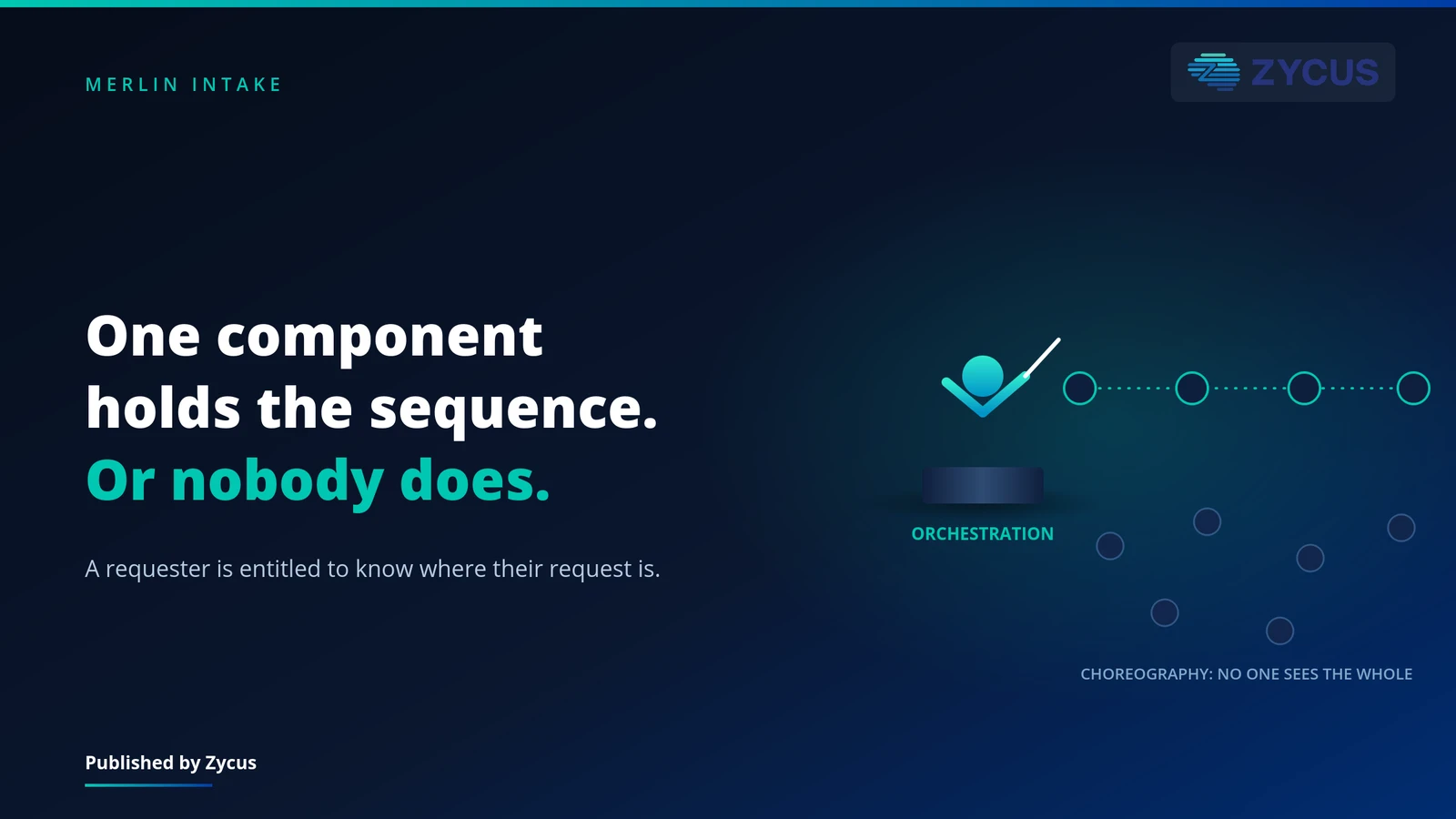
The better design avoids the selection step entirely, as Figure 2 shows. A requester describing what they need in ordinary language should not have to choose a category first, since choosing correctly requires knowing how procurement is organized. Merlin Intake captures the request conversationally in Microsoft Teams or Slack and determines the category from the description, which removes the classification decision from the person least equipped to make it.
Where a form must be chosen manually, make the choices describe the purchase rather than the procurement category. Requesters know they are buying a laptop. They do not know it is indirect IT hardware.

Figure 2: Who should carry the classification decision.
How do you know a form is working?
Two numbers, and both are already available.
First-pass completeness, meaning the proportion of requests arriving with every required field populated and needing no return trip. When a form asks for things requesters cannot answer, this falls, and it falls by category, which tells you which form to fix.
Abandonment, meaning requests started and not submitted. Most platforms record this and almost nobody looks at it. A form with high abandonment is not a data quality problem, it is a form people are choosing not to use, and those requests are still happening somewhere.
Review both quarterly and remove any field that has not changed an outcome. Forms accumulate fields the way processes accumulate steps, through individually reasonable additions that nobody revisits, so a review considering only what to add guarantees the form grows every quarter.
APQC measured transaction processing cost rather than form design. The relevance is that a request returned for missing information incurs that processing cost more than once, and completeness is a property of the form rather than of the requester.
Striking the right balance on your procurement intake form doesn’t mean asking for everything—it means asking for the right details at the right time. By replacing exhaustive static forms with dynamic, context-aware fields, you maintain strong commercial governance without slowing down the business.
Ready to transform your intake experience? Request a free demo today to see how intelligent, conversational intake forms can streamline purchasing for your entire organization.
Related Reads
- Which intake KPIs tell you something before it is too late?
- What Should a Procurement Intake RFP Ask For?
- Orchestration or choreography: which pattern does intake-to-ERP need?
- What must be true about your master data before intake goes live?
- What Is an Idempotency Key, and Why Does Your Intake-to-ERP Integration Need One?
- How to Evaluate Procurement Intake Software: 7 Criteria That Matter
- Procurement Intake vs eProcurement: Which Should You Implement First?
Frequently asked questions
Q1. What fields should a procurement intake form include?
Four universal fields covering what is needed, why, when, and who owns the budget, plus a small set of category-specific questions that determine which reviews apply. Any field whose answer does not change routing, approval, supplier selection, or terms is documentation rather than intake and should be removed.
Q2. Should intake forms be different for each category?
For categories that behave differently, yes, because the compliance questions differ substantially. Software needs data handling questions, professional services needs worker classification questions, capital equipment needs planning cycle questions. Most organizations need between five and eight forms rather than one or twenty.
Q3. How long should an intake form be?
Short enough that a requester can complete it without looking anything up. If preparation is required, the form has become a task rather than a request, and tasks get postponed. Length matters less than answerability, since a long form of easy questions outperforms a short form of hard ones.
Q4. Should requesters choose their own category?
Preferably not, since choosing correctly requires knowing how procurement is organized internally. Where a choice is unavoidable, label the options by what is being bought rather than by procurement category, because requesters know they are buying a laptop and do not know it is indirect IT hardware.
Q5. How do you know if an intake form is too complex?
Watch first-pass completeness and abandonment together. Falling completeness means the form asks for things requesters cannot answer. Rising abandonment means people are choosing not to use it, and those requests are still occurring through other channels where nobody is measuring them.
Q6. What is first-pass completeness?
The proportion of submitted requests containing every required field and needing no return trip for missing information. Measured by category, it identifies which specific form is causing rework rather than telling you only that rework exists.
Q7. Should intake forms ask for commodity codes?
Generally no. Coding is procurement’s expertise, not the requester’s, and asking produces guesses that look like data. The better pattern is to derive coding from the description and let procurement correct it, since a wrong code procurement can fix costs less than a wrong code procurement trusts.
Q8. How often should intake forms be reviewed?
Quarterly, with the specific question of whether each field has changed an outcome since the last review. Forms accumulate fields through individually reasonable additions and almost never lose them, so a review that only considers additions guarantees the form gets longer every quarter.