









TL;DR
- Intake-to-abandonment happens when requests get captured in a sleek intake tool—but nothing meaningful happens after submission.
- The breakdown is most visible in non-catalog and tail-spend buys (often ~40% of what stakeholders need), where workflows aren’t built to fulfill the request.
- When users hit silence and delays, they default to the workaround economy: P-cards, emails, and off-system buying—creating lost visibility and more maverick spend.
- Guided buying isn’t enough because it assumes the item/service exists in a pre-negotiated catalog, which is false for many real-world purchases.
- Agentic AI changes the game by autonomously executing the steps after intake: finding suppliers, collecting quotes, checking policy, routing approvals, and progressing to purchase.
- The 2026 success metric shifts from “requests captured” to requests completed—fast, compliant, and with a better stakeholder experience (CSAT).
The Conversation That Sparked This Post
Why your beautiful new procurement front door leads to a hallway full of workarounds—and what truly agentic AI can do about it.
Last month, a VP of Procurement at a mid-sized manufacturer shared her frustration. She’d spent early 2025 rolling out a shiny new intake system—sleek UI, AI routing, Slack integration. Adoption looked great.
Then she saw the drop-off data.
For non-catalog purchases—marketing’s trade show vendor, facilities’ emergency contractor—requests went into a black hole. Users submitted, waited, heard nothing, and quietly swiped their P-Cards instead.
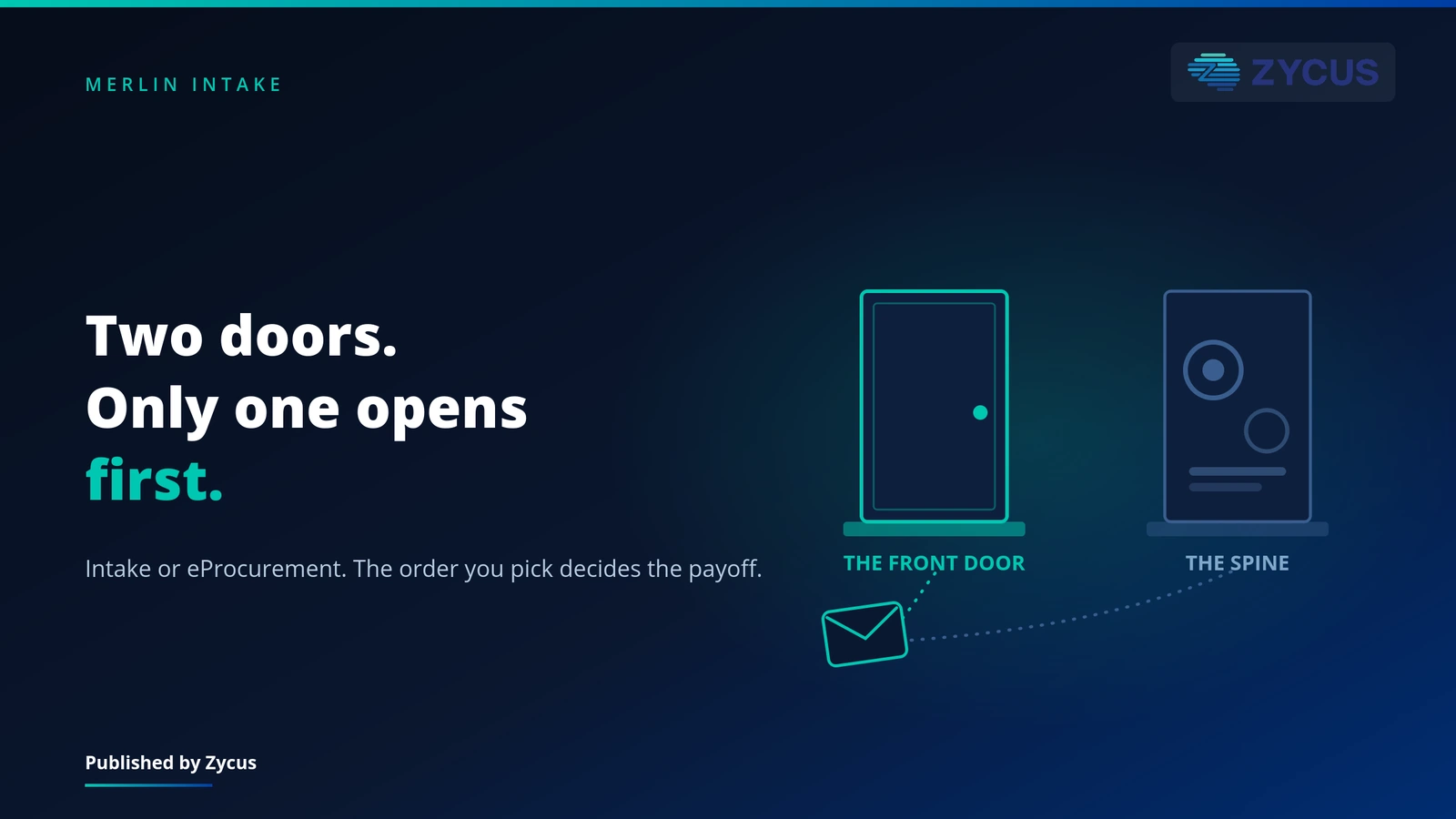
“We built a beautiful front door,” she said. “But for 40% of what our users actually need, there’s no hallway behind it.”
Her teams felt gaslit. The system promised help, then delivered nothing.
She’s not alone. Intake was 2025’s hottest procurement bolt-on—a layer added on top of existing systems to modernize the request experience. But nobody’s talking about what happens after the request is captured.
That’s intake-to-abandonment. And it’s everywhere.
Here’s why it’s happening—and what actually fixes it.
If you’ve been anywhere near procurement technology conversations in 2025, you’ve heard the word “intake” more times than you can count. CPOs across industries have invested heavily in creating sleek, user-friendly “front doors” for procurement requests. The promise was compelling: give business users an intuitive way to submit purchase requests, and compliance will follow.
There’s just one problem. For a staggering portion of purchases, that front door leads to absolutely nowhere.
The Intake Illusion
Here’s the uncomfortable truth that few vendors want to acknowledge: intake management, as currently implemented, solves only half the problem. According to Spend Matters’ 2025 market analysis, “Intake has emerged as a trending concept in a race to simplify procurement… However, too many organizations stop there without addressing the complexity of the workflows on the other end.”
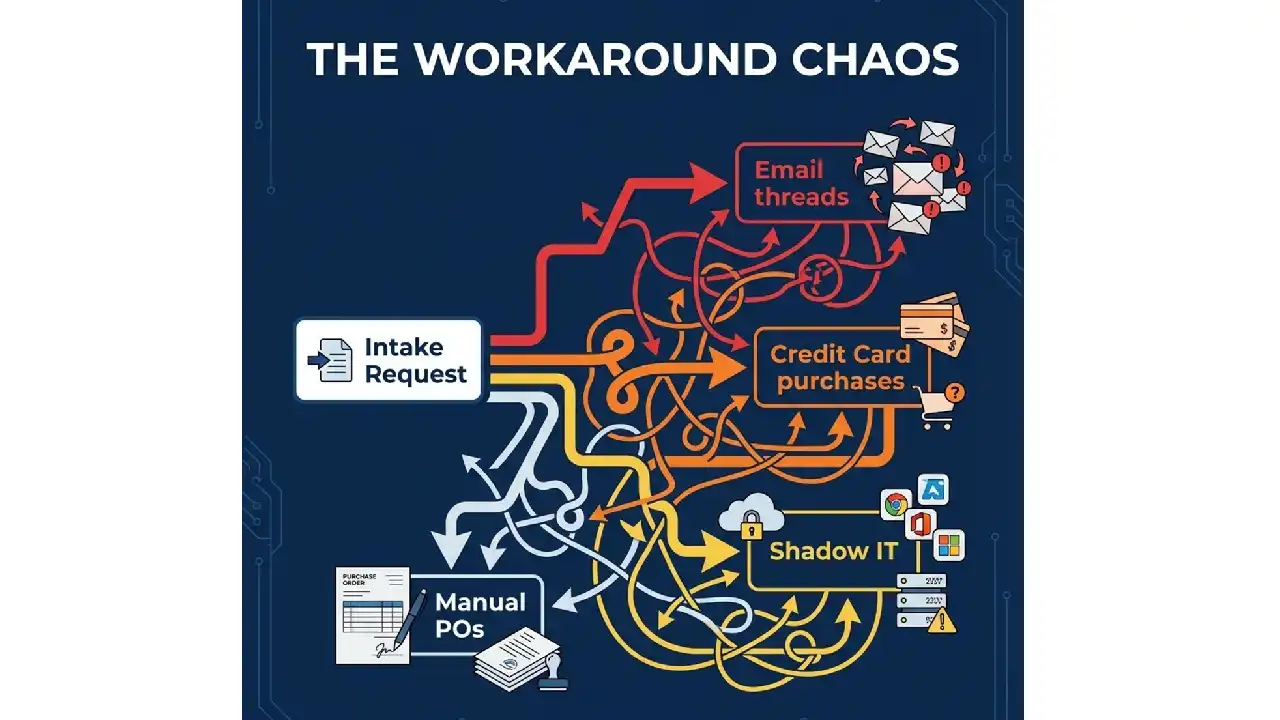
The Deloitte 2025 Global CPO Survey confirms this pattern, noting that many CPOs are focusing on intake capabilities primarily “to get closer to business stakeholders” rather than to actually complete transactions. The result? A beautifully designed request form that captures information—and then dumps users back into the chaos of email threads, credit card purchases, and manual workarounds.
Your intake tool captured the request. Then what?
For most organizations, nothing happens.
The 40% Problem No One Wants to Own
The data is stark. McKinsey research indicates that indirect spend can represent 15 to 18 percent of revenue in some industries, with tail spend and spot buying comprising a significant portion that remains largely unmanaged. Industry analyses consistently estimate that approximately 40% of indirect spend flows through spot buying and non-cataloged purchases. These aren’t edge cases. They’re the everyday reality for business users across marketing, HR, facilities, and operations who need to buy things that simply don’t exist in your carefully curated catalog.
The Hackett Group’s research reinforces this reality: tail spend purchases are “often too small to go through procurement and are not frequent enough to be included in cataloged systems.” These transactions typically follow the Pareto principle—80% of procurement transactions contributing to only 20% of total spend value.
But here’s what makes this particularly painful in 2025: organizations have now built sophisticated intake systems that capture these requests with precision. The business user dutifully fills out the form. They specify what they need. They provide justification. They click submit.
And then they wait.
And wait.
And eventually, they give up and put it on a corporate card. Or they send an email to a vendor they’ve used before. Or they find some other manual workaround that gets them what they need while procurement remains completely in the dark.
This is intake-to-abandonment—the hidden failure mode that’s silently undermining billions of dollars in procurement value.
The Workaround Economy
When intake systems fail to close the loop, organizations don’t stop buying. They just stop buying through procurement. The consequences cascade:
- Lost Visibility: Boston Consulting Group’s 2024 research suggests that without proper tail spend management, significant portions of organizational spend remain invisible to procurement teams—creating blind spots in category management and supplier risk assessment.
- Maverick Buying at Scale: When the official path doesn’t work, employees create unofficial ones. McKinsey research on indirect procurement notes that this fragmented buying leads to duplicate suppliers, inconsistent pricing, and vendor relationships that undermine negotiating leverage. Their analysis shows companies prioritizing spend visibility can reduce maverick buying by up to 40% within the first year.
- User Frustration and Poor Adoption: Perhaps most damaging long-term, failed intake experiences train business users to bypass procurement entirely. Every abandoned request reinforces the perception that procurement is a bottleneck rather than a business partner.
The irony is painful: organizations invested in intake technology specifically to improve stakeholder experience and drive adoption. Instead, they’ve created a system that captures frustration in structured form.
Why “Guided Buying” Isn’t the Answer
The traditional response to this problem has been “guided buying”—essentially, more sophisticated catalogs with better search and recommendation engines. The Art of Procurement’s 2025 State of AI report notes that these interfaces “haven’t fully delivered on their promise.”
The fundamental issue is architectural. Guided buying assumes that the item a business user needs exists in a pre-negotiated catalog with established pricing and approved suppliers. For 40% of indirect spend, this assumption is simply false.
When someone in marketing needs to hire a specialized photographer for a product launch, they can’t select from a catalog. When facilities needs emergency repair services for a specific piece of equipment, there’s no pre-configured SKU. When R&D needs a niche software license for a three-month pilot, guided buying offers no guidance.
These are real purchases that real businesses make every day. And for most organizations, the “solution” is to make the business user figure it out themselves—outside the procurement system entirely.
What Truly Agentic AI Changes
The distinction between “AI-assisted” and “agentic AI” matters enormously here. Most current procurement AI implementations offer what might be called intelligent assistance: better search results, automated classification, and chatbot interfaces for common questions. Helpful, certainly. But still fundamentally reliant on human users to navigate complex purchasing processes.
Know Where Your Procurement Organization Truly Stands on the Path to Autonomy? Download Procurement AI Adoption Index 2025–26 Report
Truly agentic AI operates differently. It doesn’t just respond to queries—it autonomously executes multi-step processes, makes decisions within defined parameters, and completes transactions without requiring human intervention at every stage.
For tail spend and non-cataloged purchases, this distinction is transformative. An agentic system can take an intake request for something that doesn’t exist in the catalog and actually do something about it: identify potential suppliers, gather quotes, evaluate options against policy requirements, negotiate within approved parameters, and route for appropriate approval—all without the business user having to become a procurement expert.
Zycus Merlin ANA represents this agentic approach to tail spend management. Rather than treating non-cataloged spend as an exception to be handled manually, it treats autonomous negotiation as the default path for purchases that fall outside strategic sourcing. The intake request becomes the starting point for an automated process that actually completes the transaction.
The shift is fundamental: from systems that capture requests to systems that fulfill them.
Watch this Video: Beyond S2P: Why the Future of Procurement Is Intake-to-Outcome (I2O)
The 2026 CPO Agenda
The Deloitte CPO Survey highlights that “internal customer CSAT” is becoming a new North Star for procurement leaders. Gartner’s 2025 trends analysis emphasizes that successful CPOs must balance traditional priorities like cost and quality with emerging stakeholder priorities including speed and user experience.
These aren’t conflicting goals—but they require rethinking what procurement technology is actually supposed to accomplish. A system that captures 100% of requests but completes only 60% of them isn’t delivering stakeholder satisfaction. It’s documenting stakeholder frustration.
The organizations that will lead in 2026 are those that close the gap between intake and outcome. Not by forcing more purchases into rigid catalog structures, but by deploying intelligent systems that can handle the inherent variability of real-world business purchasing.
Success will be measured not by how many requests are captured, but by how many are completed—compliantly, efficiently, and without forcing business users to become procurement specialists.
Closing the Gap
The intake-to-abandonment problem isn’t a technology gap. It’s an imagination gap. We’ve built systems optimized for the purchases that are easy to systematize, while treating everything else as an acceptable exception.
Forty percent of indirect spend isn’t an exception. It’s the reality of how modern organizations actually operate.
The question for every CPO evaluating their procurement technology stack should be simple: Does this system help my business users actually buy what they need? Or does it just give them a prettier way to submit requests that go nowhere?
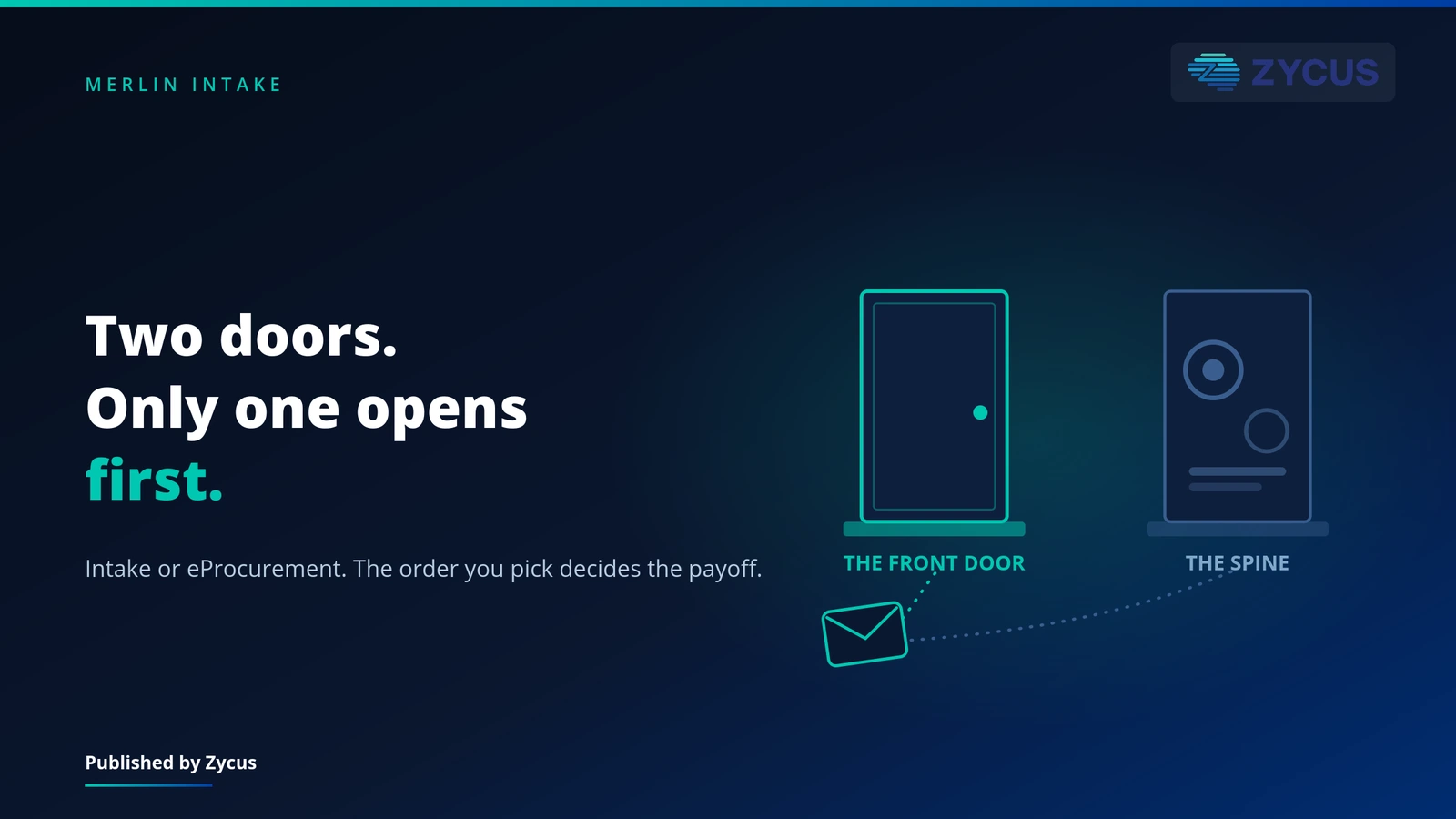
The front door matters. But the hallway behind it matters more.
Interested in understanding how agentic AI approaches tail spend differently? Explore how Merlin ANA transforms the path from intake to completed purchase at https://www.zycus.com/solution/autonomous-negotiation-agents
References:
- McKinsey & Company. (2019). Revolutionizing Indirect Procurement for the 2020s.
- PwC. (2024). Digital Procurement Survey 2024.
- Spend Matters. (2025). Procurement Technology Market Movements and Trends 2025.
Related Reads:
- On Demand Webinar: Driving AP Transformation and Cost efficiency with AI-led Automation
- eBook: 7 Key Considerations to More Effective Supplier Risk Management
- On-demand Webinar: How AI-Enabled Intake Turns Into Measurable Outcomes
- Watch Video: Watch the Merlin AI Agents in Action: From Intake to Outcomes
- Research Report: The C-Suite’s Guide to Successful Accounts Payable Transformation
- TechWatch: Integrated & Intelligent Source-to-Pay
- White Paper: Kill The Complexity- A Practical Handbook for Tackling Key Challenges in Procurement and Sourcing
- Solution: GenAI Powered Merlin Intake