


TL;DR
- Ardent Partners labels 2026 as “Year Zero” — the definitive departure from manual-first procurement. This isn’t incremental automation. It’s a structural shift to agentic AI systems that think, reason, and act without human prompts.
- Roughly 40% of enterprise spend remains unmanaged by the average procurement department. Autonomous AI agents can bring this spend under intelligent oversight without adding headcount — the biggest untapped savings lever in procurement.
- The CPO’s role fundamentally shifts: from managing task-based teams to orchestrating autonomous systems. The human designs the strategic intent; the AI handles execution in tactical categories.
- Architecture determines outcomes. AI built natively into a Source-to-Pay platform — with full contextual access to spend, contracts, suppliers, and workflows — outperforms bolt-on AI that operates on data extracts and returns recommendations in isolation.
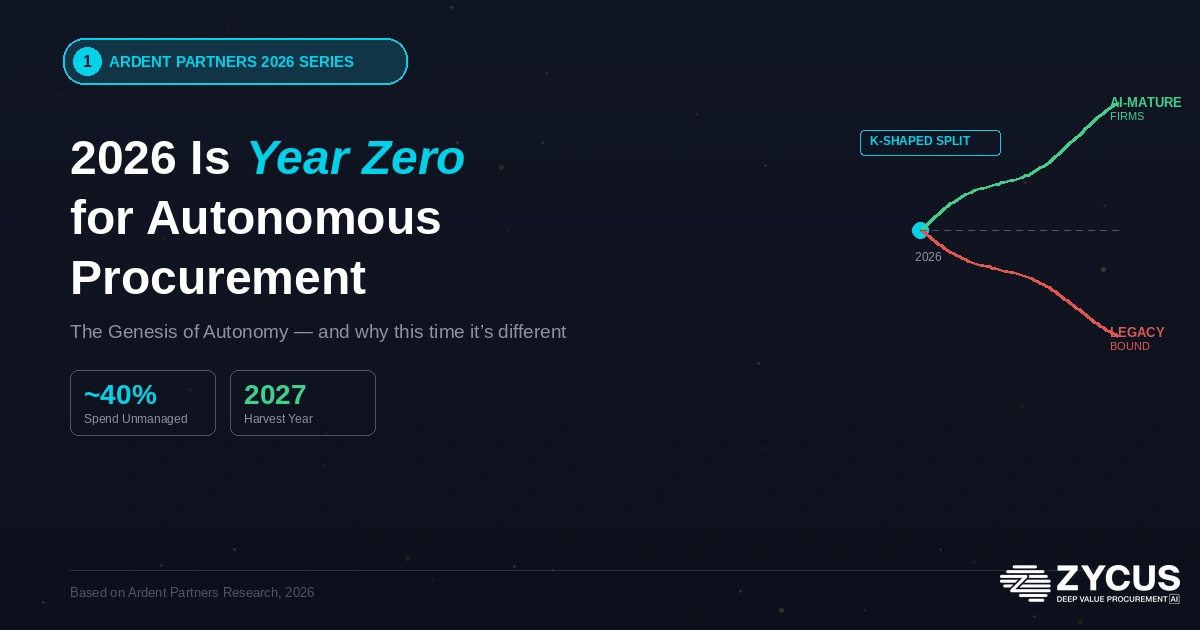
- A K-shaped divergence is emerging: technically mature organizations will expand margins through AI-orchestrated procurement while legacy-bound competitors stagnate. 2026 is the planting year; 2027 is the harvest.
There is a phrase that keeps appearing in boardroom conversations, vendor pitches, and LinkedIn posts: “AI-powered procurement.” It has been used so liberally over the past three years that most CPOs have developed a healthy immunity to it. Another dashboard with a chatbot. Another workflow tool with a recommendation engine. Another vendor claiming transformation while delivering incremental automation.
But something different is happening in 2026. And it is worth paying attention to — not because the marketing has gotten louder, but because the underlying technology has crossed a threshold that changes what procurement can actually do.
Ardent Partners’ latest research — Procurement 2026: BIG Trends and Predictions — puts a name to this moment. They call it the “Genesis of Autonomy” and label 2026 as “Year Zero”: the definitive departure from manual-first procurement operations. Not a gradual evolution. A structural break.
The Difference Between Automation and Autonomy
The distinction matters, and it is not semantic.
Automation — the kind procurement has lived with for a decade — follows rules. An RPA bot extracts invoice data because someone programmed it to. A workflow engine routes an approval because a decision tree says so. The human designs the logic. The machine executes it. Nothing happens that was not pre-scripted.
Autonomy is a fundamentally different operating model. Ardent describes agentic AI systems that can think, reason, and act without human prompts in highly tactical areas. The shift, as the report frames it, is twofold. First, technical autonomy arrives through agentic AI — systems that do not wait for instructions but identify opportunities, evaluate options, and execute within defined guardrails. Second, functional autonomy emerges through powerful analytics that give procurement the data and speed to act independently of traditionally sluggish enterprise decision cycles.
That second part is easy to overlook, but it might be the more consequential shift. Procurement has long suffered from a dependency problem — waiting for finance to approve, waiting for IT to integrate, waiting for the business to align. Functional autonomy means the department generates its own intelligence, at the speed required to act on it. The combination of technical and functional autonomy is what moves procurement from being a service function to being what Ardent calls a “self-governing engine” — one that can bypass bottlenecks, anticipate market shifts, and execute with speed that manual processes cannot match.
What This Looks Like in Practice
Abstract concepts become real when you apply them to the roughly 40% of enterprise spend that remains unmanaged by the average procurement department. That number has stubbornly persisted for years, not because procurement teams are incompetent, but because the economics never justified assigning human resources to low-value, high-volume categories.
Autonomous procurement changes that math entirely.
Consider a tail-spend category — office supplies, maintenance services, one-off IT purchases. Historically, these categories received minimal procurement attention. The contracts renewed on autopilot. Suppliers faced no competitive pressure. Savings leaked quietly.
In an autonomous model, an AI agent monitors that category continuously. It identifies a contract approaching renewal. It benchmarks pricing against real-time market data. It analyzes historical negotiation outcomes and supplier performance patterns. It drafts negotiation parameters within pre-approved guardrails and executes — not because a human initiated the process, but because the system recognized an opportunity and acted on it.
This is not a theoretical scenario. It is the operational direction that Ardent’s research points toward when it describes deploying autonomous negotiation agents and real-time should-cost modeling to capture savings across categories that were previously too low-value to justify human attention. The economic case is straightforward: if 40% of spend is unmanaged, and AI can bring even a fraction of that under active procurement influence without adding headcount, the savings impact is substantial. And in a year where persistent inflation is acting as what Ardent calls a “low-grade fever” — with suppliers baking mini-escalators into every contract — the urgency to cover more spend with intelligent oversight has never been greater.
The Orchestrator, Not the Operator
Here is where the human story intersects with the technology story — and where most CPOs need to rethink their operating model.
Ardent’s CPO takeaway on the Genesis of Autonomy is specific: “Transition your team from task-based workers into process orchestrators, where the team’s role is to design the strategic intent while autonomous systems handle the execution.”
This is not about replacing procurement professionals. It is about changing what they spend their time on. When an AI agent handles the tail-spend negotiation, the category manager is freed to focus on the strategic supplier relationships, the complex multi-stakeholder sourcing events, the category strategies that require market judgment and business context that AI cannot replicate.
The risk, though, is real. Nearly every procurement professional will be involved in an AI pilot by mid-2026 — Ardent calls this the Year of Pilots and Mass Experimentation. But not every pilot will deliver. The report is candid about this: an “AI pilot pandemic” will separate the real value from the marketing hype. CPOs need a fail-fast culture that identifies which solutions are genuinely ready for production.
The Architecture Question That Decides Outcomes
One distinction will determine which AI pilots succeed and which quietly disappear after the quarterly review: whether the AI is built into the procurement platform or bolted on top of it.
Bolt-on AI requires data to travel between systems, introduces latency, and operates without the contextual awareness of what is happening upstream and downstream in the procurement process. Built-in agentic AI operates within the transactional fabric of source-to-pay — from intake through negotiation through payment — with native access to the data, the workflows, and the historical patterns that make genuine autonomy possible.
This is not a minor architectural preference. It is the difference between an AI that recommends and an AI that acts. Autonomous procurement requires the latter.
The Fork in the Road
Ardent’s research describes a K-shaped divergence ahead — where technical maturity separates organizations moving in sharply different directions. Some firms will expand margins through AI-orchestrated procurement. Others, trapped in legacy operations and manual processes, will stagnate or decline. The correlated market where most companies moved together is dying. In 2026, there will be clear winners and clear losers, and the dividing line runs directly through how procurement organizations choose to adopt — or ignore — autonomous capabilities.
The report’s framing of 2026 as a building year is deliberate. The savings and productivity seeds planted during this year’s AI pilots and strategic pivots will manifest as major value in 2027. But that harvest only comes if you plant now.
Year Zero is not a marketing label. It is a strategic inflection point. The CPOs who architect autonomous capabilities in 2026 — who shift their teams from operators to orchestrators, who choose platforms built for agentic AI, who move decisively through the noise — will define what procurement looks like for the rest of the decade.
The ones who wait will spend 2027 trying to catch up.
But autonomy needs a front door — a place in the procurement process where intelligent orchestration begins. And as we explore next in this series, that starting point is not sourcing, contracting, or spend analytics. It is the moment a business need first arises: the intake layer, where compliance, savings, and intelligence are won or lost before a requisition is ever submitted.
The full Ardent Partners report — Procurement 2026: BIG Trends and Predictions — covers the Genesis of Autonomy alongside 12 more trends, 20 predictions, and a Five-Wave CPO Strategic Playbook. Download the complete research report here.
Continue Reading
Next in this series: Why Intake-to-Procure Is 2026’s Most Important Battleground
FAQs
Q1. What does “Year Zero” mean for procurement in 2026?
Ardent Partners uses “Year Zero” to mark the definitive departure from manual-first procurement operations. It signals the arrival of agentic AI systems capable of thinking, reasoning, and acting autonomously in tactical procurement areas — moving the function beyond rule-based automation into genuine self-governance. It is not an incremental step; it represents a structural shift in how procurement operates.
Q2. What is the difference between procurement automation and procurement autonomy?
Automation follows pre-programmed rules — an RPA bot extracts data, a workflow routes an approval. Autonomy is fundamentally different: agentic AI systems identify opportunities, evaluate options, and execute decisions within defined guardrails without waiting for human prompts. Automation does what it is told. Autonomy figures out what needs to be done and does it.
Q3. How much enterprise spend is still unmanaged by procurement?
According to Ardent Partners, roughly 40% of enterprise spend remains unmanaged by the average procurement department. This persistent gap exists not due to incompetence but because the economics of assigning human resources to low-value, high-volume categories never justified the effort. Autonomous AI agents change this equation by bringing these categories under intelligent procurement oversight without requiring additional headcount.
Q4. What should CPOs prioritize to prepare for autonomous procurement?
Ardent’s research recommends three immediate priorities: first, transition teams from task-based workers into process orchestrators who design strategic intent while AI handles execution. Second, launch AI pilots quickly through a “Procurement AI Garage” approach that bypasses slow enterprise IT timelines. Third, choose platforms where AI is natively built into the Source-to-Pay architecture rather than bolted on, since built-in AI has full contextual access to spend data, workflows, and supplier history that bolt-on solutions lack.
Q5. Why does built-in AI outperform bolt-on AI in procurement?
Bolt-on AI requires data to move between systems, introduces processing latency, and lacks contextual awareness of upstream and downstream procurement processes. Built-in agentic AI operates within the transactional fabric of Source-to-Pay — with native access to intake requests, historical pricing, contract terms, supplier risk profiles, and payment patterns. This full-context access is what enables AI to move from making recommendations to taking autonomous action.
Q6. What is the K-shaped divergence Ardent Partners predicts for procurement?
Ardent predicts a K-shaped split where technically mature organizations expand margins through AI-orchestrated procurement while competitors trapped in legacy operations stagnate or decline. The correlated market — where most companies moved in the same direction — is ending. In 2026 and beyond, the dividing line between procurement winners and losers runs directly through how organizations adopt autonomous capabilities. The report frames 2026 as the planting year and 2027 as the harvest year for those who invest now.
Related Reads:
- Autonomous Procurement: What Mid-Market Teams Can Learn from Enterprise Leaders
- Whitepaper: Is Your Procurement AI Truly Autonomous?
- How Agentic AI is Creating Autonomous Procurement Teams?
- What is Autonomous Sourcing? And Why Every CPO Should Care Now
- From Augmented Procurement to Autonomous Procurement