








The next divide in procurement isn’t digital versus analog. It’s bolt-on versus built-in — and it’s becoming a leadership choice.
Where Procurement Has Actually Been
The procurement journey has been shaped by steady improvements in process, technology, and institutional knowledge, bringing us to what many now call the new age of procurement. But to understand where you stand, it helps to first be honest about what legacy procurement really was.
Legacy procurement lived in the back office. It was treated as a procedural necessity and viewed by CEOs and CFOs as a cost center, no different from payroll. Funding and headcount were limited, and the profession was too often staffed by people who arrived there by accident rather than by design.
In that world, procurement professionals spent almost no time on training, relied heavily on spreadsheets, and lived in a permanent state of firefighting. The suppliers across the table were better equipped, better informed, and far better resourced, with stronger systems and cleaner data. Worse, the salespeople they negotiated against were investing up to 20% of their time in training, while procurement invested as little as 2%. By every measure, it was an uneven contest.
Procurement leaders responded the only way they could. They introduced category management, focused on total cost of ownership, and built global teams to drive leverage. They layered in procurement cards, reverse auctions, and eventually eProcurement systems. Each step created incremental progress: more structure, more control, and more visibility.
But beneath that progress, something fundamental never changed: procurement was still optimizing processes without improving how decisions were actually made.
Even the shift to Source-to-Pay platforms, transformative as it was, largely extended that same model. Processes got faster, approvals were automated, and compliance improved. Yet the system still depended on human intervention, fragmented data, and rigid workflows. In effect, dysfunction was being automated.
And that is exactly where the model begins to break.
The Real Inflection Point: From Process to Intelligence
What’s emerging now with AI is not another wave of automation. It’s a redefinition of how procurement operates.
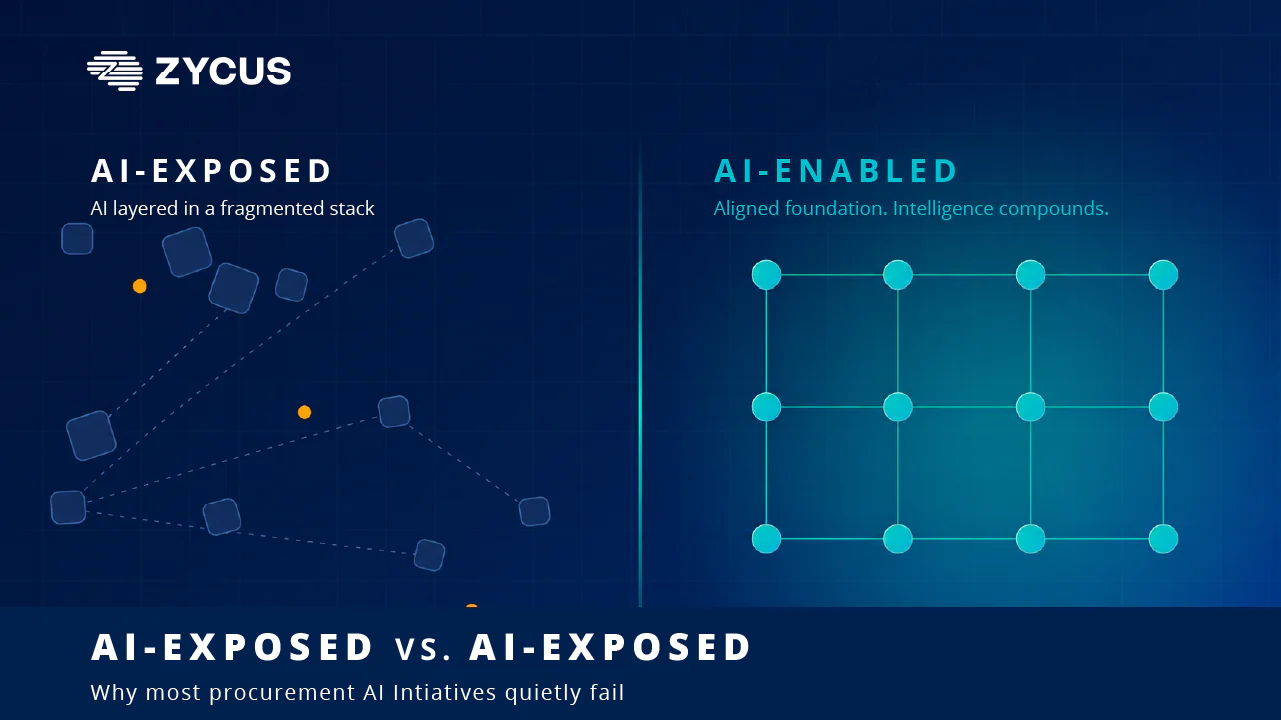
The divide is no longer between digital and non-digital organizations. It’s between those that are AI-enabled and those that are AI-exposed.
At first glance, the difference is subtle. Both groups are investing in AI. Both are deploying tools. Both appear to be progressing. Beneath the surface, however, they’re moving in opposite directions.
- AI-exposed organizations layer intelligence onto fragmented environments. Supplier data sits in one system, contracts in another, workflows in a third, and AI is placed on top with the expectation that it will produce better outcomes. Instead, it amplifies inconsistency. Decisions become harder to trace, harder to audit, and ultimately harder to trust.
- AI-enabled organizations start somewhere else: they align the foundation first, bringing data, workflows, and governance into one coherent system. In that environment, AI is not an overlay. It is an integrated decision layer that learns, adapts, and compounds value over time.
There’s a simpler way to describe the divide: bolt-on versus built-in. Bolt-on AI is intelligence retrofitted onto systems that were never designed for it. Built-in AI is intelligence the system was architected around from the start. The distinction is not cosmetic. It’s the difference between two completely different trajectories. As DORA research on AI adoption put it plainly: AI doesn’t fix a broken system; it amplifies whatever is already there. Bolt AI onto fragmented procurement and you don’t get intelligence — you get faster fragmentation.
This is not a technical footnote. It’s architectural. And increasingly, it’s a leadership choice. New-age procurement leaders are the ones deliberately choosing the built-in, AI-enabled path.
Agentic AI — and The Leadership Gap it Exposes
Agentic AI marks the first time procurement systems can move beyond execution into decision-making, not in isolated moments, but continuously across sourcing, supplier management, contracting, and spend. For the first time, systems can interpret intent, anticipate risk, and act within defined boundaries.
But that capability exposes a gap technology alone cannot close.
Legacy leadership models were built to manage activity. They rely on approvals, escalations, and oversight to stay in control. That works in a world where humans make every meaningful decision. It does not work in a world where systems do.
New-age procurement leadership operates differently. It defines how decisions should be made before the system executes them. It sets guardrails, not checkpoints. It encodes judgment into the operating model itself.
The shift sounds subtle. Its impact is not.
One model scales effort. The other scales intelligence.
A couple of years ago, I worked with a CPO who had just switched on AI agents to triage sourcing requests and route approvals. The technology worked beautifully in the demo. But the team had wrapped it in the same approval chain they had always used for people. Every agent recommendation still had to climb four levels of sign-off. Within weeks, the queues were worse than before, and reviewers faced hundreds of agent-generated decisions stamped rubber-stamping them unread. The agents hadn’t failed. The leadership model around them had. They had handed a decision-making system a control structure built for an era when humans made every call.
Why Most AI Procurement Initiatives Quietly Fail
Many organizations believe they’re transforming procurement because they’re investing in AI. In reality, they’re reinforcing the very constraints they’re trying to escape.
They introduce agents into disconnected workflows. They integrate tools instead of unifying them. They defer governance until after deployment. Layering AI on top of broken processes is like spreading beautiful frosting over a bad cake; it doesn’t fix what’s underneath. The result isn’t transformation. It’s exposure. Complexity compounds faster than capability. Every new tool becomes another layer to manage, every new integration another point of failure, and over time the system becomes harder to evolve, not easier.
There’s a name for what this produces, and procurement leaders should learn it now.
Agent Debt: The Liability Nobody is Budgeting For
Agent debt is the compounding liability in governance, integration, and maintenance that accumulates every time a team spins up an isolated AI agent without a unified foundation. It’s the agentic-era equivalent of shadow IT, except now the agents make autonomous decisions, so the stakes are higher.
It’s an easy trap to fall into because the tooling actively invites it. Agent studios and DIY agent builders make it simple to stand up a clever agent for a single task. What they quietly do is shift integration, governance, and lifecycle burden onto you, accelerating the accumulation of agent debt. You end up with a collection of impressive, disconnected demos rather than a system.
Read more: Agent Debt: The Tech Debt of the Agentic Era
This distinction will separate winners from the rest. In a year, everyone will have agents. The question will not be whether you have agents, but what kind. Isolated agents quietly accumulate debt across a fragmented stack. Enterprise-grade agents operating inside a governed, unified system are what make the others more capable.
I watched this happen inside one procurement organization last year. Three different teams, each genuinely enthusiastic, had each stood up their own agent: one for supplier onboarding, one for contract review, and one for spend classification. Individually, every one of them demoed well. But none shared data or governance, so within a few months the group was spending more time reconciling and auditing what the agents had done than the agents were saving. Three proud pilots had quietly become a maintenance liability nobody had budgeted for. That is agent debt, and it accrues faster than anyone expects.
By contrast, organizations that successfully make the transition decide differently, and early. They prioritize coherence over speed. They treat governance as a design principle, not a control bolted on after launch. They recognize that the value of AI is not in isolated use cases, but in how those use cases connect.
This is where a new class of platforms is separating itself. Rather than stitching point solutions together, agentic procurement platforms are designed as unified environments where data, workflows, and agentic capabilities operate together from the outset. The market is moving with them: recent enterprise buyer research puts the share of organizations following a platform-first strategy at roughly two-thirds, with most actively viewing a switch of core vendors before the decade is out.
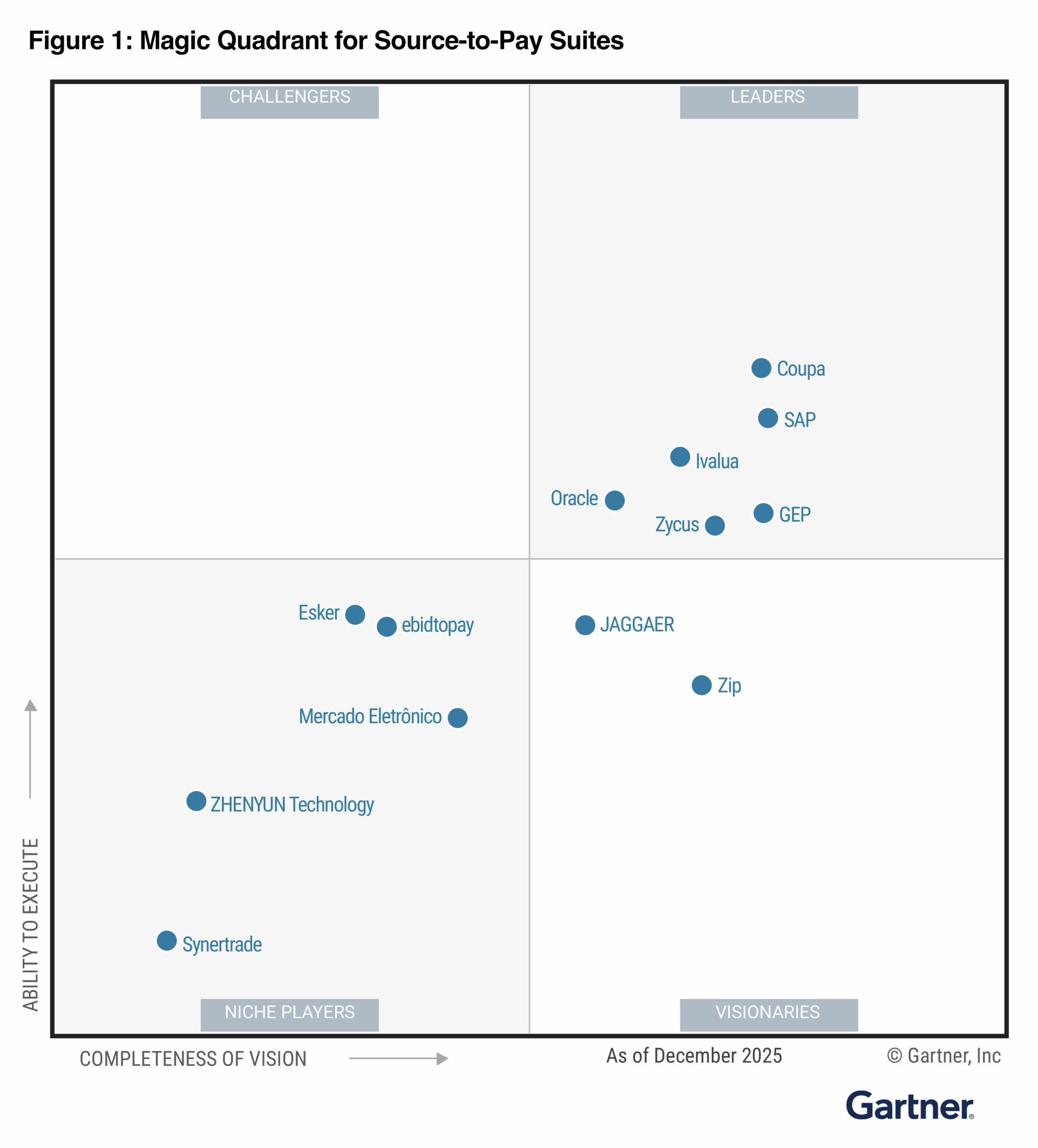
Zycus is one of the more visible examples of this shift, positioning itself not as an S2P system with AI features bolted on, but as a built-in foundation for agentic intake to outcomes. The point here is less about any one vendor and more about the signal: it’s a marker of where procurement itself is heading.
The New Mandate for Procurement Leadership
All of this redefines what procurement leadership actually means.
It is no longer about enforcing process or driving compliance. It is about designing the system through which decisions are made. That system has to be coherent. It has to be governed. And increasingly, it has to be intelligent by default.
Leaders who understand this aren’t asking how to automate procurement. They’re asking how to architect it: redefining workflows, embedding AI into the DNA of how work gets done, and managing outcomes instead of activities. The mandate is to drive AI-enabled, built-in procurement and start generating results that reposition the function, not as a cost center alongside payroll, but as a value-creating center of profit.
The best CPO I’ve worked with did exactly the opposite of the teams above. Before deploying a single agent, she spent a quarter quietly documenting what was wasted: unifying supplier data, translating approval policy into machine-readable rules, and agreeing upfront where a human had to stay in the loop. When the agents went live, they didn’t need babysitting, because the judgment was already encoded around them. Her team didn’t just move faster; they could explain and defend every decision the system made. That is the whole difference between automating procurement and architecting it.
The Bottom Line
The question is no longer whether procurement will adopt AI. That is already happening. The real question is whether organizations adopt it in a way that creates advantage, or in a way that quietly introduces new forms of risk and new layers of agent debt.
The divide between AI-enabled and AI-exposed, between built-in and bolt-on, is widening. It will not close on its own. The organizations that move decisively by aligning data, workflows, and governance into a single intelligent model will not just improve procurement performance. They will redefine it.
Driving that change is the new CPO mandate: to secure procurement its seat at the C-suite table and finally get the function off the menu for lunch.
FAQs
Q1. What is agentic procurement?
Agentic procurement is the use of AI agents that can plan, reason, and act on procurement decisions across sourcing, supplier management, contracting, and spend within defined governance boundaries, rather than simply automating individual tasks. The defining feature is decision-making, not just execution.
Q2. What’s the difference between AI-enabled and AI-exposed procurement?
AI-enabled organizations align data, workflows, and governance into one coherent system before introducing AI, so intelligence operates as an integrated decision layer. AI-exposed organizations layer AI onto fragmented systems, which amplifies inconsistency and makes decisions harder to trace, audit, and trust.
Q3. What is “bolt-on” versus “built-in” AI?
Bolt-on AI is intelligence retrofitted onto systems that were never designed for it. Built-in AI is intelligence the platform was architected around from the start. Bolt-on tends to amplify existing dysfunction; built-in compounds value over time.
Q4. What is agent debt?
Agent debt is the compounding liability in governance, integration, and maintenance that accumulates when teams deploy isolated AI agents without a unified foundation. It is similar to shadow IT, but with higher stakes because the agents may make autonomous decisions.
Q5. Why do most AI procurement initiatives fail?
They often fail because AI is introduced into disconnected workflows with governance deferred until after deployment. The result is increased complexity and agent debt instead of transformation. Successful organizations prioritize a coherent, governed, built-in foundation first.
Disclaimer: This article was originally published on the PSCM Institute by Omid Ghamami. All views and insights shared in this article are those of Omid Ghamami’s and are based on his independent research.
Related Reads: