








At DPW New York 2026, the word “agentic” was everywhere — on stage, in the expo hall, in every conversation across the Brooklyn Navy Yard. For some, it meant a smarter intake form. For others, a chatbot with a workflow attached. A prettier front door to the same old process.
At the Zycus booth, it meant something else entirely: autonomous agents executing across the full source-to-pay lifecycle, inside the tools procurement teams already use, without a human coordinating every step. I spent both days on the floor at Booth 42, and the reaction was consistent — people would stop mid-sentence, lean in toward the screen, and ask the same question in a dozen different ways: wait, it’s actually doing that on its own? But the clearest proof of the difference didn’t come from the booth at all. It came from a stage, when a Fortune 500 procurement leader stood up and showed the numbers.
The Stage Was Set for a Reckoning
Digital Procurement World New York 2026 took over the Duggal Greenhouse in Brooklyn’s Navy Yard on June 3 and 4 — a converted industrial space with the kind of high ceilings and exposed steel that make even a packed expo hall feel open. 85 speakers, 50 sessions, and a single theme stamped across every wall: RECODE. Speakers from Pfizer, Microsoft, OpenAI, Kraft Heinz, Bristol Myers Squibb, IBM, KKR, and Stripe all circled the same idea. AI is everywhere in procurement now. Real transformation is not. The organizations that win the next decade won’t be the ones bolting AI onto old processes — they’ll be the ones redesigning those processes around autonomous execution, with outcomes as the scorecard instead of transactions.
Booth 42: Where Agentic AI Stopped Being a Buzzword
At Booth 42, the demo that kept stopping people in their tracks was Merlin Intake. Not because it looked flashy — because of what it quietly wasn’t. It isn’t a request form. It isn’t a chatbot that politely collects details and files a ticket for someone else to deal with. It lives natively inside Microsoft Teams, where procurement requests already land, and when someone types what they need in plain language, Merlin Intake takes it from there: classifying it, applying policy, routing it, and pushing it through the lifecycle — autonomously, with compliance built in rather than bolted on.
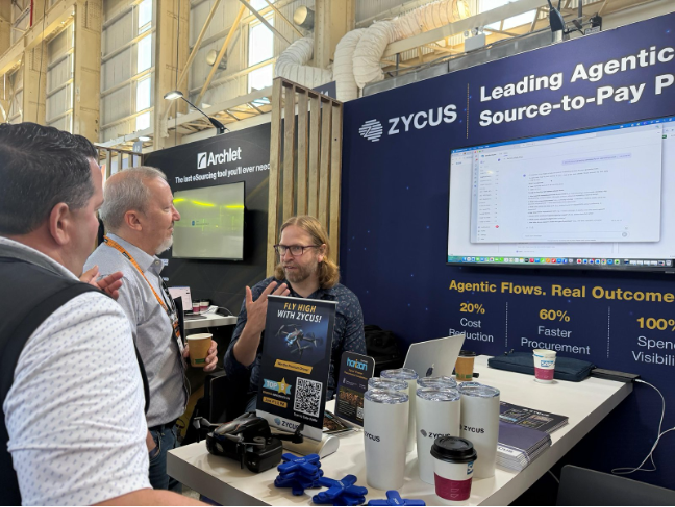
The Zycus booth at DPW New York 2026, with Merlin Intake live on screen
Procurement leaders who have sat through dozens of intake pitches recognized the gap immediately. They’d seen AI suggest the right form. They hadn’t seen AI skip the form entirely and just get on with the work — an intelligent system that is the process, not a layer sitting on top of it. A Global Requisition-to-Order Manager at a Fortune 500 pharmaceutical company lingered at the demo longer than most — it was the Teams interface that caught their attention. “We’re already living in Teams all day,” they said. “If procurement could just… happen there, that changes things.”
Merlin Intake wasn’t alone on the screen. Right alongside it, the booth was running ANA, Zycus’s Autonomous Negotiation Agent, working tail-spend deals without a human drafting every message — and a first look at Merlin Autonomous Sourcing (MAS), the newest addition to the lineup, which takes on the legwork of building supplier shortlists and running sourcing comparisons so category managers can spend their time deciding, not assembling. Three agents, each handling a different stage — what to buy, who to buy it from, and on what terms — working as one connected system rather than three separate tools that happen to share a logo.
For North American enterprise procurement leaders ready to move from pilot to production and see all three agents working together at depth, Zycus’s flagship North American event — Horizon US, September 21 to 23, 2026, at The Ritz-Carlton Bachelor Gulch, Beaver Creek, Colorado — brings leading CPOs and live agent workflows into the same room. Reserve your seat at Horizon US.
A demo on an expo floor is one thing. What happens when that same platform runs inside a $11B+ global enterprise for over a year is another — and that’s exactly what the Discovery Stage showed next.
What IFF Proved on the Discovery Stage
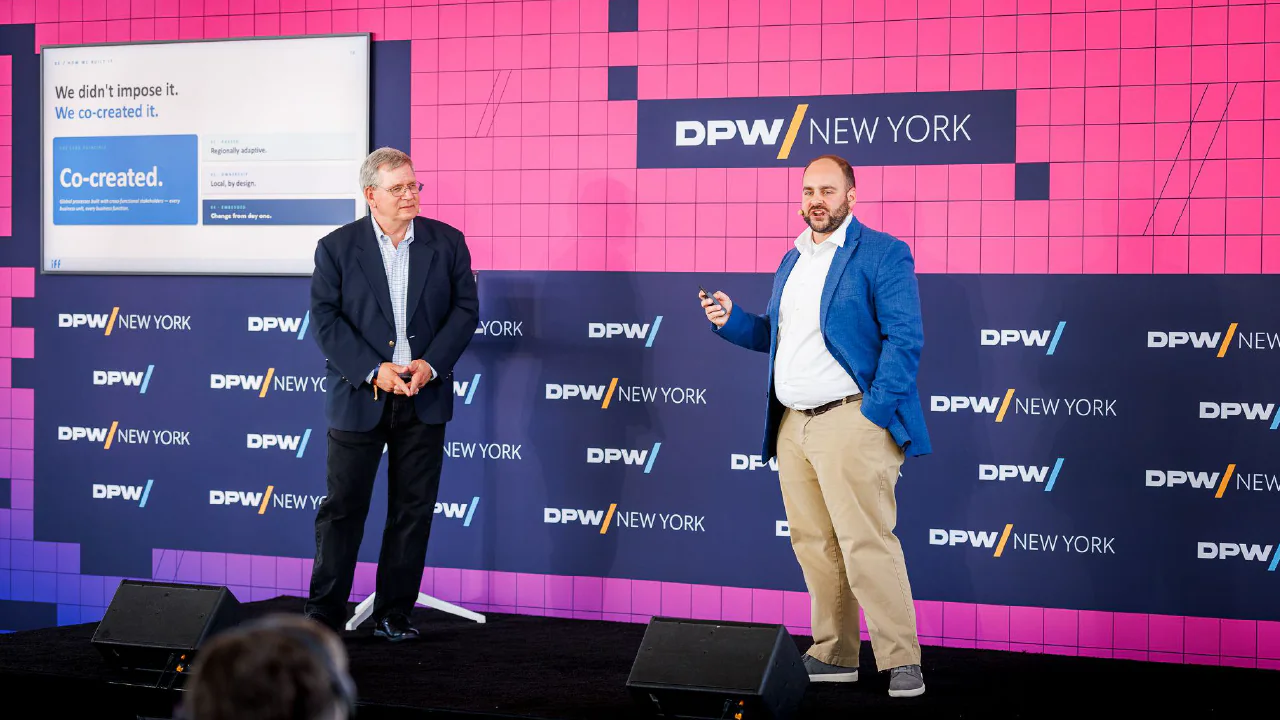
On June 3, John Schneider, Program Specialist at IFF, took the stage alongside Arthur Raguette, VP at Zycus. IFF is a $11B+ Fortune 500 company across 65 countries, and years of major acquisitions had left its procurement deeply fragmented: multiple ERPs, inconsistent governance, limited visibility into where the money was actually going.
The numbers Schneider shared weren’t projections. They were live, running today on Merlin Intake:
- $3B+ in spend under managed visibility
- 91% of transactions completed in five days or fewer, globally
- 300,000+ suppliers standardized into a single view
- Live in 23 countries, with 21 more in active deployment
What stood out watching Schneider move through those numbers was how little time he spent on any of them. No pause for effect, no slide animation building up to the big reveal — just one number after another, the way someone reads out a status they’ve checked many times before. For a $3B+ figure, that’s notable. It’s the difference between a result you’re presenting and a result you’re managing.
John Schneider and Arthur Raguette presenting IFF’s results on the Discovery Stage, DPW New York 2026
Merlin Intake is live across IFF today. ANA is next, for tail spend at scale. And the roadmap continues into agentic sourcing — the layer MAS is built for, predictive and proactive, with category managers governing the outcome rather than building it step by step. Schneider summed up the philosophy behind all of it in seven words: “Orchestrated by AI. Governed by us.” Define the boundaries, embed the controls, then let the agents run. That’s the difference between an organization that scales agentic AI and one that stays stuck in pilot mode forever.
The Gap Every Serious CPO Needs to Close in 2026
The conversation at DPW New York 2026 had a different quality to it. The question was no longer whether agentic AI would transform procurement. Every serious procurement leader in that room had moved past that. The question was more specific and more urgent: how many more quarters can an organization afford to stay in pilot mode while the gap between intention and execution widens?
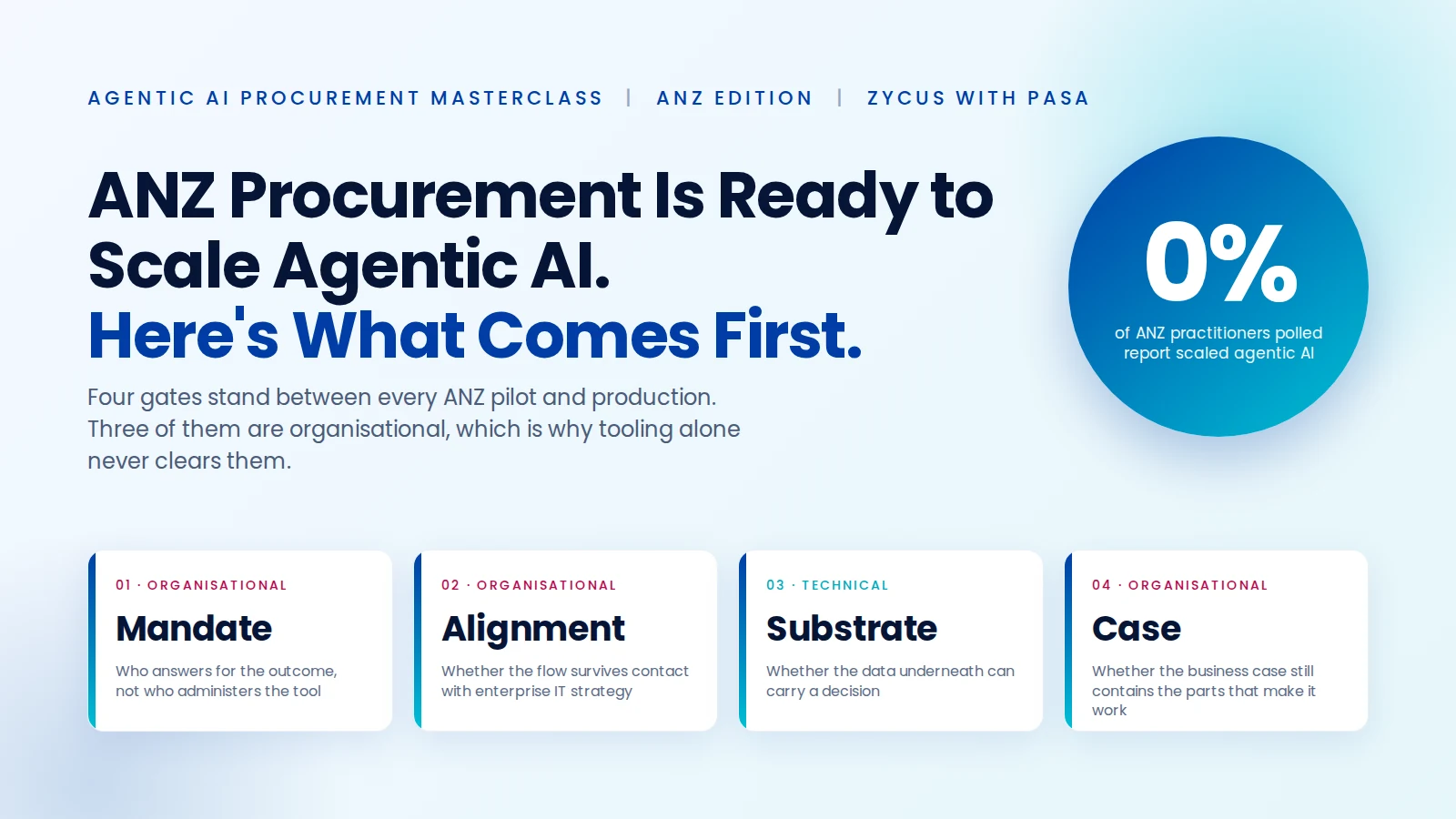
The Hackett Group’s Agentic AI in Procurement Adoption Index 2026 — the most comprehensive benchmark of its kind, drawn from responses from more than 250 global CPOs and released publicly for the first time at Zycus’s Agentic AI Procurement Summit in May 2026 — found that 58% of procurement leaders expect agentic AI to have a material impact on their organizations within the next 12 months. Yet the majority of those same organizations remain at the experimentation stage, running pilots that never reach governed, enterprise-wide deployment.
That is the gap. And IFF closed it on a stage in New York with production numbers — not a roadmap, not a vendor promise, but a practitioner result delivered to the most senior procurement audience in North America, from an enterprise running agentic AI across 23 countries and $3B+ in spend.
If you want to see where your own organization sits against that benchmark, both reports — the Hackett Group’s Adoption Index and Forrester’s Don’t Delegate AI — are available on demand. Access the research and session recordings here.
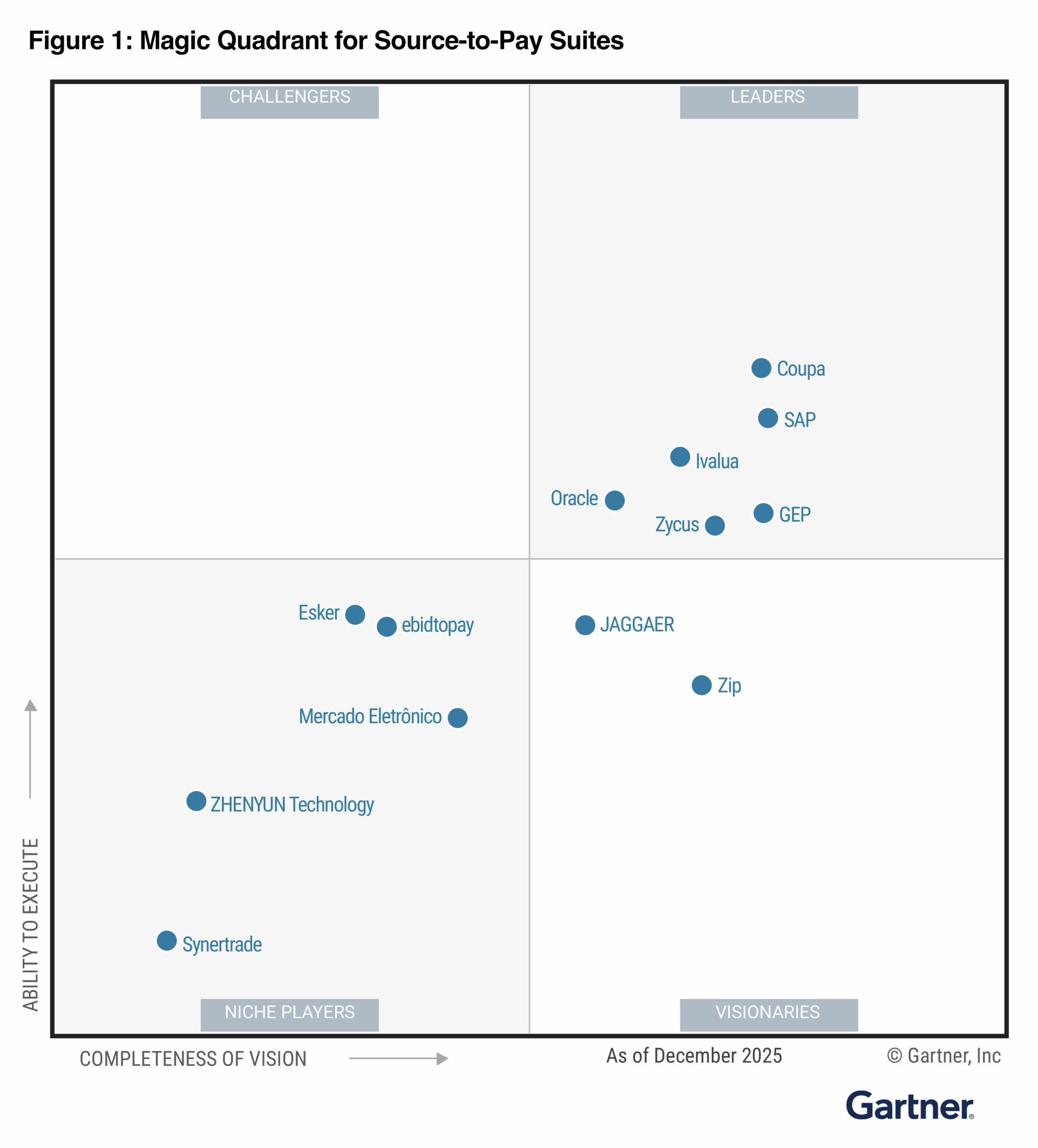
Zycus has been building toward this moment since it launched the Merlin AI suite in 2018 — recognized today as a Leader in the 2026 Gartner Magic Quadrant for Source-to-Pay Suites, and by Forrester, IDC, and Gartner Peer Insights. The North American market is at an inflection point, and the tolerance for tools that promise transformation while delivering incrementalism is running out fast.
What US Enterprise Procurement Leaders Took Away from DPW New York 2026
By the second day, the same conversation was repeating itself at booth after booth, in slightly different words each time. The US enterprise procurement leaders I spoke with kept circling back to the same thing: agentic AI in procurement is no longer a slide in someone’s 2027 roadmap. It’s a budget line for 2026, and the question on most minds wasn’t whether to invest, but how fast their organization could move from pilot to production without losing governance along the way.
For North American procurement leaders specifically, IFF’s session offered something rare at a conference: a peer, not a vendor, describing what agentic procurement in the US and globally actually looks like once the pilot phase ends — the governance model, the phased rollout, and the numbers to show for it. That’s the kind of evidence that turns a budget conversation into a budget decision.
Executing Versus Advising: The Only Question That Matters Now
DPW New York 2026 did not produce a consensus on which vendor to choose or which technology to deploy. What it produced was a consensus on what the right question is.
The right question is not: does my procurement function have AI? Every function has AI in some form now. The right question is: is that AI executing, or is it advising? Is it orchestrating the full lifecycle from intake to outcomes — autonomously, inside the systems your teams already use — or is it sitting inside a workflow, waiting to be told what to do next?
IFF answered that question with production numbers running on Merlin Intake today, and a roadmap that puts ANA and Merlin Agentic Sourcing next. Zycus answered it with all three agents live on the expo floor. Together, they made the case for agentic procurement in the US for 2026: not a 2027 ambition, but a 2026 operational reality — for the enterprises willing to build it with the right architecture, the right governance philosophy, and a platform designed from the ground up to deliver outcomes, not transactions.
That was the real story at DPW New York 2026. Not that everyone was talking about agentic AI — but that, for the first time, someone stood up and proved what it actually means.
For US enterprise procurement leaders ready to move from Source-to-Pay to Intake-to-Outcomes, the conversation continues at zycus.com.
About IFF: International Flavors and Fragrances (IFF) is a Fortune 500 company with $11B+ in annual revenue, approximately 22,000 employees, and operations across 65 countries across four core divisions: Flavors, Fragrances, Food Ingredients, and Health and Biosciences.
Related Reads:
- From Co-Pilots to Commanders: How Agentic AI is Redefining Procurement Transformation
- The Complete Guide to Agentic AI in Procurement
- Why Agentic AI Is the Future of Source-to-Pay Automation by 2026
- Whitepaper: Beyond GenAI: The Dawn of Agentic AI in Procurement
- From ‘Cognitive Procurement’ to Agentic AI — What Actually Changed