








TL;DR
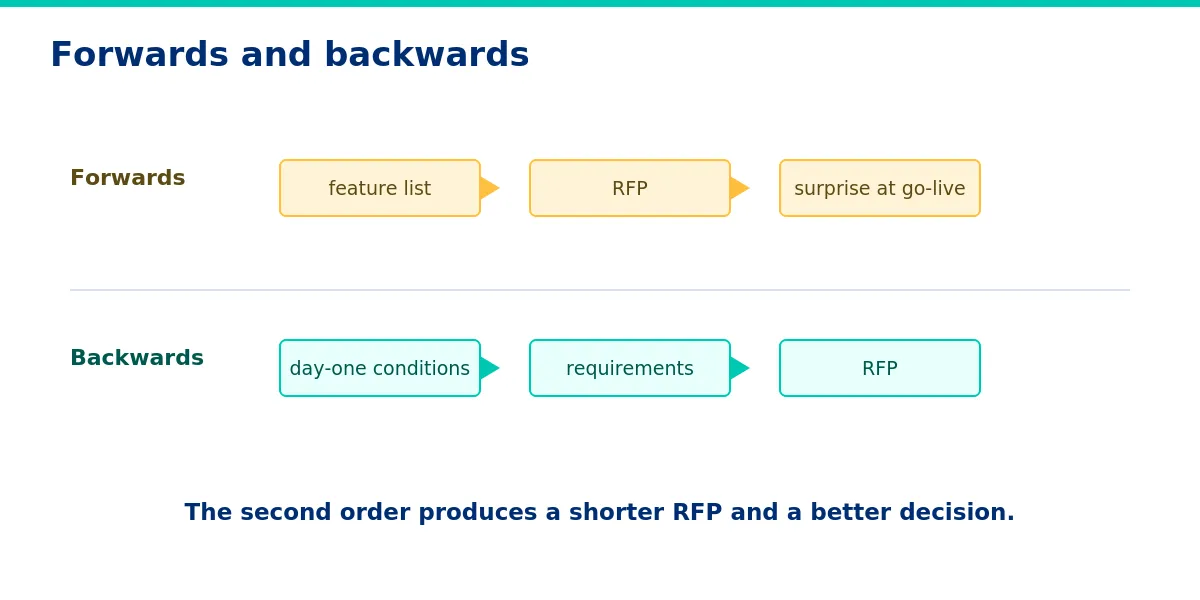
- Write the procurement intake RFP backwards from six conditions that must be true on day one, not forwards from a vendor feature list.
- Turn each day-one condition into a procurement software requirement and a demonstration you would accept as proof.
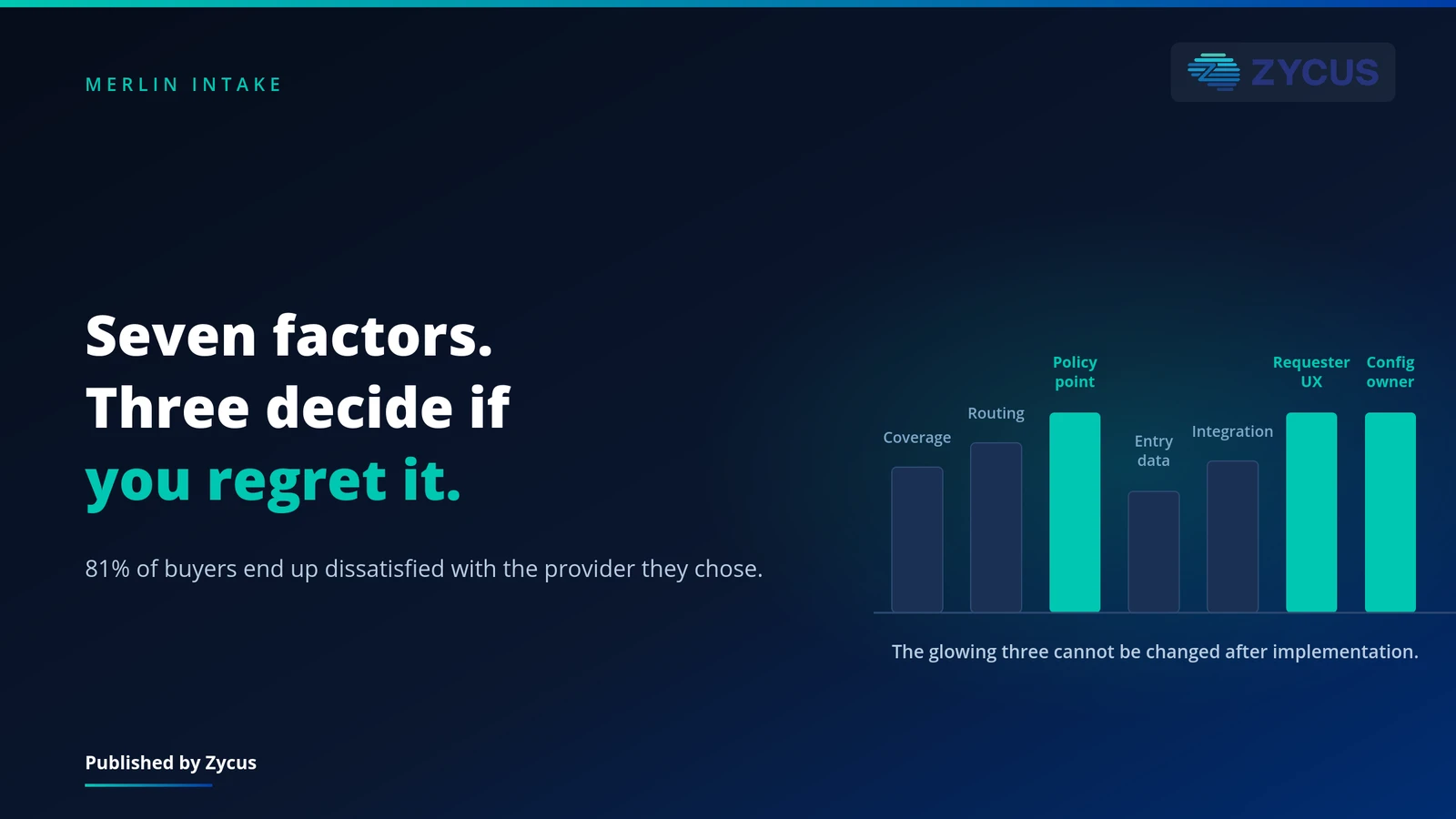
- Treat requester access, pre-commitment policy enforcement, and configuration ownership as architecture-level decisions rather than ordinary feature points.
- Score evidence, not promises: a written “yes” should never receive the same score as a successful demo using your own request.
- Keep feature-parity items, distant roadmap wishes, and untestable “AI-powered” claims out of the RFP.
An intake RFP should not be a catalogue of everything intake management software might do. It should describe the operating conditions your procurement intake process must satisfy at go-live, then require each vendor to prove that it can meet them.
This guide shows how to translate six day-one conditions into procurement software requirements, demo scripts, and a proof-based scoring model. The goal is a shorter procurement RFP that produces more separation between vendors and fewer surprises during implementation.
This is written for procurement teams issuing a formal intake RFP. Broader software-evaluation criteria and weighting can sit underneath it; this article focuses on what the RFP itself should ask for.
Why Do Procurement Intake RFPs Fail When They Start With Features?
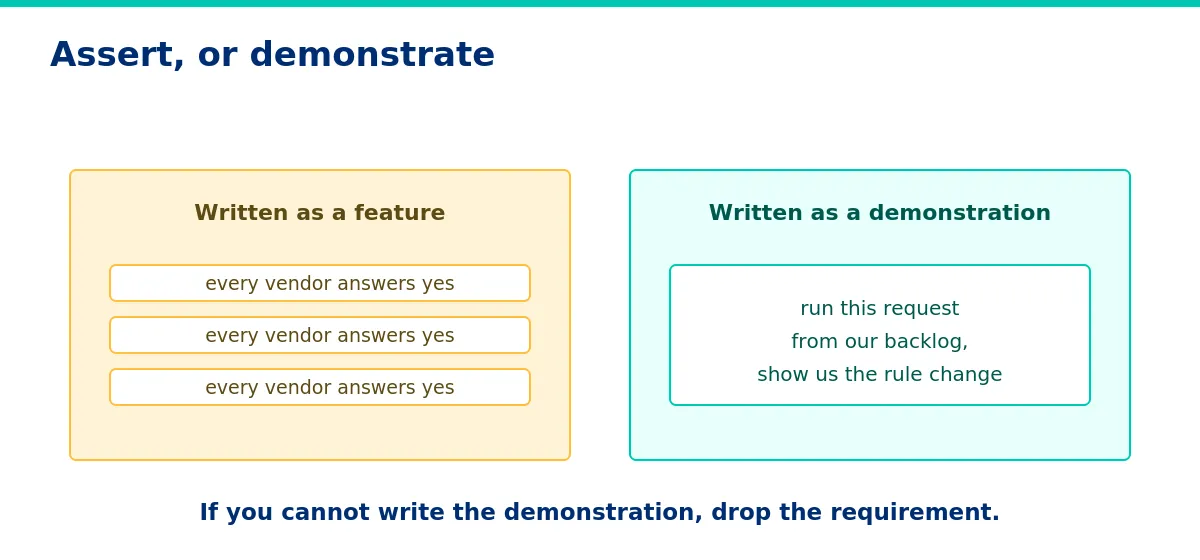
Feature lists are easy to assemble. Teams copy capabilities from vendor sites, add internal wishes, and produce a long matrix. The result looks rigorous, but if every credible vendor answers “yes,” the requirement carries almost no selection value.
A useful RFP requirement should expose a difference in operating behavior. “Supports category-based routing” is weak because everyone can claim it. “Using this request, change the category and show the workflow taking a different path without manual triage” is much harder to fake and much easier to score.
The practical test is simple: if a requirement cannot change the ranking of the shortlisted vendors, it does not deserve much space in the RFP. Start with what must be true at go-live, then derive only the requirements needed to make those conditions real.
Read More About Reliable, Fast, and Precise: AI-Powered RFP Automation
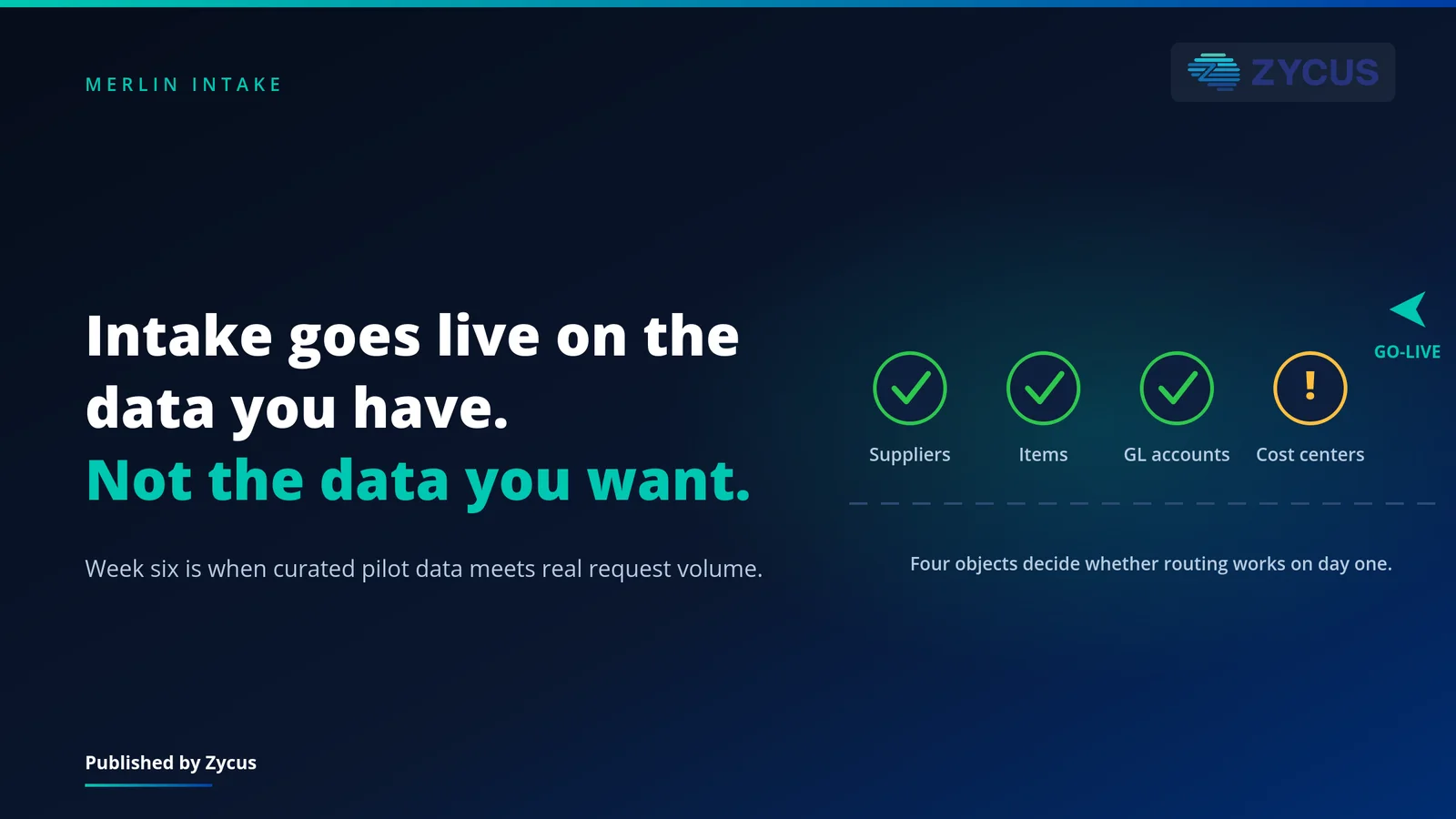
What Must Be True on Day One of the Procurement Intake Process?
| Day-one condition | What it means | Failure you are avoiding |
| Requesters can submit without training | Users can describe what they need without knowing category codes, procurement terminology, or which workflow to choose. | Email and chat remain the easier path, so adoption decays after launch. |
| A defined set of request types routes automatically | The launch scope is explicit and those requests route based on context such as value, category, supplier, entity, or risk. | Manual triage becomes the hidden operating model. |
| Policy acts before commitment | Budget, approval, supplier, and compliance rules influence the request before the user commits. | Intake becomes a reporting layer for leakage rather than a control point. |
| Procurement can change a routing rule quickly | Routine workflow changes are owned by a business administrator, not trapped in code or a vendor queue. | Every policy or organizational change becomes an IT project. |
| Unmatched requests have a governed path | A request that fits no rule goes to a named owner with status, SLA, and audit history. | Exceptions disappear into manual work or stalled queues. |
| Downstream systems receive structured data | ERP, sourcing, Contract Lifecycle Management, supplier, or finance systems receive validated fields rather than free text that must be re-keyed. | The intake front door simply moves manual work downstream. |
These are organizational choices before they are vendor capabilities. Defining them first prevents the procurement intake RFP from asking vendors to decide your operating model for you.
Which Intake Software RFP Requirements Follow From Those Conditions?
| Condition | RFP requirement | Proof to require |
| Training-free submission | The user can initiate a request in an approved channel, describe the need in plain language, and be prompted only for missing information. | Give a non-procurement user an unfamiliar request and observe whether they reach the correct path without coaching. |
| Automatic routing | Routing changes using request attributes such as category, value, supplier status, business unit, region, or risk. | Change one attribute during the demo and require the workflow to re-route visibly. |
| Pre-commitment policy | Policy checks can block, redirect, or escalate a request before a commercial commitment is made. | Submit an out-of-policy supplier or threshold breach and show what the requester sees. |
| Business-owned configuration | Authorized procurement administrators can change rules, thresholds, approvers, and request logic without code. | Ask the vendor to change a routing rule, publish it, and show the changed behavior. |
| Exception handling | Requests that match no standard path are routed to a named owner with status, audit trail, and escalation logic. | Use the messiest real request in your backlog and watch where it goes. |
| Structured handoff | Required fields are mapped and validated before writing to downstream procurement systems. | Show the outbound fields and then demonstrate what happens when a downstream system rejects one. |
This is the key upgrade from a generic procurement RFP template: every requirement contains the evidence needed to score it. If you cannot describe acceptable proof, sharpen or remove the requirement.
How Should Vendors Prove the Requirements in a Demo?
Require every shortlisted vendor to run the same scenarios using requests you provide. A standard product tour shows the path the vendor has optimized for presentation. A buyer-authored scenario reveals how the platform handles ambiguity, missing data, policy conflict, and downstream exceptions.
Use at least three scenarios: one normal request, one request that crosses multiple functions, and one request that deliberately breaks the happy path.
- New software purchase: new supplier, budget threshold, security review, contract requirement, and a defined approval path.
- Renewal or repeat purchase: existing supplier and contract context, but a changed value or policy condition that should alter routing.
- Exception scenario: ambiguous category or missing data followed by a failed downstream write, so you can see recovery and ownership.
Then ask the vendor to change one rule while you watch. This is where configuration ownership stops being an abstract requirement and becomes an observable operating model.
How Should You Score a Procurement Intake RFP?
Separate capability from proof. A vendor should not receive full credit for claiming a feature that another vendor successfully demonstrates on your scenario.
| Score | Evidence level | Meaning |
| 0 | Not supported | The vendor cannot meet the requirement. |
| 1 | Asserted | The response says yes, but no usable evidence is shown. |
| 2 | Standard proof | The capability is shown in the vendor’s own configured example. |
| 3 | Buyer-scenario proof | The vendor demonstrates the requirement using your request, rule, or exception case. |
For architecture-level conditions that are non-negotiable in your operating model, use pass/fail gates rather than allowing strengths elsewhere to compensate. Examples may include pre-commitment policy, business-owned configuration, or the requester channel you have committed to launching.
Why Does Proof Matter More as Intake Management Software Becomes AI-Driven?
AI at Wharton surveyed more than 800 senior business leaders and reported weekly generative AI use rising from 37% in 2023 to 72% in 2024. GBK Collective’s companion summary reports procurement usage rising from 50% to 94% over the same period.
That does not tell you which intake platform to select. It does explain why feature labels are becoming less useful. “AI routing,” “conversational intake,” or “autonomous workflow” can behave very differently depending on policy, data, configuration, and exception handling. The RFP therefore needs to test behavior, not the adjective attached to the feature.
How Zycus Merlin Intake Maps to These RFP Requirements
Zycus Merlin Intake provides a useful example of how these day-one conditions can be translated into product behavior without reducing the evaluation to a feature checklist. Employees can raise requests in Microsoft Teams or Slack, while AI-guided intake gathers the information needed to progress the request. Zycus also describes embedded policy controls, dynamic workflows, and a single entry point that can route requests into sourcing, contracting, buying, and other downstream procurement workflows.
For an RFP team, the value is not that these capabilities appear on a product page. It is that they create concrete scenarios to test. Ask Zycus to show a requester submitting in the channel you plan to use, a policy changing the path before commitment, an administrator modifying a routing rule, an unmatched request being handled, and the resulting record moving into the downstream process.
That keeps the comparison fair: Merlin Intake should be evaluated against the same proof standard as every other intake management software vendor. The advantage of an autonomous procurement platform built into a broader Source-to-Pay environment should show up in the continuity of the request from intake to execution, not simply in the number of connectors listed in the RFP response.
Frequently Asked Questions
1. What should a procurement intake RFP include?
Include day-one operating conditions, the procurement software requirements derived from them, the demonstration required as proof, scoring logic, integration expectations, exception handling, configuration ownership, and the real scenarios every shortlisted vendor must run.
2. How many requirements should an intake RFP have?
There is no ideal number. Use the smallest set that can separate vendors and protect your go-live conditions. Twenty sharp, testable requirements can provide more decision value than a hundred feature-parity questions answered “yes” by everyone.
3. What should vendors demonstrate for intake management software?
Require vendors to show natural-language or guided submission, dynamic routing, pre-commitment policy enforcement, business-administered configuration, exception handling, structured downstream data, and recovery from a failed handoff using your own requests.
4. Should we use a procurement RFP template?
Use a procurement RFP template for structure, not for the requirements themselves. Replace generic feature lists with conditions derived from your go-live model and attach a specific proof test to each important requirement.
5. How should procurement score intake software RFP responses?
Score evidence separately from claims. Give the highest score to capabilities demonstrated on your scenario, lower scores to vendor-standard demos or written assertions, and use pass/fail gates for architecture decisions that cannot be compromised.
6. Do we always need a formal RFP for procurement intake software?
No. If policy or spend thresholds require one, run it. Otherwise, a structured evaluation using the same day-one conditions, scripted demos, and proof-based scoring can deliver most of the decision quality with less elapsed time.