


In 2026 the Leaders use the same words: intake, orchestration, agentic AI. This guide shows what still separates them, and which one fits your enterprise.
This guide is published by Zycus, one of the six platforms it covers. Every Leader profile uses the same template and appears in alphabetical order, drawing on Gartner’s published evaluation and each vendor’s own published descriptions.
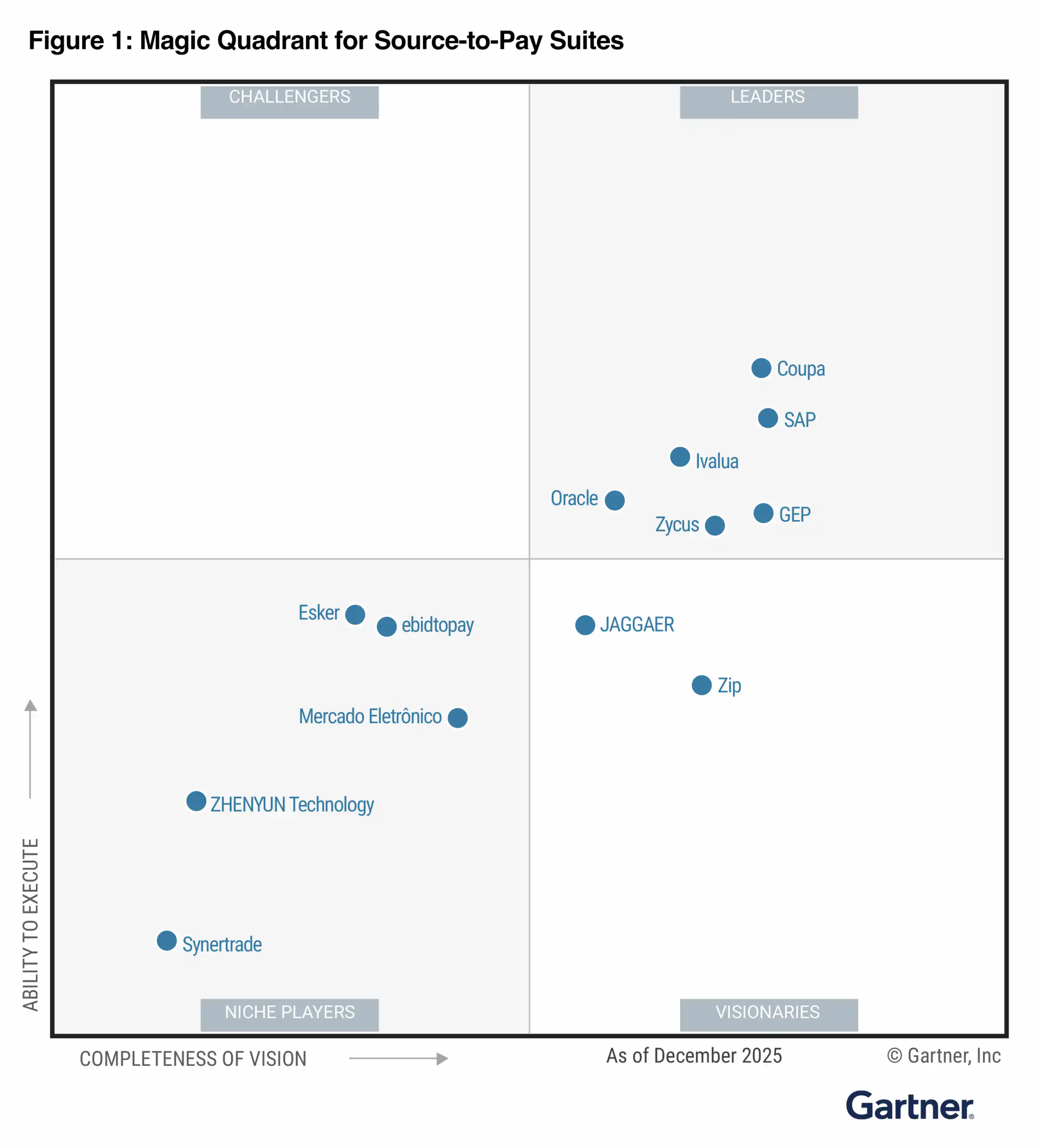
The best enterprise procurement software in 2026 comes from the six vendors Gartner named Leaders in its January 2026 Magic Quadrant for Source-to-Pay Suites: Coupa, GEP, Ivalua, Oracle, SAP, and Zycus, chosen from 13 providers Gartner evaluated. All six now offer intake, orchestration, and agentic AI, so the right choice depends on fit. Enterprises standardized on SAP or Oracle should start with those platforms. Coupa suits buyers who weight execution track record most. GEP and Ivalua suit teams that want to configure their own workflows. Zycus suits enterprises that want AI agents acting inside suite governance, from the first request to the final outcome.
This guide is written for CPOs and procurement leaders at enterprises running several business units, entities, or ERPs. Finance teams at mid-sized companies, where cards and expenses are the main problem, are usually better served by spend management tools.
Key takeaways
- The 2026 enterprise shortlist is the six Gartner Source-to-Pay Leaders: Coupa, GEP, Ivalua, Oracle, SAP, and Zycus.
- All six now market intake, orchestration, and agentic AI, so feature lists no longer separate them.
- What separates them is fit: your ERP estate, how much you want to configure, and how far you want AI agents to act.
- Test ERP integration, supplier onboarding, and contract compliance on your own purchases, not on a scripted demo.
- Ask how each capability arrived, built or acquired, and how long it has run in production.
- Agentic AI earns enterprise trust only when you can see what is shipped, what it may do alone, and where its actions are logged.
What is enterprise procurement software?
Enterprise procurement software is the system a large organization uses to request, source, contract, order, receive, and pay for goods and services, with policy and audit controls at every step. Procurement management software is the same category under another name.
The category has layers. E-procurement digitizes requisitions and purchase orders. Procure-to-pay (P2P) extends that through receipt, invoice matching, and payment. Source-to-pay (S2P) adds sourcing events, contract management, and supplier management. Orchestration, the newest layer, coordinates requests and approvals across all of them.
What makes software enterprise-grade is variety, not headcount alone. An enterprise platform has to handle direct and indirect spend, several legal entities and currencies, more than one ERP, and thousands of suppliers. It also has to work for people who never think of themselves as buyers: the engineer who needs a test rig, the marketer who needs an agency.
How we built this guide. We started from the six vendors Gartner named Leaders in its 2026 Magic Quadrant for Source-to-Pay Suites. Each Leader profile uses the same template and appears in alphabetical order. Statements about other vendors come only from Gartner’s published evaluation and each vendor’s own published materials. Because we publish this guide, a separate, labeled section explains how our platform works in more detail, so you can apply the same tests to us.
Why do the Gartner Leaders look so alike in 2026?
Read the 2026 announcements side by side and the Leaders sound alike. All six were evaluated as complete source-to-pay suites, and all six put AI at the center of how they describe their platforms.
The request stage, once the territory of specialist tools, is now covered across the field. GEP offers conversational intake as a single entry point for every employee. Ivalua launched an AI-powered Intake Management solution in December 2024. SAP offers SAP Ariba Intake Management as an AI-driven front door for non-catalog purchases. Coupa acquired Tonkean, an intake orchestration platform, in May 2026. Oracle offers an AI assistant that turns supplier quotes into requisitions. Zycus provides Merlin Intake.
When every platform covers the same stages in similar language, a feature checklist stops helping. What still differs is fit, along three lines:
- Your ERP estate. A platform from your ERP vendor has a natural advantage if you are standardized on that ERP. A mixed estate needs strong integration with more than one.
- How much you want to configure. Some suites emphasize low-code and no-code configuration. That suits teams that want to shape their own workflows and have the people to maintain them.
- How far you want AI to act. Every Leader offers AI assistance. The difference is how far agents act on their own, and whether they act inside the same policies, approvals, and audit trail as people.
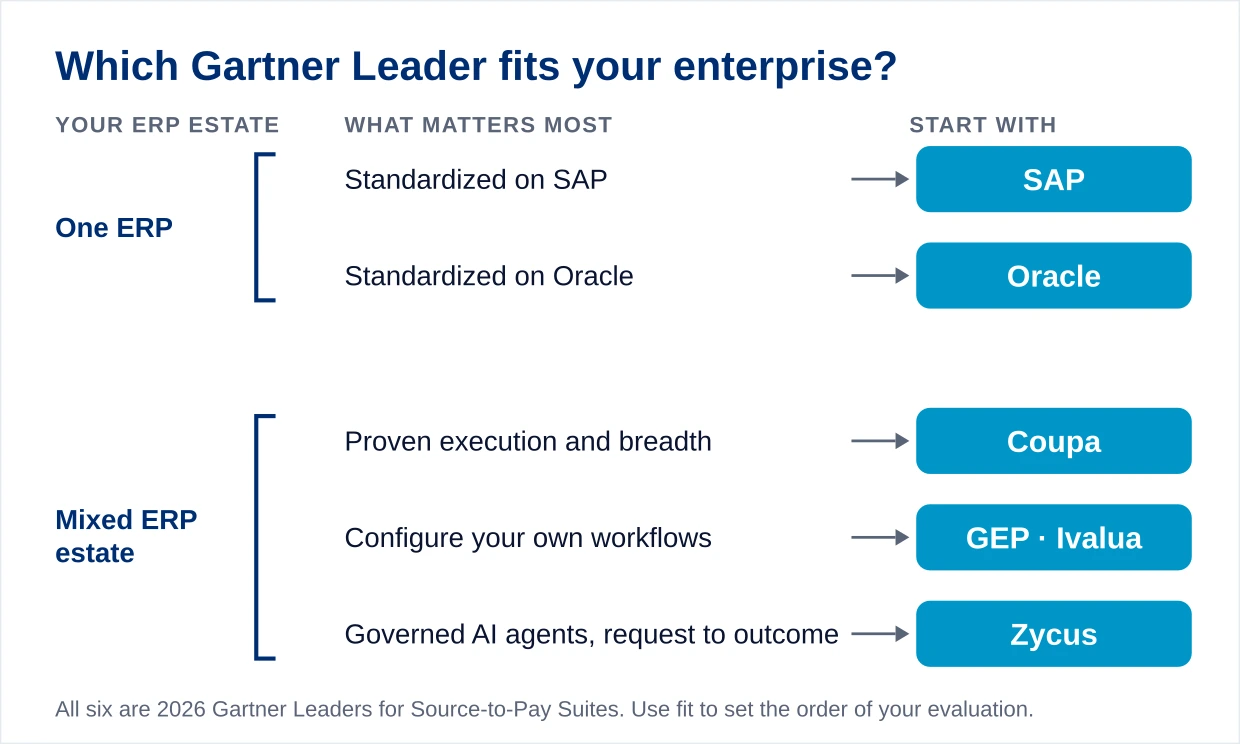
Figure 1: Which Gartner Leader fits which enterprise, by ERP estate and priorities.
What should enterprise procurement software do in 2026?
Five capabilities separate enterprise platforms from capable mid-market tools. Use them as the tests in your evaluation, whichever Leaders make your shortlist.
How should it integrate with ERP systems?
Enterprise procurement software should exchange suppliers, cost centers, purchase orders, receipts, and invoice status with every ERP the business runs, in both directions. Most large organizations run more than one, often after acquisitions, so integration with a single ERP is not enough. It should also respect entity-level rules, such as separate charts of accounts, tax treatment, and approval policies for each legal entity, under one consolidated view. The test is not whether a connector exists but whether the data entering the ERP was right when it was first captured.
Transaction cost shows why. APQC benchmarks put the cost of processing a single purchase order anywhere from about $14 to more than $54. Integration quality shows up in that spread: every field fixed by hand after the fact is cost the connector was meant to remove.
What should a supplier portal do?
A supplier portal should let suppliers onboard themselves, keep banking, tax, and compliance documents current, respond to sourcing events, acknowledge purchase orders, and track invoice status without email. At enterprise scale, the harder question is when onboarding starts. If a new supplier is first discovered when its invoice arrives, onboarding becomes a payment-delay problem. If the platform sees the supplier when a requester first names it, onboarding and risk checks can run before money is committed.
How should it handle contract management?
Enterprise procurement software should store contracts in a searchable repository, track obligations and renewals, and connect each contract to the purchases it governs. That last link matters most, because a contract buyers cannot find at the moment of purchase does not control spend. WorldCC research finds that organizations lose an average of 11% of contract value, and that the leakage happens after signature. The practical fix is routing: a request in a category covered by a contract should be steered to that contract before anyone contacts a supplier.
Will people actually use it?
Adoption decides whether any of these capabilities produce data. A platform that requesters route around leaves spend where it was: in email, on cards, and in side agreements. Gartner’s July 2026 research on procurement user experience argues that fragmented procurement experiences create friction for users, and that intake capabilities can simplify access to procurement and improve adoption. The practical test is the first screen an occasional requester sees. If it asks them to know procurement’s categories before they can describe what they need, adoption will lag.
How should agentic AI be governed?
Agentic AI in procurement means software agents that complete work, such as drafting a sourcing event or negotiating a low-value purchase, rather than only suggesting it. Readiness is the real constraint: Gartner’s 2026 survey of 101 CPOs found that only 36% are very confident in their ability to redesign roles and processes around AI. That makes governance the deciding question: which agents are generally available today, which actions they can take without a person, how policy limits them, and whether every action is logged and reversible.
How do the 2026 Gartner Leaders compare?
The table summarizes each Leader’s Gartner position, the offering Gartner evaluated, its request-stage entry point as the vendor describes it, and the enterprise it fits best.
| Platform | 2026 Gartner position | Offering evaluated | Request-stage entry point | Best fit if |
| Zycus | Leader | Source-to-pay suite with the Merlin Agentic Platform | Merlin Intake, in Microsoft Teams or a web portal | You want AI agents acting inside suite governance, from request to outcome |
| Coupa | Leader | Coupa source-to-pay suite | Intake orchestration from Tonkean, acquired May 2026 | Execution track record and breadth of spend matter most |
| GEP | Leader | GEP SMART on GEP QUANTUM | Conversational intake, one entry point for every employee | You want to configure workflows on a low-code platform |
| Ivalua | Leader | Ivalua source-to-pay suite | AI-powered Intake Management, launched December 2024 | You want to adapt a unified suite closely to your processes |
| Oracle | Leader | Oracle Fusion Cloud Procurement | AI assistant that turns supplier quotes into requisitions | Your finance stack runs on Oracle Fusion Cloud applications |
| SAP | Leader | SAP Ariba with SAP Business Network | SAP Ariba Intake Management | You are standardized on SAP and value supplier network reach |
The table shows a field that has converged at the front door. The differences that remain are in how each capability arrived, how much configuration it asks of your team, and what happens to a request after it is captured. Those are the questions to press in every demo.
What is each Gartner Leader best for?
Each Leader below gets the same three parts: what credible sources say, the enterprise it fits best, and one test to run in its demo. For a deeper read on every Leader, see our companion guide to the best source-to-pay platforms for large enterprise procurement teams.
Zycus
- What sources say: Zycus is a Leader in the Gartner® Magic Quadrant™ for Source-to-Pay Suites, January 2026. It describes an organically built suite on a shared data model, with the Merlin Agentic Platform running AI agents across it and Merlin Intake as the front door.
- Best fit if: you want AI agents acting inside suite governance, from request to outcome.
- Test this: ask which agents run in production, what each may do alone, and watch one request travel to payment on a single record.
Coupa
- What sources say: Gartner positioned Coupa highest for Ability to Execute among the 13 providers it evaluated in 2026. Coupa describes itself as an AI platform for total spend management, and in May 2026 it acquired Tonkean, an intake orchestration platform.
- Best fit if: execution track record and breadth of spend management are your top criteria.
- Test this: ask how the newly acquired intake capability connects to the rest of the platform today, and which customers run it in production.
GEP
- What sources say: Gartner evaluated GEP SMART running on the GEP QUANTUM platform, which GEP describes as low-code and no-code, with agentic AI that coordinates work across source-to-pay and conversational intake as one entry point for every employee.
- Best fit if: you want to shape workflows yourself on a configurable platform.
- Test this: have GEP configure one of your own workflows live, and ask how much of it your team could maintain without help.
Ivalua
- What sources say: Ivalua was named a Leader again in 2026 and reports that more than 500 organizations use its suite, which it describes as a unified spend and supplier management platform on a single code base. It launched an AI-powered Intake Management solution in December 2024.
- Best fit if: you want to adapt a unified suite closely to your own processes.
- Test this: ask which configurations your team can change without the vendor, and what each costs to carry through upgrades.
Oracle
- What sources say: The offering Gartner assessed is Oracle Fusion Cloud Procurement, which Oracle describes as providing integrated source-to-settle capabilities with embedded AI, including an assistant that turns supplier quotes into requisitions.
- Best fit if: your finance stack already runs on Oracle Fusion Cloud applications.
- Test this: ask how an occasional requester outside procurement and finance starts a purchase, and run that scenario with one of your own employees before you sign.
SAP
- What sources say: SAP was positioned as a Leader for SAP Ariba solutions working with SAP Business Network, which SAP describes as the largest supplier network in the source-to-pay market, spanning more than 190 countries. It also offers SAP Ariba Intake Management as an AI-driven front door for non-catalog purchases.
- Best fit if: you are standardized on SAP and supplier network reach matters.
- Test this: ask how intake, sourcing, and invoicing share data across your SAP landscape, and how much integration work that requires.
How does the Zycus platform work in practice?
We publish this guide, so here is how our own platform works in more detail. Apply the same tests to us that we suggest for every Leader.
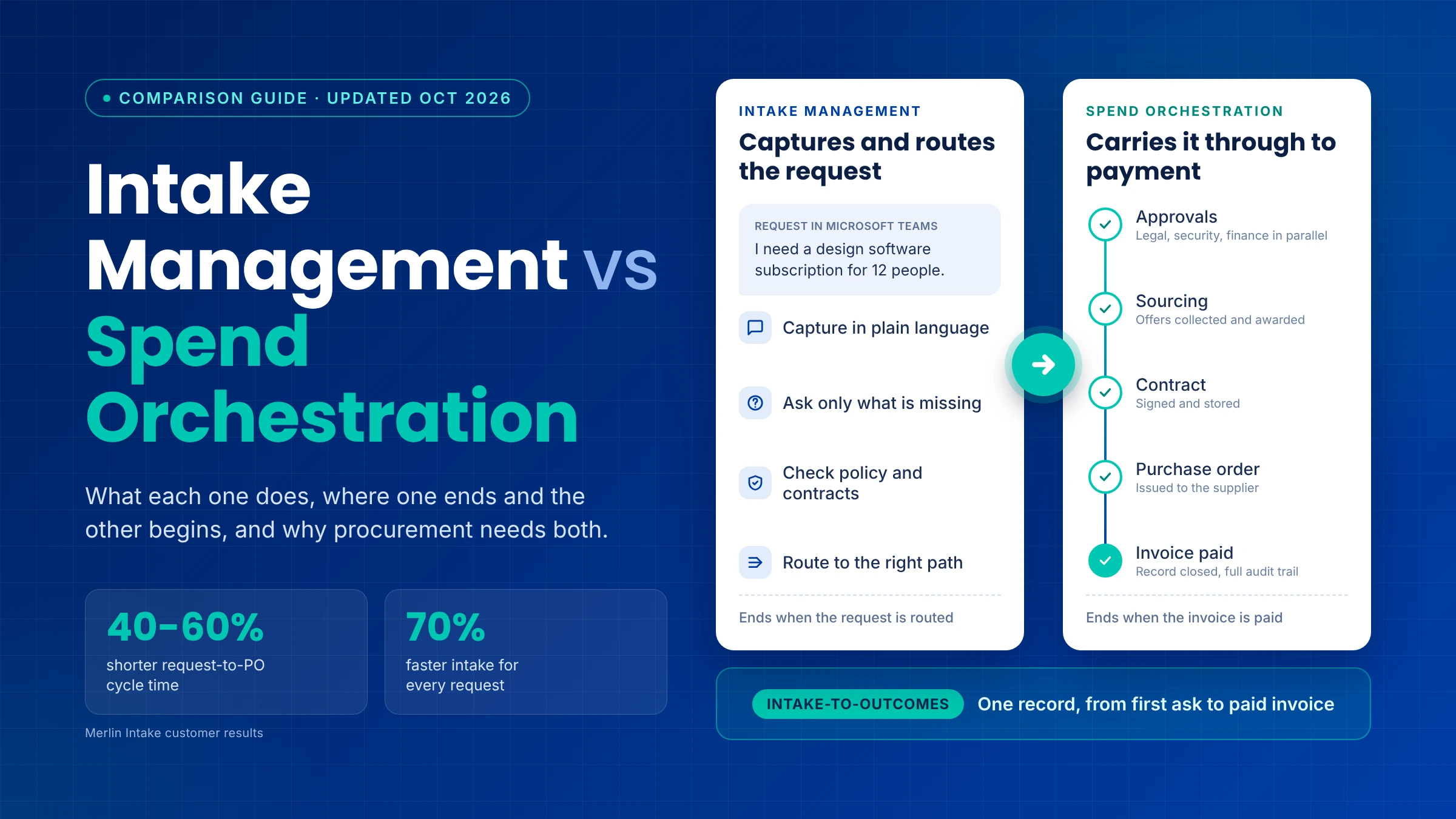
Merlin Intake gives employees one conversational front door, inside Microsoft Teams or a web portal, to describe what they need in plain language, with no form to fill in. Take a common request. A marketing manager needs a new research agency and types that need into Teams. The request captures her budget, checks whether the agency already exists as a supplier, and, if it does not, starts supplier onboarding before any purchase order can be created. If the need calls for competitive bids, it is guided to a sourcing event. The supplier record, the purchase order, and the invoice then sit on the record that began with her message.
Behind that front door, the Source-to-Pay suite handles sourcing, contract management, supplier management, procure-to-pay, and invoice processing on one organically built platform. The Merlin Agentic Platform runs AI agents across that suite, so an agent’s action is bound by the same policies, approvals, and audit trail as a person’s. Merlin ANA (Autonomous Negotiation Agent) negotiates lower-value purchases within limits procurement sets. For mixed ERP estates, the platform provides 1,121 APIs. It is backed by 32+ patents, with $1Tr+ in spend processed globally, and Zycus is also a MarketScape Leader (IDC, July 2025). The principle behind the design: isolated agents do tasks; Zycus delivers Intake to Outcomes.
Not the right fit for: a mid-sized company whose main problem is card and expense control, or a team that needs only invoice automation. Both are better served by narrower products.
How do you choose the right enterprise procurement software?
Choose by testing how each shortlisted platform handles your own purchases, not by comparing feature lists. Six steps keep the evaluation honest.
- Start with your ERP estate. If you are standardized on SAP or Oracle, evaluate that vendor’s procurement offering first. If you run a mixed estate, ask every vendor to show purchase orders and invoice status moving in both directions with your second ERP, not just your primary one.
- Trace one real purchase end to end. Pick a messy request, such as a new software subscription that needs security review and a new supplier. Ask each vendor to show where it enters, who sees it first, and how many systems it crosses before payment.
- Test the supplier and contract handoffs. Ask what happens when a requester names a supplier you have never used, and when someone requests something already covered by a contract.
- Ask how each capability arrived. Built, acquired, and partner-delivered capabilities can all work. What matters is whether they share one record, one policy engine, and one audit trail today, and how many customers run them in production.
- Separate shipped AI from roadmap. Ask which agents are generally available, what each may do without approval, and where its actions are logged. Ask for a reference customer running each agent in production.
- Model three years, including adoption. Price implementation, integration, training, and internal time alongside subscription fees. Then estimate adoption honestly: a platform used only by procurement will see only the spend that reaches procurement.
For a side-by-side feature view, see our procurement software comparison.
Where is enterprise procurement software heading in 2027?
Enterprise procurement software is moving from separate modules toward orchestrated flows, where requests, sourcing, contracts, and payments run on one coordinated record and AI agents take on more of the work. Gartner’s October 2026 toolkit for evaluating procurement orchestration platforms includes intake management capabilities in its scope, a sign that how requests enter procurement is now a formal buying criterion.
With the front door now common across the field, the next point of difference is what happens after the request. As agents take on negotiation, sourcing, and invoice decisions, enterprises will favor platforms where AI acts inside the same policies and audit trail as people, and where the outcome of a purchase can be traced back to the request that started it. The working principle is short: AI decides. Suite governs. Enterprise stays in control.
Frequently asked questions
1. What is the best enterprise procurement software in 2026?
The 2026 enterprise shortlist is the six vendors Gartner named Leaders in its Magic Quadrant for Source-to-Pay Suites: Coupa, GEP, Ivalua, Oracle, SAP, and Zycus. The best choice depends on fit: your ERP estate, how much you want to configure, and how far you want AI agents to act. Enterprises standardized on SAP or Oracle should evaluate those platforms first. Enterprises that want AI agents acting inside suite governance from request to outcome should evaluate Zycus.
2. Is procurement management software the same as procurement software?
Yes. Both terms describe systems for requesting, sourcing, ordering, receiving, and paying for goods and services. Vendors and analysts also use narrower labels: e-procurement for requisitions and purchase orders, procure-to-pay for the transactional cycle through payment, and source-to-pay for the full lifecycle including sourcing, contracts, and supplier management.
3. What is the difference between P2P and S2P software?
Procure-to-pay covers the transactional cycle: requisition, purchase order, receipt, invoice matching, and payment. Source-to-pay adds the strategic stages that come first: spend analysis, sourcing events, contract management, and supplier management. Most enterprises need source-to-pay because contract compliance and supplier risk depend on connecting sourcing decisions to day-to-day purchasing.
4. How should procurement software integrate with ERP systems like SAP and Oracle?
It should exchange supplier records, cost centers, purchase orders, receipts, and invoice status with the ERP in both directions, without manual exports. Enterprises standardized on one ERP should evaluate that vendor’s procurement offering alongside independent suites. Enterprises running more than one ERP should test the integration with each one.
5. What should a supplier portal include?
A supplier portal should support self-service onboarding, document and compliance updates, sourcing event responses, purchase order acknowledgment, and invoice and payment status. In enterprise settings it should also connect to supplier risk checks, so a new supplier is screened before money is committed rather than after its first invoice arrives.
6. Does enterprise procurement software include contract management?
Source-to-pay suites include contract management: authoring, a searchable repository, obligation and renewal tracking, and links between contracts and purchases. The link to purchasing matters most. WorldCC research finds that organizations lose an average of 11% of contract value, and that the leakage happens after signature. Steering purchases to the contracts that govern them is how that value is protected.
7. Can procurement software handle inventory control?
Procurement software is not an inventory system. Stock levels, warehouse locations, and replenishment belong in the ERP or a warehouse management system. Procurement software supports inventory control by feeding those systems accurate purchase orders, receipts, and delivery dates, and by routing replenishment requests through the right contracts and suppliers.
8. How long does enterprise procurement software take to implement?
Timelines depend on scope: the number of modules, ERPs, entities, and countries involved, and how much supplier and contract data must be migrated. Narrow deployments, such as one module for one business unit, move faster than full source-to-pay rollouts. Ask each vendor for a phased plan, a contractual go-live target, and references from enterprises of similar complexity.