

TL;DR
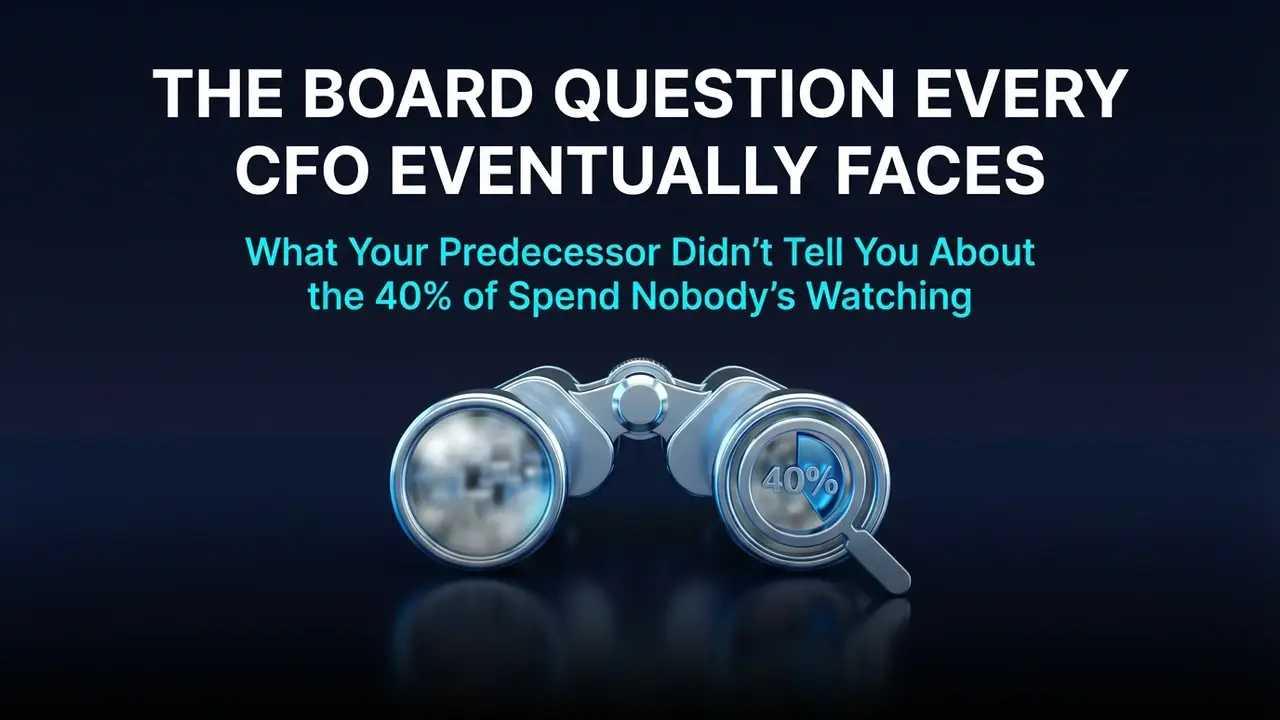
- CFO board readiness is often tested by one critical question: how much of the company’s spend is truly under management.
- Most CFOs lack full procurement visibility due to maverick buying, auto-renewed contracts, duplicate vendors, and unmanaged tail spend.
- Spend under management exposes where 40–60% of spend typically escapes active control in mid-market organizations.
- Improving procurement visibility can unlock 3–5% EBITDA improvement without reducing headcount or slowing growth.
- A focused spend audit, contract tracking, and quick-win analysis can prepare CFOs for board scrutiny in as little as 30 days.
- CFOs who address procurement blind spots early build board trust, credibility, and long-term confidence.
The Question That Changes Everything
Jennifer Walsh had been CFO for exactly 47 days when it happened.
Board meeting. Q3 review. She’d just finished presenting the financials—revenue up 12%, EBITDA improving, cash flow strong.
Then the board member from the PE firm asked:
“Jennifer, what percentage of our company’s spend is actually under management?”
She paused. “We have good vendor relationships. Procurement reports to Finance. I’d estimate… most of it?”
“Define ‘most.’ Give me a number.”
Silence.
She didn’t have one.
That question—and that silence, changed how Jennifer spent the next 90 days. And it revealed a blind spot that most CFOs inherit but never see until someone asks.
Why CFOs Don’t Have the Answer
Jennifer isn’t alone. According to recent research, only 19% of finance leaders say they’re “fully confident” they have an accurate picture of how much is being spent and where.
The problem isn’t incompetence. It’s invisibility.
Here’s what typically happens:
Your predecessor focused on the income statement, balance sheet, and cash flow. Procurement was someone else’s problem—or more accurately, everyone’s problem, which made it no one’s problem.
You inherited a patchwork: – Department heads managing their own vendor relationships – Contracts scattered across email, shared drives, and filing cabinets – AP processing invoices without asking if the purchase was optimal – No centralized procurement team or system – Finance expected to “provide oversight” without visibility
The result: 40-60% of spend in mid-market companies flows through channels Finance doesn’t see.
What “Spend Under Management” Actually Means
When that board member asks the question, here’s what they’re really asking:
“Of all the money flowing out of this company, how much are we actively controlling, negotiating, and optimizing?”
Spend under management (SUM) means: –
- Sourced strategically (not just “we’ve always used them”
- Contracted properly (not month-to-month or auto-renewing)
- Monitored for compliance (not just hoping people follow policy)
- Measured for value (not just “invoice matches PO”)
World-class organizations: 95-97% SUM
Average organizations: 60-70% SUM
Mid-market reality: 40-60% SUM
That gap—the 40-60% that’s not under management—is where money leaks.
Where the Other 40% Is Hiding
Jennifer ran her spend audit the week after that board meeting. Here’s what she found:
1. Maverick Spend (56% of purchases)
Purchases made without POs, off-contract, or with non-preferred vendors.
Jennifer’s example: – Three departments buying the same software from three different resellers – Prices: $47/seat, $52/seat, $61/seat – Cost of invisibility: 30% premium on the high end
2. Auto-Renewed Contracts (8 major contracts)
Agreements that were renewed without renegotiation because no one tracked the renewal date.
Jennifer’s example: – IT support contract: Auto-renewed at $340K (10% annual escalation baked in) – Market rate for same service: $285K – Cost of invisibility: $55K annually on one contract
3. Duplicate Vendors (14 found)
Multiple vendors providing the same or similar services across different departments.
Jennifer’s example: – Two facilities management vendors – Three office supply vendors – Four IT hardware resellers – Cost of invisibility: Lost volume discounts, higher admin costs
4. Tail Spend Chaos (18% of spend, 78% of transactions)
Thousands of small purchases (under $50K annually) with zero oversight.
Jennifer’s example: – 340 “tail” vendors representing $6.2M in annual spend – Average 20-30% premium vs. aggregated purchasing – Cost of invisibility: $1.2-1.8M in overpayment
Jennifer’s total opportunity identified: $4.2M annually on $85M revenue.
That’s a 5% EBITDA improvement from procurement alone.
The Two Types of CFO Responses
Fast-forward 90 days. Jennifer is back in the boardroom.
Same board member asks: “So, Jennifer—what’s the answer to my question?”
This time, Jennifer is ready:
“Currently, 58% of our spend is under active management. We’ve completed a full spend audit and identified $4.2M in opportunity—duplicate vendors, contract renewals, and tail spend rationalization. Here’s our 90-day roadmap to capture it.”
The board nods. The PE partner smiles. Jennifer becomes a strategic partner, not just a scorekeeper.
Compare this to what happens when CFOs don’t run the audit:
Response A (Unprepared): “We have good relationships… I’d estimate most of it?”
Result: Credibility hit. The CFO spends the next 6 months recovering from that moment.
Response B (Prepared): “Currently 58%. We’ve identified $4.2M in the gap. Here’s the plan.”
Result: Board trust earned. Budget approved for transformation.
The only difference? Response B ran the audit before the board asked.
Download eBook: 6-Month CFO Playbook for Mid-Market Procurement Success
The 5 Numbers Your Board Will Ask About
If you want to be “Response B,” you need five numbers ready:
Spend Under Management (%)
How much of the total spend is actively managed through formal processes?
How to calculate: – Total external spend (from AP): $100M – Spend with contracts + PO compliance: $58M – SUM = 58%
Maverick Spend Rate (%)
Percentage of purchases made outside approved channels.
Red flag: Above 20% = serious compliance problem
Supplier Count
Total active vendors and concentration risk.
Rule of thumb: More than 500 active vendors for a $100M company = fragmentation problem
Contract Leakage Rate (%)
Negotiated savings that fail to materialize in P&L results.
Industry reality: 40-50% leakage is common without active tracking
Cost Avoidance Quantified ($)
Value of prevented auto-renewals, eliminated duplicates, and stopped maverick purchases.
This is the number that gets boards excited.
How Jennifer Got Her Numbers in 3 Weeks
Jennifer didn’t hire consultants or buy enterprise software. She used three simple tools:
Week 1: Spend Audit – Pulled 12 months of AP data – Categorized by vendor, category, business unit – Identified duplicates and tail spend
Week 2: Contract Calendar – Compiled all contracts over $25K annually – Noted renewal dates and auto-renewal terms – Set alerts for 120 days before each renewal
Week 3: Quick Wins Analysis – Calculated savings from duplicate consolidation – Modeled payment term optimization – Quantified tail spend rationalization
Tools that helped:
- Procurement Health Scorecard: 2-minute assessment of maturity gaps
- Quick Win ROI Calculator: Quantified her $4.2M opportunity
- CFO Guide: Showed her where to look and what to measure
All three are free resources designed specifically for CFOs in their first 90-180 days.
Your 30-Day Action Plan
You don’t need 90 days to get ahead of the board question. You can do it in 30.
Week 1: Baseline Assessment
- Take the Procurement Health Scorecard (2 minutes)
- Pull 12 months of AP data
- Count total active vendors
Week 2: Opportunity Sizing
- Use the Quick Win ROI Calculator
- Identify duplicate vendors
- List contracts renewing in the next 6 months
Week 3: Quick Win #1
- Renegotiate one high-value contract
- Consolidate one duplicate vendor category
- Document savings (this becomes your board’s proof point)
Week 4: Build the Story
- Calculate your Spend Under Management %
- Quantify total opportunity ($M)
- Draft your “Response B” for the board
The Question Is Coming
Whether you’ve been CFO for 47 days or 470 days, the board question eventually comes.
You can be Jennifer before the audit, or Jennifer after it.
The difference is 30 days of focused work and the right tools to surface what your predecessor never saw.
Related Reads:
- eBook: The CFO’s Procurement Blind Spots (Free eBook)
- Take the Procurement Health Scorecard (2 minutes)
- Use the Quick Win ROI Calculator (5 minutes)
- eBook: What Happens When CFOs Inherit Procurement?
- A CFO’s Guide to Mitigating Procurement Risk and Ensuring Compliance
- The Procurement CFO Playbook: Harnessing AI for Seamless Finance and Sourcing Alignment