









TL;DR
- Source-to-Pay (S2P) digitization remains fragmented due to legacy systems, weak ROI justification, and siloed tools.
- A structured, CPO-led 6-step approach can bridge this gap, starting with a clear vision and business case, and ending with AI-driven automation.
- Key steps include:
- Aligning the S2P system with strategic procurement goals
- Building a strong ROI and Total Cost of Ownership case
- Ensuring cross-functional stakeholder buy-in
- Prioritizing end-user experience and ease of adoption
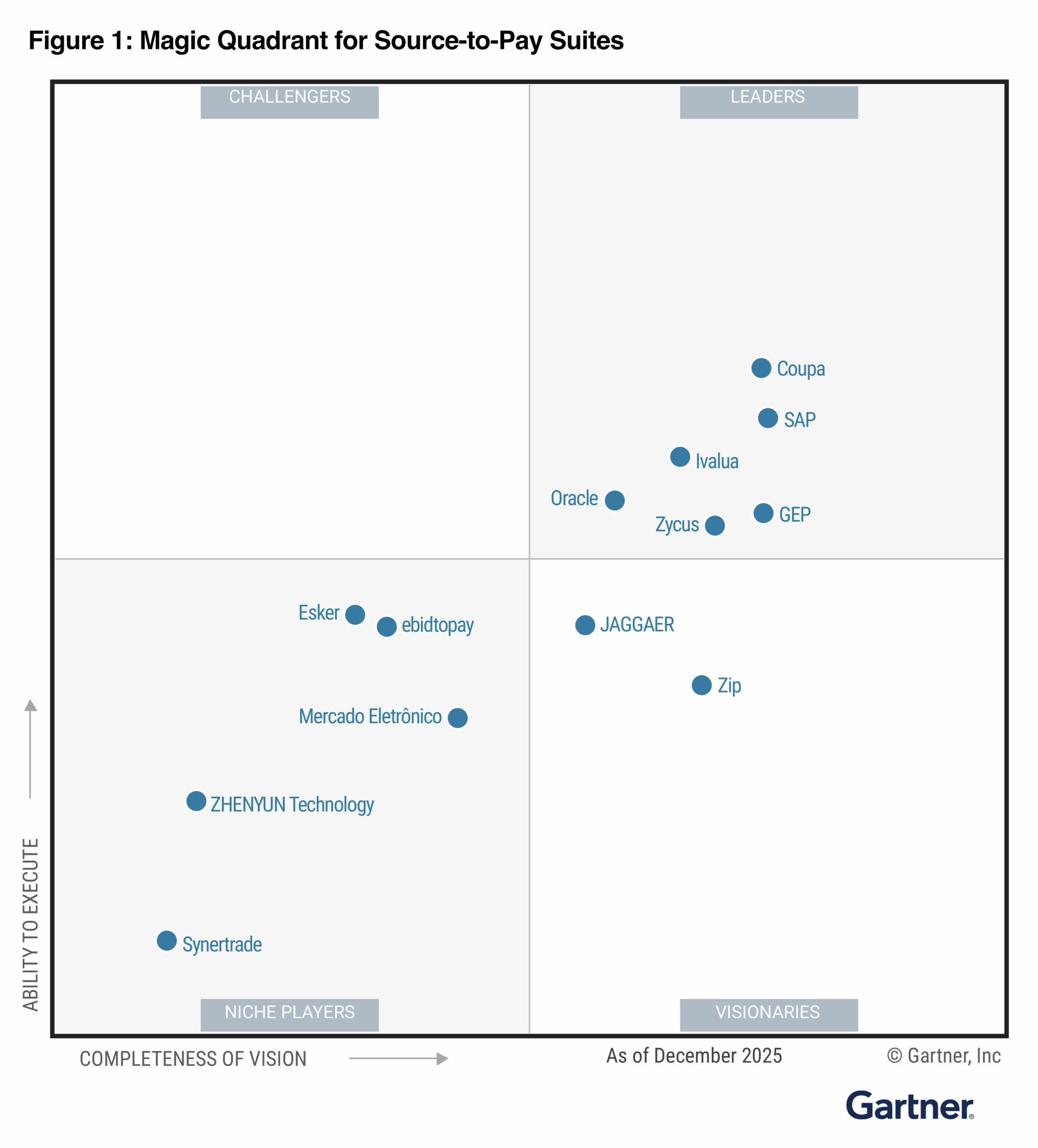
- Top-performing S2P platforms like Zycus, Coupa, SAP Ariba, and Jaggaer differ in capabilities across automation, UI/UX, AI-readiness, and scalability.
- AI is reshaping S2P by automating approvals, reducing errors, enabling intelligent sourcing, and unlocking better supplier collaboration.
- CPOs that take a holistic, tech-forward approach to S2P will drive greater efficiency, compliance, and long-term procurement transformation.
Over the last few years, the journey of digitizing Source-to-Pay (S2P) has emerged as a pivotal course for intertwining strategic precision and operational supply chain efficiency. Source to pay solution have time and again proved their mettle, in terms of boosting profit margins, reducing manual paperwork and intervention, and improving compliance. However, a completely digitized S2P system is yet to move beyond fragmented adoption.
There can be a myriad of reasons, from an procurement operations standpoint, for why this is so. Insufficient investment opportunities, lack of infrastructure, a complex dependency on legacy systems, etc., are some that come to mind. From a strategic perspective, this gap comes from the absence of a structured approach in identifying and selecting the right source to pay platform.
In this blog, we will walk you through the ultimate 6-step guide that procurement professionals should follow to select and implement the right S2P system for their business.
Strategic 6-Step Framework for CPOs to Select the Right Source to Pay System
1. Define Your Procurement Vision and Future-State Capabilities
Articulating the roadmap to reach the end-state begins by conducting an in-depth assessment of your organization’s procurement needs, objectives, and pain points. The 2023 Strategic Roadmap for Source-to-Pay Technology by Gartner emphasizes the importance of a tailored approach to technology adoption, ensuring a S2P system is aligned with the organization’s unique requirements. It is imperative to take stock of where the technology is at, where it is going, and how do you get there. While envisioning the end-state, you should also evaluate the source to pay platform’s scalability to accommodate future needs and technological advancements.
By mapping out the steps and building a migration plan with set milestones and key drivers, procurement leaders can ascertain the potential impact on operational efficiency, cost savings, and supplier relationships. Define important business outcomes, identify gaps in the existing infrastructure, create and measure key KPIs, and establish a long-term support plan to set the tone for your S2P migration vision. Zycus’s s2p solution cloud-based source-to-pay platform enables organisations to enhance procurement efficiency, spend management, manage supplier relationships, and drive cost savings through improved spend analysis, visibility and control.
2. Justify ROI with a Business Case Built on TCO & Strategic Value
Oftentimes, business cases for procurement process investment are viewed with skepticism or are ultimately rejected. The fact that procurement process sits at a lower priority order for technology investments in an organization is one of the top challenges that procurement leaders face. Businesses tend to view procure to pay as a support function, rather than one that paves the way for an uptick in revenue.
Hence, it is crucial to build a winning ROI justification to get the investment greenlit. While cost-effectiveness is crucial, focus on the source to pay platform’s Total Cost of Ownership (TCO) rather than just the initial investment. Begin by conducting a comprehensive cost analysis that considers implementation, maintenance, and potential savings over time.
According to Gartner, building a strong business case involves answers to these 4 components:
- Reason (“Why is the challenge that an automated source to pay process solves problematic and needs to be addressed right now?” “Why is the existing system no longer sufficient for the business?”)
- Resource (“What is the cost of the source to pay platform to achieve the desired result?”, “What would be the investment required in terms of time, people, and effort?”)
- Benefit (“What is the absolute value that is estimated to be gained?”, “Why is this technology solution more valuable than the other ways the strategic sourcing can be utilized?”)
- Plan (“What steps will be taken to reach the desired outcome?”, “What will be the mitigation plan in place in case of setbacks?”)
3. Identify the Right Technology Fit Within Your Ecosystem
Most organizations currently have point-solutions implemented to digitize their source to pay process, with limited end-to-end technical integration involved. These applications work in siloes, which ultimately becomes counter-productive. Instead of having a comprehensive solution that automates the spend management process and manages the entire source to pay workflow, data gets collected from different applications and then is condensed together manually. This significantly puts the sanctity of data into question.
Read our blog on: Your Guide to Source-to-Pay
The goal should be to comprehensively evaluate the source-to-pay technology suites as well as point solutions, identify how they bridge the gap in your existing infrastructure, and define where they fit in the larger ecosystem. It is also important to take note of the ever-evolving use cases as technology matures. The correct product placement depends heavily on the sweet spot where technology, infrastructure, and the expected benefits come together in harmony.
Press-release – A Leading Belgium-based Sanitary Manufacturer Partners with Zycus to Drive Source to Contract Transformation
4. Engage Cross-Functional Stakeholders for Adoption and Success
Procure to pay excellence is a team effort, and obtaining stakeholder buy-in is pivotal. A key part of selecting a source to pay solution is identifying and engaging key stakeholders to support the initiative and marshalling the resources to pull off a smooth implementation. Taking inspiration from the RACI matrix, define the roles that each individual or group will play during the project (Responsible, Accountable, Consulted, and Informed). Stakeholders must have a pulse on critical skills, both functional and technical, that need to be part of the process from the client side as well as the implementer side.
It is important to prioritize cross-functional alignment, since the key stakeholders identified will be directly impacted by the technology implementation. Engaging stakeholders early in the selection process ensures that the investment in the future-state technology bears fruit for everyone involved.
5. Prioritize End-User Experience to Maximize Adoption
A successful source to pay process relies on user adoption. McKinsey’s “The Digital Procurement Transformation Imperative” highlights that organizations with a user-centric approach are 1.3 times more likely to achieve successful transformation. Having said that, it is quite common to see organizations struggling to maintain the internal users and supplier relationships. This happens when the needs of the end-users within and outside the organization are overlooked. As per Gartner’s 2023 Strategic Roadmap for Source-to-Pay Technology
Users want technology that makes their jobs easier, makes them more effective and saves time. Sadly, most legacy procure to pay technology’s main value proposition is to make repeatable tasks quicker to perform, but they do little to make that task go away or help with making better decisions while performing the task.
It is ultimately the end-users that will need to engage and adopt the solution to achieve the desired results. And for successful engagement and adoption, one important factor to consider is the User Interface (UI) of the S2P systems. The goal should be to implement a source to pay platform that is intuitive and requires minimal training to use, thus reducing technical complexity for end users.
Also Read: What Source-to-Pay challenge are you facing today?
6. Future-Proof with AI-Driven S2P Automation
Most organizations expect to be adopting AI-enabled procure to pay solutions in the near future, and for good reason, given the potential benefits. In fact, 74% of procure to pay professionals responding to Zycus‘ annual Pulse of Procurement survey say they expect to be equipped with AI-led technology solutions within the next 12 months.
As artificial intelligence advances, the number of processes that can be automated and the level of possible automation advances with it. However, in the current scenario, most of the procurement solution stacks are layered together in a piecemeal approach. This reduces the scope of automation and hinders integration across processes.
It is not a lost battle yet, though. Consider AI based source to pay platform that take care of automating text-heavy use cases, deliver smart analytics, and are dynamic enough to adapt to your future-state capabilities.
Zycus’s comprehensive Merlin AI makes it easy to catapult to the future of procure to pay and AP automation. From requisition automation and unified search experience for catalogs, Merlin also enables inbound email automation and accurate invoice processing.
It also adds value through effective risk management by detecting duplicate and fraudulent activities within the invoice processing. Merlin AI also enhances the strategic S2P system with BOTs that can reduce time spent on data entry and identify risks during contract management.
Locating suppliers, collecting supplier bids, negotiating, completing contracts, invoice processing, and making payments don’t have to translate into laborious, time-consuming processes anymore. Effective supplier management and performance management optimization is easier to achieve with online software source to pay solutions providing automated tools.
Navigating the realm of source to pay solutions selection requires a strategic approach that combines vision, collaboration, and technology prowess. By establishing a clear vision, building a compelling business case, negotiating with vendors, matching vendor invoices, gaining stakeholder support, focusing on user needs, and harnessing AI’s potential, strategic sourcing and procurement teams can chart a course toward a digitized source to pay platform.
Comparing Leading Source-to-Pay Systems: Which One Fits Best?
| Criteria | Zycus | Coupa | SAP Ariba | Jaggaer |
|---|---|---|---|---|
| End-to-End S2P Coverage | Full Source-to-Pay suite | Complete S2P platform | Comprehensive S2P capabilities | End-to-end S2P functionality |
| AI-Powered Automation | Merlin AI across sourcing, P2P & AP | AI analytics with limited automation | AI via SAP BTP, complex to operationalize | Selective AI use cases |
| User Experience | Intuitive, Amazon-like interface | Clean, modern UI | Feature-rich but complex UI | Functional but dated UX |
| ERP Integration | Strong integrations with SAP, Oracle, Microsoft | Prebuilt connectors and APIs | Native SAP ecosystem integration | Broad ERP support |
| Scalability & Flexibility | Modular and highly scalable | Enterprise-grade scalability | Best suited for large enterprises | Mid-market to large enterprise |
| Implementation Speed | Fast, agile deployment models | Moderate implementation timelines | Long enterprise deployments | Moderate to long deployments |
| Support & Customization | High-touch support with strong customization | Standard support tiers | Partner-driven support ecosystem | Case-by-case customization |
Real-World Success Story: Regeneron’s Experience
Regeneron experienced significant benefits with Zycus’ quick turnaround time on customization, enhancing their procurement efficiency.
To learn more about how Zycus can help you implement a robust source to pay process, book a demo with us today!
FAQs
Q1. What is a Source-to-Pay (S2P) system?
A Source-to-Pay system is an integrated platform that manages the entire procurement lifecycle—from strategic sourcing, supplier selection, contracting, and purchasing to invoice processing and payment.
Q2. What are the key benefits of implementing an S2P system?
S2P systems streamline procurement processes, reduce manual errors, improve spend visibility, strengthen supplier relationships, and enhance compliance. When AI is added, it also supports automation and predictive insights.
Q3. Why do many companies struggle to fully adopt S2P platforms?
Common barriers include reliance on legacy systems, siloed point solutions, unclear ROI, limited stakeholder buy-in, and poor user experience of older platforms.
Q4. What should CPOs prioritize when selecting an S2P solution?
CPOs should focus on:
- Strategic alignment with procurement goals
- Total Cost of Ownership (TCO)
- Flexibility and scalability
- User experience and training needs
- Integration capabilities and AI readiness
Q5. How does AI enhance Source-to-Pay systems?
AI can automate data entry, flag duplicate or fraudulent invoices, assist with sourcing decisions, and improve contract management. It enables real-time risk detection and improves working capital management.
Q6. What is the difference between a point solution and an S2P suite?
A point solution handles one or two procurement tasks (e.g., invoicing or sourcing), often creating data silos. A full S2P suite offers end-to-end integration and visibility across all procurement functions.
Q7. Which departments should be involved in an S2P platform rollout?
Key stakeholders typically include procurement, finance, IT, legal, and operations teams. Early cross-functional engagement ensures smoother adoption and stronger ROI realization.
Q8. How long does it take to implement a source-to-pay system?
Implementation timelines vary. Modular S2P platforms like Zycus can be deployed faster (in phases), while larger suites may take several months depending on integration and customization needs.
Related Read:
-
- Source-to-pay vs Procure-to-pay: A Guide
- Ultimate Guide to Interpret Source-to-Pay Process Flows
- Linking Source-to-Contract & Procure-to-Pay
- 5 Key Benefits of Source-to-Pay Automation
- Research Report – Robotic Process Automation in Procurement What leaders need to know about?
- Webinar – Techwatch: Uncover the Potential of Intelligent Source-to-Pay