





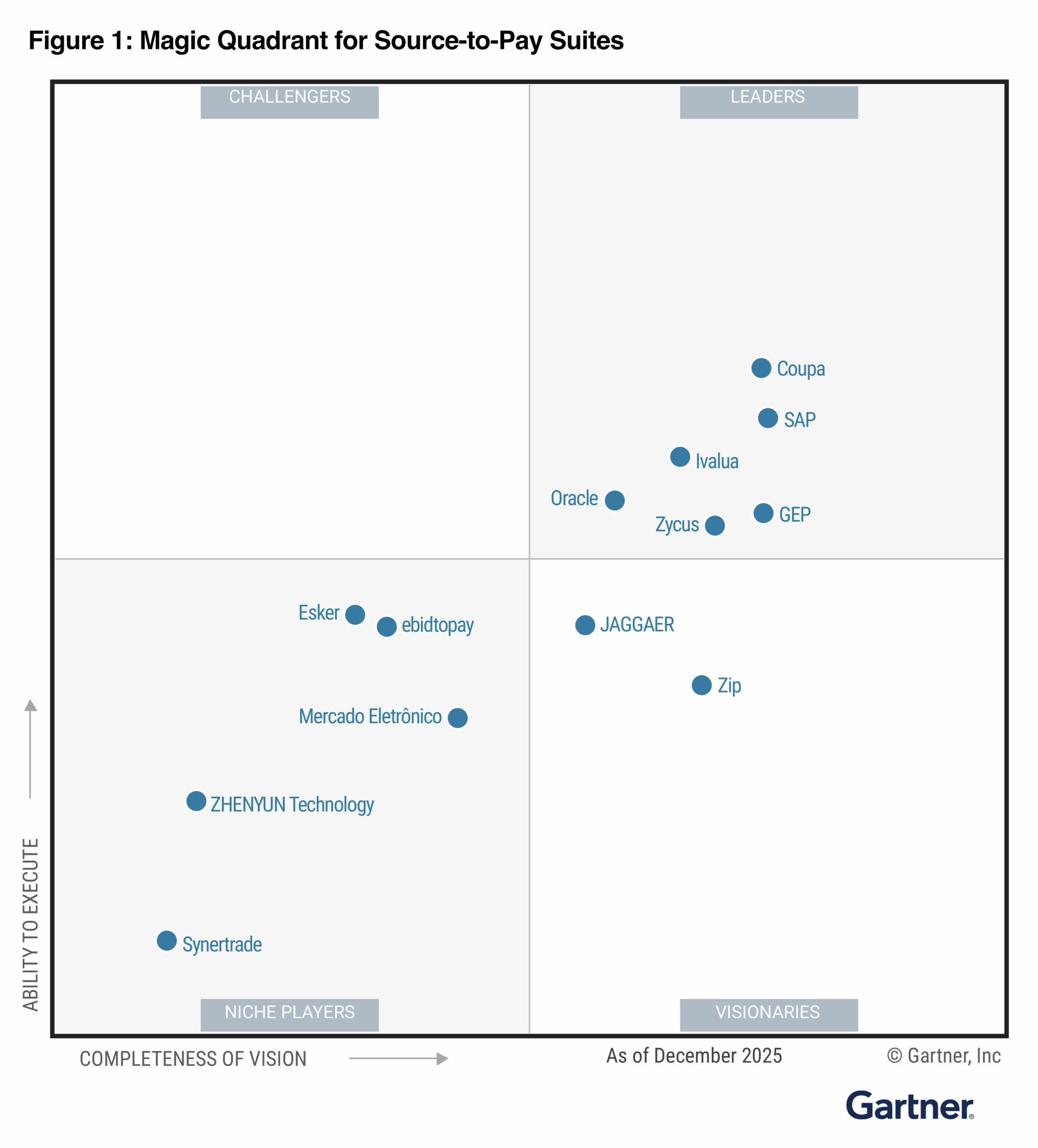


For most Chief Procurement Officers, leadership frameworks like Gartner’s Magic Quadrant are not about validation. They are about risk mitigation.
In a world where Source-to-Pay platforms underpin billions of dollars in spend, supplier relationships, and compliance exposure, few decisions carry more long-term consequence than selecting the right procurement technology partner. Leadership frameworks exist to simplify this complexity – but they also evolve alongside it.
Over the past three decades, procurement technology has undergone several fundamental shifts. And with each shift, the definition of leadership has changed. What once mattered – installed base, process coverage, scale – no longer tells the full story. Today, as procurement organisations move from transactional efficiency toward strategic value creation, leadership frameworks are being forced to adapt.
The result is a market moment that demands sharper interpretation from procurement leaders.
What is a Leadership Framework – and Why it Matters to the CPO
Leadership frameworks such as the Gartner Magic Quadrant for Source-to-Pay, Forrester Wave for Supplier Value Management (SVM), and IDC MarketScape for S2P are structured evaluation models designed to assess technology vendors across two broad dimensions: execution capability and future vision.
Each framework uses its own methodology:
- Gartner evaluates vendors based on completeness of vision and ability to execute
- Forrester’s SVM assessments emphasise supplier collaboration, value realization, and innovation
- IDC MarketScape focuses on current capabilities and future strategies within enterprise ecosystems
For the CPO, these frameworks serve as decision filters, not decision-makers. They help shortlist vendors, reduce downside risk, and provide defensible justification to boards, CFOs, and audit committees.
However, as procurement operating models evolve – from Source-to-Pay execution toward Intake-to-Outcome orchestration – the criteria embedded in these frameworks are shifting as well.
Understanding why that shift is happening is now as important as understanding who appears in the Leaders quadrant.
The Evolution of Procurement Technology: From Systems of Record to Systems of Intelligence – and Now Systems of Autonomous Outcomes
Procurement technology leadership has always been era-specific, shaped by the dominant operating models and risk priorities of the time.
In the early enterprise software era, leadership was defined by monolithic, on-premise platforms built for control, customisation, and long-term stability. ERP vendors such as SAP and Oracle established dominance by embedding procurement deeply within ERP backbones, positioning it as a core system of record. For procurement leaders, these platforms delivered standardisation, compliance, and auditability – critical requirements in a period where process control outweighed agility.
As cloud computing matured, the procurement technology landscape began to shift. Platforms such as Coupa, Zycus, and others emerged with a different value proposition: configurability over customisation, faster time-to-value, and broader business user adoption. Procurement moved beyond being an ERP sub-module toward becoming a more independent Source-to-Pay platform, focused on usability, spend visibility, and policy-driven compliance across distributed organisations.
Leadership frameworks evolved alongside this transition. Vendors that could scale across global enterprises while improving user experience, accelerating deployment, and maintaining governance began to rise in prominence. The emphasis gradually moved from systems that merely recorded transactions to platforms that could surface insights, guide behavior, and improve outcomes – marking the transition from systems of record to systems of intelligence.
Today, procurement technology is entering its next phase. As expectations shift from process efficiency to value realization, platforms are increasingly being evaluated on their ability to support autonomous, outcome-driven procurement – systems designed not only to inform decisions, but to act on them. This evolution is now reshaping how leadership itself is defined.
The Shift from Source-to-Pay to Intake-to-Outcome
Modern procurement organisations are no longer evaluated solely on transactional excellence. CPOs are increasingly accountable for:
- Supplier value realisation, not just supplier management
- Risk anticipation, not just compliance
- Speed and quality of decisions, not just process adherence
This has given rise to Intake-to-Outcome operating models – where procurement technology must orchestrate demand intake, supplier collaboration, negotiation, execution, and performance measurement as a connected intelligence loop.
Leadership frameworks are beginning to reflect this shift.
Capabilities such as AI-driven insights, supplier value management, predictive risk detection, and autonomous decision support are no longer optional differentiators. They are becoming core evaluation criteria.
Why Legacy Strengths and Future Readiness are now Diverging
One of the most important – and least discussed – realities in procurement technology is the divergence between installed base strength and architectural readiness.
Many vendors appearing in leadership frameworks today built their positions during earlier eras of procurement digitisation. Their platforms are widely deployed, and embedded in enterprise operations creating a ‘closed ecosystem’ of sorts.
At the same time, newer procurement platforms were designed during a different set of assumptions:
- That intelligence would be embedded, not bolted on
- That supplier value management would extend beyond scorecards
- That systems would not just assist – but also autonomously execute – get the job done.
Leadership frameworks are increasingly balancing these realities. As a result, CPOs now see a mix of vendors in leadership positions: some representing continuity, others signaling future orientation.
This is not about replacement. It is about discrimination.
The Rise of AI-native and Autonomous Procurement Platforms
The most significant change influencing leadership frameworks today is the rise of AI-native, agentic systems.
Unlike traditional automation, agentic procurement platforms are designed to:
- Continuously analyse spend, supplier behavior, and risk signals
- Recommend or initiate actions without manual intervention
- Learn from outcomes to improve future decisions
In Supplier Value Management, this means shifting from periodic supplier reviews to continuous value optimisation. In Source-to-Pay, it means moving beyond workflow execution toward intelligent orchestration. For instance, Zycus’ Autonomous Negotiation Agents manage tail spends autonomously from intent to order fulfilment!
Leadership frameworks are responding by evaluating not just feature breadth, but architectural depth – how naturally platforms support autonomy, intelligence, and scale without excessive configuration or services dependency.
Convergence across Gartner, Forrester, IDC – and the Market
One of the strongest indicators of structural change in procurement technology is convergence across independent evaluations.
Gartner, Forrester, and IDC apply different lenses. Customers apply none – they judge based on lived outcomes. When these perspectives begin to align, it suggests the market is recognising a common direction.
Recent evaluations across Source-to-Pay and Supplier Value Management show increasing agreement around what defines leadership:
- AI-first design
- End-to-end intelligence across procurement workflows
- Measurable business outcomes beyond cost savings
This convergence does not diminish established vendors. Instead, it highlights a growing distinction between platforms optimised for prior eras and those architected for what procurement is becoming.
What this Means for the Chief Procurement Officer
For CPOs, the implication is clear: leadership frameworks must be read with intent.
Being in a leaders quadrant is necessary – but no longer sufficient. Within leadership, CPOs must now ask:
- Was this platform designed for autonomy or adapted for it?
- Does it support Intake-to-Outcome orchestration or only Source-to-Pay execution?
- Can it deliver Supplier Value Management at scale – or simply report on it?
This level of discrimination is now critical. Selecting a platform aligned with the wrong era introduces long-term friction, limits value realisation, and increases dependency on manual intervention.
Designed Before it was Required
What leadership frameworks reward today was not always required.
AI-native architecture, autonomous intelligence, and end-to-end supplier value realisation were once optional ambitions. Platforms that embraced these principles early now appear naturally aligned with modern evaluation criteria.
Recent recognition of vendors such as Zycus across Gartner’s Source-to-Pay Magic Quadrant, Forrester’s Supplier Value Management evaluations, IDC MarketScape assessments, and customer-driven ratings reflects this reality – not as a marketing moment, but as an architectural one.
Leadership, in this sense, is not about momentum. It is about design choices compounding over time.
Procurement Leaders Designed for the Next Era
Procurement leadership frameworks will continue to evolve – as they always have. New criteria will emerge. Old assumptions will fade.
For the CPO, the strategic task is not to chase rankings, but to interpret them wisely. Leadership is a signal, not a destination. The real question is whether a platform is built for the procurement organisation you are becoming – not the one you were.
In that context, leadership frameworks do exactly what they are meant to do: not crown winners, but reveal the future.
Many of these conversations, around autonomy, outcome-driven procurement, and how leadership itself is being redefined, will be explored at Horizon EU & UK, Zycus’ premier procurement conference, where CPOs and procurement leaders will come together to examine what these shifts mean in practice.
Disclaimer: This article was originally published on the CPO Strategy by Sean Galea-Pace. All views and insights shared in this article are those of CPO Strategy and are based on their independent research.
Related Reads:
- eBook: 6 Must-Have Reports for Any Procurement Leader
- You Surely Can’t Beat These Four Traits of a Successful CPO
- eBook: CPONext: 40 Procurement Leaders to Watch Out For
- Top 5 Critical Skills Next-Gen Procurement Leaders Must Develop Now
- Capture the True Value of Procurement: A Sourcing & Procurement Leader’s Toolkit