

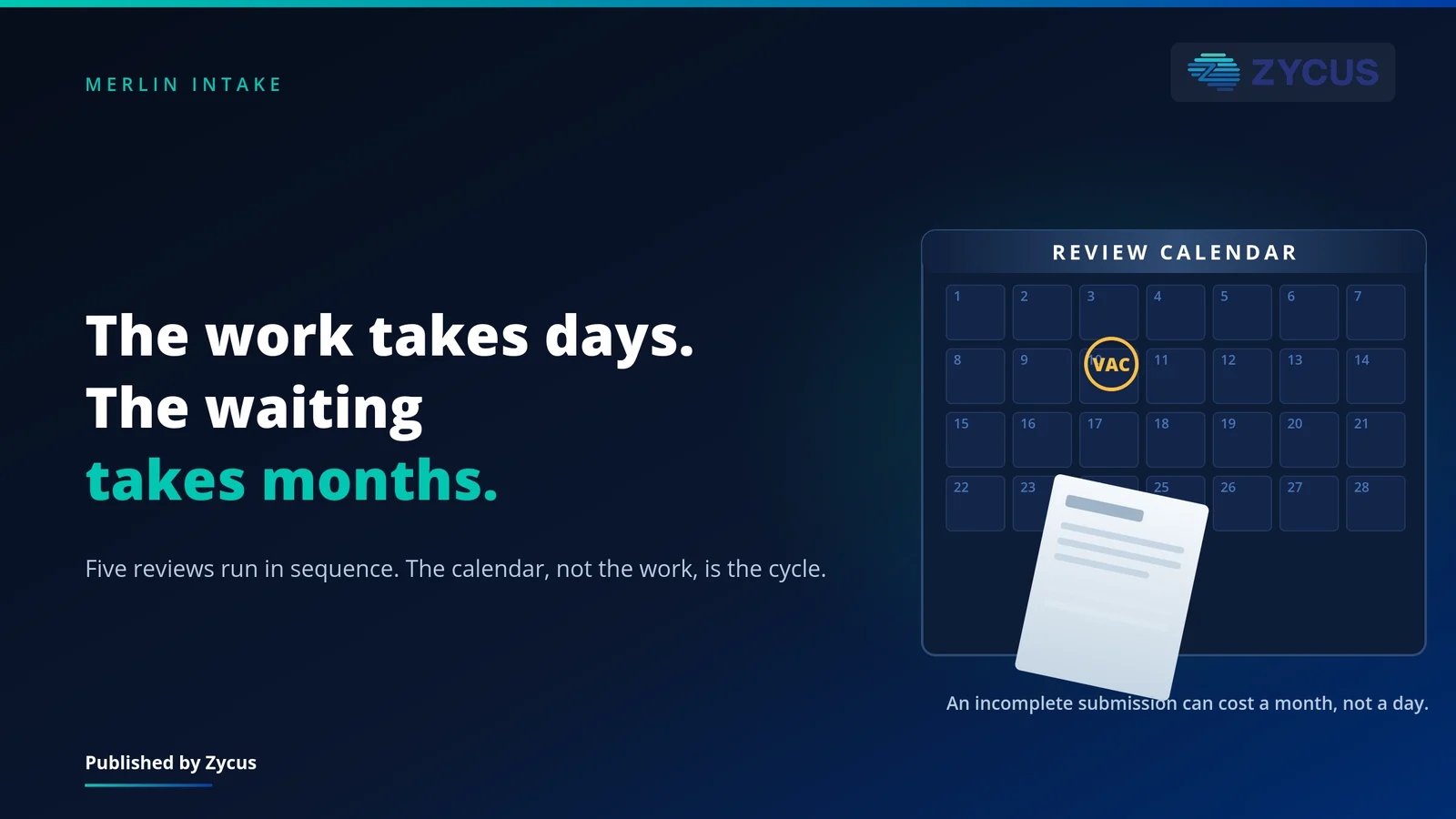

When running formal requests for clinical technology, equipment, or purchased services, sourcing teams often watch healthcare RFP cycles stretch anywhere from three to nine months. While internal stakeholders frequently blame procurement speed, elapsed time usually stems from five sequential reviews, clinical evaluation, value analysis committee approval, IT security, finance, and legal running one after another with duplicated handoffs. In this guide, we break down where those weeks go, why incomplete submissions cost months due to fixed committee schedules, and how agentic sourcing orchestration streamlines the journey from release to contract execution.
TL;DR
- Healthcare sourcing runs three to nine months from release to contract execution, and that is elapsed time rather than working effort.
- Five reviews apply: clinical evaluation, value analysis committee, IT security, finance, and legal. Each is defensible on its own.
- The calendar is consumed by the sequence between them, not by the work inside them.
- The value analysis committee meets on a fixed schedule, so an incomplete submission can cost a month rather than a day.
- See how Merlin Agentic Sourcing builds an RFP-ready strategy. Request a demo.
A healthcare sourcing cycle takes months because it is five separate reviews running one after another, not one review that happens to be slow.
Clinical evaluation, value analysis committee approval, IT security review, finance sign-off, and legal each take days of actual work. What consumes the calendar is that each one waits for the last to finish, and none of them starts with what the previous one produced.
This piece maps where the time goes. It does not argue that any particular stage should be shortened, because several of them cannot be. A companion piece covers which parts of the cycle are genuinely compressible and which are fixed. Related reading covers how AI builds an RFP and the ROI of shorter RFP timelines.
It is written for supply chain and sourcing leaders in health systems running formal RFPs for clinical technology, equipment, or purchased services.
How long does a healthcare RFP take end to end?
Three to nine months from release to contract execution is the range most health systems recognize, and complex clinical technology sits at the upper end. Some categories run longer, and enterprise clinical systems can exceed a year once implementation scoping is folded in.
That figure is elapsed time, not effort. The distinction matters because it is the source of most internal disagreement about sourcing speed. Procurement measures its own turnaround and finds it reasonable. Clinical leadership experiences the wait and finds it unreasonable. Both are describing the same cycle from different positions, and neither is wrong. The argument is unresolvable until someone measures the waiting separately from the working, which almost no health system does.
The gap between effort and elapsed time is where this analysis sits.
Where do the weeks go?
Five stages, and the sequence between them.
- Clinical evaluation establishes whether a product performs acceptably in the setting it will be used. This involves practicing clinicians who have patient loads, so availability rather than analysis sets the pace. A two-hour evaluation can wait three weeks for a two-hour window.
- Value analysis committee review is the decision gate. The committee weighs clinical benefit against financial impact and standardization goals, and it meets on a fixed calendar rather than on demand. Missing a submission deadline by a day costs a month.
- IT security review applies to anything touching the network or patient data, which is now most clinical technology. Volume of security questionnaires is the constraint, and the same vendor is often assessed repeatedly across different projects because no shared record of the last assessment exists.
- Finance validates the business case against budget and capital planning cycles that were set months earlier.
- Legal reviews contract terms, business associate agreements, and data handling. Where protected health information is involved, this review is not optional and its scope is set externally.
Each of these is defensible. None is obviously wasteful. The elapsed time comes from the fact that stage two typically begins after stage one concludes, and each stage often rebuilds context the previous stage already established.
What is a value analysis committee, and why does it set the pace?
A value analysis committee is the cross-functional body in a health system that evaluates whether a product or service should be adopted, weighing clinical evidence, financial impact, and the effect on standardization across the organization. Membership typically spans clinical leadership, supply chain, finance, and quality.
It sets the pace for a structural reason rather than a procedural one. The committee meets on a schedule, often monthly. A submission that misses a meeting waits for the next one, and a submission that arrives incomplete is deferred to the one after that. Two incomplete submissions can therefore cost more elapsed time than the entire evaluation that preceded them, as Figure 1 shows.
This is the single most consequential fact about healthcare sourcing timelines, and it is invisible in any measure of processing effort.
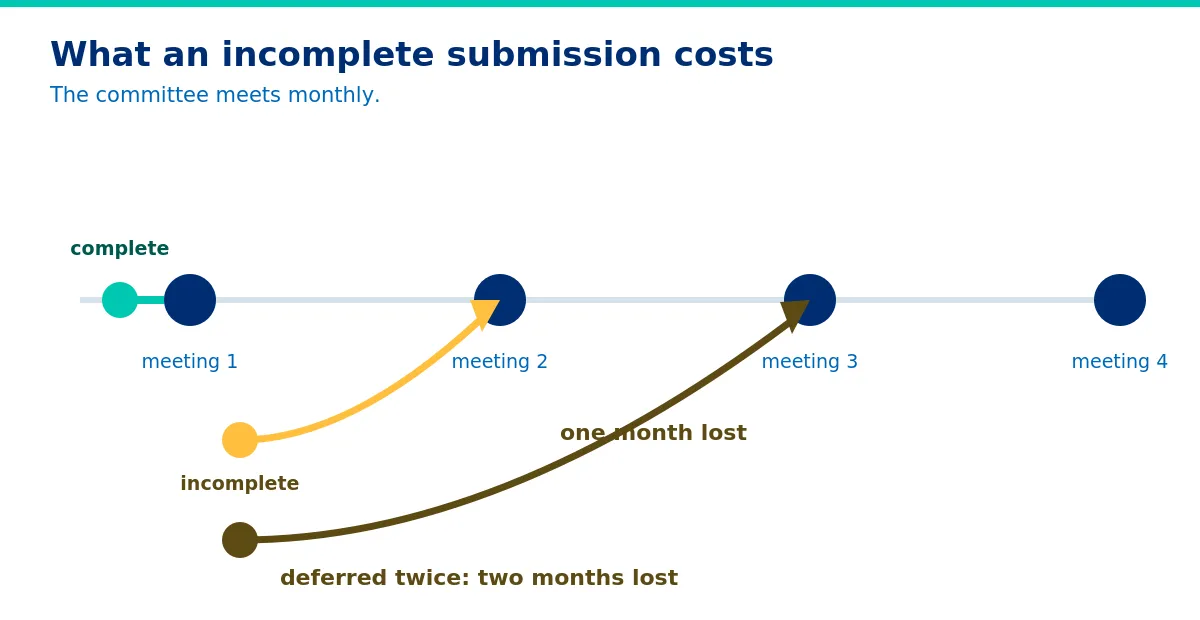
Figure 1: What a deferred submission costs when the committee meets monthly.
Why do the stages not overlap?
Because each one needs an output the previous stage produces, or believes it does.
Some of these dependencies are real. Legal cannot finalize terms before the commercial scope is settled. Finance cannot validate a business case before clinical evaluation establishes which products are viable. Those sequences are load bearing and should stay.
Others are conventions. IT security review does not depend on value analysis committee approval, but it usually waits for it, because nobody wants to spend security review capacity on a product that may not be selected. That is a rational local decision that adds weeks to the whole. Nearly every avoidable delay in a healthcare sourcing cycle has this shape: a defensible choice by one function that nobody is measuring at the level of the cycle. Figure 2 separates the two kinds.
The distinction between a genuine dependency and an inherited convention is the most useful thing a health system can establish about its own cycle, and almost nobody has documented it. It takes one workshop and it is the cheapest hour available to a sourcing team.
McKinsey was studying physician engagement in supply chain decisions, not sourcing cycle time. Two things follow for this analysis. Where no committee exists, the decision does not disappear, it disperses, and dispersed decisions are harder to schedule than committee ones. And the appetite for earlier clinical involvement suggests the sequencing described above is not a preference clinicians are defending.
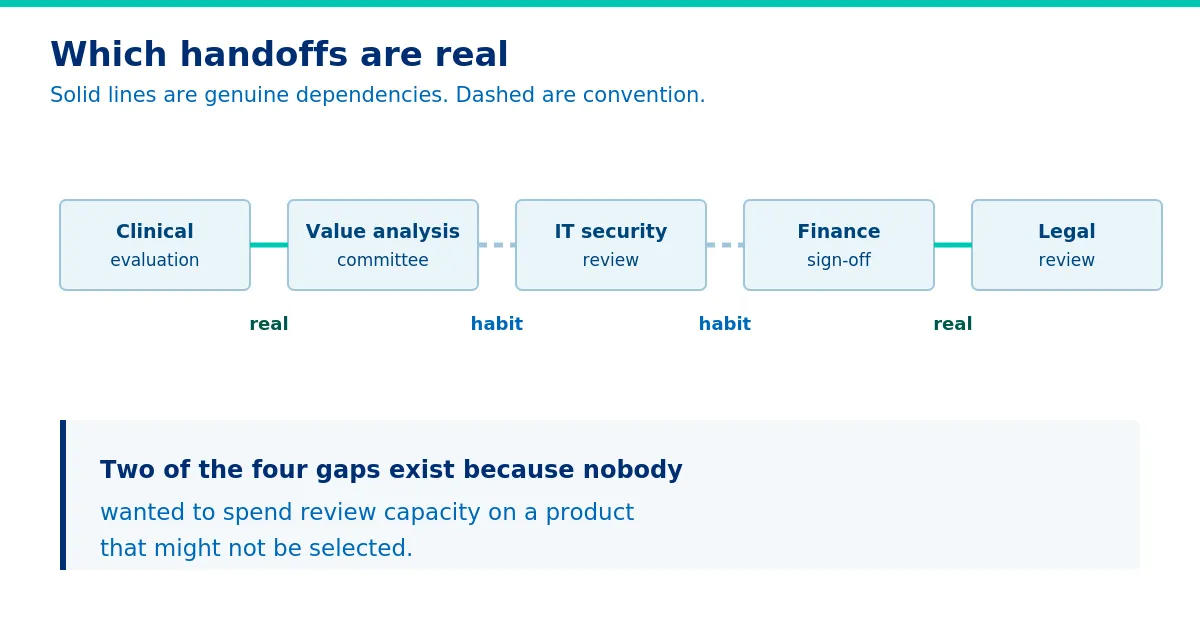
Figure 2: Two of the four handoffs are genuine dependencies. Two are convention.
What does agentic sourcing orchestration change?
It changes when work happens, not how fast each reviewer works.
Orchestration means the requirements, evidence, and documentation that each of the five stages needs are assembled once at intake and carried forward, rather than rebuilt at each gate. A security questionnaire that draws on the same product data the clinical evaluation used does not wait for clinical evaluation to finish. A value analysis submission that arrives complete does not get deferred.
Deloitte surveyed health system leadership on cost reduction broadly rather than sourcing cycles specifically. The relevance here is that standardizing and automating workflows is precisely the mechanism that removes rework between sequential gates, which is where healthcare sourcing loses most of its calendar.
Merlin Autonomous Sourcing turns a stated need into an RFP-ready strategy, assembling requirements, supplier options, and evaluation criteria in one governed flow rather than as separate handoffs. The committee still decides. It simply receives a complete submission the first time.
Fixing lengthy healthcare RFP cycles does not require compromising on clinical standards or bypassing rigorous security and legal reviews. By distinguishing genuine dependencies from inherited workflow habits and using agentic orchestration to assemble documentation once at intake, health systems can eliminate redundant rework and prevent avoidable committee delays.
Ready to accelerate your sourcing timelines and build RFP-ready strategies effortlessly? Request a demo to transforms healthcare procurement workflows.
Frequently asked questions
1. How long does a typical healthcare RFP take?
Three to nine months from release to contract execution is the range most health systems recognize, with complex clinical technology and enterprise IT at the upper end. That is elapsed time rather than working effort. The gap between the two is the practical target for improvement, because the working effort in each individual review is usually reasonable.
2. What is a value analysis committee?
A value analysis committee is the cross-functional body in a health system that decides whether a product or service should be adopted. It weighs clinical evidence, financial impact, and effect on standardization, with membership typically drawn from clinical leadership, supply chain, finance, and quality. It is the primary decision gate for clinical purchasing in most health systems.
3. Why does healthcare procurement take longer than other industries?
Because more independent reviews apply and they run in sequence. Clinical evaluation, value analysis, IT security, finance, and legal each have legitimate authority over part of the decision. Several also involve people whose primary responsibility is patient care rather than procurement, so availability rather than analysis often sets the pace.
4. Who is involved in a healthcare sourcing decision?
Typically clinical leadership, supply chain and sourcing, the value analysis committee, IT and information security, finance, and legal or compliance. For clinical technology the practicing clinicians who will use the product are usually involved directly, since adoption depends on their acceptance rather than on the contract alone.
5. What is the difference between a value analysis committee and a procurement team?
Procurement runs the sourcing process, manages suppliers, and executes the commercial agreement. The value analysis committee decides whether the organization should adopt the product at all, on clinical and value grounds. Procurement can run a flawless sourcing event and still be told no, because the two answer different questions.
6. Does a longer RFP cycle produce a better decision?
Not reliably. Additional elapsed time improves the decision when it buys genuine evaluation, and does not when it reflects waiting for a committee date or rebuilding information a previous stage already gathered. The useful test is whether the extra weeks changed anything about the eventual choice.
7. What is agentic sourcing orchestration?
Agentic sourcing orchestration coordinates the stages of a sourcing cycle so that requirements, evidence, and documentation are assembled once and reused across each review, rather than rebuilt at each gate. It does not replace the reviews or the committees. It changes what arrives at them and when.
8. Where should a health system start if cycles are too long?
Start by measuring elapsed time per stage and, separately, the waiting time between stages. Most organizations discover the waiting exceeds the working. Documenting which stage dependencies are genuine and which are conventions is the next step, and it usually costs nothing but attention.