

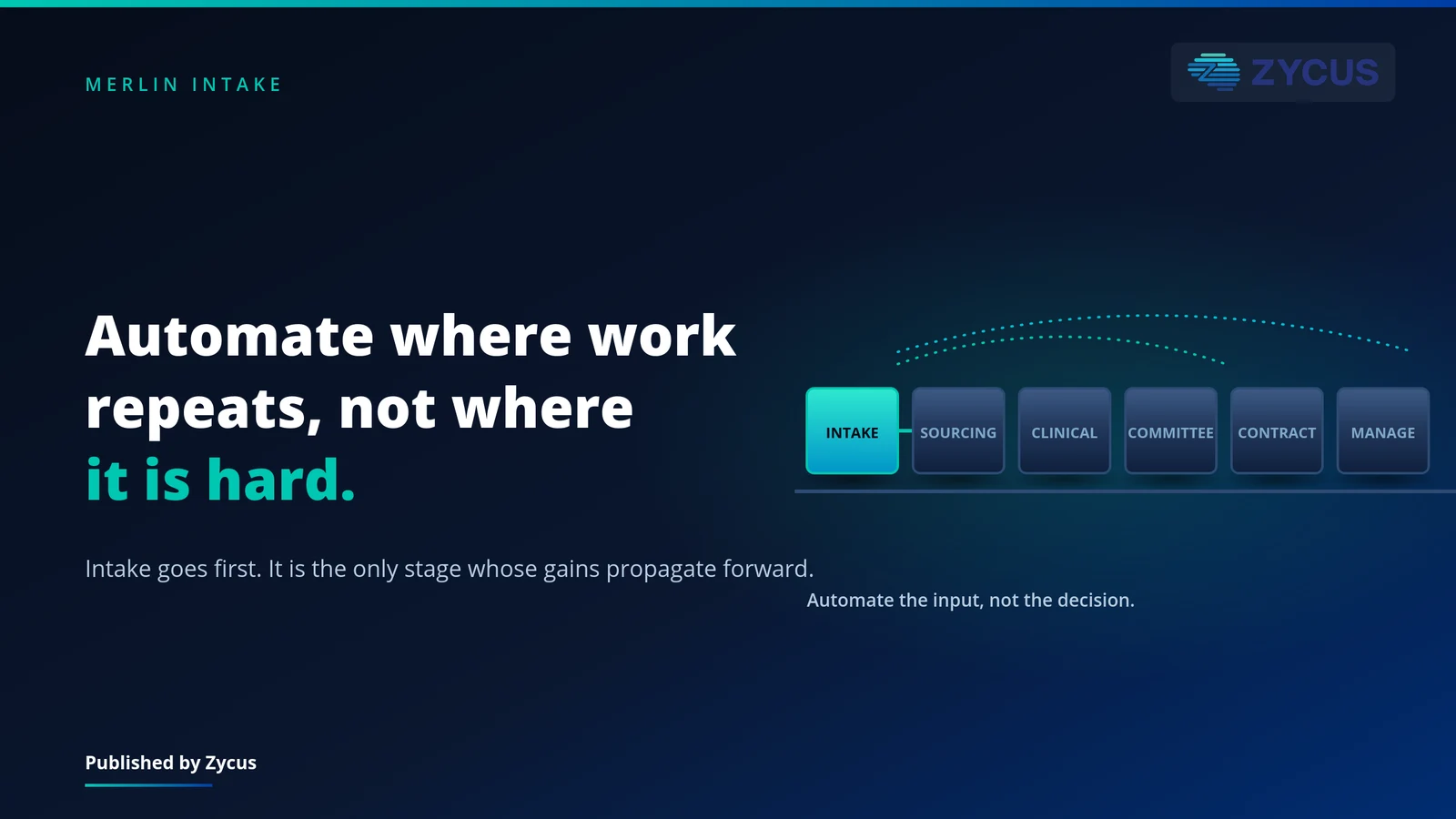

When health systems plan digital transformation initiatives, supply chain leaders often make the mistake of targeting the most complex, painful stages first rather than focusing on where work actually repeats. Attempting to automate judgment-heavy steps like clinical evaluations or committee decisions creates heavy political resistance and yields poor returns because these phases rely on human oversight rather than raw processing volume.
To build a high-impact roadmap across the healthcare procurement lifecycle, organizations must automate high-volume, rule-governed stages first starting at request intake, where clean data propagates through every downstream workflow. In this guide, we break down the six stages of hospital procurement and explain why request intake and evidence reuse should always lead your transformation sequence.
TL;DR
- Automate the stages where work repeats, not the stages where it is hard. They are rarely the same.
- Request intake goes first, because it is the only stage whose improvements propagate forward.
- Evidence reuse goes second. Most health systems reassess the same vendors because no retrievable record exists.
- Clinical evaluation and the committee decision are automated last, or not at all. Automate the input, not the decision.
Automate the stages where the work is repeated, not the stages where it is hard. They are rarely the same stages, and the second is where most programs start.
Clinical evaluation is the hardest part of healthcare procurement and close to the worst place to begin, because its difficulty is judgment rather than volume. The intake of requests, the assembly of committee submissions, and the reassessment of suppliers already assessed are comparatively unglamorous and are where repeated effort actually sits.
This is written for supply chain leaders sequencing a multi-year automation program rather than evaluating a single tool.
What does the healthcare procurement lifecycle actually contain?
Six stages, and they behave differently. Treating the lifecycle as one thing produces multi-year programs with nothing measurable in the first year, and those rarely survive to reach the stages meant to justify them.
Request intake, where a need becomes a structured requirement. Sourcing, where options are identified and evaluated. Clinical evaluation, where performance in setting is established. Committee decision, where adoption is approved. Contracting, where terms are agreed and executed. And ongoing management, covering compliance, price variance, and renewal. Each carries a different volume profile and a different amount of judgment, and those two properties predict automation return better than how painful a stage feels.
Automation returns most where a stage is high volume, rule governed, and repeated with variation. It returns least where a stage is low volume, judgment governed, and consequential. Figure 1 places them. Sorting the six on those two axes is most of the sequencing decision, and it can be done in a workshop before any platform is discussed. Doing it after a platform is selected means the platform sorts them for you.
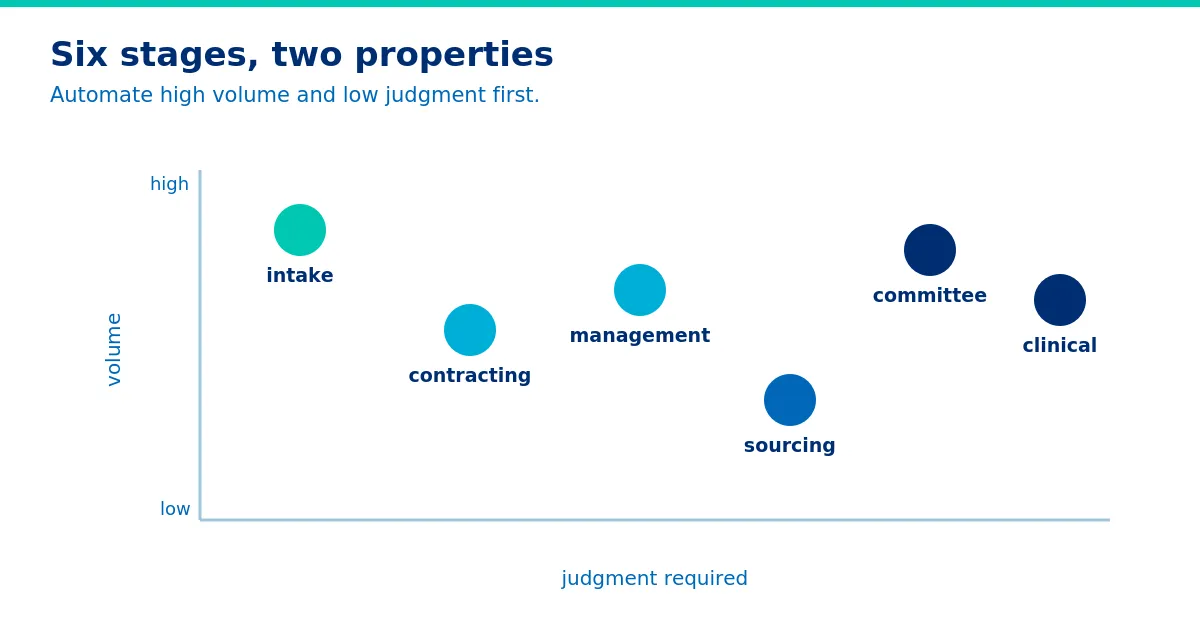
Figure 1: Volume and judgment, and where each stage sits.
Which stage should you automate first?
Request intake, in almost every case. It is also the least contested politically, since no function loses authority when the front door improves.
It is the highest volume stage, the most rule governed, and the one whose output every later stage depends on. Improvements here propagate forward, as Figure 2 shows, which is not true of improvements anywhere else in the lifecycle. A clean, coded, policy-checked request makes sourcing faster, committee submissions completer, and contracting less error prone.
It is also the stage where the failure is currently invisible. Requests arriving by email do not appear in any cycle time measure because the clock starts when procurement receives them, which conceals the wait before that point entirely. An organization measuring from receipt is measuring the half it has already solved.
The counterargument is that intake is not where the money is. That is true and it is beside the point. Intake is where the conditions for the money are set. Savings are realized at contract execution, and every defect introduced at intake is carried there and paid for, having grown more expensive at each stage it passed unchallenged.
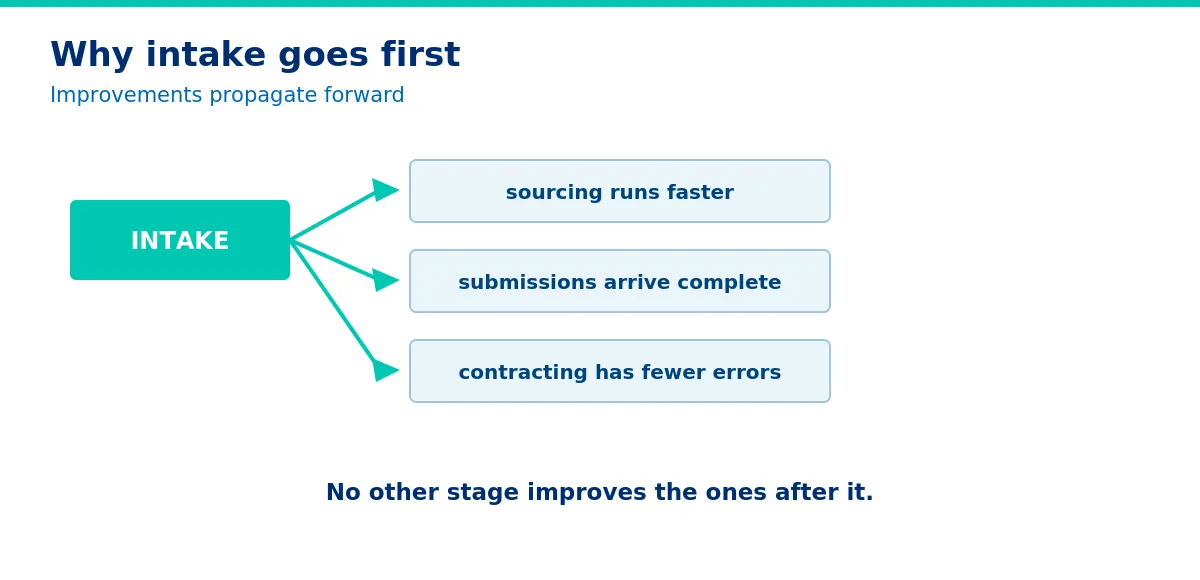
Figure 2: Intake is the only stage whose gains propagate forward.
What comes second?
Evidence reuse, across security assessment and supplier qualification. It is invisible on an org chart because no function owns the duplication, and each sees only its own share.
This is the least discussed and among the highest returning. Most health systems reassess the same vendors repeatedly because no retrievable record of the last assessment exists. The work is identical each time, which is the definition of work that should not be repeated. The saving is not faster assessment but assessment that does not happen twice.
Second priority rather than first only because it depends on structured intake to know which vendors are in scope. Attempting it first produces a reuse library nobody can search reliably.
McKinsey was surveying generative AI adoption across healthcare organizations rather than procurement sequencing. Two things follow for this argument. Administrative efficiency being named most often is consistent with the claim above that repeated, rule-governed work repays automation first. And the finding that clinical productivity deployment is already widespread does not contradict the case for automating clinical evaluation last, because preparing evidence for a clinician and shortening the evaluation period are different acts.
CAQH measures administrative transactions across the revenue cycle rather than procurement stages. Two things follow for this sequencing argument. The opportunity CAQH quantifies sits entirely in high-volume, rule-governed, repeated work, which is the same profile that makes intake and evidence reuse the first two stages here. And the residual cost is attributed to manual tasks rather than to difficult ones, which is the distinction this piece is built on.
Which stages should you automate last, or not at all?
Clinical evaluation, and the committee decision itself. Both are frequently proposed first, because that is where frustration is loudest.
Clinical evaluation is a duration rather than a queue. Automation can prepare the evidence a clinician reviews and cannot shorten the exposure period that makes the evaluation meaningful, and no amount of preparation quality substitutes for that period. Compressing it produces a weaker evaluation, and the time removed reappears later as an adoption problem, at a point where it is more expensive and harder to attribute.
The committee decision should not be automated at all. It is a judgment weighing clinical benefit against financial impact and standardization, made by people accountable for the outcome. What can be automated is everything that arrives at the committee, which is where the delay actually lives.
That distinction, automating the input rather than the decision, is the one worth carrying through the whole program. It is also the framing that makes clinical and committee stakeholders willing participants rather than defensive ones.
How do you sequence the whole program?
Intake, then evidence reuse, then contracting, then ongoing management, as Figure 3 sets out, with sourcing improved throughout rather than as a discrete phase.
Contracting third because it is rule governed and repetitive but gated by negotiation with a counterparty you do not control. Ongoing management fourth because compliance monitoring and renewal alerting depend on clean contract and supplier data that the earlier stages produce. Sequencing it earlier is the most common way a program produces impressive dashboards nobody acts on. Attempted first, it produces alerts against records nobody trusts.
Merlin Autonomous Sourcing turns a stated need into an RFP-ready strategy in one governed flow, which is the sourcing stage improving as a consequence of structured intake rather than as a separate project. Merlin Intake handles the front door itself. The sequencing logic holds whichever platform you use: build the stages that feed other stages first.
Then measure the propagation rather than the stage. The test of a well sequenced program is whether automating one stage made the next one measurably easier. If it did not, the stages were independent and the sequencing gave you nothing.
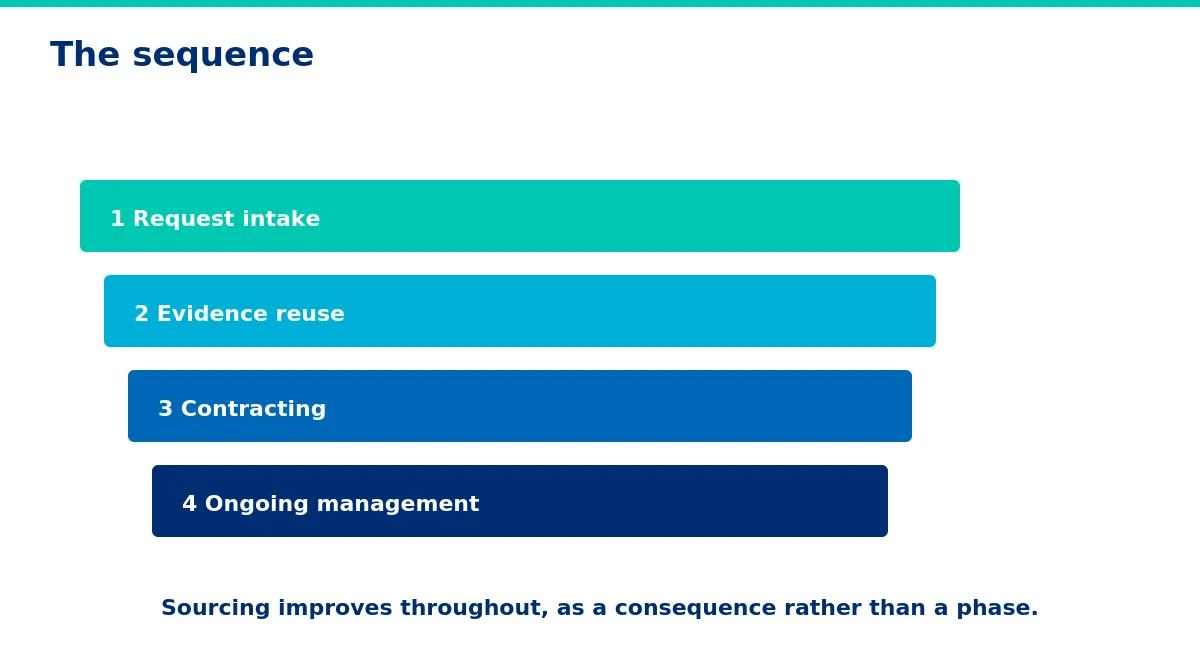
Figure 3: The order to build in.
Transforming your healthcare procurement lifecycle requires a disciplined sequencing strategy that automates repetitive inputs while respecting judgment-based decision gates. By prioritizing intake and vendor evidence reuse first, you establish clean, structured data that speeds up sourcing, eliminates duplicate questionnaires, and improves contract execution without undermining clinical authority.
Ready to streamline your enterprise purchasing front door and accelerate downstream workflows? Request a demo today to see how Zycus transforms healthcare procurement from end to end.
Frequently asked questions
1. Which part of healthcare procurement should be automated first?
Request intake, because it is the highest volume stage, the most rule governed, and the only one whose output every subsequent stage depends on. Improvements there propagate forward through sourcing, committee submission, and contracting, which is not true of improvements made further downstream.
2. Can clinical evaluation be automated?
The evidence preparation around it can be. The evaluation itself cannot, because it requires exposure over time in the setting where a product will be used, and that duration is what makes the finding meaningful. Compressing it produces a weaker evaluation whose cost usually reappears as an adoption problem after purchase.
3. Should the value analysis committee decision be automated?
No. It is a judgment weighing clinical benefit against financial impact and standardization, made by people accountable for the result. What can and should be automated is the assembly of everything that reaches the committee, since incomplete submissions rather than committee deliberation are where the delay accumulates.
4. What is the healthcare procurement lifecycle?
Request intake, sourcing, clinical evaluation, committee decision, contracting, and ongoing management covering compliance, price variance, and renewal. The stages differ in volume and in how much judgment they require, and those two properties determine which of them repay automation.
5. How long does a healthcare procurement automation program take?
Longer than a single implementation and shorter than the multi-year roadmaps often presented, because the stages can be delivered independently once sequenced correctly. Intake alone typically delivers measurable change within a quarter, which matters for sustaining a program through later stages that take longer.
6. What is the biggest source of repeated work in healthcare procurement?
Reassessment of suppliers and security postures already assessed, because most organizations have no retrievable record of previous assessments. The same vendor is evaluated from scratch across projects, and the work is identical each time, which makes it the clearest candidate for elimination rather than acceleration.
7. How do you measure whether automation is working?
Measure propagation rather than the stage in isolation. The test of correct sequencing is whether automating one stage made the next measurably easier, so watch submission completeness after intake changes and assessment reuse rate after evidence handling changes.
8. Does automation reduce clinical involvement in purchasing?
It should not, and reducing it would be a poor outcome. Clinical input determines whether a product is adopted successfully after purchase, so removing it produces contracts that clinicians route around. Automation should reduce the administrative burden of clinical participation rather than the participation itself.