

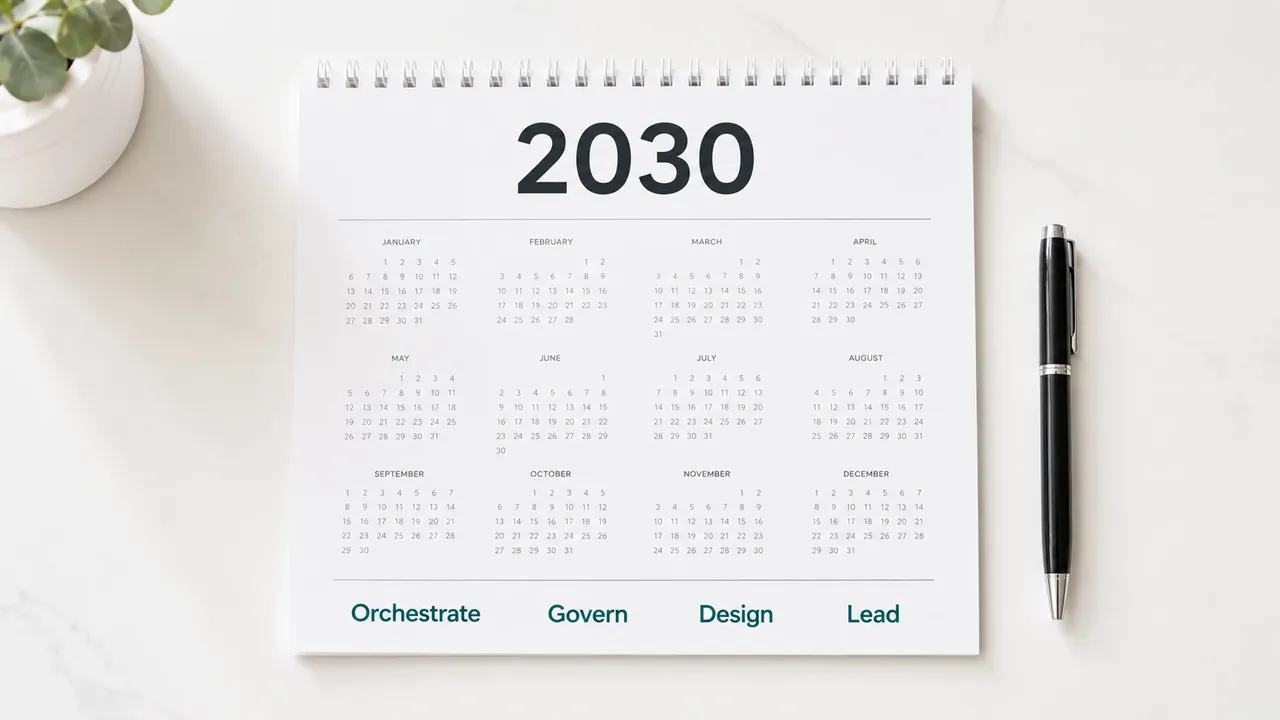

If you are writing a job description for a Chief Procurement Officer today and dating it 2030, what would the requirements section look like?
It would include the things it always has: commercial acumen, supplier relationship management, category expertise, risk judgment, stakeholder influence. These do not go away. But by 2030, they will be the foundation, not the differentiator. The differentiating capabilities will be ones that most current procurement leaders have not yet been formally trained on.
Here are four of them.
1. Orchestrating agentic systems
By 2030, the leading procurement functions will run on networks of autonomous agents, systems that handle sourcing events, supplier qualification, purchase order management and contract renewal without waiting for human instruction at each step. The CPO’s role in this environment is not to operate those systems but to orchestrate them: set the strategic parameters, design the governance framework, determine which categories require human judgment and which can be fully autonomous.
This requires a working understanding of how agentic systems operate, not at the code level, but at the level of architecture, behaviour and failure modes. What can a well-configured agent do reliably? Where does it go wrong? How do you design a portfolio of agents that work together toward a coherent commercial outcome? You can start learning this today through Agentic AI foundation courses available at CIPS, through specialist providers and through several university continuing education programmes.
2. Governing autonomous negotiation
Agentic negotiation is already operating in tail-spend categories at a number of large organisations. Systems that receive a brief, identify suppliers, run competitive processes and close agreements within defined parameters, without human involvement in each individual transaction.
Governing this responsibly requires the CPO to be able to: define negotiation boundaries that are commercially intelligent and legally defensible; audit the outcomes for bias, error and compliance risk; and explain AI-assisted decisions to boards, regulators and suppliers. This is a governance capability, not a technical one, but it requires enough technical literacy to ask the right questions. You can start learning this today.
3. Designing intake-to-outcome flows
The compression of procurement cycles from weeks to hours is not just a technology achievement. It requires a fundamental redesign of intake-to-outcome processes, the sequence of steps from when a need is identified to when it is fulfilled. In an agentic environment, those steps are orchestrated differently: some happen in parallel, some are delegated to agents, some require human escalation triggers.
The 2030 CPO will need to be fluent in workflow design at this level, able to map the human-AI handoffs, identify the points where agent behaviour must be constrained and design the exception handling that keeps autonomous processes safe. This is learnable. It sits at the intersection of procurement operations and AI workflow design. You can start building it today.
4. Managing AI-human teams
The procurement team of 2030 is not a room full of people assisted by AI. It is a mixed team of human professionals and autonomous agents, each contributing what they do best. Managing that team requires a different kind of leadership: setting objectives that agents and humans can both pursue coherently, designing review processes that catch errors at the right point, building team cultures where human professionals see agents as colleagues rather than threats.
This is new management territory. The frameworks are still being developed. The professionals who engage with it seriously now will be the ones who shape it for others later. You can start engaging with this today.
The funded route
The Procurement Futures Fund exists to make all four of these capability areas financially accessible to senior procurement professionals now. It co-pays 50% of any accredited Agentic AI course, up to EUR 1,000, at any provider you choose. One hundred spots. No obligation. The four capabilities above are learnable. The fund removes the cost barrier to starting.
The 2030 job description is being written now. The professionals who build these four capabilities deliberately, starting today, will be the ones leading the function when it matters most.
Related Reads:
- Most Procurement AI Investments Are Stalling. Here’s What 240 Global Leaders Just Told Us
- AI in Procurement: The Ultimate Guide to the New OS
- Leading Procurement in the AI Era: With Intelligent Orchestration Built for Speed and Impact
- The CPO’s Dilemma at the AI Crossroads: From Governance to Greatness
- What We Would Fund if Budget Were No Constraint: The Procurement Leader’s Ideal AI Curriculum
- Five Questions the Fund Panel Asks Every Application