

A question we have been asked more than once since launching the Procurement Futures Fund: why only half?
If the goal is to remove the financial barrier to Agentic AI training, why not remove it entirely? Why ask a senior procurement professional to co-invest when the whole point of the fund is to make upskilling accessible?
It is a fair question. The answer is partly philosophical and partly practical.
The philosophy
There is a consistent finding in the research on professional development completion rates: the people who pay something toward their own training are meaningfully more likely to finish it than those who receive it free. This is not a judgment about motivation or character. It is a structural observation about the relationship between investment and commitment.
When you pay half the cost of a course, you have made a decision. You have allocated budget, cleared time, made a case to yourself about why this is worth it. That decision creates a different psychological relationship with the learning than a fully-funded programme where the friction of commitment has been removed.
We want the professionals who receive fund support to finish their courses, apply the skills and change something about how they work. The co-payment model is designed to select for the people who are genuinely committed to that outcome.
The practical case
There is also a straightforward resource argument. A 50% co-payment model means the fund can support twice as many professionals as a fully-funded model with the same budget. One hundred professionals each receiving up to EUR 1,000 is a meaningful programme. The same budget fully funding fifty professionals reaches half the people.
We chose breadth over full subsidy because the problem we are trying to address, the systemic under-investment in procurement leadership capability for the AI era, is broad. One hundred professionals across different geographies, industries and organisations is more likely to shift the signal than fifty.
What this means for applicants
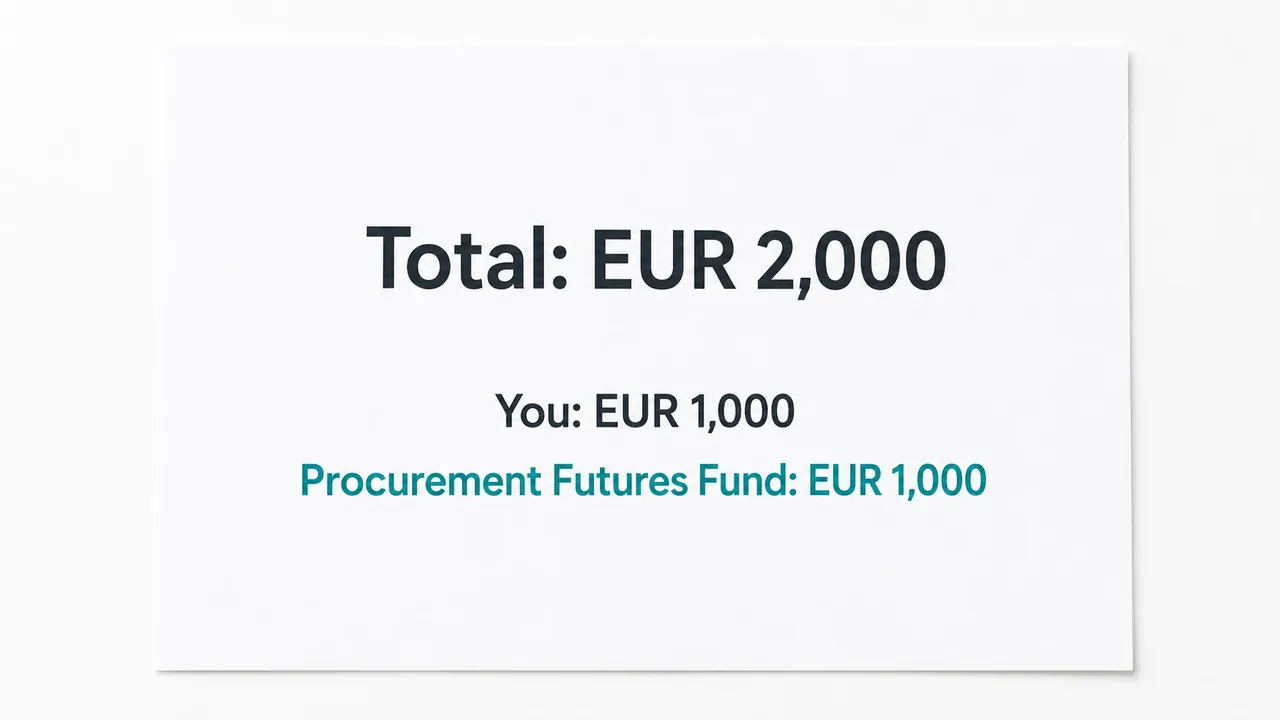
The co-payment requirement is real. If the cost of a course is EUR 2,000, the fund covers EUR 1,000 and the professional covers the rest. If the organisation covers the professional’s half, that is entirely eligible, employer funding and fund support can be combined. The point is that the commitment is genuine, however the professional’s half is sourced.
This is a co-investment. The fund puts in half. You put in half, your money, your time, your intention to apply what you learn. That combination is what makes it work.
Related Reads:
- Most Procurement AI Investments Are Stalling. Here’s What 240 Global Leaders Just Told Us
- AI in Procurement: The Ultimate Guide to the New OS
- Leading Procurement in the AI Era: With Intelligent Orchestration Built for Speed and Impact
- The CPO’s Dilemma at the AI Crossroads: From Governance to Greatness
- What We Would Fund if Budget Were No Constraint: The Procurement Leader’s Ideal AI Curriculum
- Five Questions the Fund Panel Asks Every Application