








Most procurement organizations have deployed AI that assists. The shift to AI that executes — end to end, without hand-holding at every step — is a different architectural decision entirely.
From the Agentic Procurement Summit 2026 · Session 2 · Aatish Dedhia, Founder and CEO, Zycus
TL;DR
- The 2026 Gartner CIO and Technology Executive Survey: only 17% of organizations have deployed AI agents, yet more than 60% expect to do so within two years. Nearly all organizations have identified the steam engine. Almost none have built the factory.
- The previous blog identified five root causes of procurement AI failure. Four of the five trace to the same structural confusion: treating AI as a tool when the value lies in a system.
- Copilots answer questions. Agents achieve outcomes end to end. Most procurement teams have one and believe they have the other.
- The industrial revolution’s transformation came not from the steam engine but from the factory system that reorganized work around it. Agentic AI is that second step.
- The difference between a copilot and an agent is not speed. It is whether the AI hands off to a person or to the next step in a governed, end-to-end flow.
- Aatish Dedhia, Founder and CEO of Zycus, delivers the full argument at APS 2026. → Watch the session
The Wrong Unit of Measure
Gartner’s 2026 Hype Cycle for Agentic AI, drawing on its CIO and Technology Executive Survey, found that only 17% of organizations have deployed AI agents to date, while more than 60% expect to do so within the next two years. That 43-point gap is not a timeline. It is a structural divide between organizations that have identified the steam engine and those that have built the factory.
Most procurement organizations are measuring AI progress in the wrong units: number of tools deployed, use cases piloted, copilots licensed. These are steam engine metrics. They measure what is being installed. They do not measure whether the factory has been built.
Root Cause Four, Revisited
The previous blog in this series identified five root causes of procurement AI failure. Root Cause 4, isolated agents with manual seams, describes organizations that have deployed genuine AI capabilities and still cannot get them to deliver transformation. The reason is not the quality of the agents. It is that the agents are not a system.
That is the steam engine problem. And it was solved, in a different industry, a century and a half ago. At APS 2026, Aatish Dedhia, who has spent over two decades building procurement technology and processing more than a trillion dollars in real enterprise spend, opened his session with exactly that parallel.
What LLMs and Copilots Actually Are
LLMs and copilots are extraordinarily capable tools. They compress research that takes hours into seconds. They draft, analyze, summarize, and advise. They raise individual productivity in measurable ways.
They also, in every case, hand the result back to a person. The output of a copilot is always: here is something for you to decide what to do with next. The human remains the integration layer between one AI-assisted task and the next. The process still runs through people.
This is not a limitation of current LLMs that better models will resolve. It is the correct description of what a copilot is: a tool that makes the individual worker more powerful. The steam engine made the mill worker more productive. It did not reorganize how work flowed through the mill.
What the Factory Required
McKinsey’s 2025 State of AI research found that AI high performers are nearly three times as likely to have fundamentally redesigned workflows as part of their AI efforts, compared with organizations that deploy AI tools into existing processes. The difference is not the quality of the AI. It is whether the organization rebuilt what the AI was asked to do.
The industrial revolution’s transformation did not happen when factories installed steam engines. It happened when they reorganized production around the engine: breaking work into repeatable steps, routing materials in deliberate sequences, removing the craftsman’s judgment from each individual stage and embedding it into the system’s design. The factories that captured the value were not those with the strongest engines. They were those that redesigned what the engine was asked to do.
That principle did not expire with the industrial revolution. It applies wherever a powerful new capability arrives without a system already built to use it.
What Agents Actually Are
Deloitte’s Tech Trends 2026 research found that while 38% of organizations are piloting agentic AI, just 11% are actively running these systems in production. The gap between piloting and production is the factory gap.
In a pilot, use cases are bounded and edge cases anticipated. In production, the full complexity of real workflows arrives. Agents in production need the surrounding system: data pipelines, governance layers, escalation paths, policy context, and handoffs that run from one step to the next without a person stitching them together.
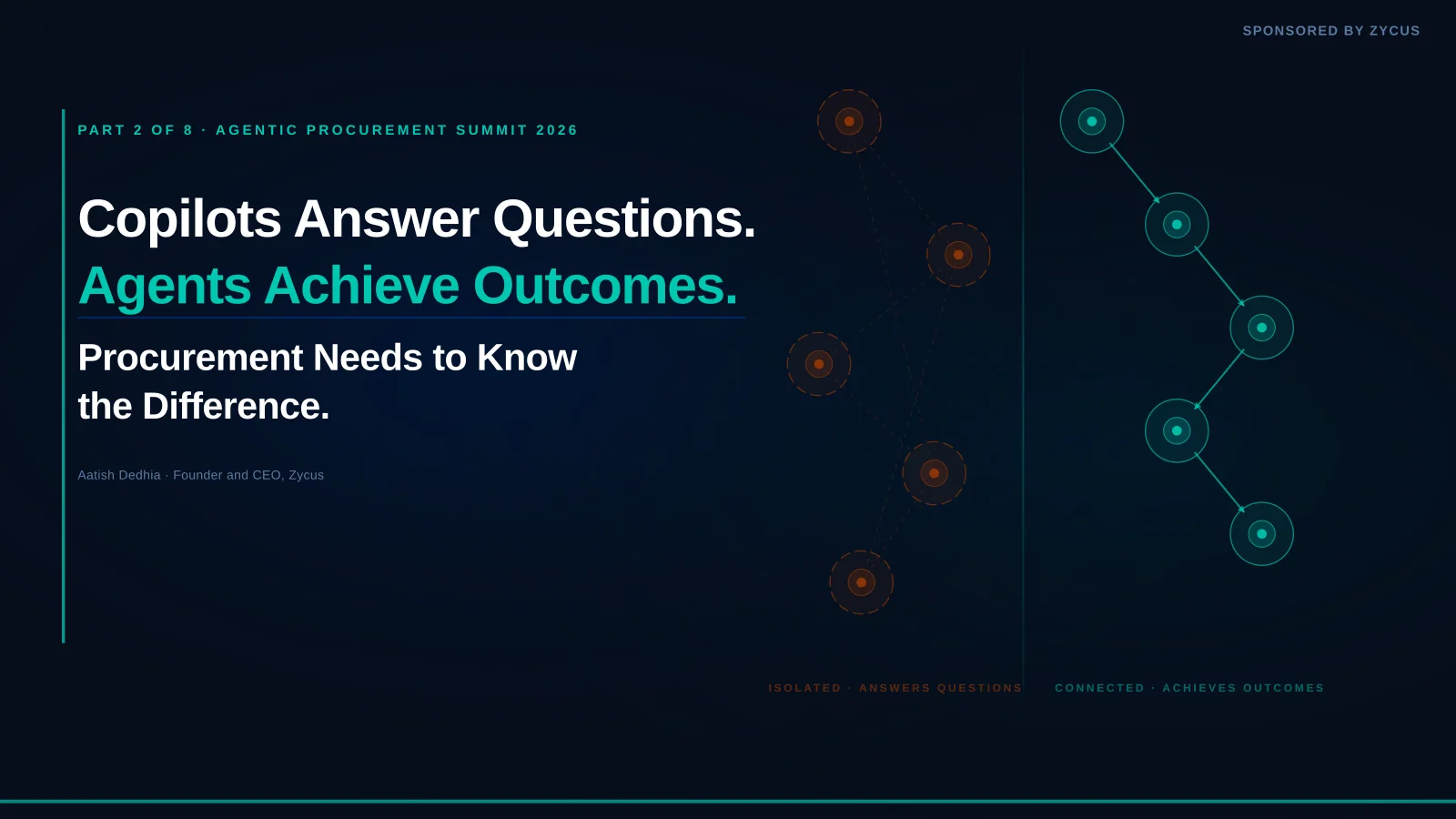
An agent is not a faster copilot. A copilot completes a task when a human hands it one and reviews the output. An agent takes a goal, decomposes it into steps, executes, coordinates the handoffs, and delivers the outcome. That is not a difference in speed. It is a difference in what runs the process.
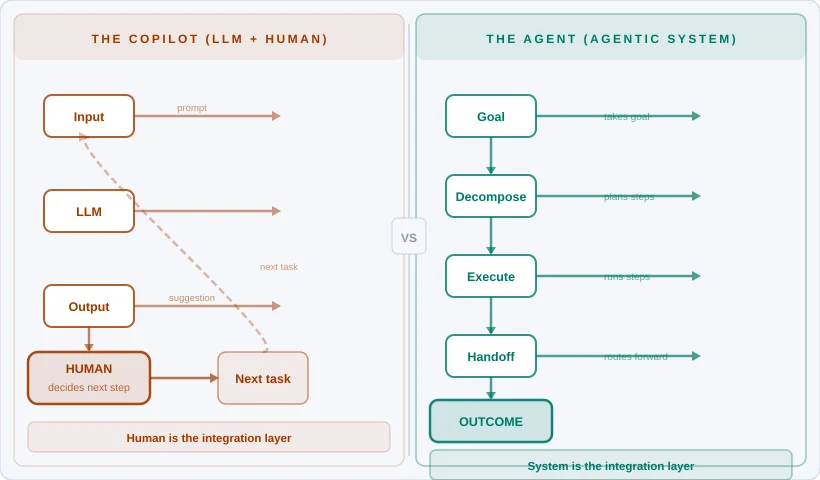
Left: the copilot routes every output back through a human decision; the human is the integration layer. Right: the agent runs from goal to outcome; the system is the integration layer.
The Procurement Parallel
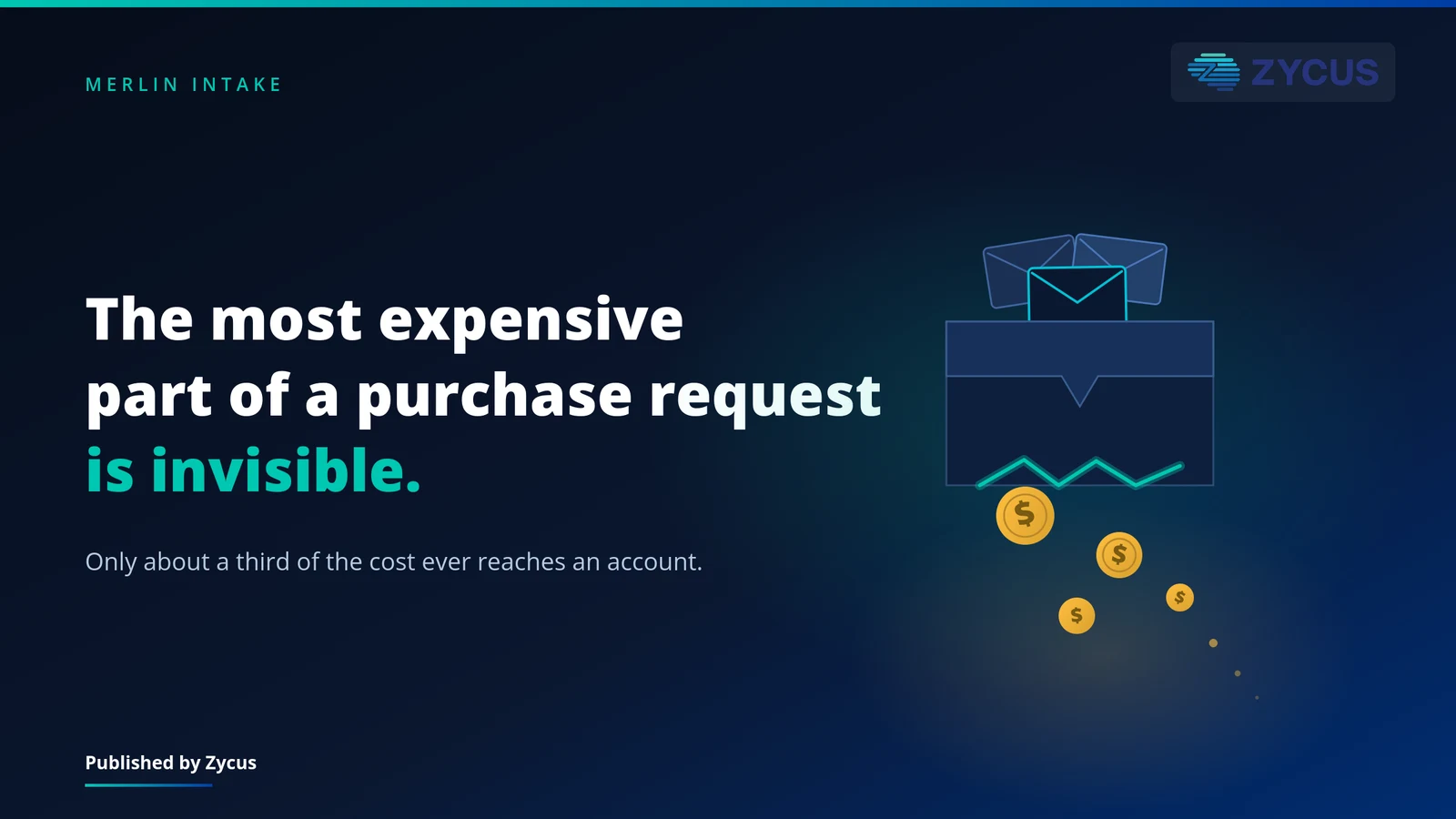
For procurement, this distinction maps precisely onto where value is lost and where it is captured. Intake is where most organizations have deployed AI: requests classified, routed, and recommended against catalog. It is useful. It is the steam engine applied to the front door.
The transformation happens when the system runs from intake through sourcing, negotiation, contract execution, and payment without a person serving as the router between stages. Every stage between intake and payment is a seam that still requires a person. The value is captured when those seams are designed out of the system. From intake to outcomes, not intake to the next human decision. The CIO Market Pulse research maps the scope of that gap across procurement functions in detail.
The Architecture That Makes it Possible
This is the architectural requirement that separates the factory from the steam engine: not a better model, not a faster copilot, but a platform where AI runs from Intake-to-Outcomes without human seams between the stages.
The Merlin Agentic Platform is built on this principle. At Zycus, built-in beats bolt-on is not a positioning line: it is the structural requirement for AI that has to reason correctly in production. An AI layer operating from outside the architecture will always encounter the seams. It will fail at precisely the points where the data, the policy context, and the process logic it needs are not accessible to it. The factory does not have seams. That is the distinction.
The Decision
The factories that captured the industrial revolution’s value were not distinguished by which steam engine they chose. They were distinguished by whether they built the factory.
Procurement organizations making AI investments today face the same choice. The steam engine is widely available. The factory is rare. The gap between 17% deployed and 60% intending to deploy will not close on its own. It closes when the architectural decision gets made. The system has to be built to execute it.
Agentic Procurement Summit 2026 — On-Demand Access. Aatish Dedhia, Founder and CEO of Zycus, presents the full session on the agentic AI imperative and what it means for how procurement is built next. Sponsored by Zycus. → Watch the full session
Previous Blog in the series: Five Decisions That Kill Procurement AI — All Made Before Day One
Next blog in the series: Why “Source-to-Pay” Is the Wrong Way to Describe What Procurement Is Building Next
FAQs
Q1. If our copilots are already improving productivity, why does the factory argument apply to us?
Copilot gains are individual. Procurement’s cycle times, savings rates, and contract compliance do not change because one person improved. The factory argument applies when the goal shifts from what individuals do to what the system delivers.
Q2. What does workflow redesign actually require in practice?
Map every stage where a human routes between steps and ask whether each handoff is structural or historical. Most are historical. Redesign specifies what happens at each stage before the first agent is deployed.
Q3. Our pilot results were strong. What explains the gap between piloting and production?
Pilots anticipate edge cases; production encounters them in full volume. Agents in production need governance architecture, data pipelines, and escalation logic that pilots simulate but cannot stress-test. That infrastructure gap is what the 38%/11% split measures.
Q4. How do we know whether we are building a factory or a better steam engine?
Test whether your system runs from intake to outcomes without a human as the integration layer. If agents hand off to people at multiple points, it is a better steam engine.
Q5. Is the steam engine still valuable while we build the factory?
Yes. LLMs and copilots deliver real productivity gains and should stay in production. The strategic error is treating the steam engine as the destination rather than the starting point. Both can run simultaneously.
Q6. What is the first architectural decision a CPO needs to make before building the factory?
Built-in versus bolt-on. A native architecture gives the AI the data, policy context, and process logic to operate without seams. A bolt-on architecture encounters those seams at exactly the points where production complexity arrives.
Related Reads: