


TL;DR
- Only 48% of digital initiatives meet or exceed their business outcome targets, according to Gartner. Sourcing tools are no exception.
- In large enterprises, the hard part isn’t going live. It’s getting every category, business unit and supplier to run events through the tool.
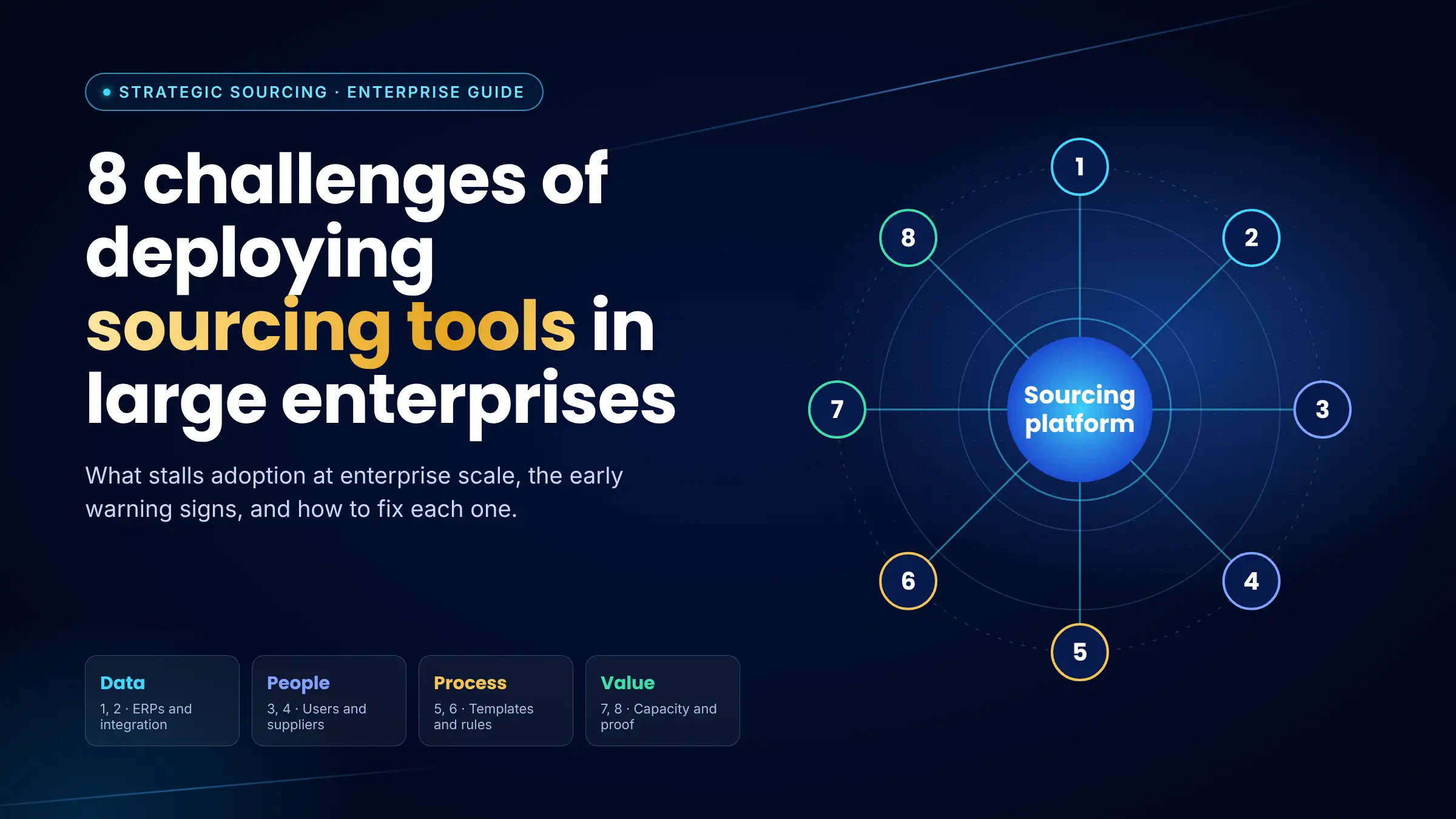
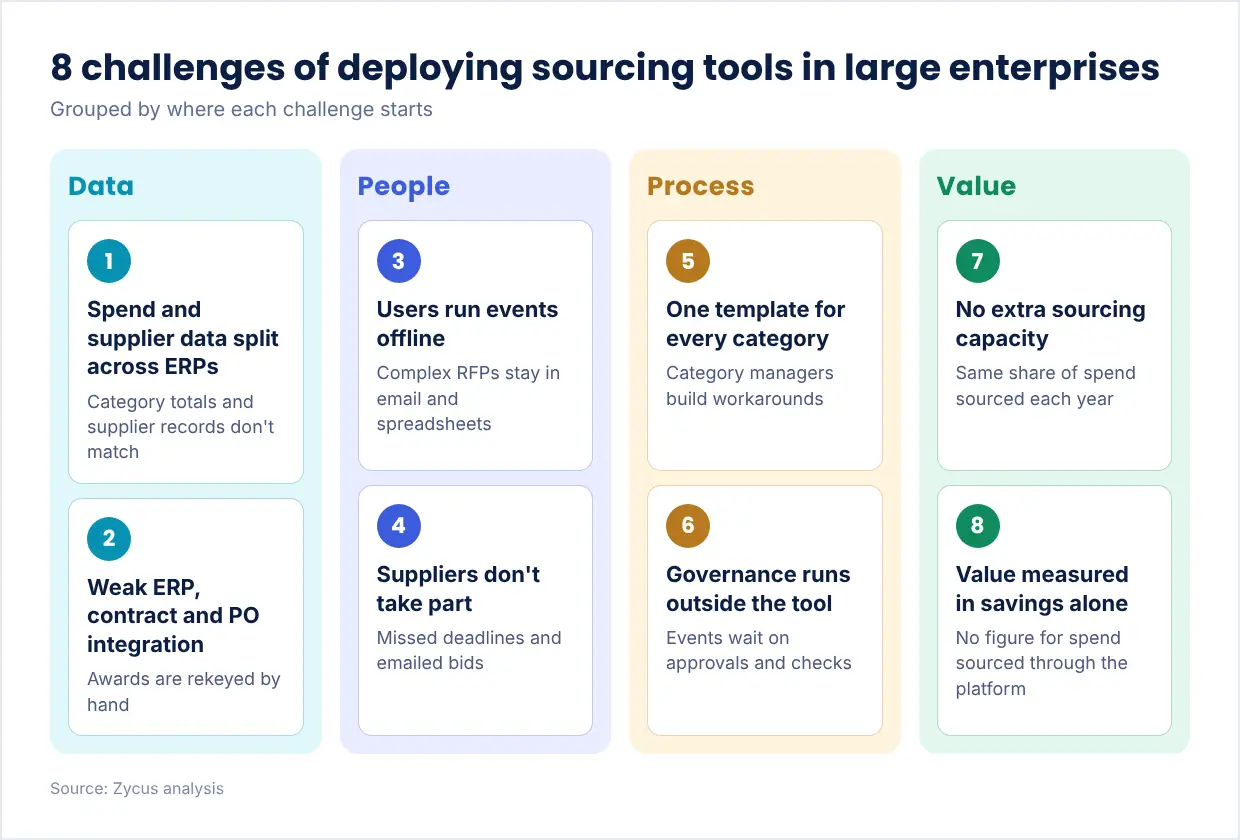
- The 8 challenges cluster into four groups: data, people, process and proof of value.
- Siloed ways of working are the top barrier CPOs report to delivering value from technology.
- AI sourcing agents can take on event work your team doesn’t have capacity for, but they raise the bar on data and governance.
Why sourcing tools stall in large enterprises?
Buying a sourcing tool and adopting it are two different milestones. Most large organizations cleared the first one years ago. The second is where value is won or lost.
“Only 48% of digital initiatives enterprise-wide meet or exceed their business outcome targets.” (Gartner 2025 CIO and Technology Executive Survey)
E-sourcing tools in procurement follow the same pattern. A typical enterprise rollout goes live on schedule, runs a strong first wave of RFQs in one or two categories, and then plateaus. Events for complex categories drift back to email and spreadsheets. New business units are onboarded on paper but keep their own process. Savings are reported, but nobody can say what share of addressable spend was actually sourced through the platform.
The strategic sourcing challenges behind this aren’t about the software’s features. They come from what changes at enterprise scale: more ERPs, more categories, more stakeholders, more suppliers and more rules. The eight challenges below are the ones that come up most often, grouped by where they start.
Data challenges
1. Spend and supplier data is split across several ERPs
- What it looks like: sourcing managers can’t see total spend for a category, so they can’t size an event, pick the right suppliers or set a credible target price. Supplier records are duplicated across business units under slightly different names.
- Why scale makes it worse: large enterprises often run several ERPs after acquisitions, each with its own supplier master and category codes. The sourcing tool inherits that fragmentation on day one.
- The fix: classify and cleanse spend before rollout, not after. Build one supplier master for the categories in your first wave, and agree a single category taxonomy the sourcing tool will use. A full cleanup of every ERP can come later; a clean first wave can’t.
2. Sourcing tools don’t integrate cleanly with ERP, contract and purchasing systems
- What it looks like: an event is awarded in the sourcing tool, then someone rekeys the award into the contract system and again into the ERP to create a PO. Pricing drifts between the three.
- Why scale makes it worse: every additional ERP or regional instance multiplies the integration work, and IT queues are long.
- The fix: when you evaluate sourcing tools that integrate with ERPs for procurement, test the full path from award to contract to PO, not just a data export. Prioritize integrations for the categories with the highest event volume, and make “no rekeying” an acceptance criterion for go-live.
People challenges
3. Users keep running events offline
- What it looks like: the tool is live, licenses are assigned, but complex RFPs still run over email and spreadsheets. Only the simplest RFQs go through the platform.
- Why scale makes it worse: this is the core of enterprise strategic sourcing software adoption challenges. Hundreds of buyers across regions each have a way of working that already gets results, and the tool feels like extra steps. Siloed ways of working were the top barrier to delivering value, cited by 57% of CPOs. (Deloitte 2025 Global Chief Procurement Officer Survey) Adoption doesn’t fail because buyers resist technology. It fails because the tool is added on top of the old process instead of replacing it.
- The fix: make the platform the only route to an award above a set threshold, and retire the old templates. Train in three layers: tool basics, sourcing best practice, then a live event with support on hand.
Read More About How to Structure the RFP Distribution and Review Process
4. Suppliers don’t take part
- What it looks like: invited suppliers miss deadlines, email their bids instead of using the portal, or decline because registration is too heavy.
- Why scale makes it worse: a global supplier base means many languages, time zones and levels of digital maturity. Small and specialist suppliers are the most likely to drop out, and they are often the ones you need for competitive tension.
- The fix: keep supplier registration light for one-off events, provide supplier guides in local languages, and track supplier response rates by category. A falling response rate is an early sign that an event design is too complex.
Process challenges
5. One event template doesn’t fit every category
- What it looks like: the template built for indirect spend is forced onto direct materials, services or capital projects, so category managers work around it.
- Why scale makes it worse: large enterprises source across very different categories, each with its own pricing structures, evaluation criteria and approval rules.
- The fix: build a small library of event templates by category type, such as direct materials, indirect goods, services and capital projects, each with its own pricing table and scoring model. Let category leads own their template within shared rules.
6. Governance and regional rules slow every event
- What it looks like: events stall waiting for approvals, legal review or compliance checks that happen outside the tool.
- Why scale makes it worse: multinational enterprises face different rules by region and industry, from data residency requirements to sector regulations and public-sector thresholds.
- The fix: build approval gates, compliance checks and audit logging into the event workflow, configured by region and category. Governance that runs inside the tool speeds events up; governance that runs beside it slows them down.
Value challenges
7. The sourcing team doesn’t have capacity to run more events
- What it looks like: the tool makes each event faster, but the team still sources the same share of spend because headcount hasn’t changed. Tail spend and renewals go unsourced.
- Why scale makes it worse: the gap between addressable spend and sourcing capacity grows with the size of the enterprise. AI category agents deliver “15 to 30 percent efficiency improvements” by automating tasks that don’t add value. (McKinsey, The future of category management: The power of AI category agents) Efficiency only pays off if the time saved goes back into sourcing.
- The fix: measure the manual effort saved by sourcing tools in procurement, then reinvest it in more events, not just faster ones. Automate the repetitive steps first: supplier shortlists, RFx drafting, bid comparison and award scenarios.
8. Value is measured in savings alone
- What it looks like: the business case reports savings from the events that ran, but nobody tracks how much addressable spend went through the platform or how many events ran outside it.
- Why scale makes it worse: reported savings can look healthy while most spend is still sourced the old way, and leaders lose sight of the real return.
- The fix: track adoption alongside savings. Report spend sourced through the platform, number of events by category and business unit, cycle time from request to award, and supplier participation.
Watch On-Demand Webinar – Autonomous Sourcing: Speed, Savings & Strategic Edge in Procurement
Early warning signs your sourcing tool deployment is stalling
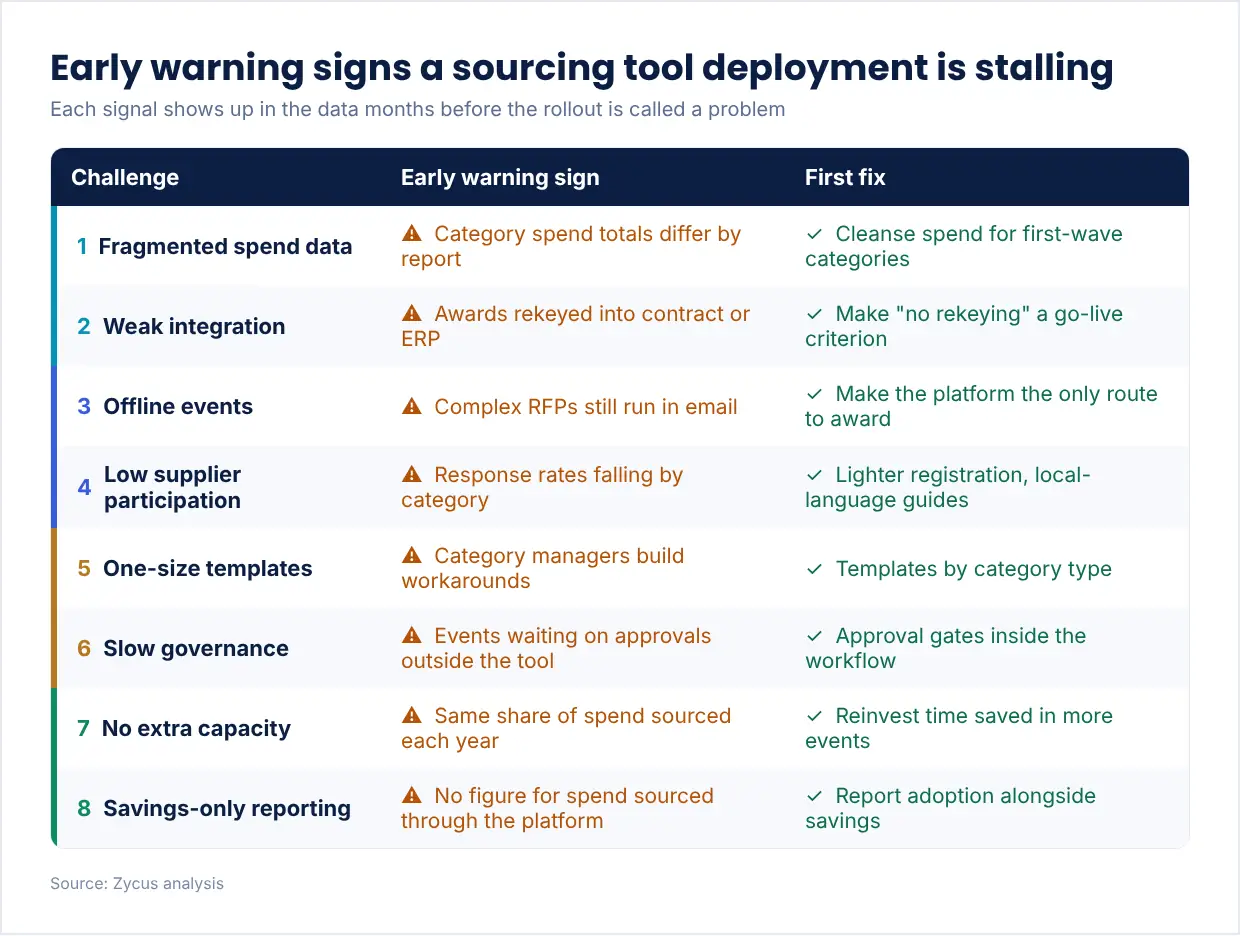
Most of these challenges show up in the numbers months before anyone calls the rollout a problem. Watch for these signals:
| Challenge | Early warning sign | First fix |
| 1. Fragmented spend data | Category spend totals differ by report | Cleanse spend for first-wave categories |
| 2. Weak integration | Awards rekeyed into contract or ERP | Make “no rekeying” a go-live criterion |
| 3. Offline events | Complex RFPs still run in email | Make the platform the only route to award |
| 4. Low supplier participation | Response rates falling by category | Lighter registration, local-language guides |
| 5. One-size templates | Category managers build workarounds | Templates by category type |
| 6. Slow governance | Events waiting on approvals outside the tool | Approval gates inside the workflow |
| 7. No extra capacity | Same share of spend sourced each year | Reinvest time saved in more events |
| 8. Savings-only reporting | No figure for spend sourced through the platform | Report adoption alongside savings |
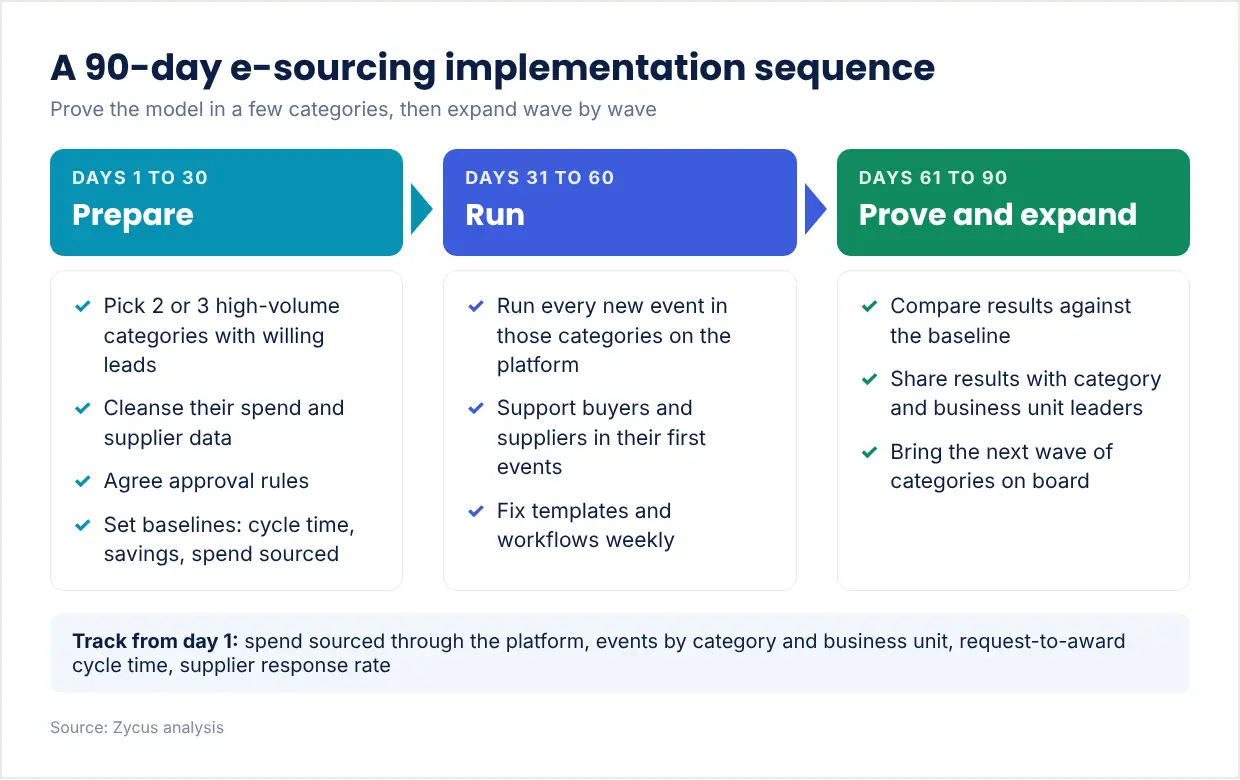
A 90-day e-sourcing implementation sequence for large enterprises
Enterprises that scale sourcing tools well rarely start with a big-bang rollout. They prove the model in a few categories, then expand.
- Days 1 to 30: prepare. Pick two or three high-volume categories with willing category leads. Cleanse their spend and supplier data, agree the approval rules and set baseline metrics for cycle time, savings and spend sourced.
- Days 31 to 60: run. Run every new event in those categories through the platform. Support buyers and suppliers in person during their first events, and fix template and workflow issues weekly.
- Days 61 to 90: prove and expand. Compare results against the baseline, publish them to category and business unit leaders, and use the results to bring the next wave of categories on board.
Where AI sourcing agents change the deployment math?
The next wave of sourcing technology doesn’t just make events faster for buyers. AI agents can run large parts of an event themselves. That changes challenge 7 most of all, because capacity no longer depends only on headcount. It also raises the bar on everything else: agents need clean data, clear rules and governance that procurement trusts.
“Only 36% of chief procurement officers (CPOs) are very confident” in their ability to redesign roles and processes for AI. (Gartner CPO survey, May 2026)
That confidence gap is why the foundations above matter more, not less, in an AI rollout.
Merlin Autonomous Sourcing is built for this. It runs within the Zycus Source-to-Pay suite on the Merlin Agentic Platform and works from one data core. It analyzes spend, shortlists and scores suppliers, builds RFx questionnaires and pricing tables, manages supplier Q&A and models award scenarios. Human approval gates and a full audit trail keep procurement in control. Zycus reports a 60% reduction in cycle time from strategy to award, and 3 to 5x more sourcing events with the same team.
Customers see the same pattern. Sirva cut its sourcing cycle time by 50% and the hours spent on each sourcing event by 70% (watch the Sirva story).
Check your sourcing platform readiness
The Procurement Platform Readiness Assessment takes about 15 minutes and benchmarks your platform, AI maturity and financial impact. To see AI sourcing agents run an event end to end, request a demo of Merlin Autonomous Sourcing.
Frequently asked questions
Q1. What are the biggest challenges of deploying sourcing tools in large enterprises?
The most common are fragmented spend data across several ERPs, weak integration with contract and purchasing systems, users running events offline, low supplier participation, templates that don’t fit every category, slow governance, limited team capacity and measuring value through savings alone. Most stem from scale rather than from the software itself.
Q2. What are the challenges in adopting procurement technology?
The barriers CPOs cite most are organizational rather than technical: siloed ways of working, competing priorities, limited capability to support execution and talent gaps. Adoption improves when the new tool replaces the old process instead of being added on top of it, and when adoption is measured alongside savings.
Q3. Why do e-sourcing tools in procurement go underused?
Usually because buying the tool is treated as the finish line. Licenses are assigned, but complex events still run in email and spreadsheets because the tool feels like extra steps. Making the platform the only route to an award above a set threshold, and training on live events, closes the gap.
Q4. How long does an e-sourcing implementation take in a large enterprise?
A focused first wave can go live and show results in about 90 days: 30 days to prepare data and rules for two or three categories, 30 days running every new event through the platform, and 30 days to measure results and plan the next wave. A full enterprise rollout is phased over several waves.
Q5. How much manual effort do sourcing tools save in procurement?
It depends on how much of the event is automated. McKinsey reports 15 to 30 percent efficiency improvements from AI category agents. The bigger gain comes from reinvesting that time in more events, so a larger share of addressable spend is sourced.
Q6. What should sourcing tools integrate with in a large enterprise?
At a minimum: your ERPs for spend data, supplier masters and POs; your contract management system so awards become contracts; and your purchasing system so negotiated prices are used. The test is whether an award flows to a contract and a PO without anyone rekeying it.