


When healthcare sourcing projects stall for months, teams often blame the RFP document itself, ignoring the reality that RFPs usually get stuck in four distinct operational queues rather than failing on drafting quality. These primary healthcare RFP bottlenecks include requirements that cannot be scored, clinical evaluations delayed by staff availability, security reviews repeated from scratch for every project, and value analysis committee submissions deferred due to missing information.
In this guide, we break down where healthcare sourcing cycles actually lose time, why adding effort to the RFP document changes nothing, and how to unblock each operational bottleneck to accelerate your timelines.
TL;DR
- Four stall points: unscoreable requirements, clinician availability, security review repeated per project, and deferred committee submissions.
- Each is a queue rather than a task, which is why effort spent on the RFP document changes little.
- Fix committee submission completeness first. The return is a full cycle per avoided deferral and nothing structural changes.
- Clinical evaluation is last on the list, because it is a duration rather than a bottleneck.
Healthcare RFPs get stuck in four places, and only one of them is the RFP itself.
Requirements that arrive incomplete, evaluations that wait on clinician availability, security reviews repeated per project, and committee submissions deferred for missing information. Each is a queue rather than a task, which is why adding effort to the RFP document does almost nothing to the timeline.
This piece assumes the map set out in the companion diagnosis of where healthcare RFP cycles lose time. It names the specific stall points and what unblocks each one.
None of the four is a failure of effort. Each is a place where a request waits for something that is not being worked on.
Where does the requirement stage stall?
On requirements that are complete enough to circulate but not complete enough to score.
A requirement written as “must integrate with the EHR” passes review, reaches suppliers, and produces answers that cannot be compared. The evaluation then stalls while procurement establishes what each supplier actually meant, which is work that should have happened before issue.
McKinsey was describing supply chain breadth rather than requirement drafting. The bearing here is that a category range that wide makes reusable requirement templates valuable and generic ones dangerous, because a requirement precise enough for one clinical category is usually meaningless in the next.
The unblock is a scoring test applied before issue: for each requirement, write the answer that would score full marks. If you cannot, suppliers cannot either.
The distinction that matters is between a requirement that is incomplete and one that is imprecise. An incomplete requirement is caught before issue because something is visibly missing. An imprecise one passes every internal review, because everyone reading it supplies their own interpretation without noticing they have done so.
This is also the stall point where the cost is least visible. Nobody records the two weeks spent establishing what four suppliers meant by the same phrase, because it presents as evaluation work rather than as rework.
Why does clinical evaluation stall?
Availability, not analysis.
The evaluation itself may take two hours. Securing two hours from clinicians carrying patient loads takes weeks, and the delay is invisible in any measure of effort because nobody is working on the request while it waits.
The common mistake is to treat this as a scheduling problem and respond by asking earlier. The better response is to reduce what needs clinician time at all. Comparative summaries, prepared evidence, and pre-filtered shortlists all convert clinician hours from evaluation to judgment, which is the part only they can do.
Where a category genuinely needs hands-on assessment over time, that duration is a floor and should be planned around rather than compressed.
There is a version of this that looks like a scheduling win and is not. Booking clinician time early in the cycle secures the slot but often means evaluating a shortlist that has not settled, which produces an assessment of options that are later withdrawn. The time is spent either way.
The better sequencing is to fix the shortlist first and then book, accepting the calendar wait, because a well-timed evaluation of the right options costs less total elapsed time than an early evaluation of the wrong ones.
Why does security review stall?
Because the same vendor is assessed from scratch on every project.
Figure 1 shows the shape. No shared record exists of the last assessment, so a supplier evaluated three months ago for a different department is evaluated again. The work is identical, the answer is usually the same, and the queue is the constraint.
CAQH measured administrative transactions across the revenue cycle rather than security review. It is included because repeated assessment of unchanged vendors is precisely the profile of manual work CAQH describes: high volume, rule governed, and performed again each time because no record of the previous instance is retrievable.
The unblock is an assessment register with an expiry date. Reassess when something changed or the period lapsed, not when a new project starts.
The register does not need to be sophisticated. A supplier name, an assessment date, a scope note, and an expiry is enough to answer the only question that matters at the start of a project, which is whether this assessment already exists and is still current.
Where an organization has no register at all, the first version can be assembled from the last two years of completed assessments in a few days, and it usually reveals that a small number of suppliers have been assessed repeatedly.
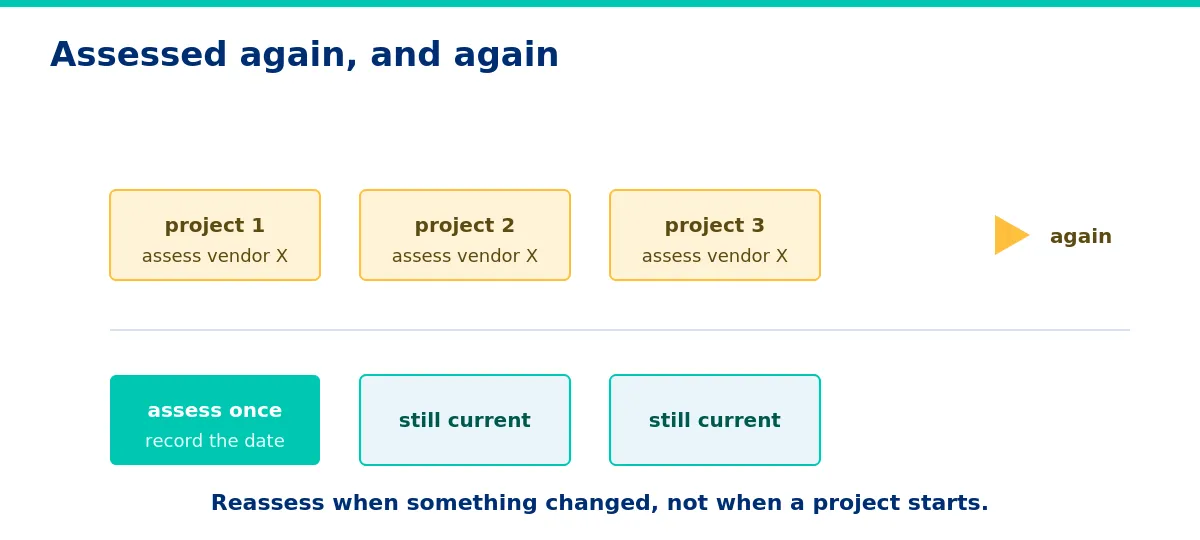
Figure 1: The same vendor, assessed from scratch on every project.
Why do committee submissions stall?
Because they arrive incomplete and the committee meets monthly.
A submission deferred for a missing financial model costs a full cycle, as Figure 2 shows. Two deferrals cost two. This is the highest-leverage stall point in healthcare sourcing because completeness sits entirely within procurement’s control and no governance changes.
Deloitte surveyed cost reduction broadly rather than committee submissions. The relevance is that standardization is the named mechanism, and a submission template that assembles the same evidence set every time is standardization at its least glamorous and most immediately effective.
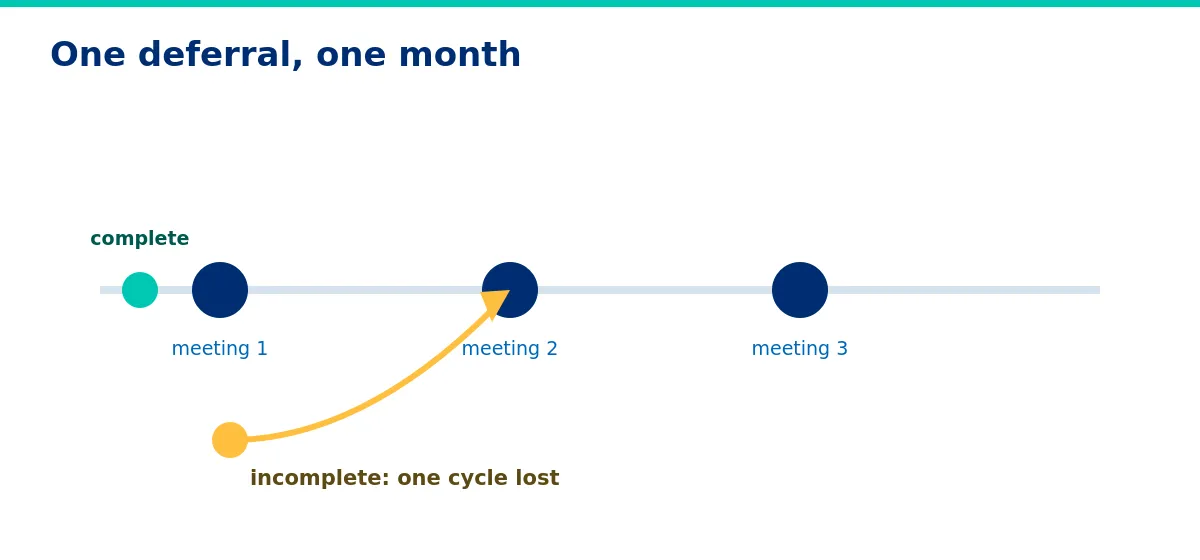
Figure 2: A deferred submission costs a full committee cycle.
Which bottleneck should you fix first?
Committee submissions, then security reassessment, then requirements.
Submissions first because the return is a full committee cycle per avoided deferral and the change costs nothing structural. Security reassessment second because the work is identical each time, which makes it elimination rather than acceleration. Requirements third because the fix is real but slower, requiring template work per category.
Clinical evaluation is deliberately last. It is the stall point people complain about most and the one least available to process improvement.
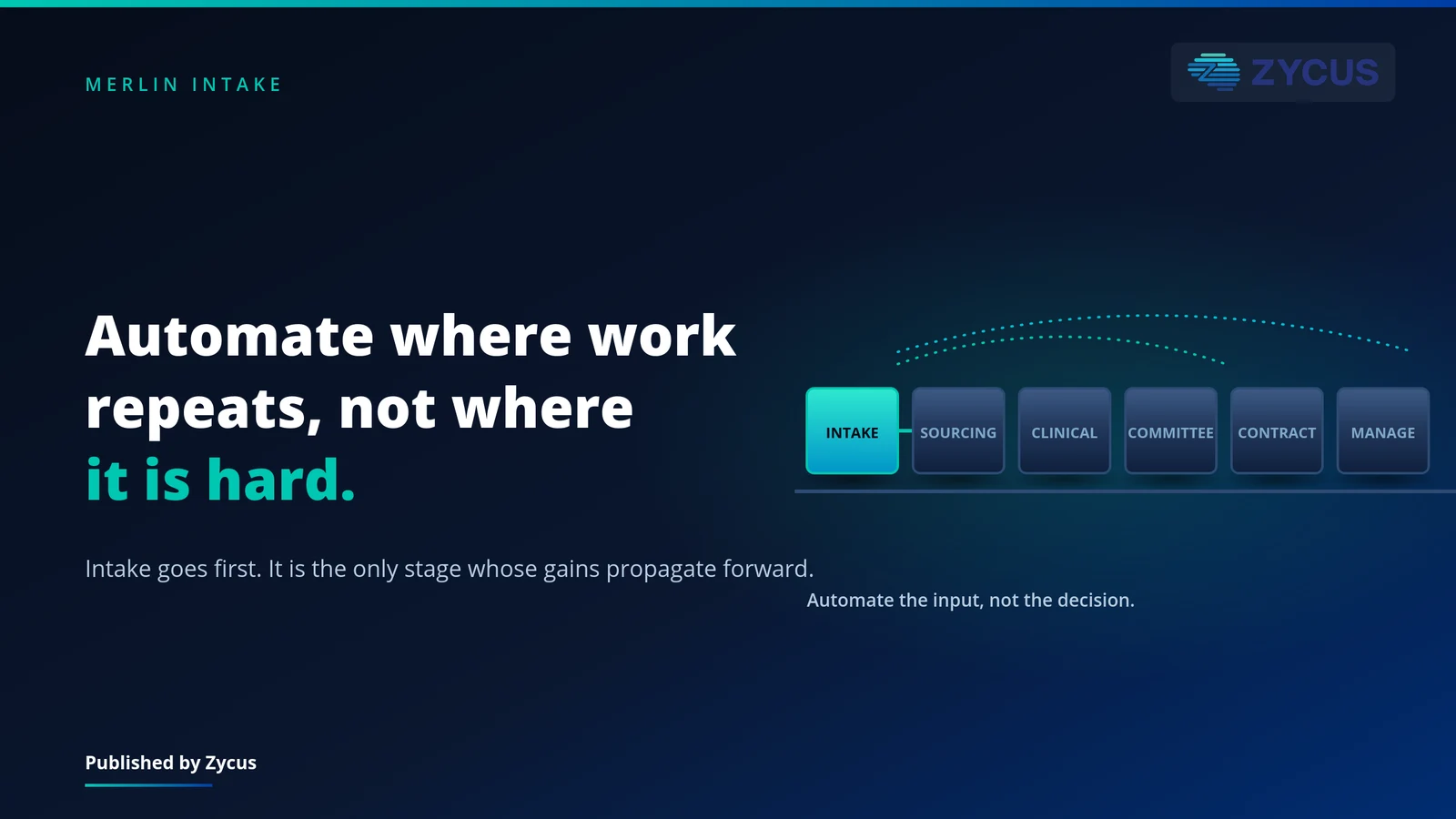
Merlin Autonomous Sourcing turns a stated need into an RFP-ready strategy, assembling requirements, supplier options, and evaluation criteria in one governed flow rather than as separate handoffs. The committee still decides and the clinicians still evaluate. What changes is how much of the material is rebuilt at each gate.
Then measure the four separately. A single cycle-time number tells you the process is slow. Four queue lengths tell you which one to work on, and they usually show the load concentrated in one or two rather than spread evenly.
Fixing persistent healthcare RFP bottlenecks requires recognizing that delays are queues rather than tasks—meaning effort spent rewriting documents changes little without structural fixes to workflow sequencing. By prioritizing value analysis committee submission completeness, establishing vendor security registers with expiry dates, and refining requirement scoreability, health systems can dramatically reduce elapsed time without compromising clinical rigor.
Ready to eliminate operational queues and build RFP-ready strategies from intake to execution? Request a demo to see how Zycus transforms healthcare procurement workflows.
Frequently asked questions
1. What are the main bottlenecks in a healthcare RFP process?
Incomplete requirements that cannot be scored, clinical evaluation waiting on clinician availability, security review repeated per project because no assessment record exists, and committee submissions deferred for missing information. Each is a queue rather than a task, which is why effort spent on the RFP document itself rarely changes the timeline.
2. How do you write requirements that can actually be scored?
For each requirement, write the answer that would score full marks before issuing. If you cannot write it, suppliers cannot produce it and the responses will not be comparable. This test removes a substantial proportion of a typical requirements list and takes an afternoon.
3. Why does clinical evaluation take so long?
Because it depends on the availability of clinicians carrying patient loads rather than on the analysis itself. A two-hour evaluation can wait three weeks for a two-hour window. The delay is invisible in effort-based measures because nobody is working on the request while it waits.
4. How can you reduce clinical evaluation time without weakening it?
Reduce what needs clinician time rather than compressing the evaluation. Comparative summaries, prepared evidence, and pre-filtered shortlists convert clinician hours from assessment to judgment. Where hands-on evaluation over time is genuinely required, that duration is a floor and should be planned around.
5. Why is vendor security review repeated for every project?
Because most health systems hold no retrievable record of previous assessments, so a vendor evaluated for one department is evaluated again for the next. The work is identical and the answer usually unchanged. An assessment register with an expiry date removes most of it.
6. What causes value analysis committee delays?
Submissions arriving incomplete rather than committee deliberation. A submission deferred for missing information costs an entire cycle, often a month. Completeness is within procurement’s control, which makes this the highest-return fix available and the one requiring no governance change.
7. Which healthcare RFP bottleneck should be fixed first?
Committee submission completeness, because the return is a full cycle per avoided deferral and nothing structural changes. Then security reassessment, because repeated identical work is elimination rather than acceleration. Requirements third, since template work is slower. Clinical evaluation last.
8. Does AI shorten healthcare RFP cycles?
It shortens the portion consumed by rebuilding information at each gate, which is where most of the recoverable time sits. It does not shorten clinical evaluation duration, regulatory review, or negotiation with a counterparty, so claims of halving an end-to-end cycle should be checked against which portion is actually being addressed.