


When shopping for enterprise software, sourcing leaders often fall into the trap of evaluating solutions based on how fast they can draft documents, ignoring the reality that drafting speed is rarely the actual bottleneck. General procurement demos are designed around flashy feature lists rather than the specific bottlenecks that slow down hospital purchasing, such as value analysis committee reviews and IT security questionnaires.
To ensure your software investment delivers measurable returns, you must know how to properly evaluate healthcare RFP automation platforms based on the parts of your cycle that actually bind. In this guide, we break down the five critical capabilities that matter most in healthcare, why your operational constraints should guide software selection, and how to test vendors using your own real-world scenarios.
TL;DR
- Evaluate against the part of your cycle that actually binds, not against the capability a demo is built around.
- Five capabilities matter in healthcare: committee submission completeness, evidence reuse, structured handoff, auditability, and configuration ownership.
- Weight what cannot be changed after implementation more heavily than what can be added later.
- Size the business case against the discretionary portion of your cycle, since the regulated portion does not compress.
Evaluate a healthcare RFP platform on what it does with the parts of your process you cannot change, not on the parts you were going to improve anyway.
Every platform in this category will show you a faster RFP build. That is the easy half, and it is the half a demo is designed around. The half that decides whether the investment returns anything is what happens at the value analysis committee, the security questionnaire, and the clinical evaluation, none of which the platform controls and all of which set your actual cycle time.
This is written for health system sourcing leaders running a formal evaluation. It sets out criteria rather than ranking products, because the right answer depends on which part of your own cycle is binding.
What should you evaluate first?
Fit against your constraints, before capability. This ordering is unusual in a software evaluation and it is what stops the exercise becoming a feature audit, which is the default state of a software evaluation left to run itself.
The four constraints that set the floor on a healthcare sourcing timeline are clinical evaluation duration, regulatory and security review, contract negotiation, and capital planning windows. None of them moves because you bought software. Any evaluation that does not name them will implicitly assume they are addressable, and the business case will inherit that assumption.
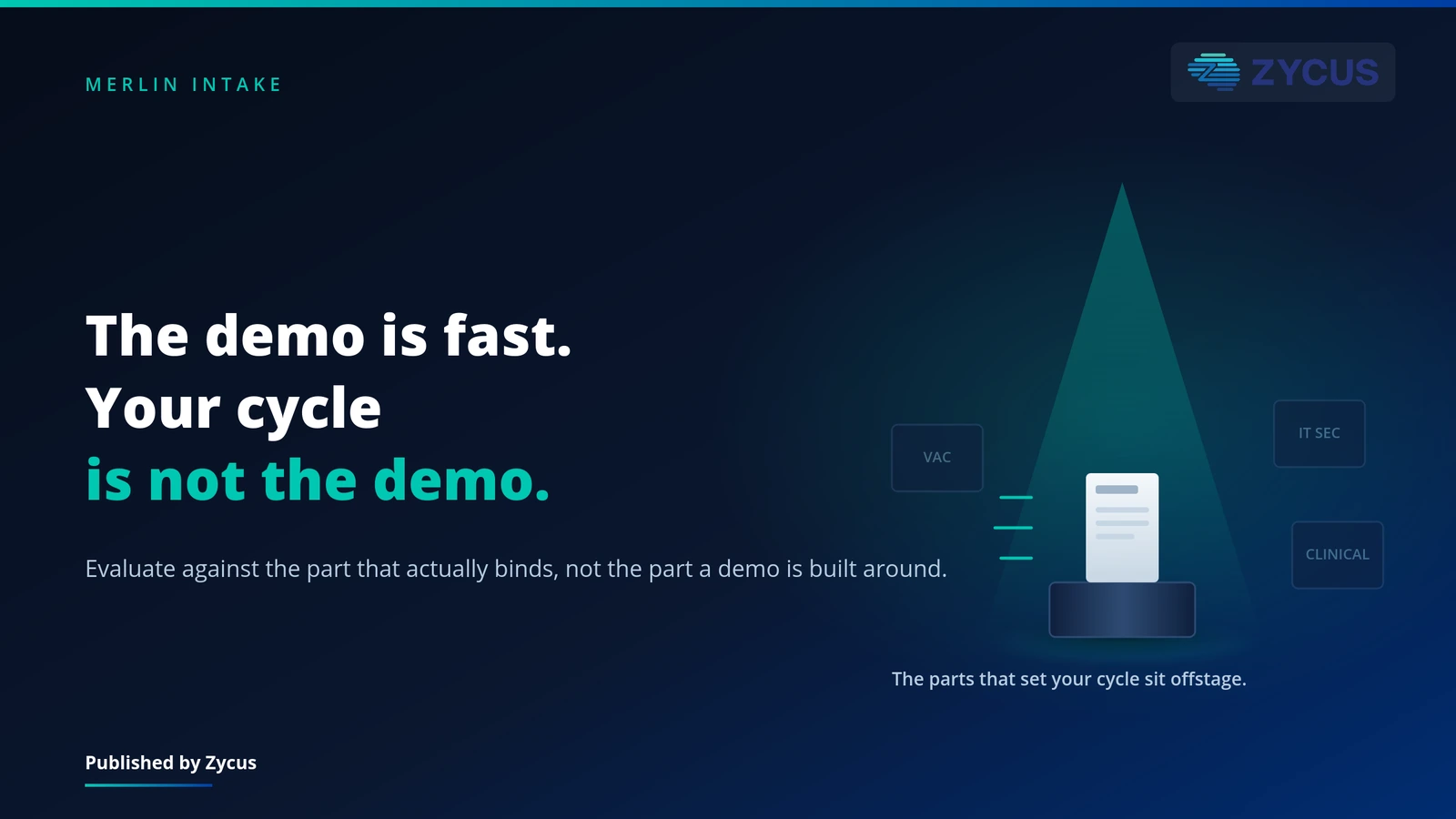
So the first evaluation question is not what the platform does. It is which part of your cycle currently consumes the most elapsed time, and whether this platform touches it at all. A platform that halves RFP drafting time in an organization where drafting was never the constraint has delivered a real improvement that changes nothing measurable, as Figure 1 shows.
Answer that first and most of the evaluation narrows on its own, because a large share of the feature comparison stops being decision relevant. It also gives you a defensible reason to shorten the requirements list, which is otherwise a difficult conversation internally because every requirement has an author.
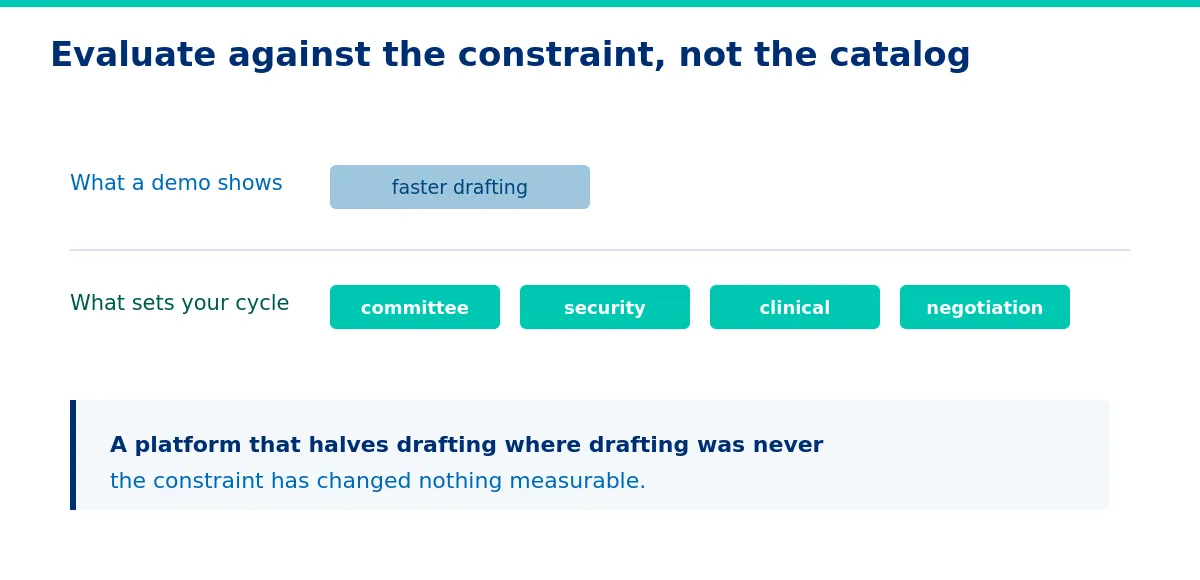
Figure 1: A demo shows drafting. Your cycle is set elsewhere.
Which capabilities actually matter in healthcare?
Five, set out in Figure 2, and they are not the five that lead a demo. Each maps to a stage where healthcare cycles actually lose time rather than to a stage that photographs well.
- Submission completeness for committee review. Whether the platform can assemble a value analysis submission that arrives complete on first pass. This is the single highest-return capability in healthcare sourcing because a deferred submission costs a full committee cycle, and completeness is entirely within your control rather than the committee’s.
- Reuse of security and vendor evidence. Whether an assessment completed for one project is retrievable for the next, or whether every project reassesses the same vendor from scratch. Ask to see where a completed assessment goes after a project closes.
- Structured requirements that survive handoff. Whether requirements gathered at intake reach clinical, IT, and finance in usable form, or whether each function rebuilds them.
- Auditability of the decision trail. In regulated environments, being able to show how a decision was reached is not a reporting nicety. It is frequently the difference between a defensible award and a contested one, and it is far cheaper to have by design than to reconstruct afterward.
- Configuration ownership. Whether sourcing can change a routing rule, an evaluation template, or a scoring model without a vendor engagement.
That last one is the most predictive and the least demonstrated, for the same reason it is in any procurement platform evaluation: it describes an operating reality rather than a feature. Ask who changed the last evaluation template, when, and what it required.
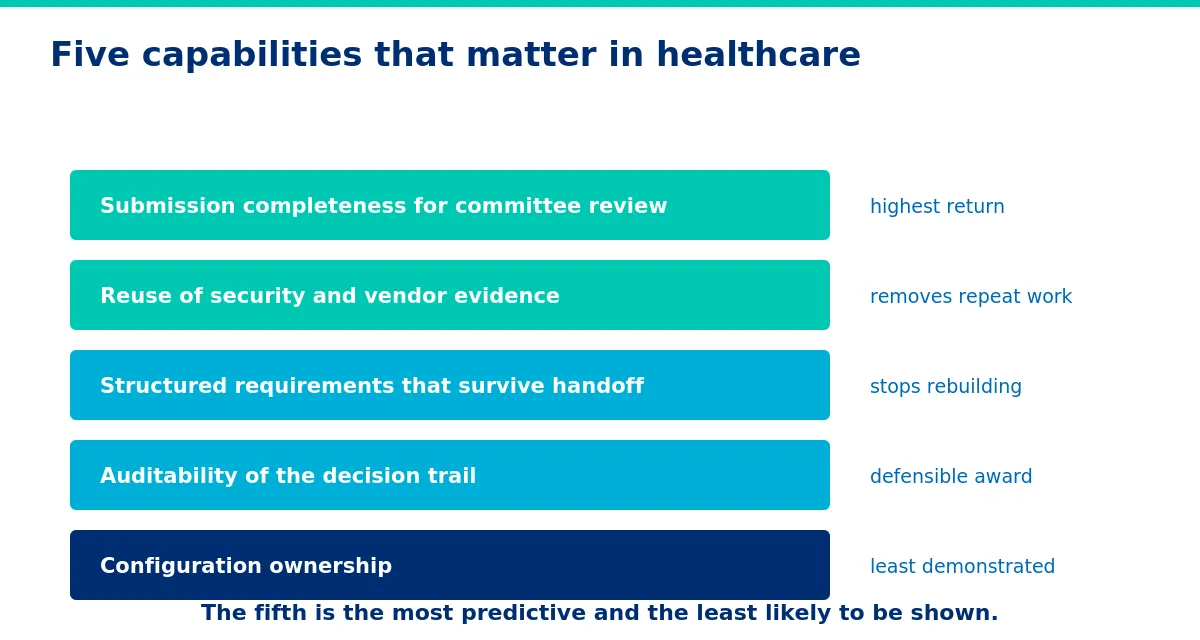
Figure 2: The five capabilities that decide the outcome in healthcare.
What should you ask in a demo?
Bring your own material, and make them run it. Prepared demos are optimized over many cycles and tell you about the vendor rather than about your process.
Supply a real RFP your organization has already completed, including the awkward one with a clinical evaluation that changed the shortlist. Ask the vendor to run it end to end. A platform that performs well on prepared scenarios and poorly on yours has told you what you need to know at no cost. Run the same material past every vendor so the comparison is genuine rather than impressionistic.
Then ask three specific questions. What does the platform produce for a value analysis committee, and can you see it. What happens to a security assessment after the project closes. And who changes an evaluation template, with a demonstration rather than an answer. Each of these takes minutes to ask and hours to fake, which is what makes them useful.
Vendors who answer these precisely have built for healthcare. Vendors who redirect to a feature list have built for procurement generally and are adapting, which is not disqualifying but should change what you weight.
How should you weight the criteria?
By what you cannot change after implementation. That is a harder criterion to apply than feature coverage and it is the one that correlates with regret.
Configuration ownership, the structure of the decision trail, and where policy is enforced all follow from architecture and cannot be renegotiated later. Template libraries, integrations, and reporting can be added or improved.
Weight the first group heaviest even though the second group is easier to score. Ease of scoring is why evaluations drift toward the reversible criteria, and the drift is worth naming before it happens. This is the same discipline that applies to any procurement platform selection, and it is more consequential in healthcare because the regulated portions of the process are precisely the ones that are hardest to retrofit.
What does the business case actually rest on?
The discretionary portion of your cycle, not the whole cycle. Building it on the whole cycle produces a number that will not survive its first review by finance.
McKinsey was measuring the size of the spend opportunity, not sourcing platform returns. The bearing on this evaluation is that savings are realized at contract execution, so a platform’s contribution to the business case is the elapsed time it removes before that point, multiplied by the spend flowing through the cycles it touches.
Successfully choosing among healthcare RFP automation platforms requires looking beyond polished vendor demos and focusing on the capabilities that address your actual cycle constraints such as value analysis committee submission completeness and security evidence reuse. Weight architecture and configuration ownership heavier than reversible features, and size your business case against the discretionary portion of your timeline.
Ready to select a platform built specifically for clinical evaluation and complex hospital workflows?
Request a demo today to transform healthcare procurement from intake to execution.
Frequently asked questions
1. What should a healthcare RFP automation platform do?
At minimum it should assemble complete submissions for value analysis committee review, retain security and vendor assessment evidence for reuse, carry structured requirements through to clinical, IT, and finance without rebuilding, and produce an auditable decision trail. Faster RFP drafting is table stakes and rarely the binding constraint.
2. How do you evaluate sourcing software for a health system?
Start by identifying which part of your own cycle consumes the most elapsed time, then assess whether the platform touches it. Weight capabilities that cannot be changed after implementation, such as configuration ownership and where policy is enforced, more heavily than capabilities that can be added later.
3. What is different about healthcare sourcing software?
The presence of a clinical evaluation stage, a value analysis committee as decision body, and security and privacy obligations that apply to most clinical technology. General procurement platforms handle the commercial process well and often have no concept of the committee submission, which is where healthcare cycles are actually lost.
4. Should we buy a healthcare-specific platform or a general procurement one?
It depends on whether the healthcare-specific stages are where your time goes. If committee submissions and security reassessment consume the calendar, a platform with no concept of them will underdeliver. If your constraint is general sourcing execution, a general platform may fit better and cost less.
5. How do you build a business case for sourcing automation in healthcare?
Size it against the discretionary portion of your cycle rather than the whole cycle, since clinical evaluation, regulatory review, negotiation, and capital windows do not compress. Multiply the elapsed time realistically removed by the spend flowing through the affected cycles. Vendor-supplied cycle-time percentages are not a substitute for that arithmetic.
6. What questions should we ask sourcing vendors in a demo?
Ask them to run a real completed RFP of yours, including a difficult one. Ask what the platform produces for a value analysis committee and to see it. Ask what happens to a security assessment after a project closes. Ask who changes an evaluation template and to watch it happen.
7. How long does implementation take?
It varies with integration scope and data readiness more than with platform choice, so treat any timeline quoted before a data assessment as provisional. The more useful question is what must be true about your supplier, item, and cost center data before go-live, since that usually determines the schedule.
8. Do we need an RFP to buy sourcing software?
Where spend thresholds or public procurement rules require one, yes. Where they do not, a structured evaluation with scripted demos against your own scenarios delivers most of the value with less elapsed time. What matters either way is defining your constraints before looking at products.