


When health systems are pressured to speed up procurement, leadership often pushes to shorten every phase of a sourcing project, ignoring the reality that roughly half of the timeline is rigidly fixed by regulation, contract law, and clinical requirements. Treating the entire workflow as a simple process inefficiency leads to rushed clinical evaluations and missed targets that erode internal credibility.
If your organization wants to successfully compress healthcare RFP cycle timelines, you must first separate immutable constraints from discretionary, habit-driven delays like committee waiting and repeated data gathering. Read on to learn where recoverable time sits and how to accelerate your workflow without sacrificing rigor.
TL;DR
- Roughly half of a healthcare sourcing cycle is fixed and roughly half is habit. Only the second is available to you.
- The floor is set by clinical evaluation duration, regulatory review, contract negotiation, and capital planning windows.
- The recoverable time sits in committee waiting, sequential handoffs by convention, and information gathered more than once.
- Start with submission completeness to the value analysis committee. It costs no governance change and returns a full committee cycle.
- See how Merlin Agentic Sourcing builds an RFP-ready strategy. Request a demo.
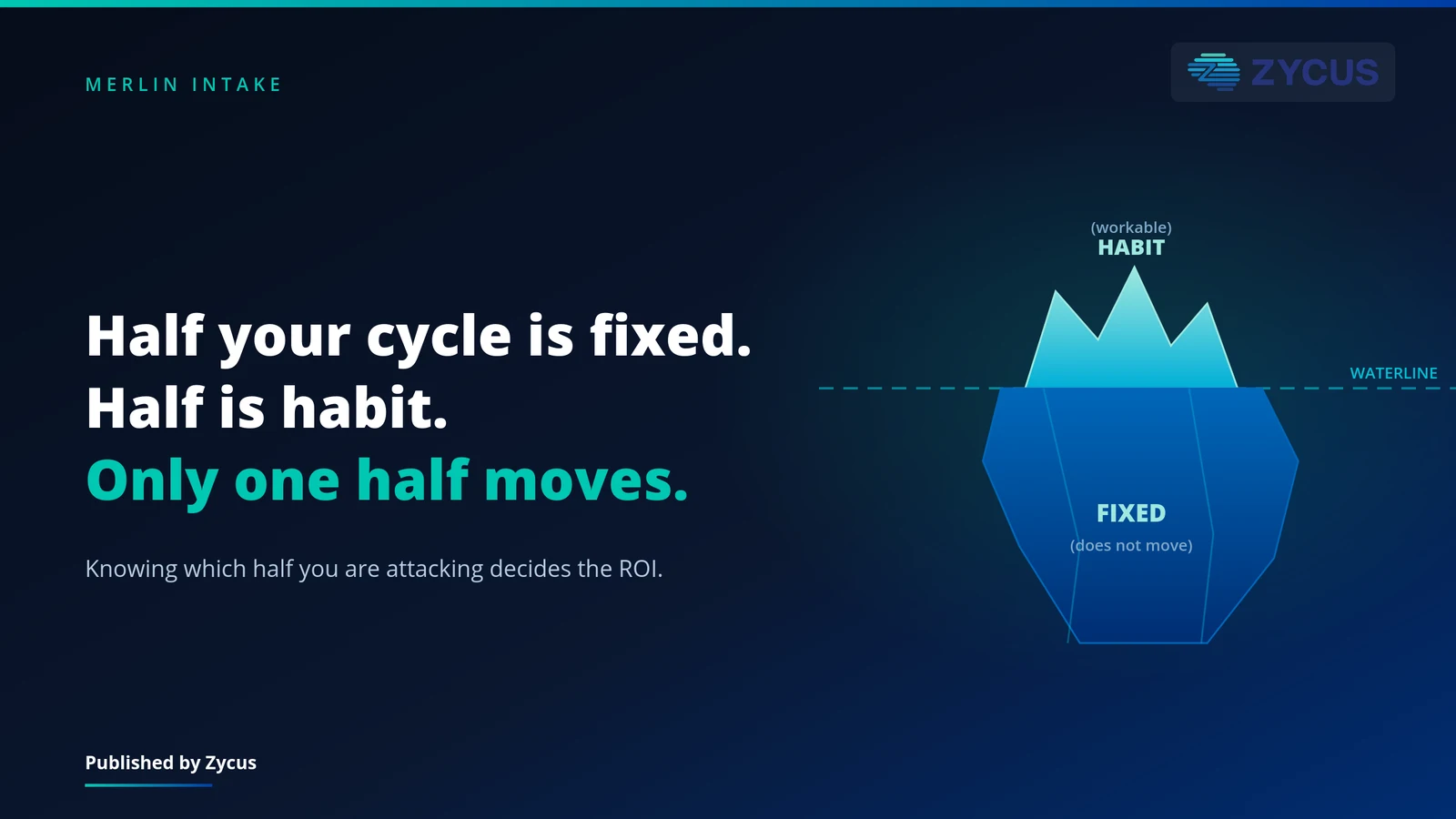
Roughly half of a healthcare sourcing cycle is fixed and roughly half is habit, and most improvement programs attack the wrong half.
The fixed portion is set by regulation, contract law, and the genuine time a clinical evaluation takes. The discretionary portion is set by committee calendars, sequential handoffs, and information gathered more than once. Only the second is available to you.
This piece assumes the map set out in the companion diagnosis of where healthcare RFP cycles lose time. It is written for supply chain and sourcing leaders being asked to shorten cycles without being told which parts are actually movable. The ROI of a shorter RFP timeline depends entirely on which half you target.
What sets the floor on a healthcare sourcing timeline?
Four things, and none of them yields to process improvement. Knowing which four separates a credible timeline commitment from an aspirational one. Figure 1 sets them out.
Clinical evaluation needs enough exposure to establish that a device or system performs acceptably in real conditions. That is a duration, not a queue. Compressing it does not make the evaluation faster, it makes it weaker. Time removed here reliably reappears later as an adoption problem, which costs more and is harder to attribute.
Security and privacy review has an externally defined scope where protected health information is involved. The questionnaire can be answered faster. It cannot be skipped.
Contract negotiation with a counterparty runs at the speed of two organizations, only one of which you control. Preparation is available to you. Their legal queue is not.
Capital planning cycles are set annually. A request arriving after the window closes waits for the next one regardless of how good it is.
Together these establish a realistic floor. Any target below it is a target that will be missed, and missing it repeatedly is how sourcing teams lose credibility on timelines.
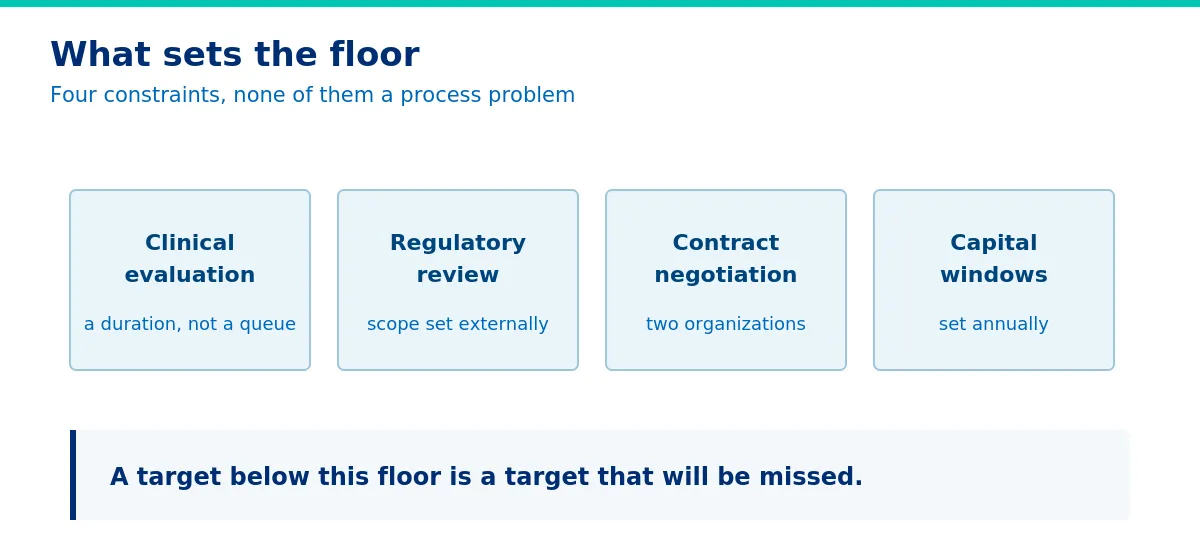
Figure 1: The four constraints that set the floor.
Which delays are regulatory or contractual?
The test is whether an external party defines the requirement. If the answer is yes, the obligation is fixed. Its duration usually is not, and conflating the two is the most common analytical error in this area.
Regulatory review of clinical devices, business associate agreement execution, data residency and privacy obligations, and in public health systems the statutory posting and protest periods all qualify. These are visible, documented, and defensible. They are also usually the shortest part of the cycle, which surprises people, because regulatory obligation is the explanation most often offered for delays that are not actually regulatory. Testing that explanation against the calendar is usually the first useful thing an improvement effort does.
The common error is treating anything adjacent to compliance as fixed. A security questionnaire is a regulatory obligation. Taking six weeks to complete one because the same vendor is assessed from scratch every time is not.
WorldCC was measuring how contracting functions allocate responsibility, not healthcare sourcing timelines. It is included because it corroborates the point above from a different direction: negotiation is the dominant claim on contracting capacity, which is why it behaves as a floor rather than as a delay that better process removes.
Which delays are discretionary?
Three, and they account for most of the recoverable time, as Figure 2 shows.
Waiting for a committee date. A value analysis committee meeting monthly creates up to four weeks of waiting per submission, and a deferred submission doubles it. The committee is not the delay. The submission arriving incomplete is. This distinction matters politically as well as operationally, because efforts framed as speeding up the committee tend to be resisted and efforts framed as improving submissions tend not to be.
Sequential staging by convention. IT security review typically waits for value analysis approval, though it does not depend on it. Finance often waits for both. Each wait is a local decision that nobody owns at the level of the whole cycle. Every one of them is individually reasonable, which is why they persist and why no single function can fix them alone.
Rebuilt information. The product data assembled for clinical evaluation, the vendor detail assembled for security review, and the cost detail assembled for finance overlap substantially. Most health systems assemble each independently, and the duplication is invisible because each function only sees its own share of it.
Deloitte surveyed financial preparedness rather than sourcing cycles. The connection drawn here is one of timing: margin targets are set on a two-year horizon while sourcing cycles consume three to nine months each, so the number of sourcing cycles available to deliver against those targets is small enough that elapsed time becomes a financial variable rather than an operational one.
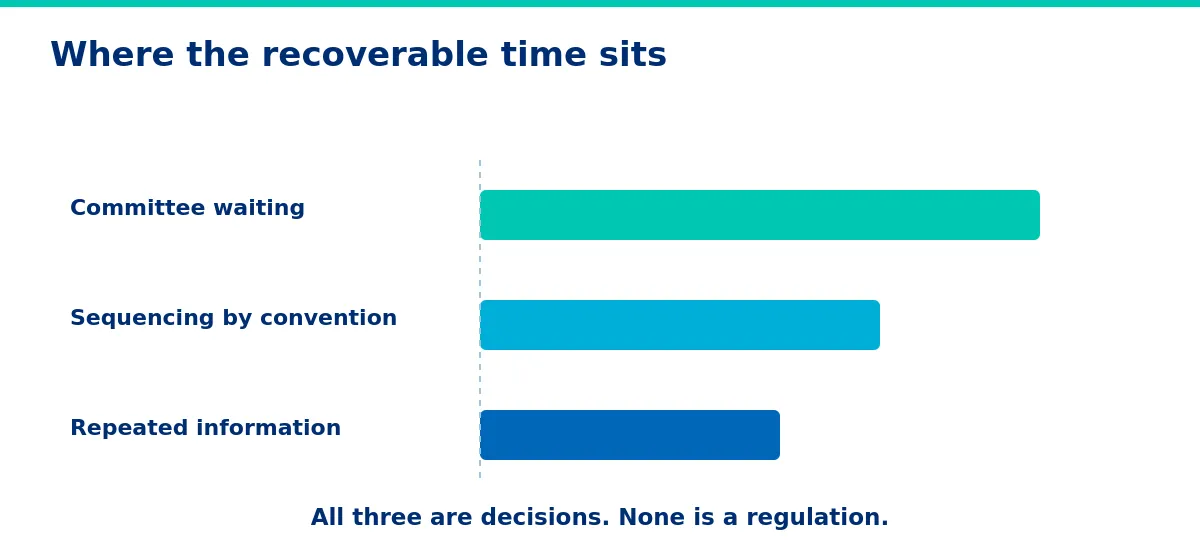
Figure 2: Where the recoverable time actually sits.
How much time is realistically recoverable?
Enough to matter, and less than a vendor will promise you. Treat any specific percentage offered without reference to your own stage timings as marketing rather than analysis.
The honest estimate comes from your own data rather than a benchmark. Measure elapsed time per stage and waiting time between stages separately, over the last twenty completed sourcing events rather than a representative sample chosen after the fact. The waiting is the addressable pool. In most health systems it is larger than the working, which is why the exercise is worth an afternoon. Until that split exists, any improvement target is guesswork and any claim of improvement is unfalsifiable.
What you cannot do is compress the floor. A program that promises to halve a nine-month cycle is promising to compress clinical evaluation and contract negotiation, and it will fail visibly at the first device purchase that matters. A target set against the discretionary portion only is less impressive in a steering committee and considerably more likely to be met.
Where should a health system start?
With the submission, not the committee. That ordering is deliberate and it is the opposite of where most improvement programs begin. Figure 3 gives the sequence.
The highest-return change available to most health systems is ensuring a value analysis submission arrives complete the first time, because a deferred submission costs a full committee cycle and completeness is entirely within procurement’s control. Nothing about governance changes and nobody loses authority. That property is what makes it achievable, because sourcing improvements that require a committee to give something up tend not to survive contact with the committee.
Second priority is separating genuine dependencies from inherited ones, which costs nothing but a workshop and a willingness to ask each function what it actually needs before it starts, rather than what it has always received.
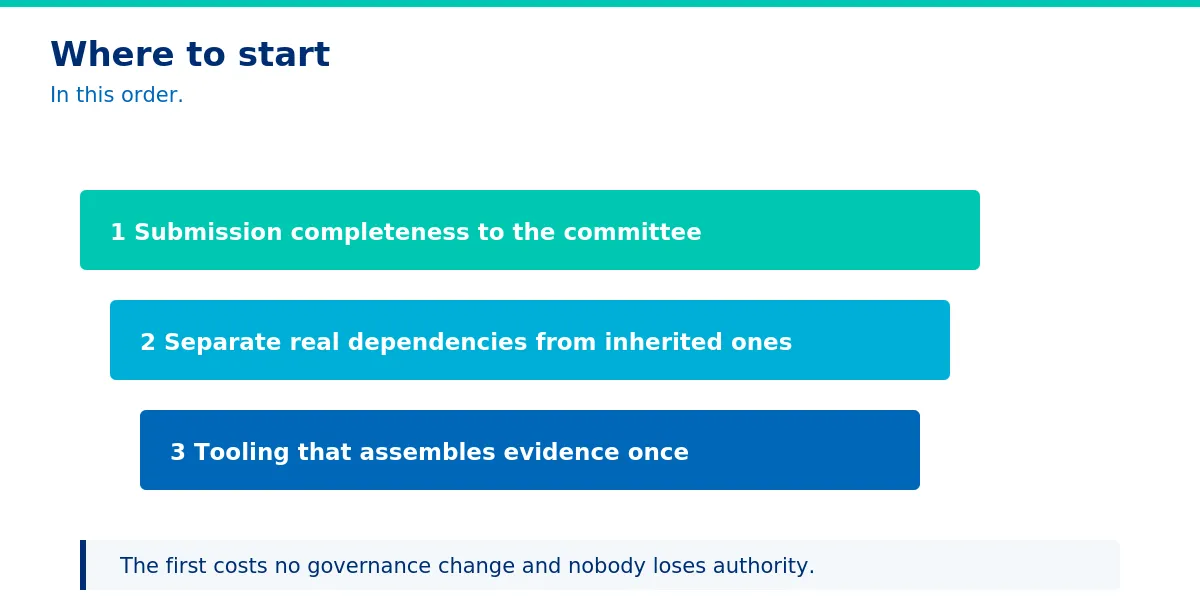
Figure 3: The order to work in.
Successfully trying to compress healthcare RFP cycle durations requires distinguishing between immutable constraints, like regulatory reviews and clinical evaluation durations—and the avoidable friction of sequential habits and incomplete committee submissions. By focusing your improvement efforts on submission completeness and assembling evidence once at intake, you can recover weeks of lost calendar time without requiring any governance changes or stripping reviewers of their authority.
Ready to eliminate redundant handoffs and streamline your health system’s purchasing strategy? Request a demo today to see how Merlin Agentic Sourcing builds RFP-ready strategies from day one
Frequently asked questions
1. Can healthcare RFP cycles be shortened?
Partly. The portion set by clinical evaluation duration, regulatory review, contract negotiation, and capital planning windows is fixed. The portion set by committee waiting, sequential handoffs, and repeated information gathering is discretionary and usually larger. Targeting the fixed portion produces missed targets and lost credibility.
2. What is the fastest part of a healthcare sourcing cycle to improve?
Submission completeness to the value analysis committee. A submission that is deferred for missing information costs an entire committee cycle, often a month, and completeness sits entirely within procurement’s control. It requires no governance change and no reviewer gives up authority.
3. Why does security review take so long in healthcare?
Usually because the same vendor is assessed from scratch on each project, since no shared record of previous assessments exists. The regulatory obligation itself is fixed in scope but not in duration. Reusing prior assessment evidence for an unchanged vendor is the main available saving.
4. Should clinical evaluation be shortened to speed up sourcing?
No. Clinical evaluation is a duration rather than a queue, and compressing it produces a weaker evaluation rather than a faster one. It is also the stage most likely to determine whether the product is adopted successfully after purchase, so time removed there tends to reappear later as an adoption problem.
5. How do you measure a healthcare sourcing cycle properly?
Measure elapsed time within each stage and waiting time between stages as two separate numbers. Most organizations track only total cycle time, which conceals the split. The waiting figure is the addressable pool and it is typically larger than the working figure.
6. What is the difference between cycle time and effort in procurement?
Effort is the hours of work performed. Cycle time is the calendar elapsed from start to finish. In healthcare sourcing the gap between them is wide, which is why procurement teams and clinical stakeholders often disagree about whether a process is slow. Both are describing the same cycle from different positions.
7. Do public health systems have less room to compress?
Generally yes. Statutory posting periods, formal protest windows, and prescribed evaluation procedures add fixed time that private systems do not carry. The discretionary portion still exists, and committee waiting and repeated information gathering behave the same way in both settings.
8. Does technology shorten healthcare sourcing cycles?
It shortens the discretionary portion by removing repeated information gathering and by making submissions complete on first pass. It does not shorten regulatory review, clinical evaluation duration, or negotiation with a counterparty. Any claim that it halves an end-to-end cycle should be checked against which portion it is actually addressing.