




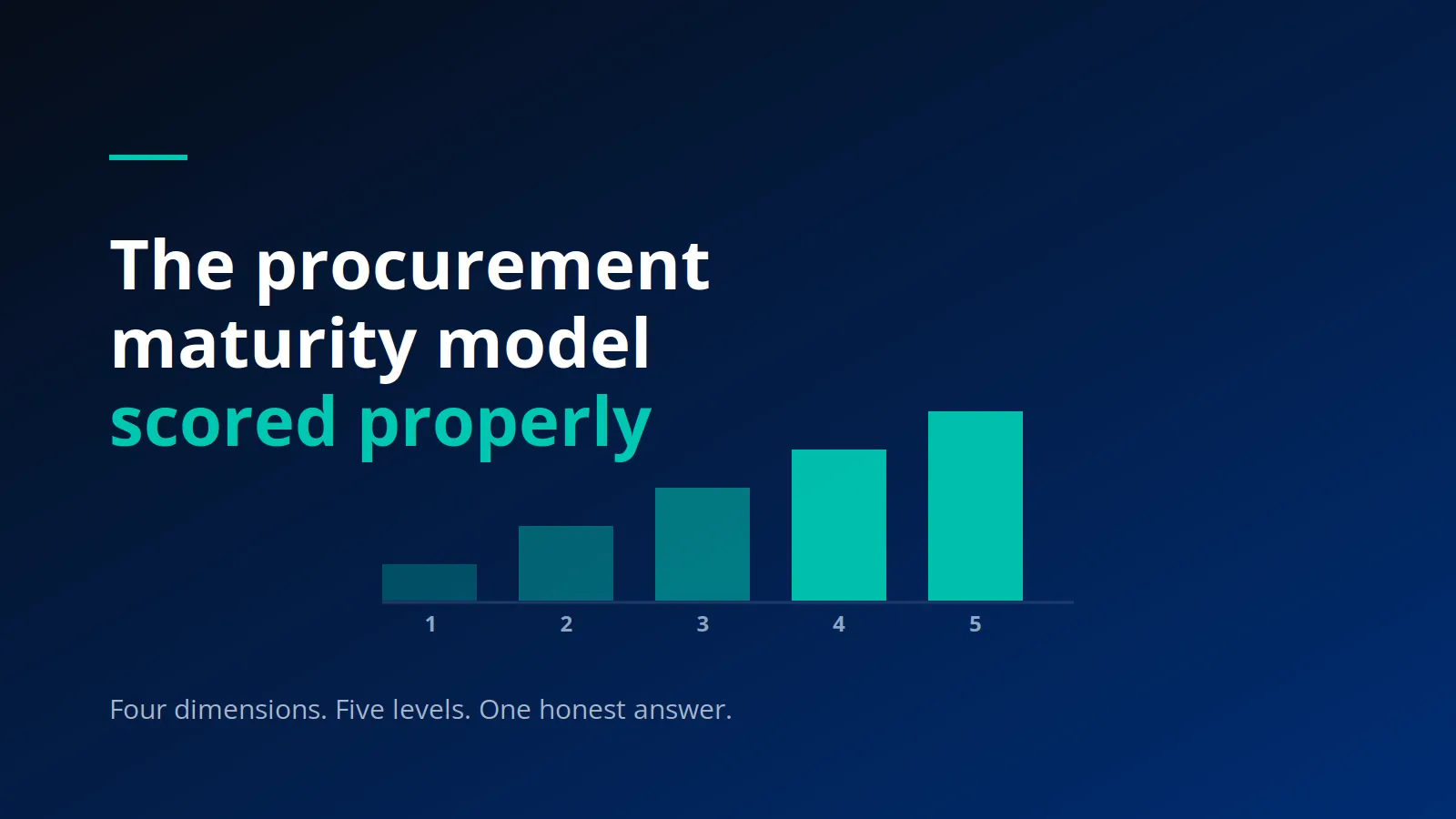

Most maturity models describe five stages and stop there. Here is a version you can actually score yourself against, across the four dimensions that separate leading procurement functions from everyone else.
TL;DR
- A procurement maturity model is a framework that scores how advanced a procurement function is, usually across five levels from manual and reactive to autonomous and outcome-driven.
- Most published models describe the stages well and leave out the part that matters: how to work out which one you are in.
- Four dimensions do the real separating. Stack consolidation, whether requests have one front door, how much runs without a human, and how tail spend is handled.
- The gap between top and bottom is wider than most leaders assume. APQC benchmarking shows organizations spend anywhere from about $14 to more than $54 to process a single purchase order.
- Self-scoring has a built-in flaw. Almost everyone places themselves above the middle, which is arithmetically impossible and makes outside data worth paying for.
- Register for PLaN 2026 and you get your own Autonomous Sourcing Index score, built with The Hackett Group, within 24 hours of the close.
A procurement maturity model is a framework that scores how advanced a procurement function is across a set of defined dimensions, usually on a five-level scale running from manual and reactive at one end to autonomous and outcome-driven at the other. The point of one is not the label. It is working out what to fix first.
Most models do the describing well and the scoring badly. They tell you what Level 4 looks like in general terms, then leave you to decide whether your organization qualifies. That decision is where the usefulness leaks away, because the honest answer is usually “parts of us, sometimes, in some categories.”
This piece sets out a version you can score. Four dimensions, five levels, and a checklist at the end.
What a procurement maturity model measures?
Most frameworks share the same broad shape. Level 1 is manual and reactive, with spreadsheets, email approvals, and no reliable spend visibility. Level 2 adds basic systems and standard processes, usually in pockets. Level 3 brings an integrated source-to-pay platform and consistent process across categories. Level 4 adds intelligence, with analytics and AI supporting decisions rather than just recording them. Level 5 is autonomous execution, where agents run defined workflows end to end and people set direction rather than process transactions.
That shape is sound. The problem is that it describes an organization as a single point on a single line, and no real procurement function works that way. You can be at Level 4 on spend analytics and Level 1 on tail spend in the same quarter.
A model only becomes useful when it scores separate dimensions separately. That way the output is not a number you argue about in a steering committee. It is a map of where the gaps are.
That limitation bites hardest for teams growing faster than their systems. Our ebook on why crawl-walk-run maturity models stall mid-market procurement makes the case that the standard staged model holds those teams back rather than guiding them.
The four dimensions that actually separate leaders
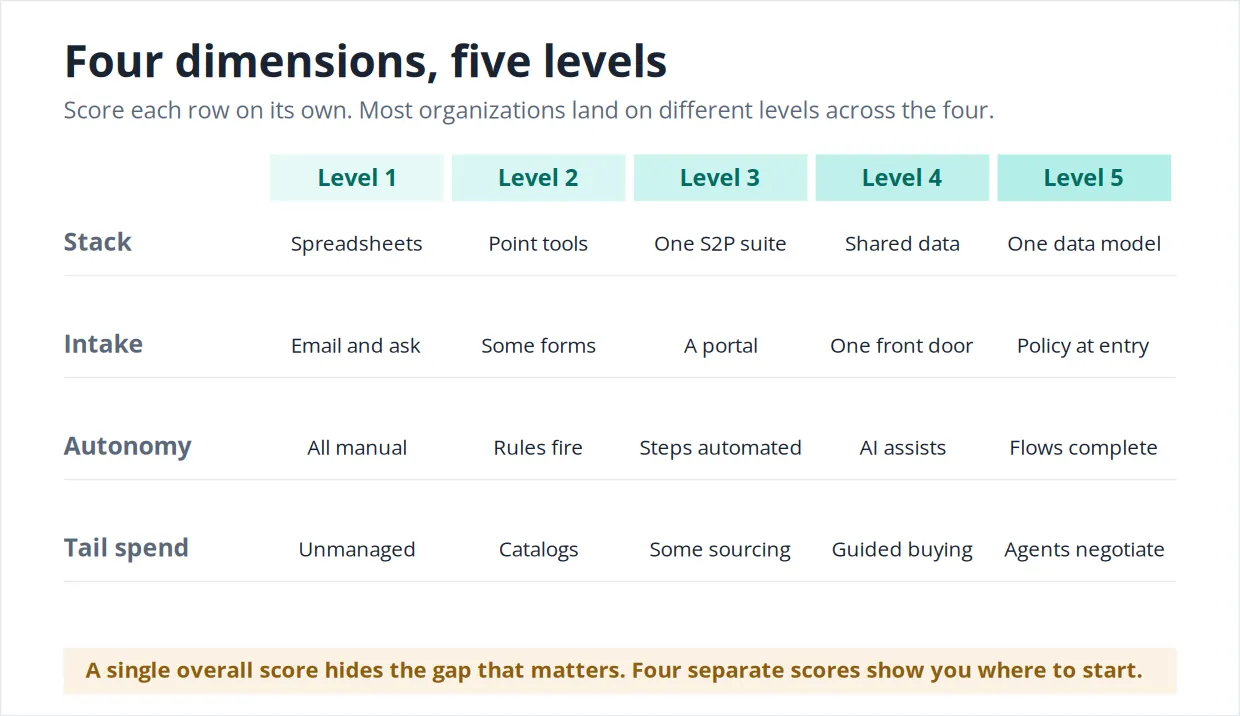
Figure 1: Four dimensions, five levels. Most organizations sit at different levels on each one.
1. Stack consolidation
How many systems does a single purchase pass through, and do they share a data model? This is the dimension most organizations overestimate.
The adoption numbers are lower than the market noise suggests. McKinsey’s survey of more than 300 procurement leaders found that only 60% of large organizations and 30% of small ones have a procure-to-pay system at all, and only about a third use e-sourcing systems. If the foundation is partial, everything built on top of it inherits the gaps.
2. The intake front door
When someone in the business needs something, where do they go? If the answer is “it depends who they ask,” you are earlier on this dimension than your technology stack suggests.
A single front door matters more than it sounds, because it is the point where policy gets applied. Without one, compliance becomes something you audit after the fact rather than something the process enforces. Organizations in the top quartile lose 60% less of their savings to maverick buying and contract noncompliance, according to The Hackett Group’s Digital World Class procurement research.
If intake is the dimension you score lowest, our whitepaper on intake management maturity works through the same scale in detail, from initial to optimized.
3. Degree of autonomy
What share of procurement work completes without a person touching it? Not assisted, not recommended. Completed.
This is the dimension with the most movement right now and the widest spread between organizations. It is also the one most often scored generously, because teams count AI-assisted steps as autonomous ones.
4. Tail spend handling
Tail spend is the test case for everything above, because it is where the economics of manual work break down. The transactions are too small to justify a sourcing event and too numerous to ignore. How an organization handles tail spend tells you whether its maturity is real or theoretical.
For a closer look at this one dimension, our autonomous sourcing maturity model breaks tail-spend automation into four stages with a short self-assessment.
The problem with scoring yourself
Self-scoring has a structural flaw. Most teams place themselves above the middle of the scale, and they cannot all be right. This is not dishonesty. People compare themselves to what they can see, and what most procurement teams can see is their own organization.
The result is that internal scores tend to be directionally useful and absolutely unreliable. You will correctly identify which of your own dimensions is weakest. You will not know whether your Level 3 is the market’s Level 3.
Outside data is what closes that gap, and the spread it reveals is usually a surprise. APQC benchmarking shows organizations spend anywhere from about $14 to more than $54 to process a single purchase order. That is close to a fourfold difference on one of the simplest measures in the function. Most teams at the expensive end do not know they are there.
What third-party benchmarking adds?
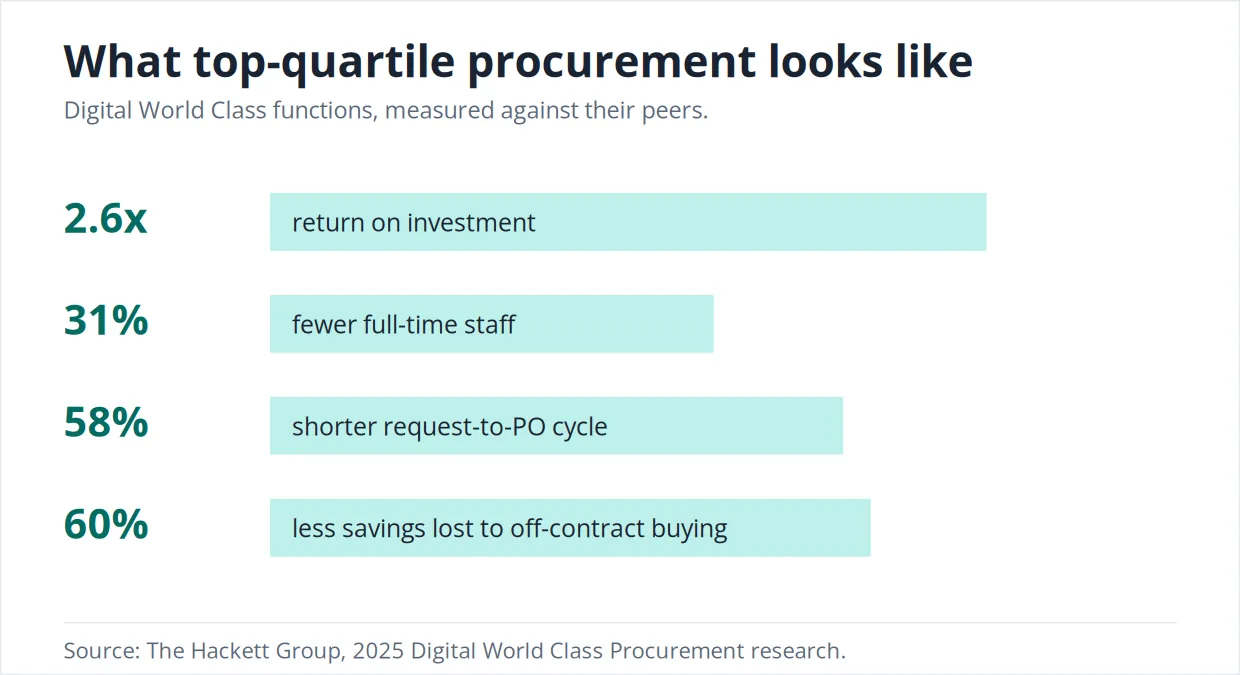
Figure 2: The measured gap between top-quartile procurement functions and their peers.
The case for external benchmarking is that it converts an opinion into a number other people will accept. A CFO will argue with “we think we are behind.” A CFO will engage with “we are at the 40th percentile on cycle time, and here is what the top quartile does differently.”
The size of the prize is documented. The Hackett Group’s Digital World Class procurement research found that top-quartile functions achieve 2.6 times the return on investment of their peers, operate with 31% fewer full-time employees, run 58% shorter requisition-to-purchase-order cycle times, and spend 1.8 times more on procurement technology. That last figure is worth sitting with. The leaders are not winning by spending less. They are winning by spending more on the right layer and getting more back.
McKinsey’s long-run data points the same way, finding that operating-model maturity correlates strongly with profitability, with leading functions contributing five percentage points or more of EBITDA margin impact.
What benchmarking costs is mostly time rather than money. A proper assessment means pulling cycle-time data, spend-under-management figures, and compliance rates into a consistent shape, which is usually several weeks of work for someone who already has a day job. Lightweight instruments trade some precision for speed, and for most organizations that is the right trade on a first pass.
How to run a procurement maturity assessment internally?
Score each dimension from 1 to 5 honestly, then have a second person score it independently without seeing your answers. Where the two disagree by more than one level, that dimension needs data rather than judgment.
Stack consolidation
- How many systems does a single purchase touch from request to payment?
- Do those systems share one supplier master, or does each hold its own?
- Can you answer a spend question across categories without exporting to a spreadsheet?
Intake front door
- What percentage of requests enter through one defined channel?
- Can a requester complete a request without knowing which process applies?
- Is policy applied at the point of request, or checked afterward?
Degree of autonomy
- What share of requests complete without a procurement person touching them?
- Which workflows run end to end today, and which only look automated?
- When an agent or rule acts, is there a log showing what it did and why?
Tail spend
- What proportion of suppliers account for the bottom 20% of spend?
- How many of those transactions go through a competitive process?
- What happens today to a request too small to justify a sourcing event?
Three questions per dimension, twelve in total. If you cannot answer one with a number, that is itself the finding.
Want the scored version? The Procurement Maturity Scorecard runs the same logic in six questions and gives you a preliminary score on the spot, no form needed. Five minutes, and you leave with a number instead of an impression.
What to do with the result?
The instinct after a procurement maturity assessment is to fix the lowest score. That is usually wrong.
Fix the front door first, whatever it scored. Intake sits upstream of everything else, so improvements downstream leak away without it. Automating a sourcing workflow that half the business bypasses just makes the compliant half faster.
Second, pick the dimension where the gap between you and the benchmark is widest rather than the one where your absolute score is lowest. A Level 2 on tail spend when the market is at Level 2 is not the urgent problem. A Level 3 on autonomy when the market has moved to Level 4 is.
Third, be realistic about what closing a level costs. Moving one level on one dimension is typically a two to four quarter program with a technology component, a process component, and a change-management component. Organizations that try to move every dimension at once generally move none of them.
Where autonomous procurement sits on the scale
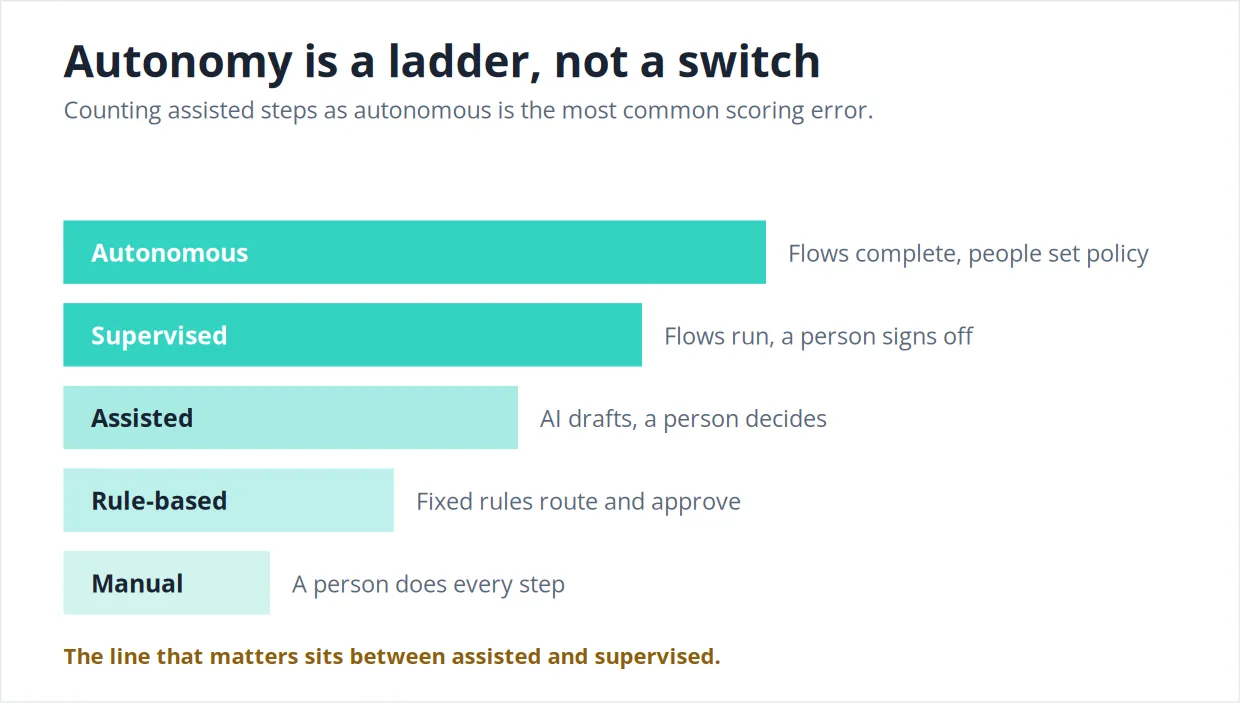
Figure 3: Autonomy is a ladder, not a switch. Most organizations are lower on it than they report.
Autonomous procurement is the top of the autonomy dimension, not a separate destination. It means defined workflows complete without human execution, with people setting policy and handling exceptions.
Check Merlin Autonomous Sourcing
The distinction that matters when scoring yourself is between assisted and autonomous. A tool that drafts an RFP for a buyer to review is assisted. A flow that identifies suppliers, runs the event, evaluates responses, and recommends an award while a human sets the guardrails is autonomous. Both are valuable. Only one moves you up a level.
McKinsey estimates AI agents could make the procurement function 25% to 40% more efficient, which is the size of prize driving current investment. Realizing it depends on the other three dimensions, because agents need a consolidated data layer to reason over, a single front door to receive work through, and clear ownership of what they are allowed to decide. That is the architectural case for treating maturity as four linked dimensions rather than one score.
If you want to see what this looks like running rather than described, the Merlin Agentic AI Platform is demonstrated live and unscripted at PLaN on 18 November, on a deliberately messy request. For a view of how organizations move up the autonomy dimension in practice, our ebook on autonomous sourcing adoption levels walks through the stages without assuming you start at the top.
For the AI dimension specifically, our AI procurement maturity model sets out five stages from manual processes to an AI-native operating model, along with how to judge organizational readiness.
Get your own score. At PLaN 2026 on 18 November, The Hackett Group launches the Autonomous Sourcing Index, a maturity instrument built on a survey of more than 100 CPOs. It scores the same four dimensions this article covers. Register, answer the intake questions, and your organization is placed on the scale and plotted against the global cohort, with a 2027 readiness plan, within 24 hours of the close. Free, virtual, three regional broadcasts.
Register for PLaN 2026 →
Frequently asked questions
What is a procurement maturity model?
A procurement maturity model is a framework that scores how advanced a procurement function is, typically across five levels running from manual and reactive to autonomous and outcome-driven. Stronger models score several dimensions separately rather than producing one overall number, because most organizations sit at different levels on technology, process, and automation.
What are the levels of procurement maturity?
Most models use five. Level 1 is manual and reactive, with spreadsheets and no reliable spend visibility. Level 2 adds basic systems and standard processes in pockets. Level 3 brings an integrated source-to-pay platform and consistent process. Level 4 adds analytics and AI that support decisions. Level 5 is autonomous execution, where defined workflows run end to end and people set direction.
How do I run a procurement maturity assessment?
A procurement maturity assessment scores four dimensions separately: how consolidated your technology stack is, whether requests enter through one front door, how much of your process completes without human execution, and how tail spend is handled. Have two people score independently and compare. Where scores differ by more than one level, that dimension needs data rather than judgment.
What is procurement digital maturity?
Procurement digital maturity measures how far a function has moved from manual processes to integrated, data-driven and automated ones. It covers whether systems share a data model, whether spend data is reliable without manual cleaning, and how much of the process runs without human intervention. It is one input into overall procurement maturity rather than the whole picture.
How do I benchmark procurement performance?
Start with measures that are defined consistently across organizations: requisition-to-purchase-order cycle time, cost to process a purchase order, spend under management, and savings lost to off-contract buying. Compare against published benchmarks from research firms, or use a third-party assessment that places you against a measured cohort. Internal trend data tells you if you are improving. Only external data tells you where you stand.
Why are most procurement maturity models hard to use?
Most describe the stages clearly but give no method for scoring yourself against them, so the assessment comes down to judgment. They also tend to produce one overall score, which hides the fact that a function can be advanced in analytics and basic in tail spend at the same time. A usable model scores dimensions separately and defines what evidence each level requires.
What is the difference between assisted and autonomous procurement?
Assisted means a tool helps a person complete work faster, such as drafting an RFP for review. Autonomous means a defined workflow completes without human execution, with people setting policy and handling exceptions. The distinction matters when scoring maturity, because counting assisted steps as autonomous is the most common way organizations overstate their level.
How long does it take to move up a procurement maturity level?
Moving one level on one dimension is typically a two to four quarter program involving technology, process redesign, and change management. Trying to move several dimensions at once generally slows all of them. Sequencing matters more than pace, and intake is usually the right first move because everything downstream depends on it.