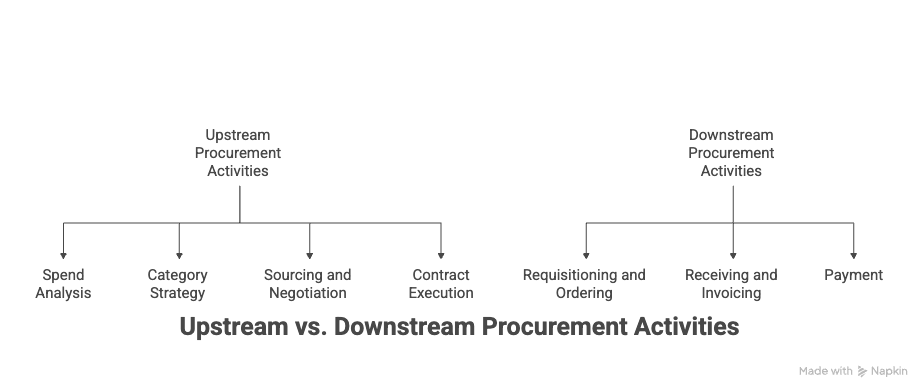
Upstream procurement refers to the strategic, pre-transactional activities in the procurement lifecycle — everything that happens before a purchase order is issued. This includes spend analysis, category strategy development, supplier identification, sourcing events, negotiations, and contract execution. Strategic upstream sourcing focuses on determining what to buy, from whom, and under what terms, setting the foundation for downstream purchasing and payment activities.
Read more: Source to Pay (S2P): A Complete End-to-End Procurement Guide
Why Upstream Procurement Matters in Procurement
The strategic decisions made upstream determine the value that can be captured downstream. By the time a purchase order is issued, most of the cost, quality, and risk profile is already locked in. Organizations that invest in upstream procurement — rigorous category strategies, competitive sourcing, and strong contracts — achieve better outcomes than those that focus only on transactional efficiency. For procurement leaders, upstream activities are where strategy meets execution, and where the greatest leverage exists to influence total cost and supplier performance.
The Core Process of Upstream Procurement
Upstream procurement begins with spend analysis and opportunity identification. Procurement examines historical spend, identifies high-value or high-risk categories, and prioritizes where strategic sourcing can deliver the greatest impact.
Category strategy development follows. For each priority category, procurement assesses the supply market, evaluates current suppliers, defines objectives, and develops a sourcing approach — whether that involves competitive bidding, negotiation, consolidation, or supplier development.
Sourcing execution translates strategy into supplier selection. This includes RFx processes, supplier evaluations, negotiations, and contract development. The goal is to secure agreements that deliver the value, terms, and risk profile defined in the strategy.
The upstream phase concludes with contract execution. Once terms are finalized and agreements are signed, the foundation is set for downstream procurement — requisitioning, ordering, receiving, and payment. Strong upstream work ensures downstream transactions deliver the intended value.
Core Components of Upstream Procurement
- Spend Analysis: The process of collecting, cleansing, and analyzing procurement data to understand what is being purchased, from whom, and at what cost.
- Category Strategy: A documented plan for how a spend category will be sourced and managed to achieve business objectives.
- Supplier Identification and Qualification: Finding and vetting potential suppliers who can meet requirements for quality, capacity, and reliability.
- Sourcing Execution: Running RFx events, evaluating proposals, and selecting suppliers based on defined criteria and strategy.
- Negotiation: Structured discussions with suppliers to reach an agreement on price, terms, service levels, and other contract elements.
- Contract Development: Drafting, reviewing, and finalizing supplier agreements that document the terms governing the relationship.
Key Benefits of Upstream Procurement
- Captures value at the point of greatest leverage — before commitments are made.
- Reduces total cost through competitive sourcing, negotiation, and supplier consolidation.
- Mitigates risk by qualifying suppliers and embedding protections in contracts.
- Aligns supplier selection with business strategy and category objectives.
- Establishes clear terms that simplify downstream purchasing and reduce disputes.
Common Pitfalls of Upstream Procurement
Skipping spend analysis: Without understanding current spend, category strategies are based on assumptions rather than facts.
Rushing sourcing events: Compressed timelines lead to incomplete supplier evaluations and weaker negotiated outcomes.
Weak contracts: Vague terms and missing protections create problems downstream. Invest in robust contract development.
Siloed strategy development: Category strategies developed without stakeholder input often fail to gain adoption or address real business needs.
KPIs of Upstream Procurement
| Dimension | Sample KPIs |
| Savings | Negotiated savings, cost avoidance, price reduction vs. baseline |
| Coverage | Spend under contract, categories with active strategies, sourcing pipeline value |
| Efficiency | Sourcing cycle time, time to contract, RFx completion rate |
| Quality | Supplier qualification pass rate, contract compliance at execution |
Key Terms in Upstream Procurement
- Downstream Procurement: The transactional activities that follow upstream strategy — requisitioning, ordering, receiving, invoicing, and payment.
- Spend Analysis: The process of examining procurement data to understand spending patterns and identify opportunities.
- Category Strategy: A plan for sourcing and managing a specific spend category to achieve defined objectives.
- Strategic Sourcing: A systematic approach to supplier selection based on total value rather than lowest price.
- RFx: A general term covering Requests for Information, Proposals, and Quotations used to solicit supplier responses.
- Spend Under Contract: The percentage of procurement spend covered by negotiated supplier agreements.
Technology Enablement
Modern Source-to-Pay platforms unify upstream and downstream procurement. Strategic upstream sourcing activities — spend analysis, sourcing, and contract management — feed directly into downstream requisitioning and purchasing, ensuring that negotiated terms are automatically applied to transactions.
FAQs
Q1. What is upstream procurement?
The strategic, pre-transactional activities in procurement — spend analysis, category strategy, sourcing, negotiation, and contracting — that occur before purchase orders are issued.
Q2. How is upstream different from downstream procurement?
Upstream focuses on strategy and supplier selection. Downstream covers transactional execution — ordering, receiving, invoicing, and payment.
Q3. Why is upstream procurement important?
Because strategic decisions made upstream determine the cost, quality, and risk profile of purchases. Value is captured before transactions occur.
Q4. What is spend under contract?
The percentage of total procurement spend covered by negotiated agreements, indicating how much spend benefits from upstream sourcing efforts.
Q5. Who is responsible for upstream procurement?
Typically strategic sourcing, category management, or procurement teams focused on supplier selection and contracting rather than transactional purchasing.
Q6. How long does the upstream process take?
It varies by category complexity. Simple categories may take weeks; strategic categories with significant spend or risk may require months of analysis and negotiation.
References
For further insights into these processes, explore Zycus’ dedicated resources related to Upstream Procurement:
- The Why, What and How of Supplier Management – Part 6: Implementation Best Practices
- The P2P Balancing Act: What Users Want – What the Business Needs?
- Two to tango – When Human meets Machine
- Redefining Oil and Gas Procurement Using AI (Artificial Intelligence) : Driving Strategic Procurement in the New Normal
- IDC Recognizes Zycus’s AI Impact in Norfolk County