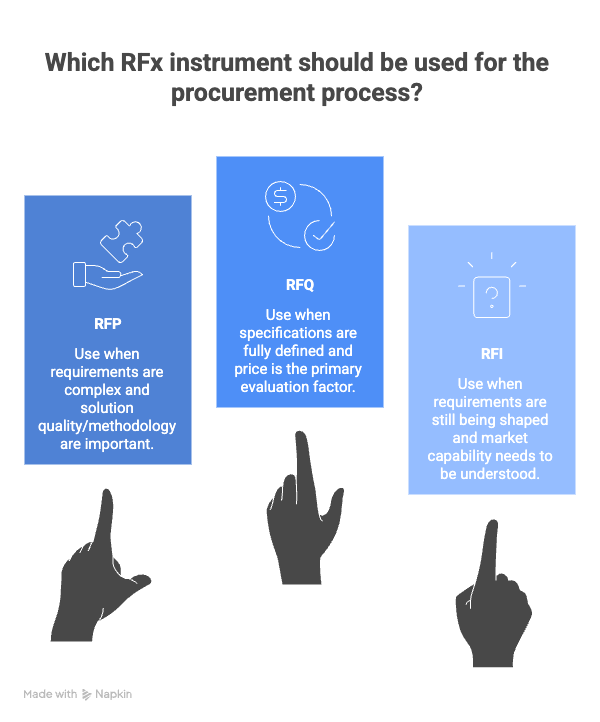
A Request for Proposal (RFP) is a formal procurement document that invites suppliers to propose solutions, methodologies, and pricing for a defined business requirement. Unlike a Request for Quotation, which asks only for price on a fixed specification, an RFP presents the business need and invites suppliers to describe how they would address it — including their approach, team, qualifications, and commercial terms. RFPs are the primary sourcing instrument for complex services, technology solutions, and requirements where the solution is not fully defined in advance.
Why RFP in Business Matters in Procurement
The RFP is one of procurement’s most versatile and widely used tools. When requirements are too complex or undefined for a simple price request, the RFP creates a structured competitive process that surfaces market capability, establishes objective evaluation criteria, and produces comparable proposals from multiple suppliers. For services, technology, and professional engagement categories, the RFP is typically the most appropriate sourcing instrument — generating the combination of solution quality and commercial competitiveness that neither pure price bidding nor negotiation alone can achieve.
Read more: RFI, RFQ, and RFP Explained: A Practical Guide
The Core Process of RFP in Business
- Requirements Definition: The RFP process begins with a clear articulation of the business need — what outcome is required, what constraints apply, and what evaluation dimensions matter most. Poorly defined requirements produce non-comparable proposals. Time invested here is the single greatest determinant of RFP quality.
- RFP Document Development: The requirements are translated into an RFP document covering: scope of work, evaluation criteria and weightings, proposal structure requirements, submission timeline, contractual terms, and pricing instructions. Clear document structure enables suppliers to respond efficiently and evaluators to compare responses objectively.
- Supplier Identification and Issuance: The RFP is issued to a shortlist of pre-qualified suppliers capable of meeting the requirements. The shortlist may be drawn from a pre-qualification exercise, an approved supplier list, or a market scan. A shortlist of three to six suppliers typically balances competition with evaluation manageability.
- Proposal Evaluation and Selection: Proposals are scored against the published criteria by a panel including procurement and business stakeholders. Scores are documented, references checked for shortlisted suppliers, and the evaluation output supports a defensible award recommendation.
Core Components of RFP in Business
- Scope of work describes what the selected supplier will deliver — outcomes, deliverables, service standards, timelines, and constraints. A well-drafted scope is specific enough to enable comparable pricing but not so prescriptive that it excludes innovative approaches.
- Evaluation criteria and weightings define how proposals will be scored across technical quality, experience, methodology, and price. Publishing criteria in the RFP document creates a fair, transparent process and protects the award decision from challenge.
- Pricing structure requests commercial information in a format that enables comparison — rate cards, fixed-fee proposals, milestone-based payments, or outcome-based pricing — depending on the nature of the engagement.
- Proposal submission requirements specify format, length, section structure, and deadline, ensuring that evaluators receive responses in a consistent form that facilitates side-by-side comparison.
Key Benefits of RFP in Business
- Creates a structured, competitive process for complex requirements where price alone is insufficient to differentiate suppliers.
- Surfaces market capability and innovative solution approaches that procurement may not have anticipated in requirements development.
- Produces a documented, defensible evaluation record that supports award decisions and responds to challenges.
- Establishes objective evaluation criteria that reduce subjectivity in supplier selection and build stakeholder confidence in the outcome.
Common Pitfalls of RFP in Business
- Issuing an RFP before requirements are sufficiently defined: Vague RFPs produce non-comparable proposals, subjective evaluation, and contracts more likely to experience scope disputes.
- Evaluating proposals on price alone: For services and complex solutions, the lowest-priced proposal is rarely best value. Evaluation must weight quality, methodology, and risk alongside price.
- Not sharing evaluation criteria with suppliers in advance: Suppliers who do not know how they will be scored cannot tailor their proposals effectively, reducing response quality and evaluation reliability.
KPIs of RFP in Business
| Dimension | Sample KPIs |
| Process Quality | Supplier response rate, # of compliant proposals received, clarification request volume |
| Evaluation Integrity | % of evaluations with documented scoring, inter-evaluator score variance |
| Cycle Time | RFP issue to award timeline, time from requirements sign-off to RFP issuance |
| Outcome Quality | Contract performance vs. proposal commitments, post-award scope change frequency |
Key Terms in RFP in Business
- Request for Proposal (RFP): A formal sourcing document that invites suppliers to propose solutions, methodologies, and pricing for a defined business requirement.
- Request for Quotation (RFQ): A sourcing document that requests price only for a fully specified requirement, used when evaluation is primarily or exclusively on cost.
- Invitation to Tender (ITT): A formal sourcing document that invites binding bids on a complete specification, typically used in regulated or public sector procurement.
- Evaluation Panel: A group of procurement and business stakeholders who collectively assess and score supplier proposals against published criteria.
- Proposal Weighting: The relative importance assigned to each evaluation criterion, defining how quality, methodology, and price contribute to the overall score.
- Shortlist: A curated list of pre-qualified suppliers invited to respond to an RFP, typically three to six in number to balance competition with evaluation manageability.
Technology Enablement
Source-to-Pay platforms support the RFP process through e-sourcing modules that manage document issuance, supplier portals for proposal submission, structured evaluation scorecards, and audit trail generation. These tools reduce administrative overhead, improve evaluation consistency, and create the documented evidence base needed to support award decisions and respond to supplier challenges.
FAQs
Q1. What is an RFP in business?
A formal document inviting suppliers to propose solutions, methodologies, and pricing for a defined requirement — used when the solution is not fully defined in advance.
Q2. How is an RFP different from an RFQ?
An RFQ asks for price on a fixed specification. An RFP asks suppliers to propose a solution to a defined need, evaluating both quality and price.
Q3. When should an organization use an RFP?
When requirements are complex or partially defined, supplier methodology and experience matter, and evaluation needs to consider quality dimensions beyond price.
Q4. How many suppliers should be invited to respond to an RFP?
Three to six is typical. Fewer reduces competitive tension; more increases evaluation burden and may deter quality suppliers from investing in a response.
Q5. Should evaluation criteria be shared with suppliers?
Yes. Publishing criteria and weightings in the RFP document enables suppliers to tailor their responses appropriately and makes the evaluation process transparent and defensible.
Q6. What happens after an RFP evaluation is complete?
The highest-scoring compliant proposal is recommended for award. The recommendation is documented, references checked, and unsuccessful suppliers notified following any required standstill period.
References
For further insights into these processes, explore Zycus’ dedicated resources related to RFP in Business: