WHAT IS OTIF AS A SUPPLIER KPI?
OTIF (on-time in-full) is a supplier performance measure showing the percentage of deliveries or order lines that arrive both within the agreed delivery window and in the full ordered quantity. Buyers use it on a supplier scorecard to judge reliability.
WHY IT MATTERS IN PROCUREMENT
A late delivery and a short delivery cause the same damage to the buyer: stock-outs, idle production, expediting costs and unhappy internal customers. Measuring each separately can hide the problem, because a supplier can look good on timeliness while shipping incomplete orders.
OTIF combines both tests in one number, so a delivery counts only if it passed both. That makes it a clear, comparable measure for supplier scorecards and a fair basis for performance conversations.
THE CORE PROCESS / LIFECYCLE
- Agree the Definitions. Buyer and supplier settle what counts as on time, what counts as in full, and what unit is counted: deliveries, orders or order lines.
- Capture the Promise. The measurement date is recorded, either the date the buyer requested or the date the supplier confirmed.
- Record the Delivery. Actual arrival date and received quantity are taken from the goods receipt, so the data comes from the receiving record and not from the supplier.
- Score Each Unit. Each delivery passes only if it is inside the window and meets the quantity rule. Otherwise it fails, and the reason is logged.
- Calculate the Percentage. Passing deliveries are divided by total deliveries in the period, then multiplied by 100.
- Review and Act. Results go onto the supplier scorecard. Failures are grouped by cause, and the buyer agrees improvement actions with the supplier.
CORE COMPONENTS
- On-time window is the allowed range around the due date, such as same day or a few days either side.
- In-full rule sets whether the quantity must match exactly or within a tolerance.
- Unit of count states whether the score counts deliveries, orders or order lines.
- Reference date says whether lateness is measured against the requested or the promised date.
- Data source is normally the goods receipt, which gives an independent record.
- Failure reasons explain misses, such as supplier delay, buyer change or carrier issue.
KEY BENEFITS
OTIF gives buyers one fair, comparable measure of reliability across suppliers. It highlights those causing disruption and rewards those that deliver as promised.
It also gives suppliers a clear target and shows the buyer where its own behavior, such as late order changes, causes misses. Used consistently, it supports supplier performance management discussions with evidence instead of impressions.
COMMON PITFALLS
- Using different definitions. If the window or quantity rule varies by buyer or site, scores cannot be compared and suppliers dispute them.
- Measuring against the wrong date. Scoring against the supplier’s own promise can hide late deliveries that missed what the buyer actually needed.
- Using supplier-reported data. Take arrival and quantity from the goods receipt, or scores reflect the supplier’s view of its own performance.
- Ignoring buyer-caused misses. Late changes and unclear orders can create failures, so log the reason before holding the supplier to account.
WORKED EXAMPLE: SCORING OTIF UNDER TWO DEFINITIONS
The same deliveries can produce different scores depending on the rules. The figures below are illustrative. OTIF equals the number of deliveries that were on time and in full, divided by total deliveries, multiplied by 100.
| Illustrative delivery | Arrives | Quantity | Strict rule | Agreed rule |
| Delivery 1 | On due date | 100 of 100 | Pass | Pass |
| Delivery 2 | One day late | 100 of 100 | Fail | Pass |
| Delivery 3 | On due date | 98 of 100 | Fail | Pass |
| Delivery 4 | On due date | 90 of 100 | Fail | Fail |
| OTIF result | 25 percent | 75 percent |
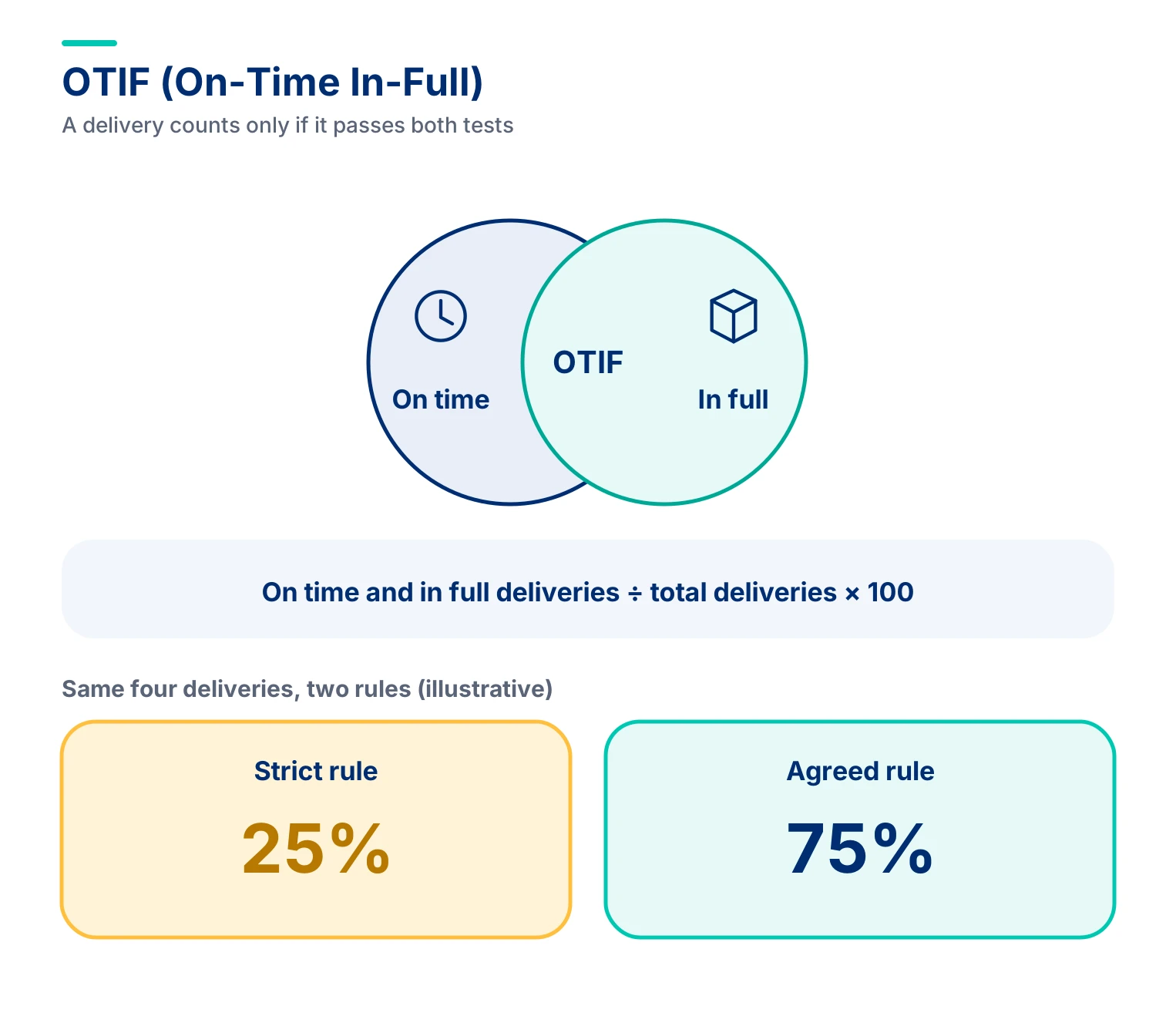
Here the strict rule needs the exact due date and exact quantity. The agreed rule allows a window of one day late and a quantity within 2 percent. The supplier did not change, but the score did. Write the window, the quantity rule and the unit of count into the supplier agreement or scorecard guide, and apply them the same way to every supplier in a category.
KPIs
| Dimension | Sample KPIs |
| OTIF rate | Percentage of deliveries on time and in full, by supplier and category |
| Component split | On-time rate and in-full rate shown separately to locate the cause |
| Failure reasons | Misses by cause: supplier, buyer, carrier or data error |
| Trend | OTIF movement over time; suppliers below target for consecutive periods |
KEY TERMS
- On-Time Delivery. Share of deliveries arriving within the agreed window.
- In-Full. Delivered quantity meets the ordered quantity under the agreed rule.
- Delivery Window. The permitted range of dates around the due date.
- Supplier Scorecard. A structured view of supplier performance across agreed measures.
- Promise Date. The date the supplier commits to deliver.
- Requested Date. The date the buyer asks for delivery.
- Order Line. One item and quantity within a purchase order.
- DIFOT. Delivery in full, on time, an alternative name for the same type of measure.
FAQs
1. What is OTIF (On-Time In-Full) in procurement?
OTIF (On-Time In-Full) is a supplier performance KPI that measures the percentage of orders or deliveries received within the agreed delivery window and in the required quantity. A delivery qualifies only when both conditions are met. Procurement teams use OTIF to evaluate supplier reliability, identify delivery failures, and reduce supply chain disruptions. It is commonly included in supplier scorecards to monitor fulfillment performance and improve supplier accountability.
2. How do you calculate the OTIF percentage?
OTIF is calculated by dividing the number of deliveries completed on time and in full by the total deliveries measured, then multiplying by 100.
OTIF Formula = (On-Time and In-Full Deliveries ÷ Total Deliveries) × 100
For example, if a supplier completes 90 out of 100 deliveries within the agreed timeframe and quantity requirements, its OTIF score is 90%. Organizations should apply consistent measurement rules to ensure accurate supplier comparisons.
3. What is a good OTIF score for supplier performance?
A good OTIF score depends on industry requirements, product criticality, delivery expectations, and contractual service levels. There is no universal benchmark suitable for every supplier. Procurement teams should establish realistic OTIF targets based on historical performance, business needs, and agreed delivery tolerances. Consistently meeting or exceeding these targets indicates reliable supplier fulfillment, while declining scores may signal delivery risks requiring corrective action.
4. What is the difference between OTIF and on-time delivery?
On-time delivery measures whether shipments arrive within the agreed delivery window, regardless of quantity. OTIF measures whether deliveries arrive both on time and with the required quantity. For example, a shipment arriving on schedule with only 90 of 100 ordered units satisfies the timing requirement but fails OTIF if no quantity tolerance applies. OTIF provides a more comprehensive measure of supplier fulfillment reliability.
5. What counts as on time and in full when measuring supplier OTIF?
An on-time delivery arrives within the agreed delivery window, measured against the requested or confirmed delivery date. An in-full delivery meets the ordered quantity or an explicitly permitted tolerance. For example, a contract may allow delivery one day late and accept quantities within 2% of the order. Procurement teams should document these rules and measurement units to ensure consistent, comparable OTIF scores.
6. What are the most common causes of poor OTIF performance?
Poor OTIF performance can result from supplier production delays, inventory shortages, transportation disruptions, incomplete shipments, and inaccurate delivery planning. Buyer-related issues, including last-minute order changes and unclear specifications, can also contribute. Procurement teams should analyze failure reasons using goods receipt records, distinguish supplier-controlled problems from external disruptions, and develop corrective action plans. Tracking recurring failures helps improve delivery reliability and reduce operational risks.
7. How can procurement teams track and improve supplier OTIF performance?
Procurement teams can improve OTIF performance by establishing standardized delivery targets, monitoring goods receipt data, and regularly reviewing supplier scorecards. Tracking on-time and in-full performance separately helps identify whether delays or quantity shortages are driving failures. Teams should investigate recurring issues, agree on corrective actions with suppliers, and monitor performance trends over time. Consistent measurement and supplier collaboration help strengthen delivery reliability and reduce supply chain disruptions.