WHAT IS CONFIRMATION OF PAYEE?
Confirmation of Payee (CoP) is a UK name-checking service that compares the payee name a payer enters with the name on the receiving bank account before a payment is sent. It returns a match, close match or no match result, and helps banks reduce misdirected payments and fraud.
WHY IT MATTERS IN PROCUREMENT
Before CoP, a UK payer could not see whether a name agreed with the sort code and account number. The payment went wherever the numbers pointed. Supplier payments are exposed to this because bank details change by email and invoices are paid in volume.
CoP is led by regulation. The Payment Systems Regulator (PSR) directed a defined set of payment providers to offer it, and Pay.UK sets the rules and standards. The check usually runs inside the bank’s channel, so procurement’s role is to give AP and treasury the exact account name and to support payment fraud controls. Scope and dates have changed more than once, so confirm the current position with your bank.
THE CORE PROCESS / LIFECYCLE
- Collect Payee Details. The payer’s team gets the sort code, account number and exact account name from the supplier through a controlled channel. For business accounts, the name is the one on the bank account, which can differ from the trading name.
- Enter or Change the Payee. A user adds the supplier as a new payee, or changes an existing payee’s details, in the bank’s online channel. Providers covered by the PSR direction must send a check when a new payee is added or a payee’s identifiers change.
- Bank Sends the Request. The payer’s bank passes the name and account details to the receiving bank, which compares the name with the account holder.
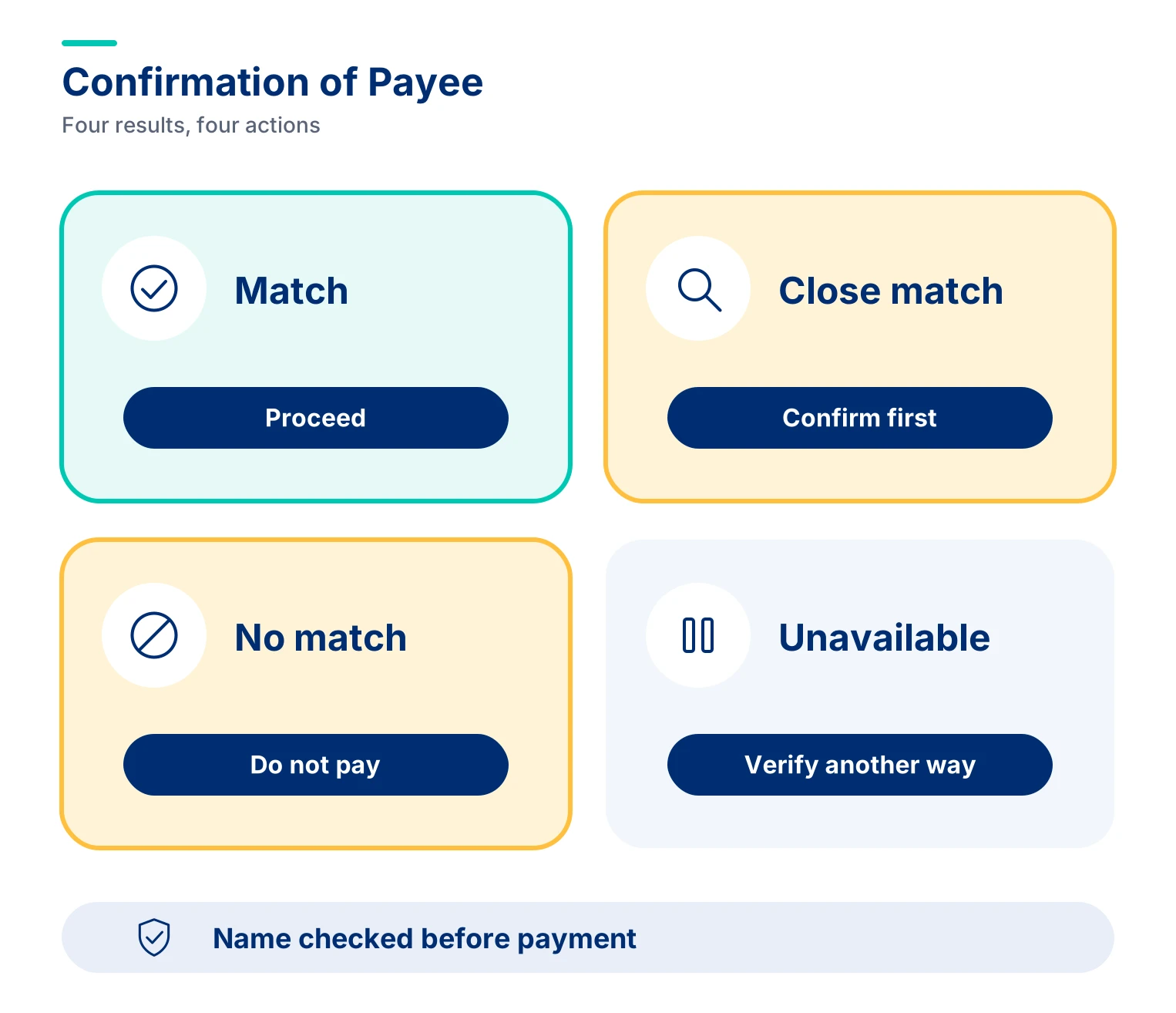
- Read the Result. The payer sees match, close match, no match or unavailable. A close match shows the actual account name, so the payer can correct the entry or check with the supplier.
- Act and Record. On a match, proceed. On anything else, contact the supplier on a number already on file before paying, and record the result and follow-up.
CORE COMPONENTS
- The name check compares the entered name with the account name.
- The four results are match, close match, no match and unavailable.
- Scope rules set which payments and providers are covered, as defined by the PSR direction and Pay.UK standards.
- The payer channel is where the result appears, usually online banking.
- Supplier-held data is the exact account name and details that procurement keeps on file in the supplier record.
KEY BENEFITS
A name check at setup gives a second line of defence against wrong-account payments. Mismatches surface before money leaves, when correction is cheap and no recovery is needed.
It also improves supplier records. Teams that hold the exact bank account name see fewer close matches and fewer payment holds.
COMMON PITFALLS
- Treating a match as full verification. CoP shows the name agrees with the account. It does not show that the supplier asked for the change.
- Ignoring close matches. A similar name can still belong to the wrong party, so a close match needs a human check.
- Assuming every payment run is checked. The PSR direction covers Faster Payments and CHAPS and lists bulk payments among exempt transactions, so confirm coverage for the way you pay.
- Holding the trading name instead of the account name. Business accounts are matched on the name held by the bank, which may differ from how the supplier trades.
WHAT EACH CONFIRMATION OF PAYEE RESULT MEANS FOR AP
Use the result to decide the next step. Never proceed on a no match because a requester says to ignore it.
| Result | What it tells you | Typical AP action |
| Match | The name agrees with the account | Proceed and keep the record |
| Close match | The name is similar and the actual name is shown | Confirm with the supplier on a known number before paying |
| No match | The name does not agree with the account | Do not pay until the details are confirmed |
| Unavailable | The check could not be done, for example a timeout, opt-out, non-existent account or provider not enabled | Verify by another method, such as a bank letter or call-back |
KPIs
| Dimension | Sample KPIs |
| Coverage | Share of new payees checked; suppliers with account name on file |
| Outcome | Match rate at first attempt; close match and no match counts |
| Control | No match results resolved before payment; unavailable results verified another way |
| Quality | Payments returned for wrong account details |
KEY TERMS
- Pay.UK. The body that oversees Confirmation of Payee and sets its rules and standards for the industry.
- Payment Systems Regulator. The UK regulator that directs payment providers to offer Confirmation of Payee.
- Faster Payments. The UK system for near real-time bank transfers.
- CHAPS. The UK system for high-value same-day payments.
- Sort Code. A six-digit number that identifies a UK bank branch.
- Payee. The person or organization receiving a payment.
- Close Match. A result showing the name is similar but not identical to the account name.
- Bulk Payment. A file containing many payments sent together, such as a supplier payment run.
FAQs
1. What is Confirmation of Payee (CoP) in the UK?
Confirmation of Payee (CoP) is a UK banking verification service that checks whether a recipient’s name matches the name registered to the receiving bank account before payment. It compares the payee’s name, sort code, and account number to help prevent misdirected payments and certain types of fraud. Procurement and accounts payable teams use CoP to improve supplier payment accuracy and identify suspicious bank account details.
2. How does the Confirmation of Payee process work?
Confirmation of Payee works when a payer adds a new recipient or changes existing bank account details through a supported banking channel. The payer’s bank sends the recipient’s name and account information to the receiving bank for verification. The system returns a match, close match, no match, or unavailable result. Businesses use these results to confirm payment details, investigate discrepancies, and reduce the risk of transferring funds to incorrect accounts.
3. What do match, close match, and no match mean in Confirmation of Payee?
Confirmation of Payee provides four possible verification results:
- Match: The recipient’s name matches the bank account details.
- Close match: The name is similar but requires confirmation.
- No match: The name does not match, so payment should be stopped until verified.
- Unavailable: Verification could not be completed and requires alternative checks.
Accounts payable teams should investigate discrepancies before authorizing supplier payments.
4. Can Confirmation of Payee prevent supplier payment fraud?
Confirmation of Payee helps prevent supplier payment fraud by identifying inconsistencies between recipient names and bank account details. It is particularly useful when suppliers request changes to their banking information. However, a successful match does not prove that a bank account change request is legitimate. Procurement and accounts payable teams should independently verify changes using previously established supplier contact details and maintain appropriate payment approval controls.
5. Is Confirmation of Payee mandatory for UK business payments?
Confirmation of Payee is mandatory for payment service providers covered by the UK’s Payment Systems Regulator requirements, rather than directly for businesses making payments. It primarily supports Faster Payments and CHAPS transactions when setting up new payees or changing their account identifiers. Certain transactions, including qualifying bulk payment arrangements, are exempt from the regulatory requirement. Businesses should confirm CoP coverage with their banking providers.
6. Does Confirmation of Payee work for international supplier payments?
Confirmation of Payee primarily applies to payments between UK bank accounts and does not generally cover standard international bank transfers. An overseas supplier receiving payment into a supported UK account may still benefit from CoP verification. For cross-border payments, businesses may need alternative checks such as IBAN validation, beneficiary verification, or independent bank account confirmation. Procurement teams should verify international supplier banking details before releasing payments.
7. What is the difference between Confirmation of Payee and bank account verification?
Confirmation of Payee is a specific UK name-checking service that compares a recipient’s name against the account details held by the receiving bank. Bank account verification is a broader process that may include checking account existence, ownership, validity, and supplier authorization. While CoP helps detect name mismatches, it does not independently establish supplier identity or confirm that requested banking changes are legitimate. Businesses should use both within supplier payment controls.