WHAT IS TIN MATCHING?
TIN Matching is an IRS e-services program that lets authorized payers check whether a vendor’s name and taxpayer identification number (TIN) combination agrees with IRS records before they file information returns. It helps accounts payable catch bad data before it causes penalties or backup withholding.
WHY IT MATTERS IN PROCUREMENT
Incorrect or missing TINs are a common cause of information return errors. When the IRS tells a payer that a payee’s name and TIN do not match, the payer must follow a set notice process and may have to begin backup withholding.
TIN Matching lets the payer find mismatches earlier. It sits alongside a collected W-9, not in place of it. Access is limited to eligible payers and their authorized agents, so confirm eligibility on IRS.gov and read AP compliance guidance with your tax team.
THE CORE PROCESS / LIFECYCLE
- Confirm Eligibility and Register. The payer or its authorized agent applies through the IRS e-services portal. Access needs an IRS online account and agreement to the program rules.
- Collect Name and TIN. AP gathers the W-9 data for each US vendor during onboarding. The name should be the one the IRS holds for that TIN, usually the name on the vendor’s tax return, not a trading name.
- Submit the Matches. Pairs can be entered one at a time through the interactive option or sent in a file through the bulk option, which suits a large vendor file.
- Review the Results. The IRS returns a result for each pair. A match supports the vendor record. A mismatch goes to vendor follow-up.
- Correct and Document. AP requests a corrected W-9, updates the vendor master and keeps a record of the check. Verified matches can support a reasonable-cause defense if penalties are assessed.
- Repeat Before Filing. Run checks on new vendors at onboarding and again on the full file before year-end filing, so corrections are made in time.
CORE COMPONENTS
Eligibility and registration control who may use the service. Name and TIN pairs are the inputs. Interactive and bulk channels serve small and large checks. Results report whether each pair matched. Confidentiality rules require the payer to protect what it receives. The checks work best when vendor data is already clean in the vendor master.
KEY BENEFITS
Finding a bad TIN in March is cheaper than finding it in January. Early checks mean fewer corrected returns, fewer IRS notices and less backup withholding to manage.
A recorded check also supports the payer’s position if penalties are questioned, and it teaches AP which intake sources produce poor data.
COMMON PITFALLS
- Matching a trading name. The IRS compares the name on the vendor’s tax records. A trading name produces false mismatches.
- Treating a match as identity proof. A match shows the name and TIN agree in IRS records. It does not show the person submitting the form is the taxpayer.
- Skipping the follow-up. A mismatch with no corrective step leaves the same bad data in the master and in the year-end filing.
- Assuming everyone is eligible. Access depends on IRS payer rules, so check eligibility before building a process around it.
WHAT TO DO WHEN A NAME AND TIN DO NOT MATCH
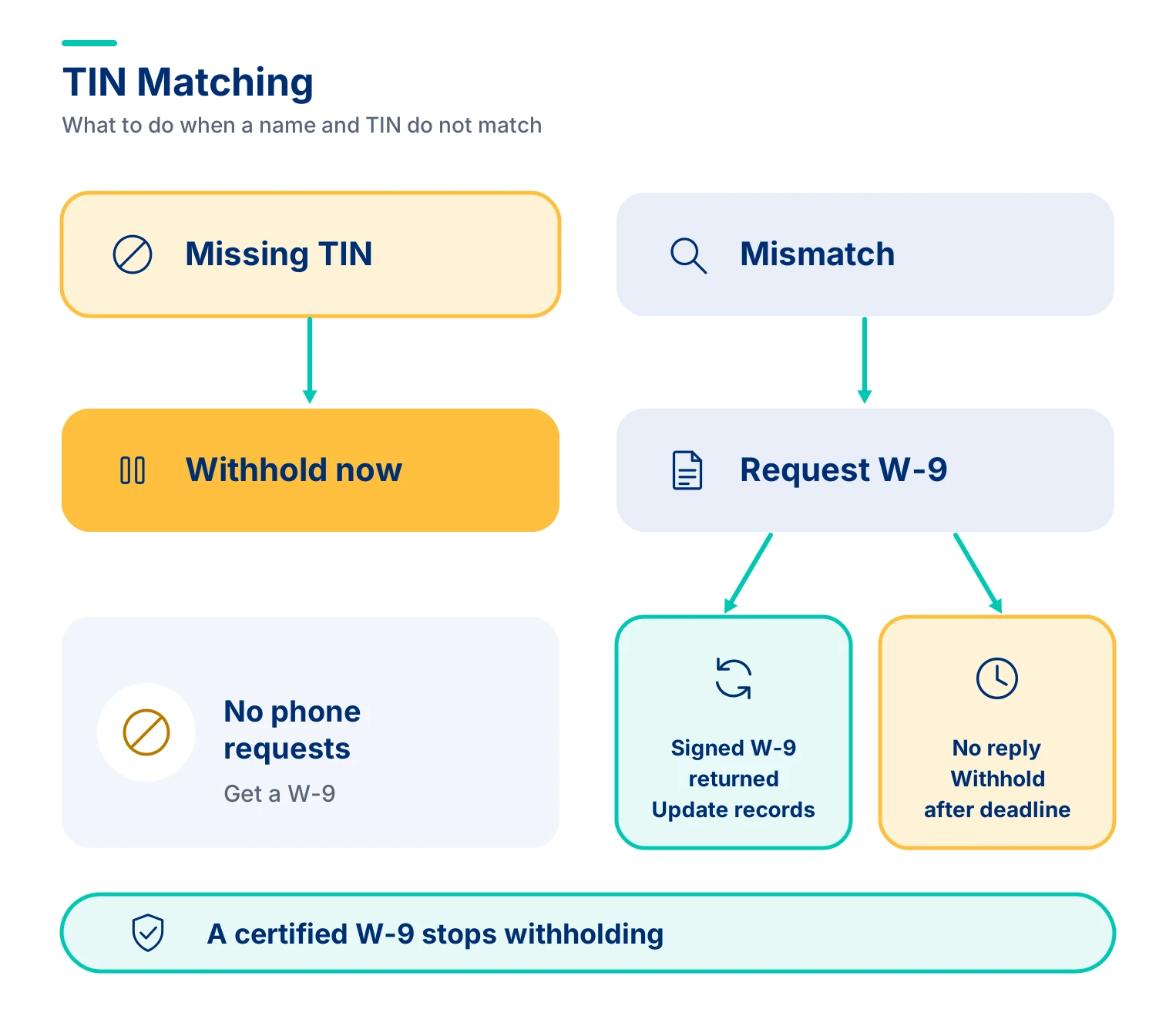
A mismatch from TIN Matching is a prompt to collect a fresh W-9. If the IRS later sends a notice, a formal process applies, summarized here from IRS Publication 1281. Confirm timelines with tax counsel.
- Missing TIN. Begin backup withholding on reportable payments right away and continue until a TIN is received.
- IRS notice of an incorrect TIN. Send the vendor a first B notice with a Form W-9 within the IRS time limits.
- No signed W-9 returned. Begin backup withholding no later than 30 business days after the notice date or the date received.
- Signed W-9 returned. Update the records and stop withholding within 30 calendar days of receiving the form.
- Phone requests. A TIN cannot be solicited by telephone in response to a B notice. A certified Form W-9 is needed to stop withholding.
KPIs
| Dimension | Sample KPIs |
| Coverage | US vendors checked before first payment and before filing |
| Quality | Mismatch rate by intake source; mismatches corrected before filing |
| Timeliness | Days from mismatch to corrected W-9 |
| Risk | IRS notices received; backup withholding applied |
KEY TERMS
- TIN. The number the IRS uses to identify a taxpayer, such as an SSN, ITIN or EIN.
- e-Services. The IRS suite of online products for tax professionals and payers.
- Information Return. A form that reports payments to the IRS and the payee.
- Backup Withholding. Tax a payer must withhold from reportable payments when a TIN is missing or incorrect.
- B Notice. A payer’s notice to a payee asking for a corrected name and TIN.
- Authorized Agent. A third party allowed to file or check on behalf of a payer.
- Reasonable Cause. A basis for penalty relief when the payer acted in good faith.
FAQs
1. What is TIN Matching in procurement and accounts payable?
TIN Matching is an IRS verification service that allows authorized payers to check whether a supplier’s legal name and Taxpayer Identification Number (TIN) match IRS records. TINs include Employer Identification Numbers (EINs), Social Security Numbers (SSNs), and Individual Taxpayer Identification Numbers (ITINs). Procurement and accounts payable teams use TIN Matching to identify incorrect vendor tax information, improve Form 1099 reporting accuracy, and reduce potential penalties and backup withholding issues.
2. How does the IRS TIN Matching process work?
The IRS TIN Matching process allows eligible payers to submit supplier names and taxpayer identification numbers through the IRS e-Services platform. Businesses can use interactive matching for individual checks or bulk matching for larger supplier databases. The IRS compares each name and TIN combination against its records and returns a matching result. Accounts payable teams investigate mismatches, request corrected vendor information, and update supplier records before filing information returns.
3. What is the difference between TIN Matching and Form W-9?
Form W-9 is a tax document that U.S. suppliers complete to provide their legal name, taxpayer identification number, and tax classification. TIN Matching is an IRS service that verifies whether the submitted name and TIN combination matches government records. While Form W-9 collects supplier tax information, TIN Matching helps validate its accuracy. Businesses typically use both during supplier onboarding to reduce errors in Form 1099 reporting.
4. Who is eligible to use the IRS TIN Matching service?
IRS TIN Matching is available to eligible payers and their authorized agents who file qualifying information returns, such as certain Forms 1099. Organizations must meet IRS participation requirements, register through IRS e-Services, and obtain access approval. The service is not available for unrestricted public identity verification. Procurement and finance teams should confirm their organization’s eligibility before integrating TIN Matching into supplier onboarding and tax compliance workflows.
5. What happens if a supplier’s name and TIN do not match IRS records?
When a supplier’s name and TIN do not match IRS records, accounts payable should verify the legal name, review the submitted Form W-9, and request corrected information. A pre-filing mismatch alone does not automatically trigger backup withholding. However, missing or obviously incorrect TINs and formal IRS notices may create withholding obligations. Organizations should document corrective actions and follow applicable IRS notification procedures.
6. Does a successful TIN match confirm a supplier’s identity?
No, a successful TIN match only confirms that the supplier’s submitted name and taxpayer identification number combination agrees with IRS records. It does not establish that the person submitting the information is the legitimate taxpayer or that the supplier is trustworthy. Procurement teams should conduct additional supplier verification, including business registration checks, banking information validation, and relevant compliance screening. TIN Matching supports tax data accuracy but does not replace supplier due diligence.
7. When should businesses perform TIN Matching for suppliers?
Businesses should perform TIN Matching during supplier onboarding, before relevant reportable payments where practical, and before filing annual information returns such as Form 1099. Additional checks are advisable when suppliers change their legal names or taxpayer identification details. Accounts payable teams should also review existing vendor records periodically to identify outdated information. Regular verification helps reduce filing errors, unnecessary IRS notices, and supplier payment disruptions.