



Centralized decision making in procurement is an operating model where key purchasing and sourcing decisions are controlled by a central procurement team, rather than being made independently by multiple departments, plants, or business units.
Instead of every team buying in its own way, centralization ensures procurement decisions follow one standard approach — covering supplier selection, policy approvals, contract usage, and spend governance. The result is consistent buying, stronger control, and measurable outcomes across the Source-to-Pay (S2P) lifecycle.
Read more: 6 Key Procurement Organizational Structures You Can Consider To Optimize
Why Centralized Decision Making Matters in Procurement
Procurement decisions are rarely isolated. A single “local” purchase can create enterprise-level impact — higher prices, policy violations, supplier risk exposure, or audit gaps.
Centralized decision-making matters because it helps organizations:
- Drive cost savings at scale by consolidating demand and avoiding fragmented buying.
- Enforce policy adherence by ensuring approvals and buying rules are consistent.
- Reduce risk exposure by controlling which suppliers are used and under what terms.
- Increase spend visibility by connecting decisions to data, contracts, and transactions.
- Improve governance by making decisions traceable and defensible across stakeholders.
In short, centralization turns procurement from “many purchases” into one controlled system of spend.
Where Centralization Applies Across the Procurement Lifecycle
Centralization isn’t about controlling every purchase — it’s about controlling the decisions that shape spend.
It typically applies to:
- Supplier selection: who can be purchased from, and why.
- Contract governance: which terms must be used, and when exceptions apply.
- Approval and budget rules: who approves what, and under which thresholds.
- Risk and compliance checks: what conditions must be met before engagement.
- Performance governance: how supplier delivery and adherence are measured.
This alignment ensures procurement behaves like a governed business function — not just a purchasing channel.
The Centralized Procurement Decision Flow
1. Request Intake
Centralized decision making begins when the business raises a requirement — goods, services, or a supplier engagement request. Instead of informal buying, requests enter a structured intake flow so the organization knows what is being purchased, why it is needed, and what budget or category it belongs to.
This creates the first layer of procurement control — visibility before purchase execution.
2. Policy Checks and Approval Routing
Once a request is raised, centralized governance ensures it follows standardized rules such as budget thresholds, delegation of authority, category restrictions, and supplier eligibility.
Approvals are routed based on what the request involves — ensuring the right stakeholders validate spend before it becomes a commitment.
This prevents rogue purchasing while keeping control consistent across departments.
3. Supplier and Contract Decisioning
This is the core value point of centralization — routing spend to the right suppliers and right contracts.
Instead of users selecting vendors freely, the system guides them toward preferred suppliers, contracted items, or pre-approved service providers. If a request needs sourcing, it moves into an RFx or negotiation workflow rather than becoming an off-contract purchase.
This is how organizations reduce leakage and drive savings realization.
4. Standardized Negotiation and Contracting
For high-value or high-risk purchases, centralized decision making ensures negotiations follow category strategies, pricing benchmarks, and legal playbooks.
Contracts are structured using approved templates and clause standards so that risk controls, SLA expectations, and compliance requirements are not reinvented for every supplier engagement.
This reduces contract variation and prevents inconsistent terms across business units.
5. Execution Through Controlled P2P Channels
Once the decision is approved, execution happens through governed Procure-to-Pay routes — purchase orders, catalogs, service confirmations, invoice matching, and payments.
This ensures the purchase is not only approved centrally, but also executed in a way that remains compliant and auditable through downstream finance and AP flows.
Centralization succeeds only when execution is also structured.
6. Tracking Outcomes and Governance Proof
Centralized decision making becomes truly valuable when it produces measurable outcomes — not just approvals.
This includes tracking policy adherence, contract usage, supplier performance, exception rates, and value delivered. It creates a defensible trail showing that procurement decisions were made consistently, rationally, and with governance controls in place.
That’s what allows procurement to scale without losing control.
Centralized vs Decentralized vs Hybrid (Procurement Reality)
Centralized decision making does not always mean centralized execution.
- Centralized procurement works best when the organization needs strong compliance, cost control, and supplier governance.
- Decentralized procurement works when speed and local flexibility are the priority.
- Hybrid procurement is most common — central teams define supplier strategy and controls, while business units execute within guardrails.
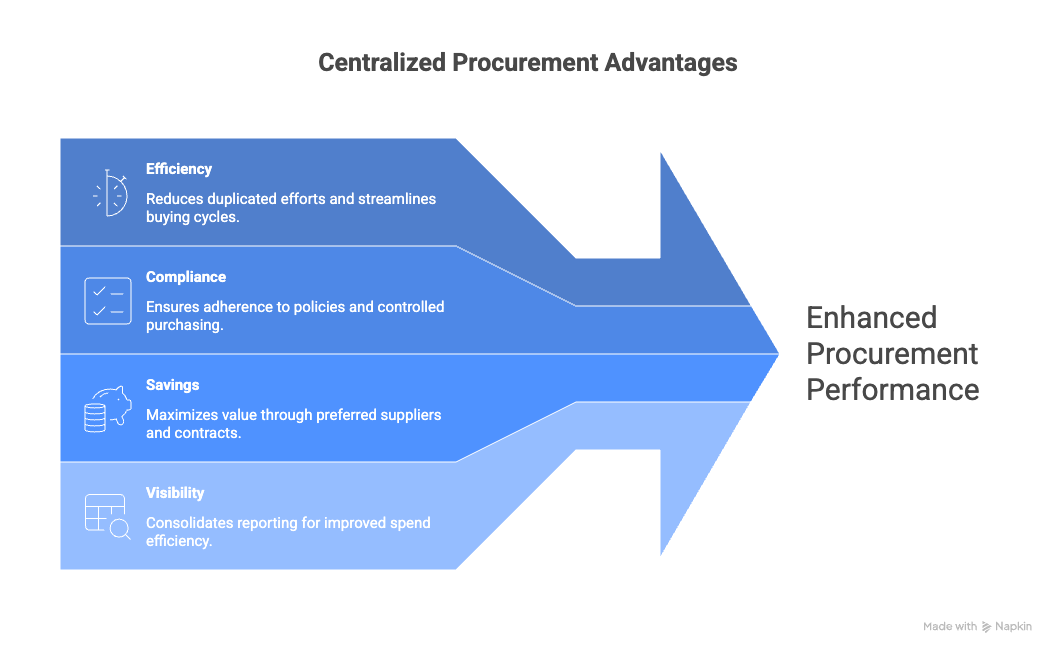
The best model is one where centralization creates control without creating friction.
KPIs & Data
| KPI Category | What to Track |
| Compliance | % spend on contract, % preferred supplier usage |
| Control | % spend under management, maverick spend rate |
| Efficiency | requisition-to-PO cycle time, approval SLA adherence |
| Savings | savings realization %, price compliance %, avoidance value |
| Governance | exception rate, override frequency, audit trail completeness |
Key Terms in Centralized Decision Making
- Decision Rights: who has the authority to approve procurement actions.
- Delegation of Authority (DoA): approval limits by spend value and role.
- Preferred Suppliers: centrally approved suppliers for compliant buying.
- Contract Compliance: % purchases aligned to negotiated contract terms.
- Spend Under Management: spend governed through procurement workflows.
- Maverick Spend: purchases made outside the approved process.
FAQs
Q1. What is centralized decision-making?
Centralized decision-making is when key decisions are made by a single leader or central group instead of individual teams.
Q2. What are the key characteristics of centralized decision-making?
It features central authority, standardized rules, uniform approvals, and consistent decision execution across the organization.
Q3. What are the advantages of centralized decision-making?
It improves control, policy adherence, cost efficiency, and reduces duplication through standardized decision frameworks.
Q4. What are the disadvantages of centralized decision-making?
It can slow decisions, reduce local flexibility, and create bottlenecks if approvals are overly rigid.
Q5. How does centralized decision-making work in procurement?
A central procurement team controls supplier selection, approvals, contracts, and buying policies to ensure compliant and governed purchasing.
Q6. When should enterprises centralize decision making?
Enterprises should centralize when spend is fragmented, compliance risk is high, or supplier and contract control is weak.
Q7. Is centralized decision making better than decentralized decision making?
Not always, centralized works best for governance, while decentralized works best for speed; many organizations use a hybrid model.
Q8. What is a hybrid procurement model?
A hybrid model centralizes supplier strategy and policies, while business units execute purchases within approved guardrails.
Q9. What KPIs show centralized decision making is working?
Key KPIs include spend under management, contract compliance %, maverick spend rate, and approval cycle time.
References
For further insights into these processes, explore Zycus’ dedicated resources related to Centralized Decision Making:
- Identifying the Pulse of Procurement in US
- RPA, Intelligent Automation and Agentic AI: Navigating the Automation Revolution
- The Why, What & How of Strategic Sourcing: Part 3 – Hurdles in Achieving Smooth e-Sourcing
- Customer-centric Procurement – Correlating Customer Experience to World Class Performance
- Navigating the Future: AI-Powered Transformation of Procure-to-Pay










