



Absorption costing is a method of product costing in which all manufacturing costs — both variable and fixed — are included in the cost of a product. Fixed overhead costs such as factory rent, depreciation, and supervisory salaries are absorbed into the unit cost alongside direct materials and labor. This means the full cost of production is allocated to each unit manufactured, regardless of whether it is sold in the same period. Absorption costing is the standard required by most financial reporting frameworks for inventory valuation.
Why Absorption Costing Matters in Procurement
Procurement teams working with manufactured goods, contract manufacturers, or cost-plus pricing arrangements need to understand absorption costing to assess whether a supplier’s quoted price reflects reasonable cost allocation. Suppliers using absorption costing embed fixed overhead into their unit prices, meaning that cost per unit varies with production volume — higher volumes spread fixed costs across more units, lowering the per-unit cost. Procurement can use this understanding to negotiate more effectively, challenge cost breakdowns, and push for volume-driven price reductions that reflect the supplier’s actual cost structure.
Download Whitepaper: Tariff Impact on Facilities Management Procurement
The Core Process of Absorption Costing
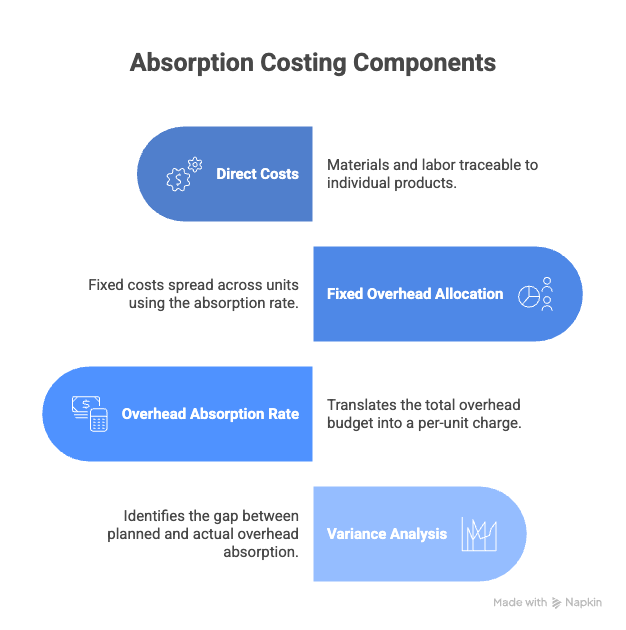
The absorption costing process begins with the classification of all manufacturing costs into direct costs — materials and labor directly attributable to production — and indirect costs, or overheads, which support production but cannot be traced directly to a single unit.
Overhead costs are then collected into cost pools and allocated to products using a predetermined overhead absorption rate. This rate is typically calculated by dividing budgeted overhead by a chosen activity measure such as direct labor hours, machine hours, or units produced. The choice of absorption base affects how costs are distributed across products and periods.
As production occurs, overhead is absorbed into work-in-progress and finished goods inventory at the predetermined rate. When units are sold, the absorbed overhead flows through to cost of goods sold, matching costs to revenue. Any difference between actual overhead incurred and overhead absorbed is treated as an over- or under-absorption variance and adjusted at period-end.
Key Benefits of Absorption Costing
- Provides a complete unit cost that reflects both variable production costs and the fixed overhead required to maintain production capacity.
- Complies with generally accepted accounting principles and financial reporting standards for inventory valuation.
- Supports cost-plus pricing negotiations by giving procurement a structured framework for challenging supplier overhead allocations.
- Enables procurement to assess the volume sensitivity of a supplier’s quoted price, identifying where volume commitments can drive cost reductions.
Common Pitfalls of Absorption Costing
- Confusing absorption costing with total cost of ownership: Absorption costing captures the manufacturing cost of a unit. TCO encompasses the full lifecycle cost of using it, including maintenance, energy, and disposal.
- Accepting overhead absorption rates without scrutiny: Suppliers can inflate unit costs by using low volume assumptions in their overhead absorption rate. Procurement should request the basis of the rate and challenge unrealistic denominators.
- Ignoring the impact of production volume on unit cost: Because fixed overheads are spread across units, a supplier producing at low capacity will show a higher absorbed cost per unit than one running at full utilization. This is important context when evaluating prices.
- Treating absorption costing as the only cost lens: For internal decision-making, variable costing often provides more relevant information. Procurement should understand which cost framework a supplier is using and why.
How Procurement Can Use Absorption Costing Knowledge
- Request cost breakdowns from suppliers: Understanding what is in a supplier’s overhead pool and how it is allocated reveals whether the absorption rate is reasonable or inflated.
- Negotiate volume commitments to reduce unit cost: If fixed overheads are spread over a larger volume, the absorbed cost per unit falls. Volume commitments can justify price reductions grounded in the supplier’s own cost structure.
- Use in cost-plus contract reviews: For cost-plus or open-book contracts, understanding how overheads are absorbed allows procurement to verify that charges are reasonable and correctly calculated.
KPIs of Absorption costing
| Dimension | Sample KPIs |
| Cost Transparency | % of key suppliers providing cost breakdowns with overhead detail |
| Price Benchmarking | Variance between absorbed unit cost and market reference price |
| Volume Leverage | Price reduction achieved through volume-driven overhead dilution |
| Contract Compliance | Over/under-absorption variance in cost-plus arrangements |
Key Terms in Absorption Costing
- Overhead Absorption Rate: A predetermined rate used to allocate fixed overhead costs to products, calculated as budgeted overhead divided by a chosen activity measure.
- Direct Costs: Costs directly traceable to a specific product, including direct materials and direct labor.
- Fixed Overhead: Production costs that remain constant regardless of output volume, such as factory rent, depreciation, and supervisory salaries.
- Variable Costing: An alternative costing method in which only variable manufacturing costs are included in the product cost; fixed overheads are expensed in the period incurred.
- Cost-Plus Pricing: A pricing model in which the seller charges the buyer their actual cost plus an agreed margin, making cost transparency a contractual requirement.
Technology Enablement
ERP and cost management systems automate overhead absorption calculations and generate variance reports. For procurement, spend analytics platforms can incorporate supplier cost breakdown data, enabling category managers to benchmark absorbed unit costs against market references and monitor cost movements across contract periods.
FAQs
Q1. What is absorption costing?
A costing method in which all manufacturing costs — variable and fixed — are included in the unit cost of a product.
Q2. How does absorption costing differ from variable costing?
Absorption costing includes fixed overheads in unit cost. Variable costing excludes them, treating fixed overhead as a period expense rather than a product cost.
Q3. Why does production volume affect unit cost under absorption costing?
Because fixed overheads are spread across all units produced, higher volume reduces the fixed cost per unit; lower volume increases it.
Q4. Why should procurement understand absorption costing?
To assess supplier cost breakdowns, challenge overhead allocations, negotiate volume-driven price reductions, and review cost-plus contracts accurately.
Q5. What is an overhead absorption rate and how is it calculated?
It is the rate at which overhead is charged to products, calculated by dividing total budgeted overhead by a chosen activity measure such as labor hours or machine hours.
Q6. What does over-absorption mean?
It means more overhead was absorbed into production than was actually incurred, typically because actual output exceeded the budgeted volume used to set the absorption rate.
References
For further insights into these processes, explore Zycus’ dedicated resources related to Absorption Costing:
- Revolutionizing Supplier Onboarding with Generative AI: Efficiency, Accuracy, and Beyond
- These 5 Contract Management Best Practices can do Wonders!
- Walking the Extra Mile: Procurement Greets Finance – Part 2: Bridging the Gap between Procurement and Finance
- Driving Compliance – Persistent Issue for Procurement Organizations
- In Talks with Zycus: Cincinnati Bell’s Finance Transformation Story










