



Competitive Dialogue is a procurement procedure used for complex contracts where the buyer cannot define the technical solution or contract structure in advance. Rather than issuing a fixed specification, the buyer engages in structured dialogue with a shortlist of pre-qualified suppliers to develop the solution collaboratively before inviting final tenders. It is most commonly used in public sector procurement for infrastructure, IT, and service delivery contracts where innovative or technically complex solutions are required and no single correct answer exists at the outset.
Why Competitive Dialogue Matters in Procurement
Issuing a fixed specification before understanding what the market can offer often produces poor outcomes — too prescriptive and it rules out better solutions; too vague and it generates non-comparable bids. Competitive Dialogue creates a structured space for market engagement before commitment. Procurement learns what is technically feasible and commercially viable, then finalizes requirements before inviting binding bids — producing better specifications and contracts more likely to deliver the intended outcome.
The Core Process of Competitive Dialogue
- Publication and Pre-Qualification: The buyer publishes a notice describing the requirement at a high level and inviting expressions of interest. Interested suppliers are assessed against pre-qualification criteria covering capability, financial standing, and relevant experience. A shortlist of typically three to five suppliers is invited to participate in the dialogue phase.
- Structured Dialogue: The buyer holds separate, confidential sessions with each shortlisted supplier to explore solutions, identify technical and commercial options, and progressively narrow scope toward a viable specification. Multiple rounds may be required. Confidentiality between participants must be maintained throughout.
- Closure of Dialogue and Final Tender: Once the buyer has identified solutions that meet its needs, dialogue is formally closed. Remaining participants submit final, binding tenders based on the developed solution. No further negotiation on fundamental elements is permitted.
- Evaluation and Award: Final tenders are evaluated against published criteria, typically including both quality and price under a Most Economically Advantageous Tender framework. The winning bidder is notified, and a standstill period is observed before contract signature.
Core Components of Competitive Dialogue
- Pre-qualification stage filters the market to a manageable shortlist of capable, financially stable suppliers before the resource-intensive dialogue phase begins. Robust pre-qualification criteria prevent unsuitable suppliers from consuming dialogue capacity.
- Dialogue management structures the engagement between the buyer and each supplier through a series of meetings with defined agendas and objectives. Each dialogue round should move closer to solution definition — unfocused dialogue extends the process without improving specification quality.
- Confidentiality protocols protect each supplier’s proposed solution from being shared with competitors. Breaching confidentiality during the dialogue phase undermines competition and can invalidate the procurement.
- Closure discipline ensures that dialogue ends at the right point — when solutions are sufficiently developed to support final tender — rather than continuing indefinitely. Clear closure criteria prevent scope creep and process delay.
Key Benefits of Competitive Dialogue
- Enables procurement of complex requirements where a fixed specification cannot be defined in advance without limiting the solution space.
- Produces better-specified contracts by incorporating market knowledge and supplier expertise before requirements are finalized.
- Reduces the risk of procurement failure on complex projects by ensuring that final tenders are based on solutions that have been tested against the buyer’s needs.
- Maintains competitive tension throughout the process by engaging multiple suppliers simultaneously until the final tender stage.
Common Pitfalls of Competitive Dialogue
- Using Competitive Dialogue for requirements that could be specified in advance. The procedure is resource-intensive for both buyers and suppliers. Using it for requirements that could be handled through an ITT adds cost and time without improving outcomes.
- Insufficient dialogue management discipline. Dialogue rounds that lack clear agendas and objectives drift without producing the specification clarity the procedure is designed to achieve.
- Breaching supplier confidentiality. Sharing solution ideas or commercial terms between competing participants during dialogue destroys competitive integrity and can expose the procurement to legal challenge.
- Closing dialogue too early. Issuing final tenders before solutions are sufficiently developed forces suppliers to price risk into their bids, increasing cost and reducing the quality of responses.
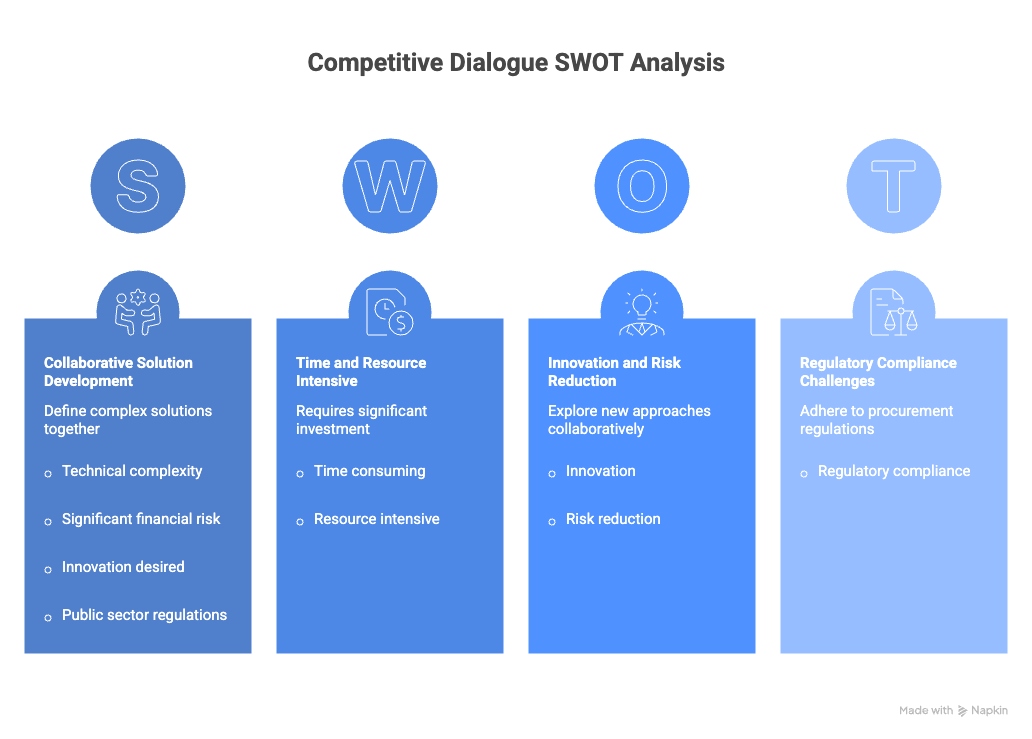
KPIs of Competitive Dialogue
| Dimension | Sample KPIs |
| Process Efficiency | Total Competitive Dialogue cycle time, number of dialogue rounds required |
| Specification Quality | Number of clarifications requested after final tender issue, tender withdrawal rate |
| Competition | Number of suppliers completing to final tender stage |
| Outcome Quality | Variance between tendered and delivered solution, contract change order frequency |
Key Terms in Competitive Dialogue
- Pre-Qualification Questionnaire (PQQ): A document used to assess supplier capability and eligibility before the dialogue phase begins.
- Most Economically Advantageous Tender (MEAT): An evaluation approach that considers both price and quality, standard for Competitive Dialogue outcomes.
- Solution Specification: The output of the dialogue phase — a detailed description of the technical and commercial solution forming the basis for final tender submissions.
- Dialogue Round: A structured session between the buyer and a single supplier to explore solution options and progress toward specification clarity.
Technology Enablement
e-Tendering platforms support Competitive Dialogue through secure supplier portals that manage document exchange during dialogue rounds, confidentiality controls that prevent cross-supplier information sharing, and evaluation tools that score final tenders against published criteria. These capabilities reduce administrative overhead while maintaining the process integrity that Competitive Dialogue requires.
FAQs
Q1. What is Competitive Dialogue?
A procurement procedure for complex contracts where the buyer engages in structured dialogue with shortlisted suppliers to develop the solution before inviting final binding tenders.
Q2. When should Competitive Dialogue be used?
When requirements are too complex or technically undefined to specify in advance, particularly for infrastructure, IT, and integrated service contracts.
Q3. How is Competitive Dialogue different from an ITT?
An ITT issues a fixed specification and receives binding bids. Competitive Dialogue develops the specification through supplier engagement before bids are invited.
Q4. Can the buyer negotiate after final tenders are received?
No. After dialogue closes and final tenders are submitted, fundamental elements of the contract cannot be negotiated. Minor clarifications may be permitted but not substantive changes.
Q5. How many suppliers should be shortlisted for dialogue?
Three to five is typical. Fewer reduces competitive tension; more increases process cost and complexity without proportionate benefit.
Q6. How long does a Competitive Dialogue process typically take?
Six to eighteen months, depending on complexity, number of dialogue rounds, and the evaluation timeline after final tenders are received.
References
For further insights into these processes, explore the following Zycus resources related to Competitive Dialogue:
- Ap automation recession
- AI for risk mitigation plan
- Generative AI in source to pay hype or reality
- What is Competitive Dialogue Procedure
- Procurement Innovation in Public Services: London’s 2025 Strategic Guide
- 8 Common Mistakes to Avoid in Your Direct Procurement Process: Optimizing Efficiency and Minimizing Risk










