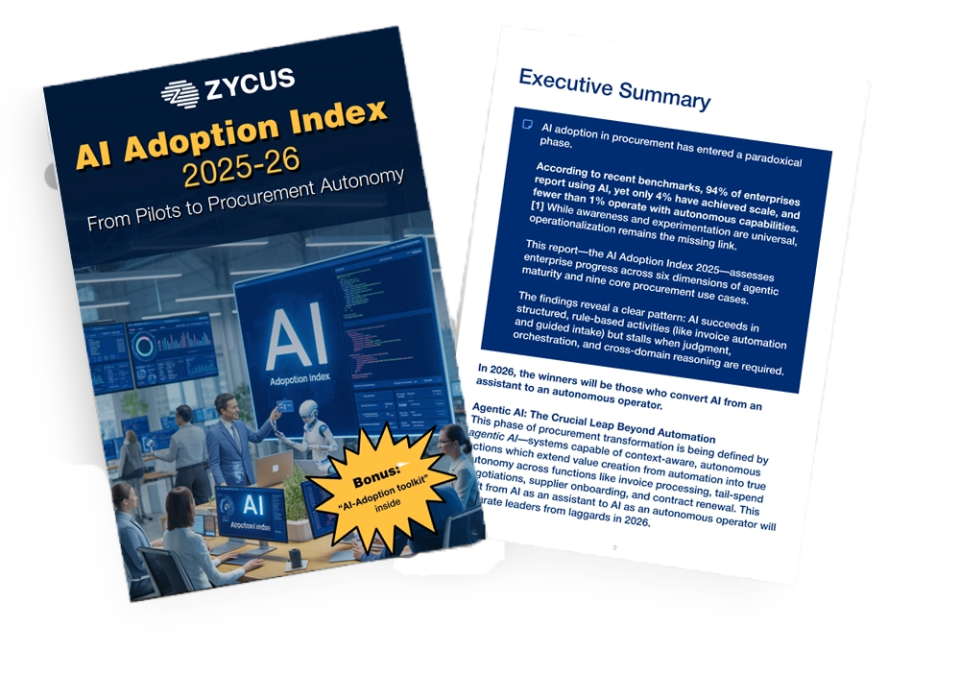





The #1 Agentic AI
Procurement
Solution
Every S2P vendor is marketing AI agents in 2026. But most are automating tasks with a new label not running autonomous, outcome-driven procurement workflows. This guide cuts through the noise so you can evaluate what actually matters.
Zycus Merlin Agentic AI vs. The Other S2P Vendors
Six evaluation parameters. Three competitor categories. See how Zycus stacks up across what actually matters in agentic AI procurement.
| Parameter | Zycus MerlinAI-Native S2P Suite | Legacy S2P SuitesLegacy multi-module S2P platforms | Legacy ERP ProcurementProcurement inside ERP suites | Point SolutionsIntake-only / niche tools |
|---|---|---|---|---|
| AI Architecture | ||||
| Agent design model | Purpose-built agenticDesigned to plan, decide, and execute not retrofitted onto a workflow engine | Retrofitted AIAI layer added on top of multi-module architecture assembled through acquisitions | ERP-first, procurement secondAI priorities follow the broader ERP roadmap | Modern stack, narrow scopeCloud-native but designed for one function, not end-to-end S2P |
| Multi-agent orchestration | Native across S2PAgents hand off across intake → sourcing → contracts → AP on one data model | Limited by module fragmentationCross-module coordination still maturing across acquired product lines | Within ERP stack onlyProcurement orchestration outside ERP stack is limited | No cross-functional orchestrationCannot orchestrate beyond their designed function |
| ERP agnosticism | Fully agnosticFull AI performance with SAP, Oracle, Dynamics, Workday | Generally agnosticPre-built connectors for major ERP platforms | ERP-tetheredNon-SAP/Oracle buyers face degraded performance | Connector-dependentRequires integration to pass data downstream |
| Agentic Maturity | ||||
| Autonomous execution vs. assisted recommendations | Agents execute decisionsANA negotiates, Intake routes, AP matches without human approval at every step | Mostly recommendationsAI surfaces suggestions; execution requires human approval | Rules-based automationWorkflow automation with AI-assisted guidance not autonomous decisions | Autonomous within one functionActs within scope; hands off to humans at the boundary |
| S2P stage coverage | Intake, Sourcing, Negotiation, Contracts, AP, AnalyticsAll in production no gaps | Selective coverageVaries across acquired product lines | Finance-weightedAP and invoice strongest; sourcing agents limited outside ERP-native environments | One function onlyFull coverage requires multiple point tools |
| Autonomous negotiation | In productionMerlin ANA negotiates tail spend live with enterprise customers | Announced, not validatedAutonomous sourcing announced; enterprise-scale validation pending | Not a designed use caseBuilt for compliance, not negotiation autonomy | Niche onlySome tail-spend tools offer it no cross-category coverage |
| Data | ||||
| Unified data model | Single schema intake to payAgents reason with full context spend, contracts, suppliers, risk in one model | Fragmented across modulesAI context limited by what middleware can stitch together | ERP-unified, procurement-fragmentedSupplier risk and contract metadata often lives outside the ERP | Siloed by designContext gaps emerge at every function boundary |
| Real-time cross-S2P data access | Native no middleware latencyAgents query live data across all S2P functions in a single call | Delayed in some modulesData sync adds latency across acquired modules | Real-time within ERP scopeERP data excellent; adjacent procurement data requires connectors | Within their function onlyNo visibility into broader procurement context |
| Natural Language & UX | ||||
| Conversational interface | Across all S2P functionsPlain language queries across spend, contracts, suppliers, risk from any channel | Copilot in select modulesNLP inconsistent across acquired product lines | ERP copilot finance-first UXTied to ERP UI; not designed for business requestors | Excellent but only in their lanePolished NLP within their function; ends at their boundary |
| Zero-friction intake | Native Teams / Slack no portalPlain language request → routed, compliant procurement action | Guided buying reduces frictionForm-free intake not yet standard across the platform | Form-heavy requisition flowsERP approval hierarchies are deeply embedded by design | Yes their core use caseExcellent intake UX; doesn't connect to execution agents downstream |
| Governance & Security | ||||
| Policy enforcement at agent level | Guardrails at the point of actionSpend thresholds and approval rules enforced when the agent acts not just at the UI | Workflow-level controlsPolicy in workflow engine; not always native to AI agent decisions | ERP-grade complianceMature approval controls strongest for finance-driven compliance | Entry-point enforcement onlyNo downstream compliance visibility once handed off |
| Data security | SOC 2 Type II, ISO 27001, Azure OpenAINo procurement data used to train external LLMs | Enterprise-gradeSOC 2, ISO 27001 standard across major platforms | ERP-grade battle-testedSAP / Oracle security among the most mature in enterprise software | Varies significantlyDue diligence required maturity ranges widely |
| Pricing | ||||
| AI included vs. add-on | Included no separate AI licensingMerlin agents part of the platform not token-based upsells | Add-on / token-basedForrester flags token-based AI pricing as a transparency concern | Separate licensing requiredSAP Joule / Oracle AI require additional fees on top of ERP + procurement module | Included within narrow scopeFull coverage requires multiple tools, each with its own cost |
| Total cost of ownership | Single platform no integration taxOne contract, one data model, one support relationship | Module-based complexityCost scales with modules activated; acquired lines may carry separate contracts | Highest TCO in the categoryERP + module + AI license + implementation cost compounds significantly | Low entry, high expansion costCoverage gaps compound integration and licensing costs across tools |
| Pricing flexibility (Gartner Peer Insights VoC 2025) | 4.5 / 5 | Varies | SAP: 3.8 / 5 lowest in cohort | Varies |
| What to evaluate | Zycus MerlinAI-Native S2P Suite | Legacy S2P SuitesLegacy multi-module S2P platforms | Legacy ERP ProcurementProcurement inside ERP suites | Point SolutionsIntake-only / niche tools |
|---|---|---|---|---|
| How was the AI built? | Purpose-built agenticDesigned from scratch to plan, decide, and execute procurement actions not retrofitted onto an existing workflow engine | Retrofitted AIAI layer added on top of a multi-module architecture assembled through acquisitions agents can only reason across what the data model unifies | ERP-first, procurement secondAI priorities follow the broader ERP roadmap procurement is one module among many | Modern stack, narrow scopeOften cloud-native and well-engineered but designed for one function, not end-to-end S2P orchestration |
| Can agents coordinate across S2P? | Native multi-agent orchestrationMerlin agents hand off across intake → sourcing → contracts → AP on one platform and one data model | Limited by module fragmentationCross-module orchestration still maturing; agent coordination depends on how well acquired modules have been integrated | Within ERP stack onlyAgents work well inside the ERP procurement-specific orchestration outside that stack is limited | No cross-functional orchestrationPoint solutions cannot orchestrate beyond their designed function by architecture |
| Does it work with any ERP? | Fully ERP-agnosticFull AI performance with SAP, Oracle, Dynamics, Workday no ERP dependency | Generally agnosticWorks across ERP environments; pre-built connectors for major platforms | ERP-tetheredFull value requires same-stack ERP non-SAP/Oracle buyers face degraded performance and integration overhead | Connector-dependentRequires integration with ERP or S2P suite to pass data downstream; integration quality varies |
| Platform stability | Stable, single codebaseNo active migration built as one product, no stitching required | Migration in progressSeveral legacy S2P vendors managing active platform consolidations post-acquisition assess transition risk before committing | Architecture modernization underwaySAP BTP migration completing through 2026; full agentic capability dependent on completion | Stable within scopeSimpler architecture but stability of a narrow tool doesn't mitigate the risk of integration with your broader stack |
| What to evaluate | Zycus MerlinAI-Native S2P Suite | Legacy S2P SuitesLegacy multi-module S2P platforms | Legacy ERP ProcurementProcurement inside ERP suites | Point SolutionsIntake-only / niche tools |
|---|---|---|---|---|
| Autonomous execution vs. assisted recommendations | Agents execute decisionsMerlin ANA negotiates, Merlin Intake routes, Merlin AP matches invoices without waiting for human approval at every step | Mostly recommendationsAI surfaces suggestions and flags exceptions; human approval still required for most execution steps | Rules-based automationWorkflow automation with AI-assisted guidance not autonomous decision-making in a procurement context | Autonomous within one functionCan act without human input inside their scope but hand off to humans at the boundary of their function |
| Which S2P stages have live agents? | Intake, Sourcing, Negotiation, Contracts, AP, AnalyticsAll named agents in production no gaps, no "coming soon" | Selective coverageAgents available in some modules; coverage varies across acquired product lines and release timelines | Finance-weightedAP, invoice, and spend compliance strongest; sourcing and contract agents limited outside ERP-native environments | One function onlyFull S2P coverage requires buying, integrating, and managing multiple point tools each with its own contract and support model |
| Can agents negotiate autonomously? | Yes in productionMerlin ANA autonomously negotiates price, payment terms, and discounts for tail spend live with named enterprise customers | Announced, not yet validatedAutonomous sourcing agents announced; independent negotiation without human approval not yet validated at enterprise scale | Not a designed use caseERP procurement is built for compliance and spend control autonomous negotiation is outside scope | Niche onlySome tail-spend point tools offer automated negotiation but no coverage beyond their single category |
| Time to value | Deploy, don't buildNamed agents pre-built and in production no custom development cycles required to get to live use | Moderate configuration requiredPlatform depth means significant setup; AI features still maturing across recently acquired modules | LongArchitecture modernization timelines, ERP customization, and implementation services extend time to live agentic capability | Fast within their functionQuick to deploy for their specific use case; the clock resets when you add the next tool |
| What to evaluate | Zycus MerlinAI-Native S2P Suite | Legacy S2P SuitesLegacy multi-module S2P platforms | Legacy ERP ProcurementProcurement inside ERP suites | Point SolutionsIntake-only / niche tools |
|---|---|---|---|---|
| Is procurement data unified in one model? | Single schema intake to paySpend, contracts, suppliers, risk, and intake data in one model agents reason with full context, not fragments | Fragmented across modulesAcquired modules carry different schemas; AI context is limited by what middleware can stitch together | ERP-unified, procurement-fragmentedFinancial data is unified inside the ERP procurement-specific data like supplier risk and contract metadata often lives elsewhere | Siloed by designEach tool holds a narrow data slice context gaps emerge at every function boundary |
| Can agents access data in real time? | Yes no middleware latencyAgents query live spend, contract, supplier, and risk data in a single call no sync delays | Delayed in some modulesData sync across acquired modules adds latency; real-time cross-module intelligence depends on integration maturity | Real-time within ERP scopeERP transaction data is excellent; procurement-adjacent data requires external connectors with their own refresh cycles | Only within their functionReal-time data access is limited to their narrow domain no visibility into broader procurement context |
| Is supplier and market intelligence built in? | Natively embeddedSupplier risk, performance, and market intelligence enriched within the Merlin data layer no third-party connector required | Available via networkCommunity intelligence and supplier data sourced from broad customer network a genuine strength | Requires external integrationThird-party supplier data connectors needed; not natively embedded in procurement workflows | Varies significantlySome intake and supplier tools include enrichment; depth and quality vary widely by vendor |
| Can data support autonomous decisions? | Yes agents reason with full S2P contextBecause all data is in one model, agents can make decisions that account for spend history, contract terms, supplier risk, and policy simultaneously | Partially depends on moduleAutonomous decisions are only as good as the data available per module; fragmentation limits cross-functional reasoning | Within ERP boundary onlyAgents can make decisions on ERP-held data well; procurement decisions requiring external context require integration | Scoped decisions onlyAgents can only reason within their data slice autonomous decisions that require cross-functional context are out of reach |
| What to evaluate | Zycus MerlinAI-Native S2P Suite | Legacy S2P SuitesLegacy multi-module S2P platforms | Legacy ERP ProcurementProcurement inside ERP suites | Point SolutionsIntake-only / niche tools |
|---|---|---|---|---|
| Can users interact in plain language? | Across all S2P functionsAsk about spend, contracts, suppliers, or risk in plain language from any channel, across the full procurement lifecycle | Copilot in select modulesNLP available in some workflows; consistency across acquired modules varies not a unified conversational experience | ERP copilot experienceSAP Joule / Oracle AI available but tied to ERP UI and designed primarily for finance users, not business requestors | Excellent but only in their laneMany intake and niche tools offer polished NLP experiences within their function; the experience ends at their boundary |
| Does it work inside Teams and Slack? | Native full S2P from your collaboration toolMerlin works inside Teams and Slack no portal login, no context switch, procurement happens where work already happens | Available via connectorIntegrations exist; experience quality varies by module and integration maturity | Not a design priorityERP procurement UX is built for finance users inside the ERP system collaboration tool integration is not a focus | Often native within their scopeMany intake point tools are Teams/Slack-first by design but coverage stops where their function ends |
| Can a requestor raise a need without filling in forms? | Zero forms, zero portalMerlin Intake converts a plain language request into a routed, compliant procurement action no forms, no portal login required | Improving guided buying reduces frictionForm-light UX available in some modules; fully conversational, form-free intake not yet standard across the platform | Form-heavy by designERP requisition workflows require structured input; approval hierarchies are deeply embedded in ERP architecture | Yes this is their core use caseIntake simplification is exactly why these tools exist; the gap is that they hand off to humans after intake, not to execution agents |
| Is the UX consistent across procurement functions? | One interface, all functionsSame conversational experience whether you're checking a contract, querying spend, or raising a request | Inconsistent across modulesUX quality varies across acquired product lines some modules feel modern, others carry legacy interface debt | ERP-grade not business-user-gradeConsistent within the ERP but designed for power users and finance teams, not the average business requestor | Different tool per functionEach point solution has its own UX procurement users navigate multiple interfaces to complete end-to-end tasks |
| What to evaluate | Zycus MerlinAI-Native S2P Suite | Legacy S2P SuitesLegacy multi-module S2P platforms | Legacy ERP ProcurementProcurement inside ERP suites | Point SolutionsIntake-only / niche tools |
|---|---|---|---|---|
| Are policies enforced at the agent decision layer? | Yes guardrails at the point of actionSpend thresholds, approval requirements, supplier diversity rules enforced when the agent acts not just at the UI | Workflow-level enforcementPolicies embedded in workflow engine; AI agents don't always carry policy context natively across all modules | ERP-grade complianceMature approval and compliance controls; policies enforced through ERP hierarchy strongest for finance-driven compliance | Entry-point enforcement onlyPolicy checks happen at intake or within their narrow function no downstream compliance visibility once handed off |
| Can humans override agents at any point? | Always full audit trail includedEvery agent action logged; human override available at any decision step autonomy with complete accountability | Partial varies by moduleOverride capability inconsistent across acquired product lines; control tower features on roadmap for some vendors | Yes ERP-grade auditFull audit trail within ERP; procurement actions logged as standard ERP financial transactions | Within their function onlyOverride and audit available inside their scope no visibility into downstream execution beyond their boundary |
| What are the data security certifications? | SOC 2 Type II, ISO 27001, Azure OpenAIData residency options available; procurement data is not used to train external LLMs | Enterprise-gradeSOC 2, ISO 27001 standard across major legacy S2P platforms mature security posture | ERP-grade battle-tested at scaleSAP and Oracle security frameworks are among the most mature in enterprise software | Varies significantly by vendorSecurity maturity ranges widely; enterprise procurement requirements may not always be met due diligence required |
| Is compliance coverage end-to-end? | Intake to pay continuousCompliance doesn't stop at intake or contract signature; Merlin monitors obligations and flags violations throughout execution | Module-dependentCompliance coverage strong in some modules; gaps appear at boundaries between acquired products | Strong within ERP scopeEnd-to-end compliance excellent within the ERP financial chain weakens outside that boundary | Function-scoped onlyCompliance visibility ends where their function ends no coverage of what happens downstream |
| What to evaluate | Zycus MerlinAI-Native S2P Suite | Legacy S2P SuitesLegacy multi-module S2P platforms | Legacy ERP ProcurementProcurement inside ERP suites | Point SolutionsIntake-only / niche tools |
|---|---|---|---|---|
| Is AI included, or an add-on? | Included no separate AI licensingMerlin AI agents are part of the platform not token-based upsells, not separately licensed modules | Add-on / token-basedForrester flags token-based AI pricing as a transparency concern; AI modules typically priced separately from the core platform | Separate licensing requiredSAP Joule and Oracle AI Agents require additional licensing on top of ERP subscription and procurement module fees | Included within their narrow scopeAI is usually bundled but full procurement coverage requires multiple tools, each with its own cost and contract |
| What does total cost of ownership look like? | Single platform no integration taxOne contract, one data model, one support relationship no cost of stitching modules or managing vendor proliferation | Module-based complexityPricing scales with the number of modules activated; acquired product lines may carry separate contracts | Highest TCO in the categoryERP license + procurement module + AI license + implementation services + ongoing customization cost compounds significantly | Low entry, high expansion costAffordable to start but achieving full procurement coverage through point solutions compounds integration, maintenance, and licensing costs |
| Pricing flexibility (Gartner Peer Insights VoC 2025) | 4.5 / 5 | Varies limited public transparency | SAP: 3.8 / 5 lowest in cohort | Varies by vendor |
| Willingness to Recommend (Gartner Peer Insights VoC 2025) | 95% | Varies | SAP: 59% · Oracle: 83% | Varies |
What Genuinely Agentic Looks Like
Zycus Merlin agents don't surface alerts. They take action from intake routing to autonomous tail spend negotiation across a single data model.
Four Reasons Buyers Choose Merlin
Beyond feature checklists the architecture decisions that compound over time.
See How Zycus Merlin Compares to Your Current Stack
Get the full vendor comparison delivered to your inbox with detailed scoring, named vendor analysis, and a buyer's checklist for evaluating agentic AI procurement platforms.
Get the Analysis
Complete below and receive the full vendor comparison.
By submitting, you agree to Zycus's privacy policy. We will not share your data with third parties. You may unsubscribe at any time.