



Resource levelling is a project and capacity management technique that adjusts the timing of tasks and activities to prevent resource overload while maintaining project or operational objectives. It redistributes work across time periods or team members so that demand on any resource — person, budget, system, or supplier capacity — does not exceed the available supply at any point. In procurement, resource levelling is applied to manage the workload distribution of sourcing events, contract renewals, supplier reviews, and initiative delivery across the procurement team’s available capacity.
Why Resource Levelling Matters in Procurement
Procurement teams face a persistent capacity challenge: the volume of sourcing events, contract renewals, and supplier reviews due in any period rarely aligns neatly with available team capacity. Without deliberate planning, procurement teams experience peaks of overload followed by underutilization — with the overload periods generating rushed decisions, reduced negotiation quality, and missed renewal windows. Resource levelling gives procurement leaders the ability to manage workload distribution proactively — phasing activity across the calendar to maintain consistent output quality, prevent individual overload, and ensure that the highest-value initiatives receive adequate attention.
The Core Process of Resource Levelling
- Workload Inventory: The process begins by mapping all procurement activities due in the planning horizon — contract renewals by date, sourcing events by estimated duration, supplier review schedules, and initiative commitments. This inventory reveals the raw demand profile — when activities are due and how much capacity each requires.
- Capacity Assessment: Available procurement capacity is mapped against the demand profile — total team hours per period, factoring in planned leave, training, and non-procurement demands. The gap between demand and capacity in each period identifies where levelling intervention is required.
- Activity Prioritization and Rescheduling: Activities that create demand spikes are assessed for flexibility — which renewals can be advanced or deferred, which sourcing events can be phased, and which initiatives can be sequenced to smooth distribution. High-value activities are protected; lower-priority work is rescheduled to fill underutilized periods.
- Monitoring and Adjustment: The levelled workload plan is tracked against actual delivery. New activities that emerge are assessed for capacity impact before acceptance, and the plan is adjusted when priorities shift. Resource levelling is a continuous planning discipline, not a one-time exercise.
Core Components of Resource Levelling
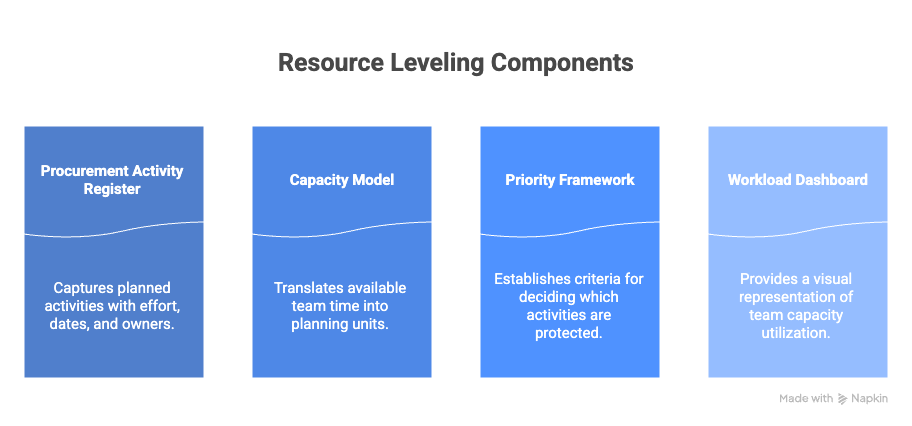
- Procurement activity register captures all planned activities with their estimated effort, required completion dates, and assigned owners — the data foundation for capacity demand mapping.
- Capacity model translates available team time into planning units — hours or days per person per period — net of non-procurement commitments. It is the supply side of the resource levelling equation.
- Priority framework establishes the criteria for deciding which activities are protected from rescheduling — contract value, expiry risk, strategic supplier relationships — and which can be flexibly phased.
- Workload dashboard provides procurement leadership with a visual representation of team capacity utilization over time — showing where resource peaks and troughs exist and tracking the effectiveness of levelling interventions.
Key Benefits of Resource Levelling
- Prevents procurement capacity overload that leads to rushed decisions, missed renewal windows, and reduced negotiation quality.
- Ensures high-value initiatives and renewals receive adequate preparation time by managing workload distribution across the planning horizon.
- Improves initiative delivery rates by matching work volume to available capacity rather than accepting demand spikes that create inevitable backlogs.
Common Pitfalls of Resource Levelling
- Planning capacity without accounting for non-procurement demands: Procurement professionals spend significant time on stakeholder management, internal meetings, and administrative tasks. Capacity models that count only procurement-dedicated hours overestimate available capacity.
- Treating all contract renewals as fixed in time: Most contract renewals can be advanced or deferred within a window without commercial consequence. Treating renewal dates as immovable prevents the flexibility that makes resource levelling effective.
- Failing to update the plan when new work arrives: Unplanned demands — urgent stakeholder requests, emergency sourcing events, project additions — are the most common source of capacity overload. Each new commitment should trigger a re-assessment of the levelled plan.
- Managing resource levelling informally: Workload visibility that depends on a CPO’s intuition or a team leader’s awareness is inadequate. Resource levelling requires a structured, visible plan that the whole team can see and contribute to.
Resource Levelling Applied to Procurement Planning
- Contract renewal calendar: Mapping all contract renewals by quarter reveals the natural concentration of renewal work — typically at financial year boundaries. Procurement can advance some renewals and defer others to smooth the workload without commercial risk.
- Sourcing event pipeline: Staggering the launch dates of major sourcing events prevents simultaneous supplier evaluation burdens that degrade evaluation quality and extend cycle times.
- Supplier review scheduling: Distributing strategic supplier business reviews across the year rather than clustering them in one quarter ensures that each review receives adequate preparation and follow-up time.
- Initiative phasing: Sequencing major procurement initiatives so that no two require peak effort simultaneously — protecting team capacity for both the initiative and ongoing operational work.
KPIs of Resource Levelling
| Dimension | Sample KPIs |
| Capacity Utilization | Team capacity utilization rate, % of periods with overload vs. target |
| Delivery Quality | % of sourcing events completed within planned timeline, missed renewal rate |
| Plan Adherence | % of levelled activities delivered on rescheduled date, unplanned work intrusion rate |
| Workload Balance | Variance in individual utilization across team members |
Key Terms in Resource Levelling
- Resource Levelling: A planning technique that adjusts activity timing to prevent resource overload while maintaining operational and project objectives.
- Capacity Model: A structured view of available team time per planning period, net of non-procurement commitments, used to assess workload feasibility.
- Workload Smoothing: The rescheduling of activities from overloaded periods to underutilized ones — the practical mechanism through which resource levelling is applied.
- Procurement Activity Register: A comprehensive record of all planned procurement activities with effort estimates, deadlines, and assigned owners.
Technology Enablement
Procurement planning and workflow platforms support resource levelling through activity pipeline dashboards, capacity utilization tracking, and workload distribution views. Integration with contract management systems provides visibility into upcoming renewal dates across the full portfolio, enabling procurement leaders to identify concentration risks and schedule proactive levelling interventions before overload periods arrive.
FAQs
Q1. What is resource levelling in procurement?
A planning technique that distributes sourcing events, contract renewals, and supplier reviews across available team capacity to prevent overload and maintain delivery quality.
Q2. How is resource levelling different from prioritization?
Prioritization decides which activities to do. Resource levelling decides when to do them to match demand with available capacity over time.
Q3. What is the most common cause of procurement capacity overload?
Contract renewal clustering at year-end and accepting new work without assessing its capacity impact on existing commitments.
Q4. How should unplanned urgent work be handled?
By assessing its capacity impact before accepting it, identifying what planned work must be deferred to accommodate it, and updating the resource levelling plan accordingly.
Q5. What tools support resource levelling in procurement?
Project management platforms, procurement planning dashboards, and capacity tracking spreadsheets — the key requirement being visibility of both planned work and available capacity in the same view.
Q6. Is resource levelling relevant for small procurement teams?
Yes — more so than for large teams. Small teams have less slack capacity to absorb demand spikes, making proactive workload planning more critical, not less.
References
For further insights into these processes, explore Zycus’ dedicated resources related to Resource Levelling:










