


A purchase order acknowledgement (POA) is the supplier’s formal response to a purchase order, confirming whether it accepts the order and on what terms. It confirms price, quantity and delivery date, or flags changes, before the supplier starts work.
Why it matters in procurement?
A Purchase Order is only a request until the supplier responds. Without acknowledgement, the buyer does not know if the order was received, accepted or quietly changed. Surprises on price or delivery date then arrive when the goods are already needed.
POA closes that gap early. It turns the PO into a confirmed commitment from both sides, gives planners a delivery date they can rely on and gives accounts payable a firm basis for later matching. It also gives suppliers a clear point to raise capacity problems early.
Read Purchasing Request vs Purchase Order
The core process / lifecycle
- PO Transmission. The buyer sends the approved PO to the supplier by EDI, supplier portal or email. The transmission is logged so the buyer can see when it was sent.
- Supplier Review. The supplier checks items, prices, quantities, delivery dates and terms against its own capacity and records.
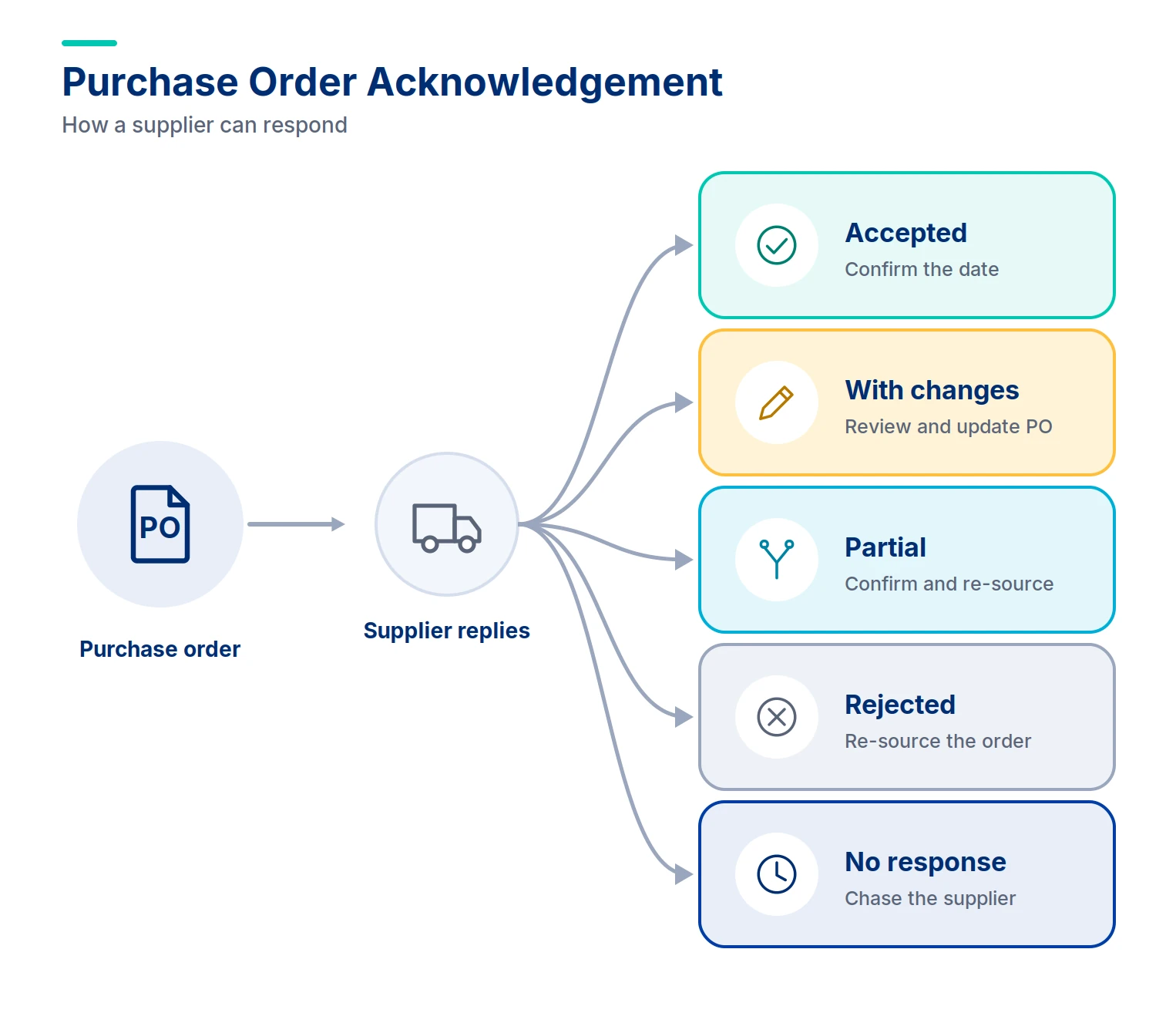
- Acknowledgement Response. The supplier replies line by line: accepted as issued, accepted with changes, or rejected. Accepting some lines and not others is a partial acceptance. Changes name the line, the field and the new value.
- Buyer Review. Buyers compare the response with the purchase order. Matching responses are confirmed automatically. Changes go to the buyer or planner to accept or counter.
- PO Update. Agreed changes are written back to the purchase order as a new version, so price, quantity and date match the confirmation.
- Follow-Up. Orders with no response by a set deadline are chased, and confirmed dates feed delivery tracking.
Read More About What is Purchase Order Management
Core Components
The acknowledgement message carries the supplier’s response by line. Change details capture differences in price, quantity or date. A response deadline sets how long the supplier has to reply. Version control keeps the original PO and each agreed revision. Tolerance rules decide which small differences confirm automatically.
Key Benefits
POA gives buyers early warning on supply problems, before delivery dates slip. It confirms delivery dates that planners can rely on. It catches price differences while they are still cheap to resolve, not at invoice matching. It creates a clear record that both sides agreed to the terms. It gives suppliers a defined moment to flag stock or capacity limits. And it reduces calls and emails asking whether an order was received.
Common Pitfalls
- Treating silence as acceptance. An order with no response may never have been seen, and the buyer plans around a date that does not exist.
- Accepting changes without updating the PO. The invoice then fails matching because the PO still shows the old terms.
- Reviewing every response by hand. Without tolerance rules, planners spend time confirming responses that already match.
- Setting no response deadline. Suppliers delay replying, and the buyer cannot tell a slow answer from a lost order.
Acknowledgement Responses And What The Buyer Does Next
- Accepted as issued. The supplier confirms every line. The buyer records the confirmed delivery date and no further action is needed.
- Accepted with changes. The supplier changes a price, quantity or date. The buyer accepts, counters or cancels, then updates the PO.
- Partially accepted. Some lines are accepted and others are not. The buyer confirms the accepted lines and re-sources or renegotiates the rest.
- Rejected. The supplier declines the order. The buyer cancels it and sources elsewhere.
- No response. The deadline passes without a reply. The buyer chases the supplier and escalates if the order is urgent.
KPIS
| Dimension | Sample KPIs |
| Responsiveness | Acknowledgement rate; time to acknowledge |
| Accuracy | Share accepted without change; price change rate |
| Delivery | Confirmed date versus requested date; late confirmation rate |
| Follow-up | Unacknowledged orders past deadline; chase actions |
Key Terms
- Order Confirmation. Another common name for the supplier’s acknowledgement of an order.
- Advance Ship Notice (ASN). A supplier notice sent at dispatch, listing what is being shipped.
- EDI 855. The X12 electronic message suppliers use to send a PO acknowledgement, known as ORDRSP in EDIFACT.
- Purchase Order Change Order. A formal revision to an issued PO.
- Delivery Date Confirmation. The date a supplier commits to deliver, as stated in the acknowledgement.
- Tolerance. The allowed difference between the PO and the response that can be confirmed without review.
- Backorder. An order line the supplier cannot fill now and will deliver later.
Checkout Zycus Purchase Order Management Software
Related Reads
- What is Standard Purchase Order
- What is Direct Purchase
- What is Planned Order Collaboration?
- What is Purchase Requisition Software?
FAQs
Q1. What is a purchase order acknowledgement?
It is the supplier’s response to a purchase order, confirming acceptance and the terms, or flagging changes.
Q2. Is a purchase order acknowledgement the same as an order confirmation?
Mostly yes. Order confirmation is the common supplier-side name for the same response. Both confirm the supplier’s acceptance of the PO and its terms.
Q3. How is a purchase order acknowledgement different from the purchase order itself?
The purchase order is the buyer’s order. The purchase order acknowledgement is the supplier’s answer to it.
Q4. How is a purchase order acknowledgement different from an advance ship notice?
The purchase order acknowledgement comes after the order and confirms acceptance. The ASN comes at dispatch and describes what is being shipped.
Q5. Is a purchase order acknowledgement legally binding?
Acceptance of a PO can form a contract, but the effect depends on jurisdiction and the terms in place. Confirm with legal where it matters.
Q6. What should happen if the supplier changes the terms?
The buyer reviews the change, accepts or counters it, and updates the PO so it matches what was agreed. A response that changes terms is usually a counter-offer, so the PO is not agreed until the buyer accepts.
Q7. When can acknowledgements be handled automatically?
When the response matches the PO within set tolerances. Only differences need a person.