



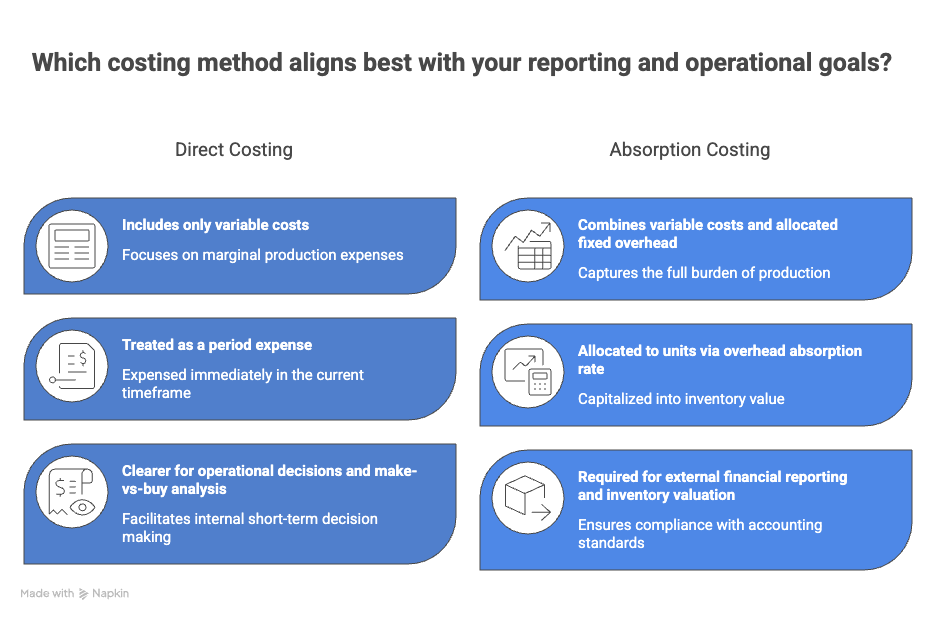
A direct cost system is a costing methodology that assigns only variable costs — direct materials, direct labor, and variable overhead — to products or services, treating fixed overhead as a period expense rather than a product cost. Also known as variable costing or marginal costing, it contrasts with absorption costing, which allocates both fixed and variable costs to each unit produced. In procurement and operations, direct cost systems are used to understand the true variable cost of production decisions, support pricing analysis, and evaluate the financial impact of volume changes without the distortion that fixed overhead allocation introduces.
Read more: Your Guide to Direct Spend Management in Procurement
Why Direct Cost System Matters in Procurement
Procurement professionals working with manufacturers, contract producers, or cost-plus supply arrangements need to understand the costing method their suppliers use to construct pricing. When a supplier uses a direct cost system internally, their quoted prices reflect variable cost plus margin — without fixed overhead absorption. Understanding this enables procurement to assess the true cost sensitivity of supplier pricing to volume changes, identify where price reductions are feasible as volumes shift, and challenge cost-plus quotes with an informed understanding of what drives the supplier’s cost structure at different output levels.
The Core Process of Direct Cost System
- Cost Classification: The direct cost system begins by separating all production costs into variable and fixed categories. Variable costs — materials, direct labor, variable utilities — are assigned to products. Fixed costs — rent, depreciation, management salaries — are treated as period costs and expensed in full in the period they are incurred, regardless of production volume.
- Variable Cost Assignment: Variable costs are traced to each unit produced using standard rates or actual costs. The resulting direct cost per unit reflects only the costs that change with production volume — making it sensitive to the raw material prices and labor rates that procurement manages.
- Contribution Margin Calculation: Revenue less variable cost produces the contribution margin — the amount each unit contributes to covering fixed costs and generating profit. This is the key management metric in a direct cost system: decisions are evaluated by their impact on contribution, not on fully absorbed unit cost.
- Period Cost Reporting: Fixed costs are reported separately from product costs, typically on the income statement as a lump sum. This presentation makes the relationship between volume, cost, and profit transparent — a key advantage of direct costing for operational decision-making.
Core Components of Direct Cost System
- Variable cost pool contains all costs that vary directly with production volume. In procurement terms, this is primarily direct material spend — the category that procurement has the most direct influence over and the one most sensitive to sourcing decisions.
- Contribution margin analysis evaluates profitability based on contribution after variable costs — enabling make-vs-buy, pricing, and volume decisions that absorption costing can obscure.
- Break-even analysis uses the direct cost framework to calculate the volume at which total contribution equals total fixed costs. Procurement’s role in managing variable cost directly affects the break-even position.
Key Benefits of Direct Cost System
- Provides a clear view of variable cost sensitivity — showing how material price changes flow directly to contribution margin.
- Enables procurement to challenge cost-plus quotes by understanding what portion of the supplier’s cost is truly variable versus fixed overhead allocation.
- Improves internal make-vs-buy analysis by focusing on incremental variable cost rather than fully absorbed unit cost.
Common Pitfalls of Direct Cost System
- Confusing direct costing with full financial reporting: Direct cost systems are management tools. External reporting under GAAP and IFRS requires absorption costing for inventory valuation — organizations use both, for different purposes.
- Applying direct costing to supplier quotes without understanding their method: Suppliers using absorption costing will build overhead into quoted prices. Procurement must identify which method a supplier uses before challenging their pricing structure.
- Treating all overhead as fixed: Some overhead costs are semi-variable. Incorrectly classifying them as fixed distorts contribution margin analysis.
KPIs of Direct Cost System
| Dimension | Sample KPIs |
| Variable Cost Control | Direct material cost per unit vs. standard, variable cost variance by category |
| Contribution Margin | Contribution margin per product/category, contribution margin ratio |
| Procurement Impact | Material cost reduction effect on contribution margin, price variance vs. standard |
| Break-Even Position | Break-even volume by product line, margin of safety ratio |
Key Terms in Direct Cost System
- Variable Costing: A costing method that assigns only variable production costs to products, treating fixed overhead as a period expense.
- Contribution Margin: Revenue minus variable cost — the amount each unit contributes to covering fixed costs and generating profit.
- Period Cost: A cost expensed in the period it is incurred rather than assigned to a product — how fixed overhead is treated under direct costing.
- Absorption Costing: A costing method that assigns both variable and fixed production costs to each unit, the standard for external financial reporting.
- Break-Even Analysis: The calculation of the volume at which total contribution equals total fixed costs and the operation becomes profitable.
- Marginal Cost: The cost of producing one additional unit — equivalent to variable cost per unit in a direct cost system.
Technology Enablement
ERP systems support direct cost system reporting through configurable cost accounting modules that separate variable and fixed cost pools, calculate contribution margins by product line, and generate break-even analysis. For procurement, spend analytics platforms can overlay variable cost data against contracted rates to assess procurement’s contribution to margin performance across the product portfolio.
FAQs
Q1. What is a direct cost system?
A costing methodology that assigns only variable costs to products, treating fixed overhead as a period expense rather than a product cost.
Q2. How is a direct cost system different from absorption costing?
Direct costing assigns only variable costs to products; absorption costing assigns both variable and fixed overhead. Direct costing is used for management decisions; absorption costing is required for external reporting.
Q3. Why does this matter for procurement?
Because procurement manages the variable costs that directly affect contribution margin — understanding the direct cost framework helps procurement assess the true financial impact of sourcing decisions.
Q4. What is contribution margin?
Revenue minus variable cost per unit — the measure of how much each unit sold contributes to covering fixed costs and generating profit.
Q5. How does procurement affect break-even?
By reducing direct material cost, procurement lowers the variable cost per unit, increasing contribution margin and reducing the volume required to break even.
Q6. Can suppliers use different costing methods?
Yes. Some suppliers use direct costing internally while quoting on absorption cost basis externally. Procurement should clarify which method underpins a cost-plus quote before evaluating it.










