



Single sourcing is a procurement strategy in which an organization intentionally selects one supplier to fulfill all requirements for a specific category, product, or service. Unlike sole sourcing, where only one supplier exists in the market, single sourcing is a deliberate choice made from among multiple available options. The decision is driven by strategic, operational, or relationship-based factors.
Read more: Sourcing Strategies: Multi Sourcing Vs Single Sourcing – A Strategic Pathway
Why Single-Sourcing Matters in Procurement
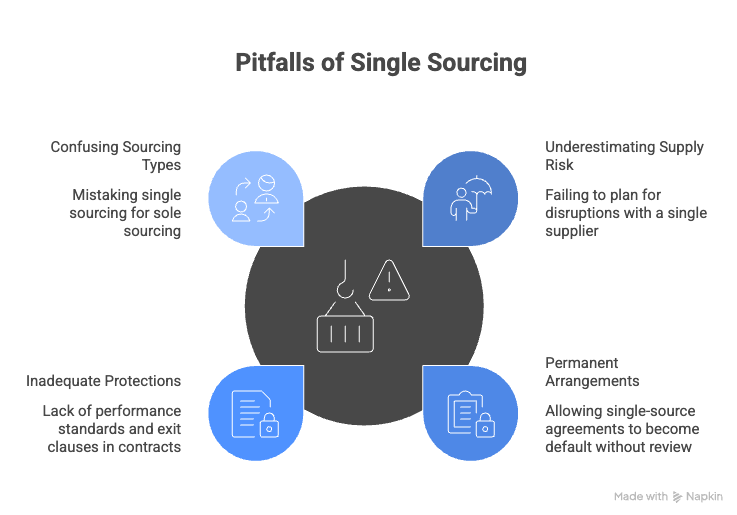
Single sourcing concentrates spend with one supplier, creating leverage for deeper pricing negotiation and preferential treatment. It simplifies supplier management and enables closer collaboration on quality, innovation, and delivery performance. However, it also concentrates supply risk. Procurement teams must weigh these trade-offs carefully and implement appropriate risk mitigation, including contractual protections and contingency planning.
The Core Process of Single-Sourcing
The process begins with a category analysis that identifies which goods or services are candidates for single sourcing. Procurement evaluates total spend volume, supply market complexity, and the strategic importance of the category. High integration requirements and dominant supplier positions are common indicators.
Once a category is identified, procurement conducts a supplier assessment covering financial stability, production capacity, quality management, and relationship history. A formal agreement is then negotiated, including volume commitments, pricing schedules, service level agreements, and contingency provisions.
With the agreement live, procurement transitions into active management. This includes performance monitoring, regular business reviews, and ongoing risk assessment. As conditions change, procurement evaluates whether the single-source arrangement remains appropriate or whether diversification is warranted.
Core Components of Single-Sourcing
Supplier qualification validates that the chosen supplier meets all technical, financial, and operational requirements before spend is consolidated. Any gaps identified at this stage should be addressed contractually or through supplier development before the arrangement is finalized. Risk mitigation planning identifies alternative suppliers that could be activated under emergency conditions, even if not under active contract. Performance governance maintains accountability through regular reviews and KPI tracking. Contract structure defines commercial terms, exclusivity arrangements, pricing review triggers, and exit conditions that protect the organization if conditions change.
Key Benefits of Single-Sourcing
- Deepens supplier relationships, enabling collaboration on innovation, lead time reduction, and joint problem-solving.
- Reduces administrative overhead associated with managing multiple suppliers within the same category.
- Consolidates spend, improving commercial leverage and creating opportunities for volume-based pricing.
- Supports supplier investment in dedicated capacity or tooling that benefits both parties over the long term.
When Single Sourcing Makes Strategic Sense
- High integration requirements: When supplier systems or tooling are deeply embedded in production, switching costs make multi-sourcing impractical.
- Dominant market position: If one supplier controls significant capacity or technology, consolidating with them typically yields better terms than splitting volume.
- Strong relationship track record: A supplier with proven performance, transparency, and responsiveness is a lower-risk single-source candidate than a newer partner.
- Supplier willingness to invest: Suppliers commit more capital and resources when volume assurance is in place, making single-source arrangements a stronger platform for joint development.
KPIs of Single-Sourcing
| Dimension | Sample KPIs |
| Supplier Reliability | On-time delivery rate, fill rate, stockout incidents |
| Cost Performance | Price variance vs. market benchmark, year-on-year cost movement |
| Risk Exposure | Single-source spend as % of category, contingency readiness score |
| Contract Compliance | SLA adherence rate, penalty clause activations |
Key Terms in Single-Sourcing
- Sole Sourcing: A situation where only one supplier exists in the market, removing supplier choice from procurement.
- Dual Sourcing: A risk mitigation strategy that splits supply of a category between two qualified suppliers.
- Supply Concentration Risk: The exposure created when a significant share of supply depends on a single source.
- Contingency Supplier: A pre-qualified alternative supplier that can be activated in the event of primary supplier failure.
- Preferred Supplier: A supplier designated as the primary source in a category based on performance or strategic alignment.
- Category Strategy: A documented plan defining how procurement will manage a specific spend category, including sourcing approach.
Technology Enablement
Modern Source-to-Pay platforms support single-source management through supplier performance dashboards, contract management modules, and spend analytics that flag concentration risk. These tools provide procurement with the visibility to monitor arrangements and trigger reviews when supplier performance or market.
FAQs
Q1. What is single sourcing?
Single sourcing is the deliberate selection of one supplier for a category, chosen from among available alternatives.
Q2. How is single sourcing different from sole sourcing?
Sole sourcing reflects a market constraint where only one supplier exists. Single sourcing is a strategic choice.
Q3. What categories are best suited to single sourcing?
Categories with high integration requirements, significant switching costs, or dominant supplier positions are typical candidates.
Q4. What are the main risks of single sourcing?
Supply disruption with no fallback, dependency on supplier financial health, and reduced competitive tension on pricing.
Q5. How can organizations mitigate single-source risk?
Contractual protections, pre-qualified contingency suppliers, and periodic market assessments are the most common approaches.
Q6. How often should single-source decisions be reviewed?
Most organizations review single-source arrangements annually or at contract renewal.
Q7. Can single sourcing and competitive pricing coexist?
Yes. Volume consolidation and benchmarking clauses can preserve pricing competitiveness without active bidding.
References
For further insights into these processes, explore Zycus’ dedicated resources related to Single-Sourcing:
- How is Cognitive Procurement Impacting Business Users?
- Navigating the Shift: What is a Paperless Accounts Payable System?
- Felix Felicis for commodity managers – Would it be of any help?
- ESSENTIAL SOURCE-TO-PAY KPIS, IMPLEMENTATION MINDFULNESS & BENCHMARKING
- Mastering Supplier Risk Assessment: Best Practices Revealed










