


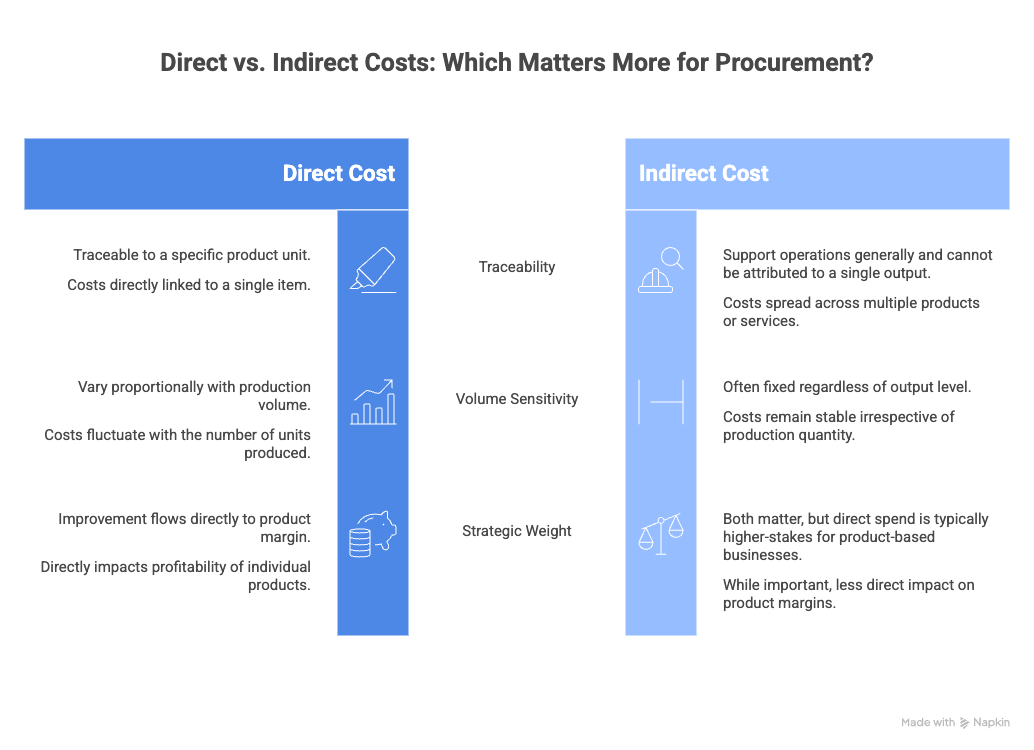
Direct cost is any cost directly attributed to the production of a specific good or service. In manufacturing, direct costs include raw materials, components, and direct labor — varying proportionally with output volume. In procurement, direct costs represent the purchased inputs that become part of the delivered product, making their management central to product cost competitiveness and margin performance.
Why Direct Cost Matters in Procurement
Direct cost procurement is strategically critical because it directly affects product cost, margin, and competitiveness. Unlike indirect spend, where savings primarily reduce overhead, savings in direct material procurement flow through to product cost and can create or protect a competitive pricing advantage. For manufacturers, direct material can represent 50 to 70 percent of total product cost. Category managers responsible for direct spend are therefore among the most commercially impactful roles in the procurement function, with their decisions directly influencing the organization’s profit and loss.
Read more: Your Guide to Direct Spend Management in Procurement
The Core Process of Direct Cost
- Should-Cost Modelling: The process begins with understanding what a component or material should cost based on its constituent inputs — raw material, labor, overhead, and margin. Should-cost analysis gives procurement an analytical basis for negotiation that enables challenge of supplier pricing from a cost-structure perspective.
- Supplier Qualification and Development: Direct material suppliers typically require technical qualification — process capability assessment, quality system certification, and production trials — before they can supply at commercial scale. Qualification timelines are longer than for indirect categories and must be planned into the product development cycle.
- Sourcing and Negotiation: Direct category sourcing uses the full range of procurement tools — competitive events, long-term agreements, volume commitments — but must balance commercial optimization with supply continuity and quality requirements. For critical direct materials, supply security often takes precedence over achieving the lowest possible price.
- In-Life Cost Management: Once a direct material supplier is live, procurement actively manages cost through regular price reviews, productivity improvement programmes, value engineering, and specification optimization. The goal is to reduce cost over the product lifecycle rather than treating the contracted price as fixed.
Core Components of Direct Cost
- Bill of Materials (BOM) lists every purchased input required to produce one unit of product — materials, components, packaging — with quantities and specifications. BOM accuracy is essential for procurement planning and cost modeling.
- Should-cost analysis builds a bottom-up cost model for each purchased component based on its constituent inputs. It enables procurement to assess supplier quotes against what the component ought to cost rather than relying on benchmark comparisons alone.
- Supplier qualification validates that a supplier can consistently produce to specification at scale, with the quality systems, capacity, and financial stability required for a production supply relationship.
- Value engineering is the collaborative process through which procurement and engineering review specifications to identify design or material changes that reduce cost without compromising function or quality.
Key Benefits of Direct Cost
- Directly reduces product cost, improving margin or enabling competitive pricing where cost is a key differentiator.
- Provides an analytical basis for negotiation through should-cost modelling, enabling challenge of supplier pricing from a cost-structure perspective.
- Reduces production disruption risk through rigorous supplier qualification and supply continuity planning for critical direct materials.
Common Pitfalls of Direct Cost
- Treating direct procurement as purely transactional: Direct spend requires strategic management — should-cost analysis, supplier development, value engineering — that purely transactional buying cannot deliver. Under-investing in direct procurement capability leaves significant margin improvement on the table.
- Optimizing price at the expense of supply continuity: For critical direct materials, supply disruption costs — line stoppages, customer delivery failures — can dwarf the savings from aggressive price negotiation. Supply security must be weighted appropriately in direct category strategy.
- Failing to engage procurement early in product development: Procurement engaged after design specifications are finalized has limited ability to influence material selection, supplier choice, or cost structure. Early involvement enables design-for-procurement that reduces cost from the outset.
- Ignoring total cost of quality: Direct material quality failures generate scrap, rework, warranty claims, and customer returns that can far exceed the apparent saving from a lower-cost supplier. Total cost of quality must be included in direct sourcing decisions.
KPIs of Direct Cost
| Dimension | Sample KPIs |
| Cost Performance | Direct material cost as % of product cost, year-on-year cost reduction per component |
| Quality | Incoming quality acceptance rate, supplier defect rate, cost of quality incidents |
| Supply Continuity | Direct material stockout incidents, line stoppage hours attributable to supply failure |
| Savings Delivery | Value engineering savings achieved, should-cost gap closed |
Key Terms in Direct Cost
- Bill of Materials (BOM): A structured list of all materials, components, and quantities required to produce one unit of a product.
- Should-Cost Analysis: A bottom-up cost model that estimates what a component or material should cost based on its constituent inputs, used to challenge supplier pricing.
- Value Engineering: A collaborative review of product specifications to identify design or material changes that reduce cost without compromising function or quality.
- Direct Material: Raw materials and components purchased for incorporation into a finished product.
- Indirect Cost: Costs that support operations but cannot be directly traced to a specific product unit — facilities, IT, professional services.
- Total Cost of Quality: The full cost of producing and delivering a product to required quality standards, including prevention, appraisal, and failure costs.
Technology Enablement
Direct procurement is supported by product lifecycle management tools that connect BOM data to sourcing workflows, should-cost modelling platforms that enable analytical negotiation preparation, and supplier quality management systems that track incoming quality and defect rates. Integration between PLM, procurement, and ERP ensures that design changes, specification updates, and cost improvements flow consistently through the supply chain.
FAQs
Q1. What is a direct cost in procurement?
A cost directly attributable to producing a specific good or service — raw materials, components, and direct labor that become part of the delivered product.
Q2. How is direct cost different from indirect cost?
Direct costs are traceable to a specific product and vary with volume. Indirect costs support operations generally and cannot be directly attributed to a single output.
Q3. Why is direct procurement strategically important?
Because direct material cost directly affects product margin and pricing competitiveness — in manufacturing, it can represent 50 to 70 percent of total product cost.
Q4. What is should-cost analysis and why does it matter?
A bottom-up model of what a component should cost based on its inputs — giving procurement an analytical basis to challenge supplier pricing rather than relying on market comparisons alone.
Q5. How does direct procurement manage supply continuity risk?
Through dual sourcing, safety stock calibrated to lead time variability, supplier financial monitoring, and supply continuity planning for critical direct materials.
References
For further insights into these processes, explore Zycus’ dedicated resources related to Direct Cost:
- Smarter Way to Modernize Direct Procurement in Manufacturing
- How highly innovative procurement organizations are different!
- These 5 Contract Management Best Practices can do Wonders!
- Procurement and Vendor Management Need a Center of Excellence to Be Digital-Business-Ready
- The C-Suite’s Guide to Successful Accounts Payable Transformation
- Victoria Police at Zycus’ MCG event: Unlocking Deep Value with Agentic AI