



Tail Spend Management refers to the structured approach used by organizations to control, optimize, and govern low-value, high-volume purchases that typically fall outside strategic sourcing programs. While each individual transaction is small, tail spend collectively represents a significant portion of total procurement activity and often carries disproportionate risk, inefficiency, and leakage.
Tail spend typically includes ad-hoc purchases, spot buys, one-time services, and non-catalog items—areas where compliance is weakest and visibility is lowest. Effective tail spend management brings these fragmented purchases back into the procurement ecosystem without slowing down the business.
Read more: Guide to Tail Spend Analysis: What it is and Why it Matters
Why Tail Spend Matters
Tail spend is often unmanaged not because it is unimportant—but because it is operationally complex. Thousands of suppliers, infrequent purchases, and decentralized buying behavior make traditional sourcing impractical.
When left uncontrolled, tail spend leads to:
- Maverick purchasing outside approved suppliers and contracts
- Price inconsistencies and missed savings opportunities
- Supplier risk and compliance exposure
- High processing costs relative to transaction value
- Poor spend visibility and data quality
Managing tail spend effectively transforms procurement from reactive policing into proactive enablement.
Read more: The Silent 20%: Why Tail Spend Is Procurement’s Hidden Goldmine
The Tail Spend Management Framework
Tail spend management operates as a control and enablement loop, balancing speed for users with governance for procurement.
| Area | Objective | Outcome |
| Visibility | Identify tail spend patterns | Spend transparency |
| Intake & Guidance | Channel demand correctly | Policy-aligned buying |
| Supplier Rationalization | Reduce supplier sprawl | Lower risk and cost |
| Tactical Sourcing | Optimize spot purchases | Cost efficiency |
| Automation | Reduce processing effort | Operational efficiency |
| Continuous Improvement | Shrink the tail | Long-term savings |
The Core Tail Spend Management Flow
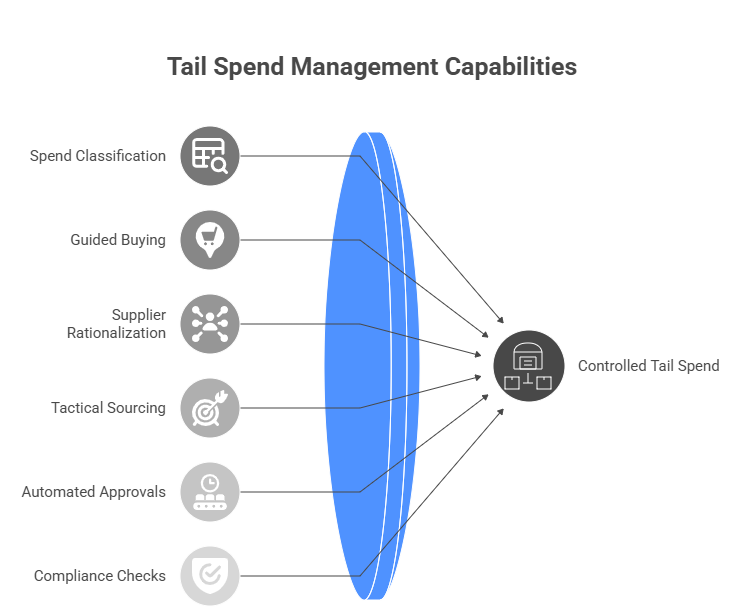
1. Spend Visibility and Tail Identification
Tail spend management begins with visibility. Organizations analyze historical spend data to identify low-value, non-contracted purchases spread across many suppliers and categories.
This analysis helps procurement distinguish between strategic spend that requires sourcing and tail spend that requires control, automation, or consolidation.
2. Guided Intake and Demand Channeling
Once identified, tail spend must be captured through structured intake rather than ad-hoc buying. Employees are guided to the right purchasing path based on category, value, and risk.
Low-risk purchases may be routed to catalogs or preferred suppliers, while higher-risk requests trigger reviews or lightweight sourcing—ensuring speed without sacrificing governance.
3. Supplier Consolidation and Rationalization
Tail spend often results in excessive supplier fragmentation. Supplier rationalization focuses on consolidating spend with fewer, vetted suppliers where possible.
Reducing the supplier base lowers onboarding effort, improves compliance, strengthens negotiation leverage, and reduces operational risk.
4. Tactical and Spot Sourcing
Not all tail spend can be cataloged or pre-contracted. For one-off or urgent requirements, tactical sourcing methods—such as quick RFQs or spot negotiations—are used.
These lightweight sourcing approaches ensure competitive pricing and basic compliance without the overhead of full strategic sourcing cycles.
5. Automation and Touchless Processing
Automation is critical to making tail spend economically manageable. Standardized workflows, auto-approvals, and rule-based routing reduce manual effort and processing costs.
By minimizing human intervention in low-value transactions, procurement teams can focus their time on high-impact strategic activities.
6. Compliance, Risk, and Controls
Despite low transaction value, tail spend can carry significant risk—especially related to supplier compliance, data security, ESG, or regulatory exposure.
Effective tail spend management embeds controls such as preferred supplier usage, approval thresholds, audit trails, and policy enforcement to reduce exposure without creating friction.
7. Continuous Optimization and Tail Reduction
Tail spend management is not static. Over time, recurring tail purchases are identified and either moved into catalogs, consolidated into contracts, or strategically sourced.
The goal is not just to manage tail spend—but to shrink the tail continuously.
Read more: 5 Key Benefits of Automating Tail Spend Management
Key Concepts in Tail Spend Management
Several principles define effective tail spend programs:
- Enablement over Enforcement: Make compliant buying easier than bypassing procurement
- Proportional Control: Apply lighter governance for low-risk spend
- Speed with Guardrails: Preserve business agility while maintaining policy alignment
- Automation First: Reduce processing cost below transaction value
- Continuous Consolidation: Convert unmanaged spend into managed channels
These concepts help procurement balance governance with business responsiveness.
Read more: Tail Spend vs. Tactical Spend vs. Maverick Spend: Clearing the Confusion in Procurement
KPIs for Tail Spend Management
| Dimension | Sample KPIs |
| Visibility | % spend classified, tail spend share |
| Compliance | Maverick spend %, preferred supplier usage |
| Efficiency | Cost per transaction, touchless rate |
| Savings | Cost avoidance from consolidation |
| Risk | Unvetted supplier count |
Tracking these metrics ensures tail spend management delivers measurable value.
Explore Zycus’ Tail Spend Management Solution
Tail Spend and the Broader Procurement Ecosystem
Tail spend management connects closely with:
- Guided Buying to steer employee purchasing behavior
- Procure-to-Pay to automate low-value transactions
- Supplier Management to control onboarding and risk
- Analytics to identify consolidation and sourcing opportunities
When embedded into the broader procurement lifecycle, tail spend becomes a managed segment, not an unmanaged exception.
Key Terms in Tail Spend Management
- Tail Spend: Low-value, high-volume purchases that fall outside strategic sourcing programs.
- Tail Spend Management: The structured approach to control, optimize, and govern unmanaged low-value purchases.
- Maverick Spend: Purchases made outside approved suppliers, contracts, or procurement processes.
- Spot Buying: One-time or ad-hoc purchases made without pre-negotiated contracts.
- Guided Buying: User-facing controls that steer employees toward compliant purchasing options.
- Supplier Rationalization: Reducing the number of suppliers to consolidate spend and lower risk.
- Non-Catalog Spend: Purchases not available through approved catalogs or frameworks.
- Spend Visibility: The ability to classify and analyze procurement spend across categories and suppliers.
- Touchless Processing: Automated handling of purchases with minimal or no manual intervention.
- Policy Compliance: Adherence to organizational purchasing rules and approval thresholds.
FAQs
Q1. What is tail spend management?
Tail spend management is the process of controlling and optimizing low-value, non-strategic purchases to improve visibility, compliance, and efficiency.
Q2. Why is tail spend important in procurement?
Although individually small, tail spend can represent a large share of suppliers, transactions, and risk when left unmanaged.
Q3. How does tail spend contribute to maverick spending?
Tail spend often bypasses sourcing and contracts, making it the primary source of off-contract and non-compliant purchases.
Q4. How can organizations reduce maverick spend?
By improving spend visibility, guiding employees to approved buying channels, consolidating suppliers, and automating low-value purchasing workflows.
Q5. What tools are used to manage low-value spend?
Common tools include guided buying systems, catalog management, tactical sourcing tools, automated approvals, and spend analytics.
References
- Tail Spend Optimization through GenAI Automation
- From Neglected to Negotiated: How Agents Captures More than $50M in Tail Spend
- Unlock the Hackett Group 2025 Tail Spend Management Study
- Optimize Tail Spend with Agentic AI | Webinar
- P2P Touchless long tail spend management: The New Benchmark for World Class P2P Process Efficiency










