



CPO Moneyball Analytics applies rigorous quantitative analysis to procurement decisions traditionally made through experience and intuition. Inspired by data-driven talent evaluation in professional baseball, it uses advanced analytics, benchmarking data, and statistical models to identify undervalued savings opportunities, challenge procurement assumptions, and measure performance with greater precision than traditional metrics allow.
Why CPO Moneyball Analytics Matters in Procurement
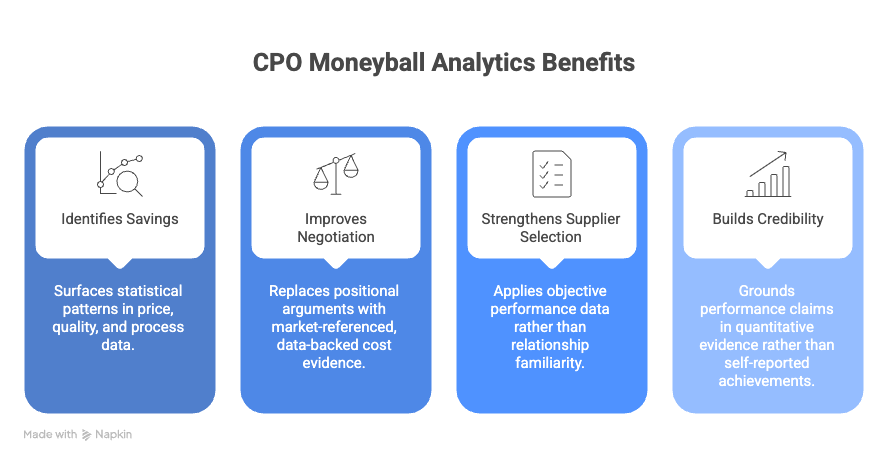
Most procurement functions collect significant data but use only a fraction of its analytical potential. Category strategies are built on experience rather than evidence; supplier selections favor the familiar over the objectively better. CPO Moneyball Analytics challenges this by applying data as the primary decision input — identifying opportunities that intuition-driven procurement misses and surfacing inefficiencies that experience overlooks. For CPOs under pressure to demonstrate value beyond savings, it provides the evidence base for better decisions and more credible performance reporting.
The Core Process of CPO Moneyball Analytics
- Data Infrastructure Audit: The process begins by assessing the quality, completeness, and accessibility of procurement data — spend transaction records, supplier performance data, contract terms, market benchmarks, and process metrics. Moneyball-style analytics requires clean, comprehensive data; organizations with poor data foundations must invest in data quality before analytical value can be extracted.
- Metric Design and Benchmarking: The team defines the specific metrics that will drive procurement decisions — cost-per-unit benchmarks by category, should-cost model targets, supplier performance distributions, process cycle time percentiles. External benchmarks are sourced to provide the reference points that reveal where internal performance is genuinely strong and where it is lagging market practice.
- Opportunity Identification Through Analysis: Statistical analysis is applied to identify patterns, anomalies, and opportunities that intuition would miss — categories where price variance across business units exceeds benchmarks, suppliers whose quality cost profile suggests a specification change would deliver more value than a price reduction, or process steps whose cycle time is a statistical outlier compared to peer organizations.
- Decision Application and Tracking: Analytical findings are incorporated into sourcing strategies, supplier selections, and category priorities. Outcomes are tracked against the predictions made by the analysis, enabling refinement of the models and building confidence in data-driven decision-making across the procurement function.
Core Components of CPO Moneyball Analytics
- Spend benchmarking compares the organization’s pricing and terms against market data and peer organizations, revealing where procurement is paying above-market rates and where renegotiation opportunity exists. Benchmarks shift procurement negotiation from positional to evidence-based.
- Should-cost modelling builds bottom-up cost estimates from raw material, labor, overhead, and margin components. Applied analytically across a category portfolio, it identifies where supplier margins are excessive and where specification changes could reduce cost more effectively than price negotiation.
- Supplier performance analytics applies statistical analysis to quality, delivery, and cost performance data across the supply base — identifying which suppliers consistently outperform and which underperform relative to their cost, enabling more analytically grounded decisions about which relationships to invest in.
- Process analytics measures the efficiency of procurement processes — sourcing cycle times, approval rates, touchless invoice percentages — using statistical benchmarks to identify where process performance is limiting procurement’s capacity to deliver value.
Common Pitfalls of CPO Moneyball Analytics
- Applying analytics to poor-quality data. Sophisticated analysis of inaccurate or incomplete data produces confident-sounding but misleading conclusions. Data quality investment must precede analytical investment.
- Using analytics to confirm existing views rather than challenge them. The value of Moneyball-style analytics lies in its ability to reveal what conventional wisdom misses. Procurement teams that use data selectively to validate predetermined conclusions lose this benefit.
- Ignoring the human judgment layer. Data identifies opportunities and informs decisions; it does not replace the relationship management, negotiation skill, and contextual judgment that procurement professionals apply. Analytics augments procurement capability — it does not substitute for it.
- Measuring what is easy rather than what matters. Analytics programmes that focus on easily measured metrics — cycle time, PO volume — without connecting to commercially important outcomes deliver process visibility without strategic value.
Analytical Questions CPO Moneyball Can Answer
Where are we paying above-market prices? Cross-referencing internal pricing against market benchmarks reveals where negotiation opportunity is greatest.
Which suppliers deliver the best total value? Combining cost, quality, delivery, and risk data into a multi-dimensional performance score identifies suppliers whose total contribution exceeds what their unit price suggests.
What would it cost if we specified differently? Should-cost modelling applied to specification alternatives identifies where design or material changes reduce cost more effectively than supplier negotiation.
KPIs of CPO Moneyball Analytics
| Dimension | Sample KPIs |
| Data Foundation | % of spend with benchmark data, should-cost model coverage by category |
| Analytical Impact | Savings identified through analytics vs. traditional methods, negotiation improvement vs. benchmark |
| Decision Quality | % of sourcing decisions with documented analytical input, post-award outcome vs. prediction |
| Process Intelligence | Process cycle time percentile vs. peer benchmark, analytical insight action rate |
Key Terms in CPO Moneyball Analytics
- Spend Benchmarking: The comparison of an organization’s pricing and commercial terms against external market data to identify pricing gaps and negotiation opportunity.
- Should-Cost Model: A bottom-up cost estimate built from constituent input prices — materials, labor, overhead, margin — used to challenge supplier pricing from an analytical cost-structure perspective.
- Performance Distribution: A statistical view of how suppliers are distributed across performance dimensions, identifying outliers that warrant different management approaches.
- Data-Driven Procurement: A procurement operating model in which analytical evidence is the primary input to sourcing strategy, supplier selection, and performance management decisions.
Technology Enablement
Advanced spend analytics platforms, benchmarking databases, and AI-powered insight tools are the infrastructure layer for CPO Moneyball Analytics. These platforms automate data aggregation, apply statistical models to identify opportunities, and present findings in formats that category managers can act on without requiring data science expertise. Integration between procurement, finance, and supplier data systems is the foundation that makes analytics both comprehensive and current.
FAQs
Q1. What is CPO Moneyball Analytics?
A procurement approach that applies rigorous quantitative analysis to decisions traditionally made through experience and intuition — identifying undervalued opportunities and measuring performance with greater precision.
Q2. Where does the Moneyball analogy come from?
From the data-driven approach to baseball talent evaluation that challenged conventional wisdom and found undervalued players overlooked by traditional scouting. Applied to procurement, it means finding value that intuition-based approaches miss.
Q3. What data does Moneyball analytics require?
Spend transaction data, supplier performance records, contract terms, market benchmarks, should-cost models, and process performance metrics — all requiring sufficient quality and completeness to support statistical analysis.
Q4. How does Moneyball Analytics improve negotiations?
By replacing positional arguments with data-backed market references — making it harder for suppliers to defend above-market pricing without factual justification.
Q5. Is Moneyball Analytics a replacement for procurement expertise?
No. Data identifies opportunities; expertise determines how to capture them. The combination of analytical insight and procurement judgment consistently outperforms either in isolation.
Q6. How should CPOs build an analytics capability?
Starting with data quality investment, defining the specific decisions analytics will inform, building or buying the analytical tools to support those decisions, and training category managers to use data in their daily work.
References
- A CPO’s Guide to Intake & Orchestration Management in 2025
- The CPO’s Playbook: 5 Strategic Nuances for Proactive Procurement Excellence
- Procurement 2025: A CPO’s Guide to Strategic Priorities, Trends, and Innovations
- Benchmarking Procurement Performance: Where Do You Stand in 2025?
- The First 90 Days as a New CPO: A 2026 Playbook (Backed by Forrester Data)










