



Supplier rationalization is the process of systematically reviewing and reducing the number of active suppliers in an organization’s supply base to eliminate fragmentation, improve commercial leverage, and reduce management complexity. It involves assessing which suppliers genuinely add value, which are redundant, and which represent unnecessary risk or cost, then taking deliberate action to exit low-value relationships and concentrate spend with a smaller, higher-performing group.
Why Supplier Rationalization Matters in Procurement
Most organizations accumulate suppliers over time through decentralized buying, emergency sourcing, and project-specific decisions made without category oversight. The result is a bloated supply base where significant management effort is consumed by suppliers delivering minimal value. Rationalization reclaims that effort, concentrates spend to generate leverage, and creates a cleaner, more governed supply base that procurement can manage proactively. It is one of the highest-return structural improvements a procurement function can undertake.
The Core Process of Supplier Rationalization
- Supply Base Audit: The process begins with a comprehensive review of all active suppliers. Procurement pulls a complete list from ERP and procurement systems and enriches it with spend data, transaction frequency, category coverage, and performance history. This often reveals the scale of fragmentation — many organizations find hundreds of suppliers receiving payments below a meaningful spend threshold.
- Supplier Segmentation: Suppliers are classified into tiers: strategic partners to retain and develop, preferred suppliers to consolidate spend with, approved suppliers to maintain under standard terms, and rationalization candidates to be transitioned out. Segmentation criteria should reflect both commercial value and supply continuity risk.
- Transition Planning: For rationalization candidates, procurement assesses whether their spend can be absorbed by retained suppliers, consolidated onto frameworks, or eliminated entirely. A transition plan is developed for each exit, covering spend reallocation, contract wind-down timelines, and any operational dependencies that must be resolved before the relationship ends.
- Governance and Controls: Once rationalization is executed, the supply base is governed under a defined model with regular reviews to prevent re-fragmentation. Policies controlling when new suppliers can be added are essential to maintaining the discipline that rationalization creates.
Core Components of Supplier Rationalization
- Supply base audit establishes the factual baseline — total supplier count, spend distribution, transaction volume, and performance status. Without this, rationalization decisions rest on incomplete information.
- Segmentation framework classifies every supplier against defined criteria to determine their tier and the appropriate management approach. It provides the rationale for retention and exit decisions.
- Exit and transition planning ensures that supplier relationships are wound down in a way that maintains operational continuity, settles financial obligations, and preserves the organization’s reputation.
- Re-fragmentation controls set rules around new supplier onboarding to prevent the supply base from expanding again through uncontrolled decentralized purchasing.
Key Benefits of Supplier Rationalization
- Reduces procurement administration by cutting the volume of suppliers requiring onboarding, compliance monitoring, and performance reviews.
- Concentrates spend with fewer suppliers, improving commercial leverage and enabling volume-based pricing improvements.
- Simplifies risk management by reducing the number of supplier relationships requiring active risk assessment and continuity planning.
- Free procurement resource from low-value transactional supplier management, redirecting it to strategic category work.
- Creates a more accountable supply base where performance expectations are clear and consistently enforced.
Common Pitfalls of Supplier Rationalization
- Rationalizing without assessing supply continuity risk: Exiting suppliers without confirming that retained partners can absorb the volume creates operational exposure. Capacity validation must precede exit decisions.
- Setting supplier count targets without a strategic rationale: Reducing supplier numbers is not an end in itself. Targets should be driven by what is commercially and operationally optimal, not by arbitrary reduction goals.
- Failing to enforce new supplier onboarding controls: Without governance over how new suppliers are added, rationalized supply bases quickly re-fragment through decentralized buying.
- Treating rationalization as a one-time project: Supply bases drift over time. Rationalization must be embedded as a recurring governance activity, not a single clean-up exercise.
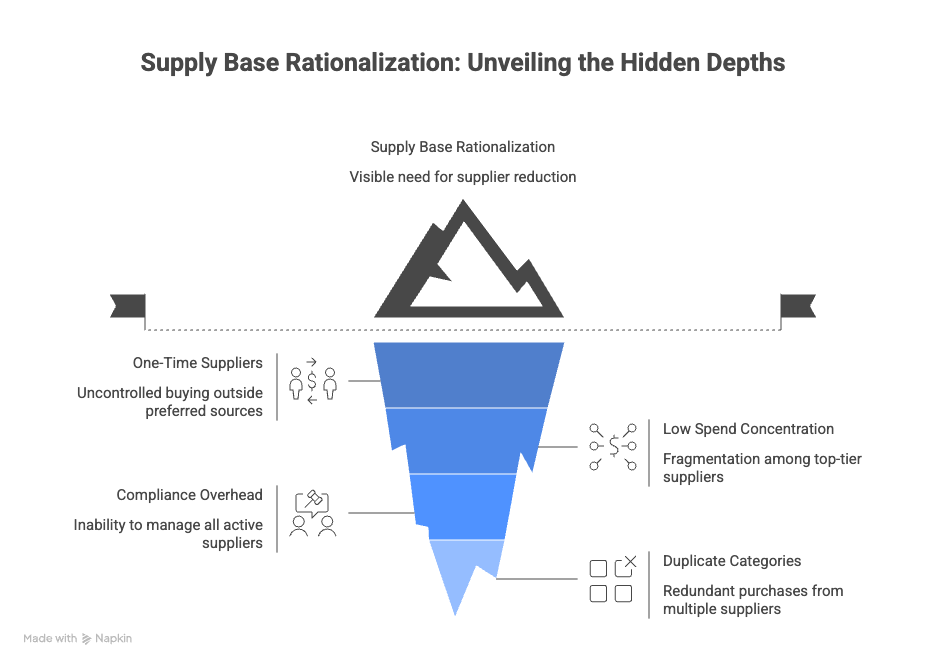
KPIs of Supplier Rationalization
| Dimension | Sample KPIs |
| Supply Base Size | Total active supplier count, year-on-year reduction rate |
| Spend Concentration | % of spend with top-tier suppliers, tail spend as % of total |
| Exit Execution | # of suppliers exited per quarter, transition on-time completion rate |
| Governance Health | New supplier additions vs. exits ratio, onboarding policy compliance rate |
Key Terms in Supplier Rationalization
- Supply Base Audit: A comprehensive review of all active suppliers, spend data, and performance history used as the foundation for rationalization decisions.
- Supplier Segmentation: The classification of suppliers into tiers based on strategic value, spend, risk, and performance, which drives rationalization and management decisions.
- Tail Spend: Low-value, high-volume transactions spread across many suppliers, typically the primary target of rationalization programs.
- Preferred Supplier: A supplier designated as the primary or consolidated source in a category following rationalization.
- Offboarding: The structured process of exiting a supplier relationship, including spend transition, contract wind-down, and financial settlement.
Technology Enablement
Spend analytics platforms support rationalization by surfacing fragmented spend patterns, quantifying tail spend, and tracking supplier count trends over time. Source-to-Pay platforms enforce rationalization outcomes through preferred supplier catalogues, onboarding approval workflows, and supplier master governance controls that prevent unauthorized additions.
FAQs
Q1. What is supplier rationalization?
The process of reviewing and reducing the active supplier base to eliminate fragmentation, improve leverage, and concentrate spend with fewer, higher-performing partners.
Q2. How is rationalization different from consolidation?
They are closely related. Rationalization is the broader structural process of reviewing the supply base; consolidation specifically refers to concentrating spend with retained suppliers.
Q3. How many suppliers should remain after rationalization?
The right number depends on category complexity, volume, and risk profile. The goal is the fewest suppliers that can reliably meet all requirements without creating unacceptable concentration risk.
Q4. What happens to contracts with exited suppliers?
Contracts are wound down according to their termination provisions. Procurement should ensure all obligations are settled and spend is fully transitioned before the relationship is formally closed.
Q5. How do you prevent supply base re-fragmentation?
Through enforced new supplier onboarding policies, preferred supplier mandates, and regular supply base reviews that track count trends.
Q6. What role does spend analytics play in rationalization?
Spend analytics identifies where fragmentation exists, quantifies the volume available for consolidation, and benchmarks pricing across active suppliers.
Referrences
For further insights into these processes, explore Zycus’ dedicated resources related to Supplier Rationalization:
- Enhancing Contract Management with Automated Clause Addition
- Spendonomics: The science of astute spend management
- 4 Tools to Elevate Procurement Performance Management and Capture the CFO’s Attention: Zycus
- Smart Spend Analysis: A bird’s eye view
- Calculating the Return on Digital Procurement: A Strategic Approach










