


WHAT IS DEMAND AGGREGATION?
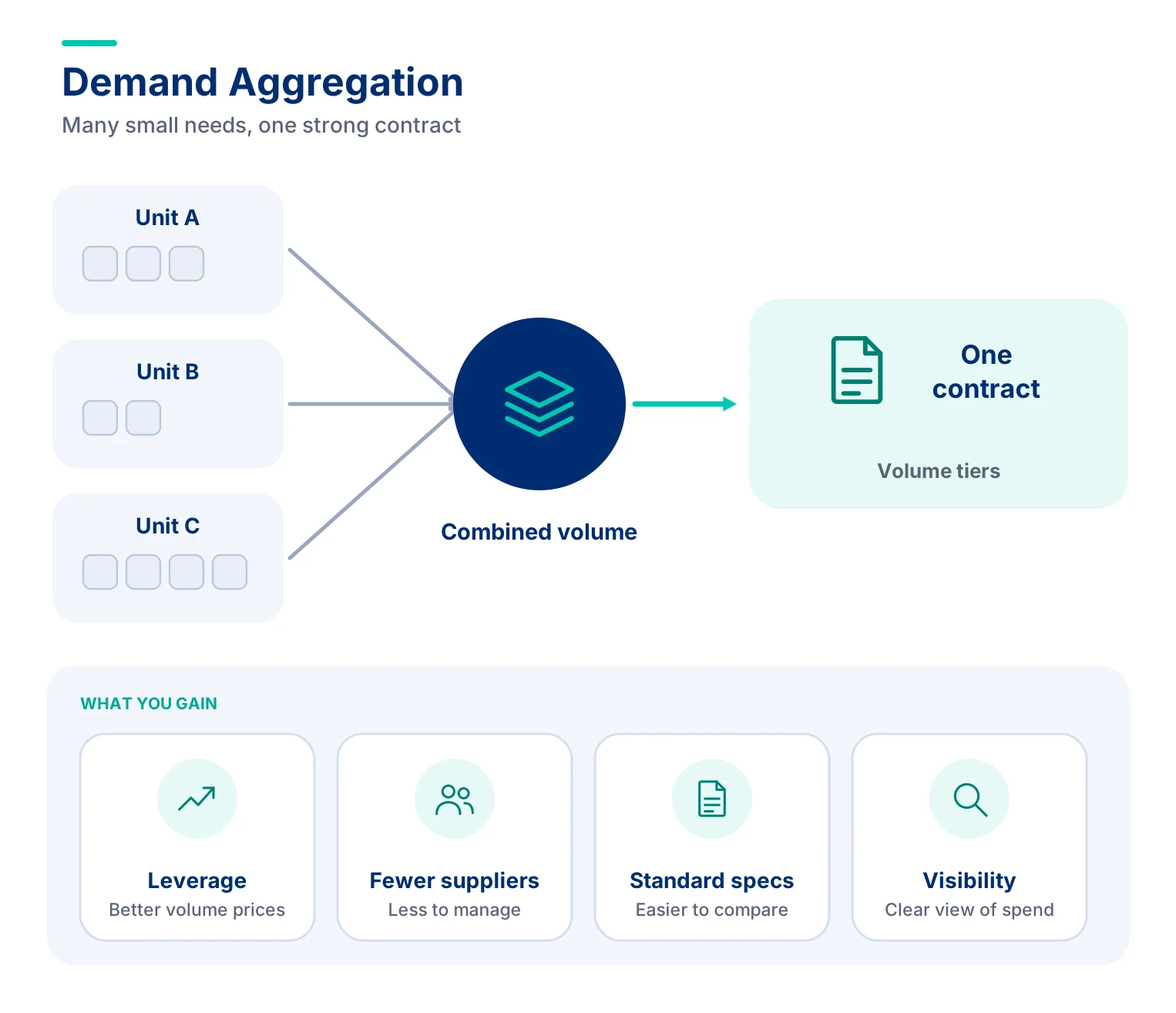
Demand aggregation is the practice of combining the purchasing requirements of several business units, sites or organizations for the same goods or services, so they can be sourced together. The larger combined volume gives buyers more negotiating power and lets suppliers offer better prices and terms.
WHY IT MATTERS IN PROCUREMENT
Many companies buy the same items through many people, sites and contracts. Each buys a small amount, so none has much leverage, and the same product may be bought at different prices from different suppliers. Aggregating demand turns this scattered volume into one clear requirement that suppliers want to win.
The gain is not only price. Aggregation also reduces the number of suppliers and contracts to manage, standardizes specifications and gives procurement a clear view of what the organization buys. It works best in categories where needs are similar across units, and less well where local requirements differ widely.
THE CORE PROCESS / LIFECYCLE
- Gather Spend Data. Procurement collects spend and volume by item, supplier and business unit, and cleans and classifies it so the same items can be matched.
- Find Common Needs. The team identifies items and categories that several units buy and checks which can use the same specification.
- Standardize Specifications. Business units agree a common specification, or a small set of options, so that suppliers can quote one requirement.
- Consolidate and Source. The combined volume is taken to market through a tender, auction or negotiation, often with volume tiers.
- Award and Contract. A single contract or framework is awarded, with clear call-off rules for each unit or site.
- Manage Compliance. Procurement tracks whether units buy through the agreed contract and measures the savings actually delivered.
CORE COMPONENTS
- Spend visibility gives a reliable view of who buys what from whom.
- Specification alignment ensures units can accept the same product or service.
- Volume commitments describe how much the buyer expects to purchase, and whether the commitment is firm or an estimate.
- Contract structure sets prices, tiers and call-off terms.
- Governance assigns an owner and a way to resolve disputes between units.
- Compliance tracking checks that the volume actually flows to the contract.
KEY BENEFITS
Aggregation raises purchasing leverage and often lowers unit prices through volume tiers. It also reduces transaction cost, since one sourcing event and one contract replace many. Standard specifications cut complexity in stock-keeping and make supplier performance easier to compare.
Fewer suppliers mean less management effort and easier risk monitoring. A consolidated view of demand also helps forecasting, so suppliers can plan capacity and may offer better service terms. The same data supports category strategy, because the organization can see where volumes are growing or shrinking.
COMMON PITFALLS
- Promising volume that units will not deliver. If forecast volumes are not firm and units buy elsewhere, the price tier is not earned and the supplier relationship suffers.
- Forcing one specification on everyone. Local needs matter, so a standard that does not fit leads to workarounds and off-contract buying.
- Aggregating where it does not help. In categories with highly local or specialized supply, consolidation can add cost and reduce service.
- Skipping compliance tracking. Without measurement, savings exist only on paper.
WAYS TO AGGREGATE DEMAND
Demand can be combined in several ways. The right one depends on how similar the needs are and who is buying. Joint purchasing between competitors needs competition law review.
| Approach | How it works | Typical fit |
| Internal consolidation | Units of one company combine requirements under one contract | Common categories such as IT, facilities and travel |
| Cross-category bundling | Related categories are tendered together to offer a larger package | Suppliers that cover several categories |
| Time aggregation | Orders are grouped into scheduled batches rather than placed one by one | Frequent small orders |
| Consortium or group purchasing | Separate organizations buy together through a shared contract | Smaller buyers, public bodies and similar institutions |
KPIs
| Dimension | Sample KPIs |
| Savings | Price reduction versus prior spend; savings delivered after consolidation |
| Consolidation | Suppliers per category; share of spend under aggregated contracts |
| Compliance | Spend through the contract as share of eligible spend; off-contract buying |
| Efficiency | Sourcing events avoided; contracts managed |
KEY TERMS
- Spend Analysis. The review of what an organization buys, from whom and at what price.
- Volume Tier. A price level that applies once purchases reach a stated quantity.
- Supplier Consolidation. Reducing the number of suppliers in a category.
- Group Purchasing Organization. An entity that negotiates contracts for a group of members.
- Call-Off. An order placed under an existing contract or framework.
- Off-Contract Spend. Purchases made outside the agreed contract.
- Specification Standardization. Agreeing one product or service definition for several buyers.
- Category Management. A structured approach to managing a group of related purchases.
FAQs
1. What is demand aggregation in procurement?
Demand aggregation is a procurement strategy that combines purchasing requirements from multiple departments, business units, or organizations to negotiate better supplier prices and contract terms. By consolidating similar purchasing needs, businesses increase buying power, reduce fragmented spending, and improve procurement efficiency. Demand aggregation also supports supplier consolidation, standardized specifications, and greater spend visibility, helping organizations achieve economies of scale.
2. How does the demand aggregation process work?
Demand aggregation begins with analyzing purchasing data across departments, identifying common requirements, and standardizing product or service specifications. Procurement teams combine purchasing volumes and negotiate consolidated supplier contracts through sourcing events or competitive bidding. Business units then purchase through the agreed contracts. Continuous monitoring of contract compliance, purchasing volumes, and realized savings helps ensure the aggregation strategy delivers measurable benefits.
3. How does demand aggregation help reduce procurement costs?
Demand aggregation reduces procurement costs by combining smaller purchasing volumes into larger orders that strengthen supplier negotiation leverage. Suppliers may offer volume discounts, better payment terms, and improved service conditions in exchange for predictable demand. Consolidated sourcing also reduces administrative expenses, duplicate contracts, and supplier management costs. However, actual savings depend on supplier competition, specification consistency, and whether business units meet committed purchasing volumes.
4. Which procurement categories are best suited for demand aggregation?
Demand aggregation works best for procurement categories with standardized requirements, recurring purchases, and demand shared across multiple business units. Common examples include office supplies, IT equipment, facility management services, travel, and standardized materials. Categories requiring highly specialized specifications, local sourcing, or customized services may offer fewer aggregation benefits. Procurement teams should assess spending patterns, supplier availability, and specification compatibility before consolidating demand.
5. What is the difference between demand aggregation and category management?
Demand aggregation focuses on combining purchasing volumes across departments or organizations to improve negotiation leverage and reduce costs. Category management is a broader procurement strategy that evaluates spending, supplier markets, risks, and business requirements across related purchases. Demand aggregation is one technique used within category management. While aggregation primarily targets purchasing scale, category management focuses on optimizing the category’s overall cost, value, risk, and performance.
6. What are the common challenges and risks of demand aggregation?
Common demand aggregation challenges include inconsistent product specifications, inaccurate spending data, unrealistic volume commitments, and resistance from business units. Excessive consolidation may also reduce supplier flexibility or create dependency risks. Organizations can address these challenges by aligning stakeholder requirements, validating demand forecasts, maintaining alternative suppliers where necessary, and monitoring contract compliance. Aggregation should prioritize categories where combined purchasing delivers genuine value without compromising operational needs.
7. How can organizations measure the success of demand aggregation?
Organizations can measure demand aggregation success using KPIs such as negotiated cost savings, realized savings, contract compliance rates, supplier consolidation, and spend under aggregated contracts. Additional indicators include reductions in sourcing events, procurement administration costs, and off-contract purchases. Comparing actual purchasing volumes against supplier commitments helps verify whether negotiated pricing benefits are achieved. Regular performance reviews ensure aggregation strategies continue delivering measurable procurement value.