


WHAT IS A CONTRACT PLAYBOOK?
A contract playbook is a guide that sets out a company’s preferred position on each key contract term, the fallback positions negotiators may accept, and the points that must be escalated for approval. It lets buyers and legal reviewers negotiate consistently and know how far they can move without further sign-off.
WHY IT MATTERS IN PROCUREMENT
Negotiators often face the same requests from suppliers: shorter payment terms, a lower liability cap, broader use of data. Without a shared guide, each negotiator decides on the spot, outcomes vary, and risk positions drift. A playbook turns company policy into practical guidance, so decisions are consistent and quick.
It also speeds approvals. When a negotiator can see that a requested term is within the approved fallback, the deal can proceed. When it is outside, the playbook shows who must approve it. A playbook is different from a clause library. The library holds the approved wording, while the playbook tells the negotiator how to use it and where the limits are.
THE CORE PROCESS / LIFECYCLE
- Select the Terms. Legal and procurement identify the clauses that matter most, such as liability, payment, termination, data protection and intellectual property.
- Set the Preferred Position. For each term, the team writes the position the company wants, with the reason behind it.
- Define Fallbacks. The team agrees alternatives that are acceptable in common situations, listed in order of preference.
- Set Escalation Points. The team states what is not acceptable without senior approval, and who can approve it, based on value and risk.
- Train and Roll Out. Negotiators learn how to use the playbook, and it is placed within their drafting and review tools.
- Review with Feedback. Legal and procurement review how often each fallback is used and which terms are escalated, and update the playbook on that evidence.
CORE COMPONENTS
- Preferred position is the outcome the company aims for.
- Fallback positions are approved alternatives.
- Escalation triggers define when a request goes to a more senior approver.
- Rationale explains why the position matters, which helps negotiators argue it.
- Negotiation tips suggest what to trade, such as longer payment terms for a lower price.
- Links to the clause library point to the approved wording for each position.
- Approval matrix shows who approves what, by value and risk.
KEY BENEFITS
A playbook makes negotiation faster and more consistent. Negotiators know what they can agree without asking, so routine terms close quickly and only real exceptions go to senior reviewers. It helps newer team members work with confidence.
It improves risk control, since positions reflect policy and approval is tied to risk. Leadership can see where suppliers push back most, which shows where terms may be out of step with the market. A shared guide also gives the company a more unified voice with suppliers, which strengthens its position.
COMMON PITFALLS
- Writing a policy but no fallbacks. Negotiators who only have a single position either refuse everything or ignore the guide.
- Leaving out the rationale. A position without a reason is hard to defend and easy to give up.
- Setting it and forgetting it. Markets and risks change, so unrevised positions become unrealistic.
- Hiding it from the people who need it. A playbook that lives in a document nobody opens does not change behavior.
THREE POSITION LEVELS WITH EXAMPLES
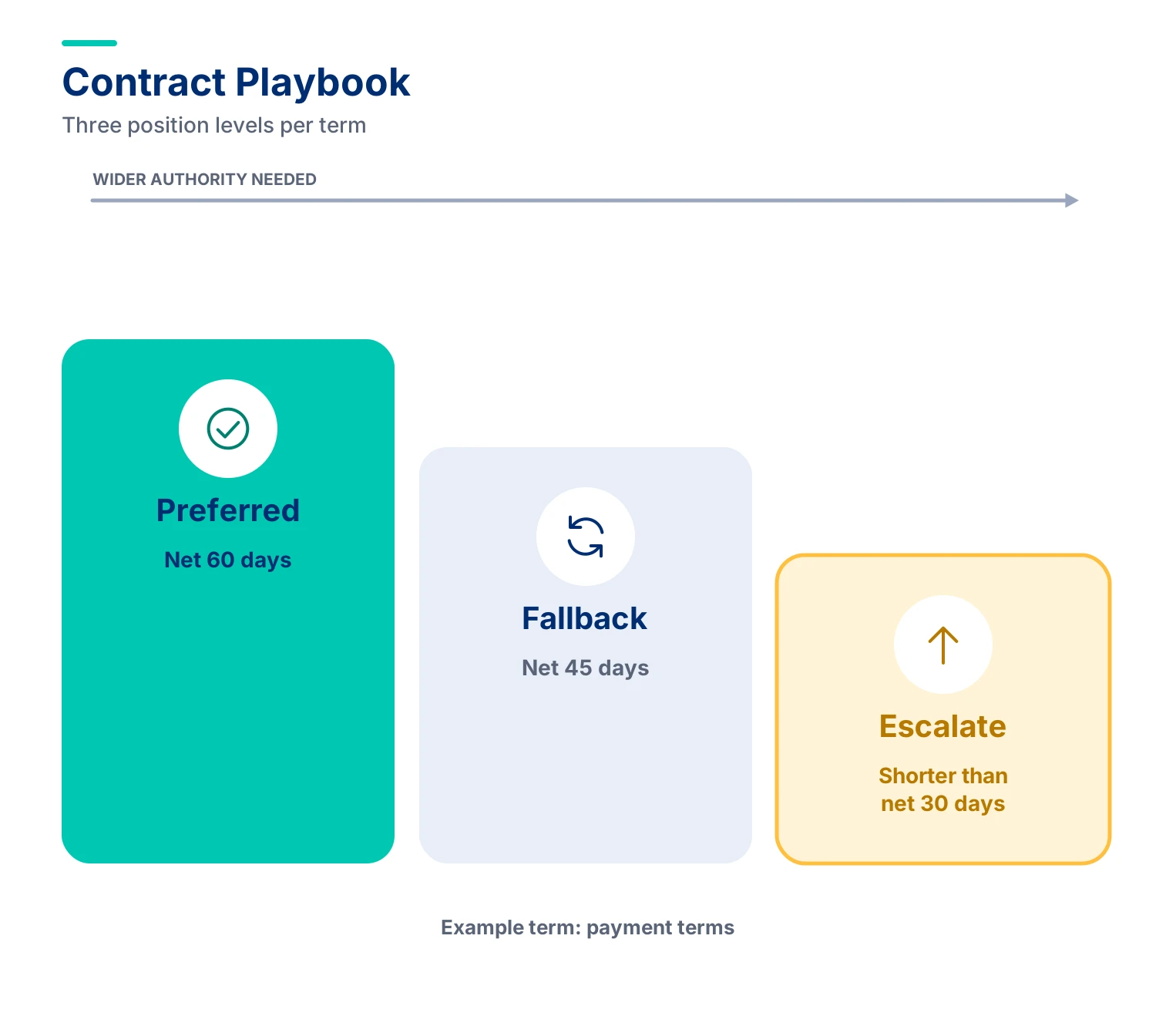
Most playbooks use three levels for each term. The examples below are illustrative and should be set by each company.
| Term | Preferred | Fallback | Escalate |
| Payment terms | Net 60 days | Net 45 to net 30 days | Shorter than net 30 days |
| Supplier liability cap | Twenty-four months of fees | Twelve months of fees | Below twelve months of fees |
| Termination | Either side may end for convenience on notice | Buyer only may end for convenience | No termination right for the buyer |
| Data protection | Company data terms | Supplier terms reviewed by legal | Data use outside the agreed purpose |
KPIs
| Dimension | Sample KPIs |
| Adoption | Contracts negotiated using the playbook; negotiators trained |
| Speed | Time from first draft to signature; share closed without escalation |
| Control | Escalations by term; deviations approved within authority |
| Currency | Terms reviewed in the last 12 months; fallback use by term |
KEY TERMS
- Preferred Position. The outcome a company aims for on a contract term.
- Fallback Position. An approved alternative that a negotiator may accept.
- Escalation. Sending a request to a more senior approver.
- Red Line. A term the company will not accept, or will accept only with the highest approval.
- Clause Library. A collection of approved contract clauses and fallback wording.
- Approval Matrix. A table showing who can approve what, by value and risk.
- Trade-Off. A concession given in exchange for a benefit on another term.
- Deviation. A departure from the company’s standard contract position.
FAQs
1. What is a contract playbook in contract management?
A contract playbook is a structured guide that defines an organization’s preferred contract terms, acceptable fallback positions, and negotiation escalation requirements. Legal and procurement teams use contract playbooks to standardize negotiations, manage contractual risks, and accelerate approvals. By establishing clear negotiation boundaries, a contract playbook helps employees make consistent decisions while ensuring non-standard or high-risk terms receive appropriate authorization.
2. What should be included in a contract negotiation playbook?
A contract negotiation playbook should include preferred contractual positions, approved fallback clauses, escalation triggers, approval authorities, and negotiation guidance. Key provisions typically cover payment terms, liability limitations, termination rights, data protection, and intellectual property. Each section should explain the business rationale behind the preferred position and link to approved clause wording. These components help negotiators resolve routine objections while maintaining legal and commercial safeguards.
3. What is the difference between a contract playbook and a clause library?
A contract playbook provides negotiation strategies, acceptable fallback positions, and escalation rules, while a clause library stores pre-approved contractual language. For example, a clause library contains alternative liability provisions, whereas a contract playbook explains when negotiators can accept each alternative. Organizations often use both together to standardize contract drafting, accelerate supplier negotiations, and maintain consistent risk management practices.
4. What are preferred, fallback, and escalation positions in a contract playbook?
Contract playbooks typically define three negotiation levels: preferred, fallback, and escalation. The preferred position represents the organization’s ideal contractual terms. A fallback position offers pre-approved alternatives when counterparties reject the initial proposal. Escalation applies when requested changes exceed authorized negotiation limits. For example, a company may prefer 60-day payment terms, accept 30 to 45 days, and require senior approval for shorter periods.
5. How do you create an effective contract playbook?
Creating a contract playbook begins with identifying frequently negotiated contract terms and defining preferred positions based on business policies. Legal and procurement teams then establish acceptable fallbacks, escalation thresholds, and approval responsibilities. The playbook should include negotiation guidance, supporting rationale, and links to approved clauses. Regular training, feedback collection, and periodic updates help ensure the playbook remains practical and aligned with organizational risk requirements.
6. Who is responsible for managing and updating a contract playbook?
Legal and procurement teams typically share responsibility for developing and maintaining contract playbooks, with input from finance, risk management, and business stakeholders. Legal defines acceptable contractual risks, while procurement contributes supplier negotiation and commercial expertise. Organizations should review playbooks at least annually and whenever regulations, business priorities, or market conditions change. Monitoring frequently used fallback positions and escalations helps identify where negotiation guidance needs improvement.
7. How can AI-powered contract management software automate contract playbooks?
AI-powered contract management software can compare proposed contract terms against approved playbooks, identify non-standard clauses, and recommend acceptable fallback language. It can also flag deviations requiring legal approval and support consistent contract redlining. When integrated with contract lifecycle management (CLM) workflows, these capabilities reduce repetitive reviews, accelerate negotiations, and improve compliance with internal policies. Human oversight remains essential for approving exceptions and high-risk contractual changes.