


WHAT IS INVOICE DISPUTE MANAGEMENT?
Invoice dispute management is the accounts payable process of logging, investigating and resolving disagreements over supplier invoices. A dispute arises when an invoice does not match what was ordered, delivered or agreed. The goal is to resolve the difference quickly so the right amount is paid on time.
WHY IT MATTERS IN PROCUREMENT
Disputes stall payment. An invoice held in dispute is not paid on time, which strains supplier relationships and can trigger late fees. Teams that handle disputes through emails and spreadsheets lose track of ownership and ageing.
Disputes also reveal upstream problems. Repeated price disputes point to weak contract data. Repeated quantity disputes point to receipt discipline. A managed process turns each case into evidence the business can fix at the source.
THE CORE PROCESS / LIFECYCLE
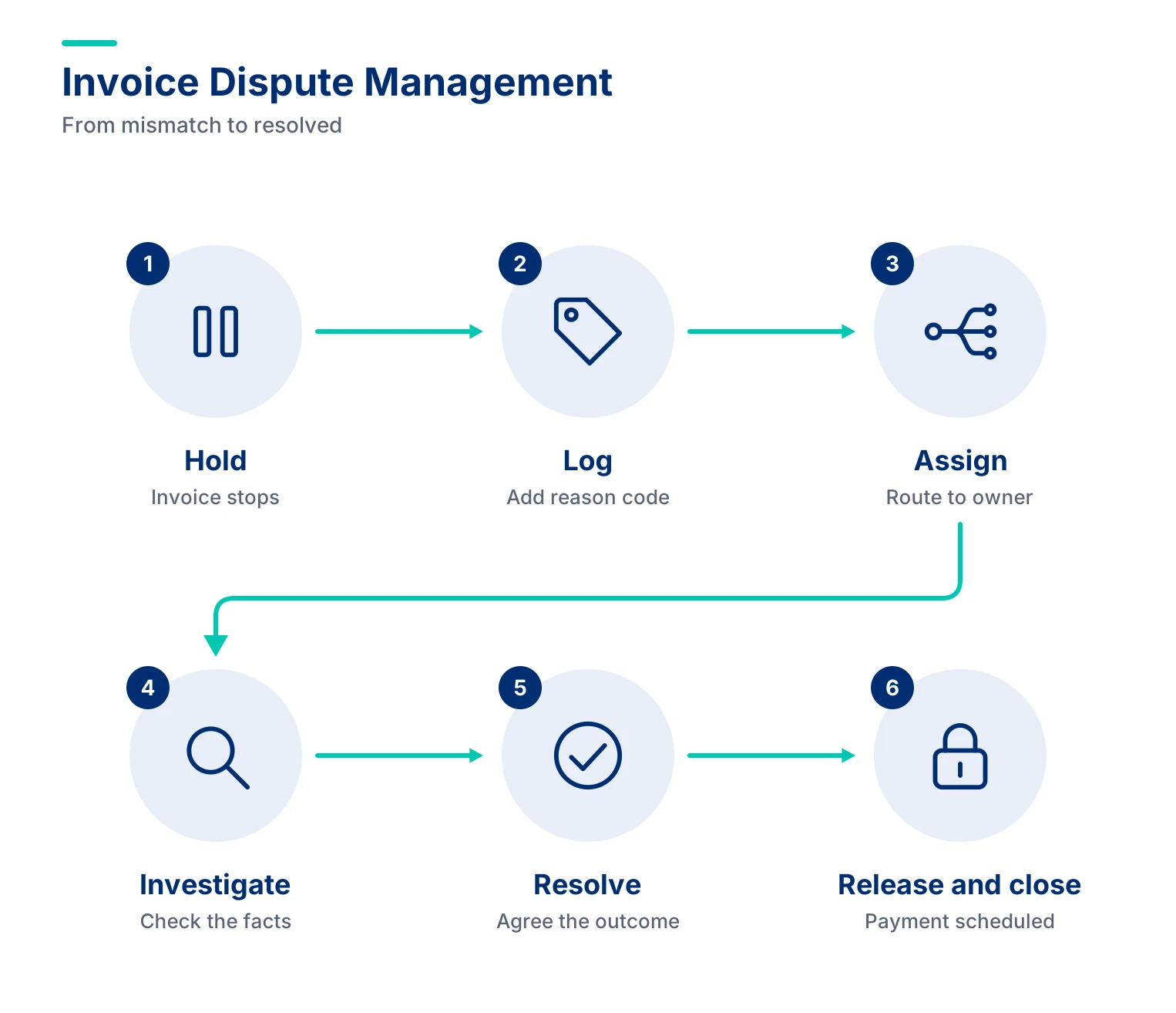
- Dispute Identification. A dispute begins when matching fails or when a supplier or approver challenges an invoice. The invoice is placed on hold so it cannot be paid until the issue is settled.
- Logging and Categorization. Accounts payable records the dispute with a reason code, such as price, quantity, tax, missing PO or duplicate. Consistent codes allow later analysis.
- Assignment. The case is routed to the person who can resolve it. Price issues go to procurement, receipt issues to the requester and tax issues to finance.
- Investigation and Communication. The owner checks the PO, contract and receipt, then contacts the supplier with the facts. All communication is recorded against the case.
- Resolution. The outcome is one of four: pay as invoiced, pay a corrected amount, request a credit note or corrected invoice, or reject the invoice. The decision and its reason are documented.
- Release and Close. The hold is lifted, payment is scheduled and the case is closed. The root cause is recorded and fed back into controls.
CORE COMPONENTS
A reason code taxonomy standardizes why invoices are disputed. Ownership rules assign each reason to a resolver. Ageing and escalation track how long each case has been open and push stalled ones upward. Supplier communication keeps a single thread, ideally in a portal, so both sides see the same status.
KEY BENEFITS
Structured dispute handling shortens resolution time because cases do not wait in inboxes. It protects supplier relationships through clear status and fewer late payments. It reduces late payment penalties and missed discounts. It gives procurement hard data on recurring causes, such as price mismatches against contract. And it improves audit readiness, since every decision has a record.
COMMON PITFALLS
- Running disputes through email. Cases lose ownership, history and ageing, and the same query gets asked twice.
- Skipping reason codes. Without categories, nobody can tell whether disputes come from pricing, receipts or supplier errors.
- Holding the whole invoice for a partial issue. Where terms allow, paying the undisputed lines while the rest is resolved keeps the supplier relationship intact.
- Closing cases without a root cause. The same dispute returns next month if the contract or process behind it is not fixed.
INVOICE DISPUTE REASONS AND WHO OWNS THE RESOLUTION
- Price mismatch. The invoice price differs from the PO or contract. Procurement confirms the agreed price and asks for a corrected invoice or a credit.
- Quantity mismatch. The billed quantity exceeds what was received. The requester confirms receipt, and the supplier corrects the invoice or ships the shortfall.
- Missing or wrong PO reference. The invoice cannot be matched. Accounts payable finds the right PO or asks the supplier to resubmit with the correct number.
- Tax or coding error. The tax rate or cost coding is wrong. Finance owns the correction.
- Duplicate or already paid. The invoice was submitted before. Accounts payable rejects it with a reference to the original.
- Service not performed. The requester disputes that the work was completed. The business owner verifies before any payment is made.
KPIs
| Dimension | Sample KPIs |
| Speed | Average resolution time; share resolved within target |
| Volume | Disputed invoices as a share of total; disputes by reason code |
| Ageing | Open disputes older than 30 days; escalation rate |
| Impact | Late payment fees from disputes; discounts missed |
KEY TERMS
- Invoice Hold. A status that blocks payment until a query is resolved.
- Reason Code. A standard label stating why an invoice was disputed.
- Credit Note. A supplier document that reduces the invoiced amount.
- Short Payment. Paying less than the invoiced amount because part of the invoice is disputed.
- Exception Queue. The work queue where invoices that fail matching are routed.
- Touchless Invoice. An invoice processed from receipt to payment with no manual intervention.
- Dispute Ageing. The length of time a dispute has been open.
FAQs
1. What is invoice dispute management in accounts payable?
Invoice dispute management is the process of identifying, investigating, and resolving disagreements between buyers and suppliers over invoice details. Disputes typically arise from incorrect pricing, quantity mismatches, tax errors, or missing purchase order references. Accounts payable and procurement teams use structured dispute management workflows to resolve discrepancies, prevent incorrect payments, reduce processing delays, and maintain healthy supplier relationships.
2. What are the most common causes of invoice disputes?
Common causes of invoice disputes include price differences between invoices and purchase orders, incorrect quantities, tax calculation errors, duplicate invoices, and missing purchase order references. Disputes can also arise when suppliers bill for goods not delivered or services not completed. Inaccurate contract data, delayed goods receipt confirmation, and inconsistent invoicing practices increase dispute frequency. Identifying recurring causes helps organizations improve invoice accuracy and reduce payment exceptions.
3. How does the invoice dispute resolution process work?
The invoice dispute resolution process begins by identifying discrepancies and placing the affected invoice on hold. Accounts payable records the dispute, assigns a reason code, and routes it to the responsible department. The assigned owner reviews purchase orders, contracts, and receipt records before coordinating with the supplier. Once resolved, the invoice is corrected, approved, rejected, or adjusted through a credit note. The outcome is documented before closing the case.
4. Can a company pay the undisputed portion of an invoice?
Yes, companies can pay the undisputed portion of an invoice while withholding the contested amount, provided contractual terms, applicable regulations, and accounting systems permit partial payments. For example, if a $10,000 invoice contains a $2,000 pricing dispute, the buyer may process the remaining $8,000 while investigating the discrepancy. Clear supplier communication and accurate documentation help prevent additional payment disputes and protect supplier relationships.
5. Who is responsible for managing supplier invoice disputes?
Accounts payable typically owns the invoice dispute management process, including case registration, tracking, and payment holds. However, responsibility for resolving individual disputes depends on the issue. Procurement handles pricing discrepancies, business requesters verify delivery or service completion, and finance addresses tax or accounting errors. Assigning clear ownership, escalation deadlines, and communication responsibilities helps organizations resolve disputes faster and maintain supplier accountability.
6. How can businesses reduce invoice disputes and payment delays?
Businesses can reduce invoice disputes by maintaining accurate purchase orders, enforcing contract pricing, validating supplier invoices, and recording goods receipts promptly. Standardized invoicing requirements and supplier communication help prevent recurring errors. Procurement and accounts payable teams should analyze dispute reason codes, monitor resolution times, and correct underlying process issues. Automated invoice matching and exception workflows can further reduce manual intervention, accelerate dispute resolution, and improve payment accuracy.
7. How does invoice dispute management software improve accounts payable efficiency?
Invoice dispute management software centralizes disputed invoices, assigns resolution owners, tracks case status, and automates escalation workflows. Integration with accounts payable automation systems enables invoice matching, discrepancy detection, and access to supporting purchase order and receipt records. Automated notifications and supplier communication improve transparency and reduce follow-ups. Dispute analytics also help organizations identify recurring errors, shorten resolution cycles, and improve supplier payment performance.