


WHAT ARE CONTINUOUS TRANSACTION CONTROLS (CTC)?
Continuous Transaction Controls (CTC) are government requirements for businesses to send invoice and transaction data to the tax authority at or near the time of the transaction, instead of only through periodic VAT returns. They give tax authorities near real-time visibility and are used mainly to reduce VAT fraud.
WHY IT MATTERS IN PROCUREMENT
For procurement and accounts payable, CTC changes when an invoice becomes valid. In some countries a supplier invoice is not legally issued until the tax authority has cleared it. A buyer may then be unable to post or deduct VAT on an invoice that bypassed the system.
CTC also differs by country, which makes global procurement harder. Clearance, reporting and platform models each need different integrations, data and timing, so a single global e-invoicing setup rarely fits.
THE CORE PROCESS / LIFECYCLE
- Invoice Creation. The supplier creates a structured invoice in the format the country requires, usually XML.
- Submission. The invoice is sent to the tax authority platform, or to a certified intermediary that reports to it.
- Validation. The platform checks the invoice against the required schema and tax rules, and may assign a unique identifier.
- Clearance or Reporting. In a clearance model the invoice is approved before it can reach the buyer. In a reporting model it goes to the buyer while the data is reported at the same time.
- Delivery. The buyer receives the validated invoice, often with its identifier, and posts it to accounts payable.
- Correction. Errors are usually fixed through credit notes or corrected documents under the country’s rules, not by editing the original.
CORE COMPONENTS
Clearance models require approval before an invoice is valid. Reporting models let businesses exchange invoices directly and send the data to the authority at the same time. Platform models route invoices through accredited providers that pass data on. A unique identifier is often assigned to each invoice, and penalties commonly apply to invoices issued outside the system.
KEY BENEFITS
Businesses that prepare well gain cleaner invoice data, fewer manual corrections and more certain VAT treatment. Structured formats reduce matching errors. Automated validation catches mistakes early. And for buyers, receiving validated invoices lowers the risk of disputed VAT deductions.
COMMON PITFALLS
- Treating CTC as a tax team issue only. Invoice receipt, approval and payment all change, so accounts payable and procurement must be involved.
- Using one setup for every country. Models, formats and deadlines differ widely between countries.
- Accepting invoices outside the system. In clearance countries, an invoice that has not been cleared may not be valid for VAT purposes.
- Ignoring offline and failure procedures. Platforms can be unavailable, and each country has its own fallback rules.
COMMON CTC MODELS AND WHERE THEY ARE USED
Status as of October 2026. Models and deadlines change, so check local rules before acting.
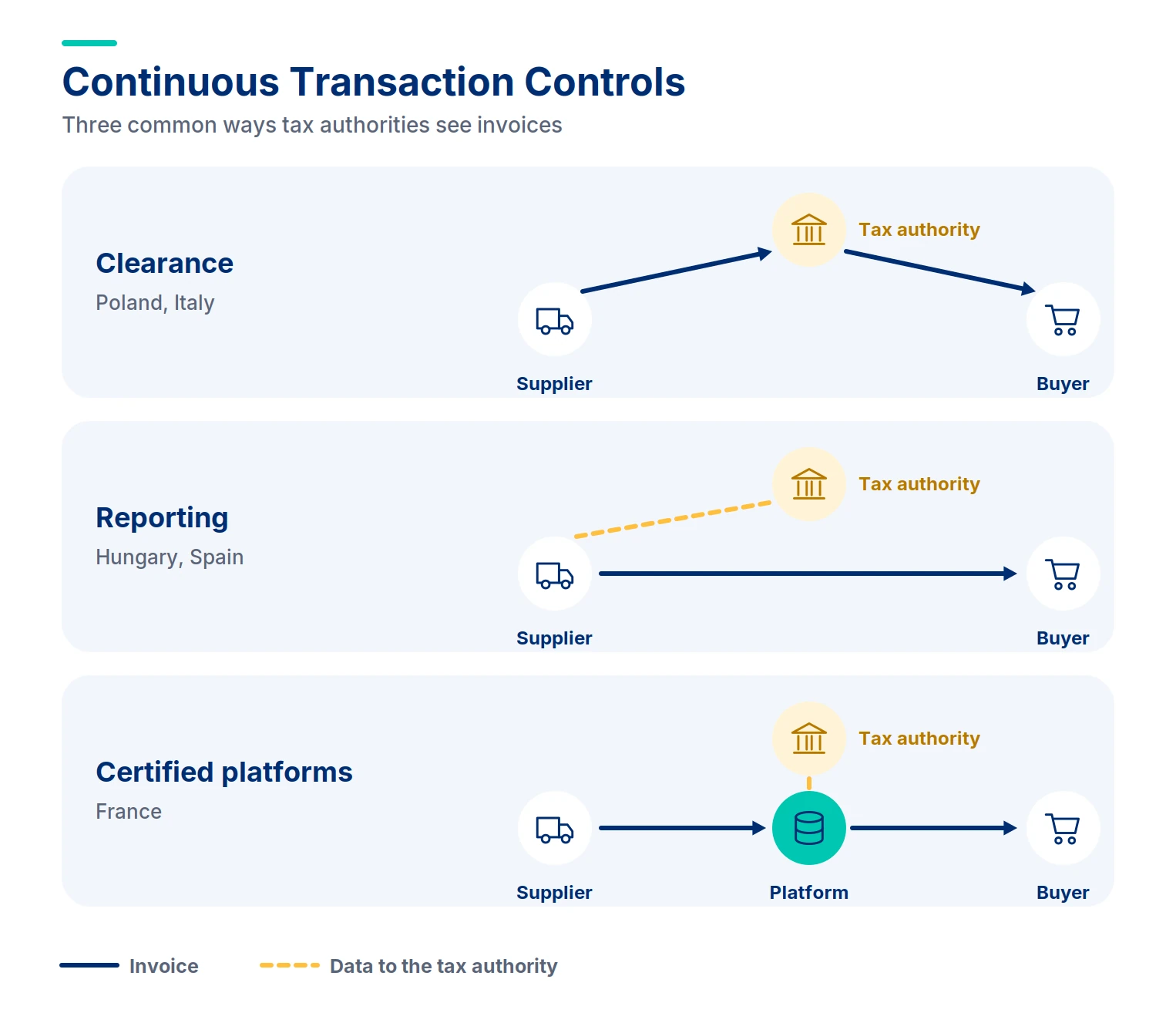
Centralized clearance. The tax authority validates each invoice before it reaches the buyer. Poland’s KSeF, mandatory since February 2026 and phased by company size, works this way, as does Italy’s SDI.
Reporting. Invoices go directly to the buyer, and data is reported to the authority at the same time. Hungary and Spain use reporting-based systems.
Certified platforms. Invoices travel through accredited private platforms that pass data to the tax authority. France’s model started on 1 September 2026, when all businesses must be able to receive e-invoices and issuing is phased by company size. Peppol is increasingly used as the exchange layer inside such regimes.
KPIs
| Dimension | Sample KPIs |
| Compliance | Invoices cleared first time; invoices rejected by the platform |
| Speed | Time from issue to clearance; invoice cycle time |
| Data | Invoices with a valid identifier; supplier records ready for CTC |
| Exceptions | Fallback or offline invoices; corrections raised |
KEY TERMS
- Clearance. Tax authority validation of an invoice before it is legally issued.
- E-Reporting. Sending invoice or transaction data to the tax authority, separate from the invoice itself.
- KSeF. Poland’s National e-Invoicing System, a central clearance platform.
- Accredited Platform. In France, a certified private platform that exchanges invoices and passes data to the tax authority.
- Unique Invoice Identifier. A number or code assigned to an invoice by the platform or authority.
- Structured Invoice. A machine-readable invoice, such as XML, not an image or a PDF.
- Real-Time Reporting. Reporting transaction data at or very close to the moment of the transaction.
FAQs
1. What are Continuous Transaction Controls (CTC) in electronic invoicing?
Continuous Transaction Controls (CTC) are government-mandated systems that require businesses to report invoice and transaction data to tax authorities in real time or near real time. Unlike traditional periodic VAT reporting, CTC enables authorities to validate or monitor transactions as they occur. These systems help reduce VAT fraud, improve tax transparency, and strengthen invoice compliance. CTC requirements vary by country and may involve electronic invoice clearance, reporting, or certified platforms.
2. How does the Continuous Transaction Controls (CTC) process work?
The CTC process begins when a supplier generates a structured electronic invoice, typically in XML format. Depending on national regulations, the invoice or transaction data is submitted to a tax authority or certified platform for validation or reporting. In clearance systems, invoices require approval before reaching buyers. In reporting systems, invoice data is transmitted alongside the transaction. Accounts payable teams then process compliant invoices and resolve any validation errors.
3. What is the difference between CTC clearance and real-time reporting models?
CTC clearance models require tax authorities to validate electronic invoices before they can be legally issued or delivered to buyers. Real-time reporting models allow suppliers to send invoices directly to customers while simultaneously reporting transaction data to tax authorities. Clearance provides upfront invoice validation, while reporting emphasizes transaction visibility. Italy and Poland use centralized clearance systems, whereas Hungary follows a reporting-based approach.
4. Which countries have implemented Continuous Transaction Controls?
Several countries have implemented CTC systems using different regulatory models. Italy operates the Sistema di Interscambio (SDI), while Poland introduced mandatory KSeF electronic invoicing in phases beginning February 2026. France launched its electronic invoicing reform in September 2026, requiring all businesses to receive structured invoices and larger companies to issue them through approved platforms. Businesses should verify country-specific requirements, implementation dates, and permitted invoice formats before transacting.
5. What is the difference between CTC and traditional e-invoicing?
Electronic invoicing refers to creating, sending, and receiving invoices in structured digital formats. Continuous Transaction Controls extend this process by requiring transaction data submission, government monitoring, or tax authority approval. For example, businesses may exchange electronic invoices directly without government involvement, while CTC clearance systems require validation before invoices become legally effective. CTC combines electronic invoicing with regulatory reporting and tax compliance requirements.
6. How can procurement and accounts payable teams prepare for CTC compliance?
Procurement and accounts payable teams can prepare for CTC compliance by reviewing country-specific e-invoicing mandates, validating supplier tax information, and ensuring ERP systems support structured invoice formats. Organizations should configure tax authority integrations, verify invoice identifiers, and establish procedures for rejected or corrected invoices. Testing electronic invoice workflows and maintaining fallback processes for system outages can help minimize compliance risks and payment disruptions.
7. How are Continuous Transaction Controls related to VAT in the Digital Age (ViDA)?
Continuous Transaction Controls and the EU’s VAT in the Digital Age (ViDA) initiative both aim to improve VAT compliance through digital transaction reporting. CTC systems operate under individual national regulations, while ViDA establishes harmonized electronic invoicing and digital reporting requirements for qualifying intra-EU transactions from July 1, 2030. Businesses operating across Europe must manage existing national CTC obligations while preparing for the broader ViDA framework.