


WHAT IS THE MODERN SLAVERY ACT?
The Modern Slavery Act is legislation that requires larger companies to report publicly on the steps they take to prevent slavery, forced labor and human trafficking in their operations and supply chains. The UK Modern Slavery Act 2015 and Australia’s Modern Slavery Act 2018 are the best known.
WHY IT MATTERS IN PROCUREMENT
Supply chains are where modern slavery risk usually sits, such as agriculture, garments, cleaning and construction. Procurement chooses the suppliers, writes the contract terms and manages the relationship, so it carries most of the practical work of reducing the risk.
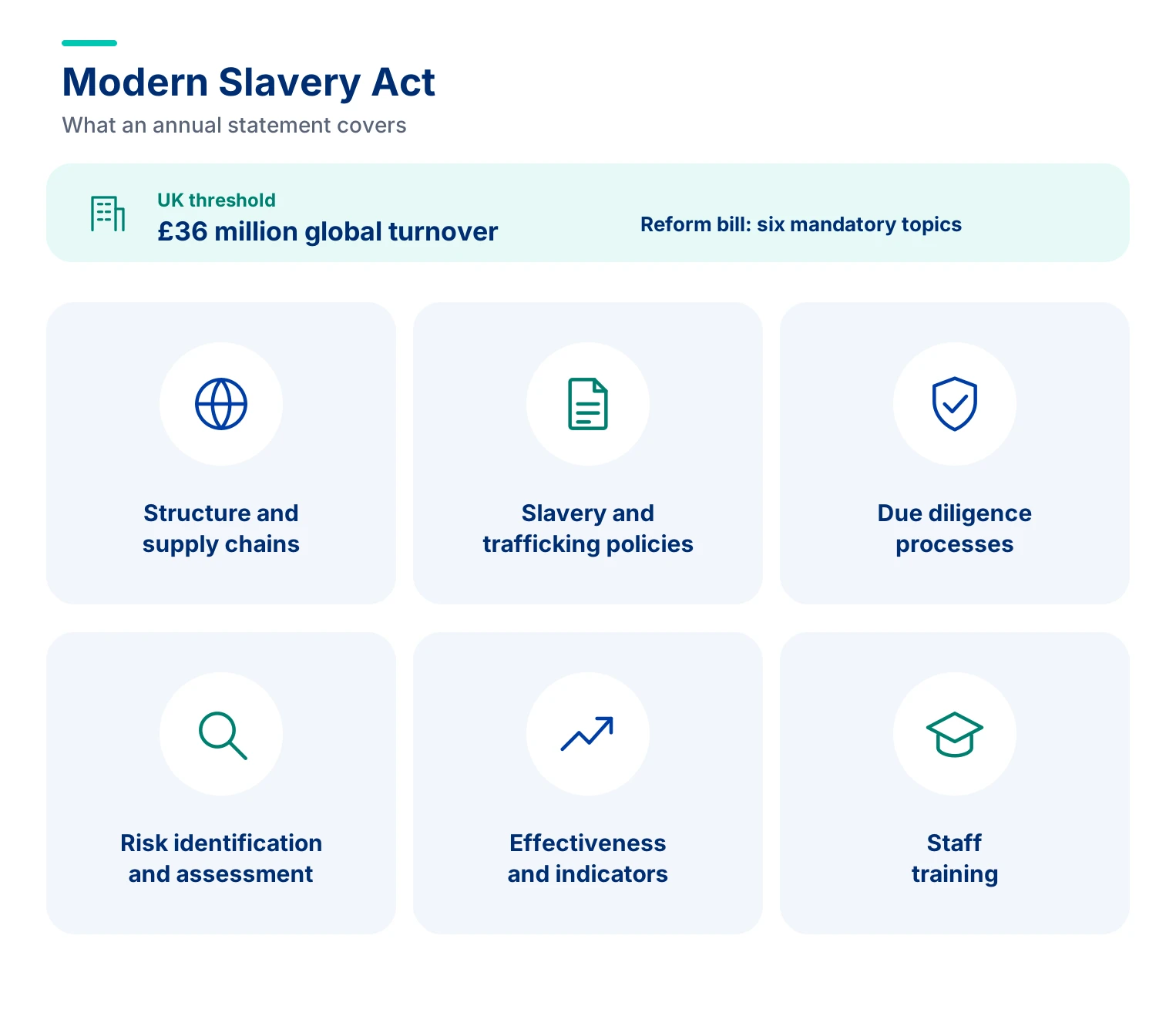
In the UK, section 54 requires commercial organizations carrying on business in the UK with a global turnover of £36 million or more to publish an annual slavery and human trafficking statement. Today the law requires a statement of the steps taken, or a statement that none were taken, and the listed topics are suggestions. The Immigration and Asylum Bill, introduced in Parliament on 30 June 2026, would make six topics mandatory, require organizations to explain any topic they skip, and add financial penalties. Reported details, such as an extension to public bodies, need expert confirmation. Australia already sets mandatory criteria above an A$100 million revenue threshold. Check the bill’s current status.
THE CORE PROCESS / LIFECYCLE
Map the Supply Chain. The team lists direct suppliers and, where it can, the labor sources behind them, by category and country, to see where workers are most exposed.
Assess Risk. Categories, countries and suppliers are rated using indicators such as labor intensity, migrant or agency labor, recruitment fees and weak enforcement.
Set Policy and Contract Terms. A supplier code of conduct and contract clauses set expectations on forced labor, recruitment practices, audit access and remediation.
Screen and Verify. Suppliers are screened at onboarding and checked through questionnaires, audits, worker voice channels and site visits for higher risk cases.
Remediate and Escalate. When indicators appear, the company agrees corrective actions, supports affected workers and, as a last resort, ends the relationship responsibly.
Report and Review. The board approves an annual statement, and the company checks whether its measures work and updates its approach.
CORE COMPONENTS
The reporting duty is the annual public statement, approved at board level in the UK and signed by a director or equivalent. Supply chain due diligence covers the risk assessment, supplier checks and contract terms procurement runs. Supplier code of conduct sets the standard suppliers agree to. Grievance channels let workers raise concerns without fear. Training equips buyers and category managers to spot warning signs such as unclear recruitment agents.
KEY BENEFITS
A structured approach gives procurement a documented, risk-based view of its supply base, so effort goes to the categories and countries where harm is most likely. It reduces legal and reputational exposure, because the company can show what it did and why.
It also helps commercially. Customers, investors and public sector buyers increasingly ask for modern slavery evidence in tenders, so a credible program helps win and keep business.
COMMON PITFALLS
Publishing a statement with no supporting work. A statement that describes policies but shows no assessment or action invites criticism and does not reduce risk.
Relying on tier-one questionnaires alone. Self-reported answers from direct suppliers rarely reveal recruitment fee abuse or labor conditions further down the chain.
Treating audits as proof. Announced audits can miss forced labor, so combine them with worker interviews and other signals.
Ending relationships at the first finding. Walking away can leave workers worse off, so remediation usually comes before exit.
WHAT AN ANNUAL STATEMENT TYPICALLY COVERS
The UK Act lists topics a statement may cover. The proposed reform would make all six mandatory. Procurement supplies most of the evidence.
| Topic | Procurement evidence |
| Structure, operations and supply chains | Spend by category and country; supplier counts by tier |
| Policies on slavery and trafficking | Supplier code of conduct; contract clauses |
| Due diligence processes | Onboarding screening; audits; corrective action records |
| Risk identification and assessment | Category and country risk ratings; high-risk supplier list |
| Effectiveness and indicators | Audit findings closed; suppliers acknowledging the code |
| Staff training | Buyers and category managers trained; completion rates |
KPIs
| Dimension | Sample KPIs |
| Coverage | Spend risk-rated; suppliers screened at onboarding |
| Assurance | High-risk suppliers audited; audits including worker interviews |
| Remediation | Findings raised and closed; average time to close |
| Capability | Buyers trained; contracts carrying the code of conduct |
KEY TERMS
- Forced Labor. Work or service obtained from a person under threat or without free consent.
- Human Trafficking. Recruiting, moving or holding people through coercion or deception for exploitation.
- Debt Bondage. A situation in which a worker is bound to an employer to repay a debt, often linked to recruitment fees.
- Section 54. The part of the UK Act that sets the annual statement duty for larger organizations.
- Slavery and Human Trafficking Statement. The annual public report describing steps taken to prevent these abuses.
- Recruitment Fees. Charges paid by workers to labor agents, a common marker of exploitation.
- Worker Voice. Channels that let workers raise concerns directly and safely.
- Remediation. Action to correct harm and support affected workers.
FAQs
1. What is the Modern Slavery Act in procurement?
The Modern Slavery Act refers to legislation addressing slavery, forced labor, and human trafficking in business operations and supply chains. The UK Modern Slavery Act 2015 and Australia’s Modern Slavery Act 2018 require qualifying organizations to publish annual statements describing their actions to address modern slavery risks. In procurement, these requirements encourage supplier risk assessments, ethical sourcing policies, contractual safeguards, and monitoring of labor practices across supply chains.
2. Which companies must comply with the UK Modern Slavery Act?
Under Section 54 of the UK Modern Slavery Act 2015, commercial organizations supplying goods or services, conducting business in the UK, and generating £36 million or more in annual global turnover must publish an annual modern slavery statement. The threshold includes applicable subsidiary turnover. Companies headquartered outside the UK may also qualify if they conduct business in the country. Organizations must publish their statements annually and obtain appropriate senior management approval.
3. How does Australia’s Modern Slavery Act differ from the UK legislation?
Australia’s Modern Slavery Act 2018 requires entities based or operating in Australia with annual consolidated revenue of at least A$100 million to publish modern slavery statements. Unlike the UK’s current reporting framework, Australia’s legislation specifies mandatory reporting criteria, including risk assessments, due diligence actions, effectiveness reviews, and consultation processes. Both laws promote supply chain transparency, but their revenue thresholds, reporting requirements, and regulatory frameworks differ.
4. What information should a Modern Slavery Act statement include?
A modern slavery statement should explain an organization’s structure and supply chains, anti-slavery policies, due diligence processes, identified risks, effectiveness measures, and employee training. In the UK, these six reporting areas are currently recommended rather than individually mandatory. Procurement teams can support reporting with supplier assessments, audit findings, contractual safeguards, corrective action records, and employee training data. Statements should accurately reflect actions taken during the reporting period.
5. How can procurement teams identify and prevent modern slavery risks in supply chains?
Procurement teams can reduce modern slavery risks by mapping suppliers, identifying high-risk countries and industries, conducting due diligence, and implementing supplier codes of conduct. Risk indicators include recruitment fees, migrant worker exploitation, debt bondage, and limited worker protections. Supplier audits, confidential grievance channels, and worker interviews help identify potential violations. When risks are discovered, organizations should prioritize corrective actions and worker remediation rather than immediately terminating supplier relationships.
6. Does the Modern Slavery Act apply to international suppliers and smaller businesses?
The Modern Slavery Act can indirectly affect smaller businesses and international suppliers through the requirements of their customers. Even when suppliers fall below statutory reporting thresholds, larger organizations may require supplier questionnaires, contractual commitments, labor practice assessments, and compliance documentation. International businesses may also have direct reporting obligations if they meet applicable jurisdictional requirements. Procurement teams should communicate supplier expectations clearly and prioritize due diligence according to identified risks.
7. What changes to the UK Modern Slavery Act are proposed in 2026?
The UK’s Immigration and Asylum Bill 2026 proposes stronger supply chain transparency requirements, expanded expectations for public sector organizations, and tougher financial penalties for reporting failures. These changes aim to improve corporate accountability for modern slavery risks. As of October 2026, the proposed reforms have not replaced the existing Section 54 reporting requirements. Businesses should continue following current legislation while monitoring parliamentary developments and preparing for potentially stricter reporting obligations.