



Supply Chain Risk Management Software is a digital system that helps procurement teams identify, monitor, and mitigate supplier-related risks across the Source-to-Pay lifecycle.
It ensures that supply networks remain stable, compliant, and resilient by continuously tracking risk signals such as supplier disruptions, financial instability, regulatory exposure, ESG violations, and geopolitical events.
Rather than treating risk as a periodic supplier review, modern systems embed risk controls directly into sourcing, supplier management, contracts, and procure-to-pay execution.
Download Whitepaper: The Why, What And How of the supplier management in Procurement
Why it Matters in Procurement
Supply chain disruptions rarely begin with a single catastrophic event. They start with early warnings — delayed deliveries, expiring certifications, compliance gaps, financial stress, or rising quality failures.
Without structured monitoring, these issues surface too late, leading to:
- production downtime
- supplier failures and urgent re-sourcing
- contract value leakage
- compliance penalties
- damaged supplier relationships
Supply chain risk software prevents this by creating a governed, always-on risk layer across procurement operations.
Capabilities such as external risk intelligence monitoring — often embedded through tools like Merlin Risk Radar — help ensure early signals are detected before disruption becomes impact.
Download Research Report: Taking a 360° Approach to Supplier Management
The Core Supply Chain Risk Management Flow
1. Supplier Risk Screening and Early Due Diligence
Risk management begins before supplier engagement. Suppliers are evaluated for sanctions exposure, financial credibility, regulatory history, ESG posture, and geographic dependency risks.
Digital screening ensures only suppliers meeting baseline trust requirements enter sourcing pipelines, reducing compliance risk from the start.
Platforms aligned with Merlin Risk workflows strengthen this stage by enriching supplier profiles with real-time external risk data.
2. Risk Profiling and Supplier Tiering
Not every supplier requires the same level of oversight.
Modern systems classify suppliers by criticality:
- strategic and high-risk suppliers monitored continuously
- operational suppliers reviewed periodically
- transactional suppliers validated with lighter controls
This tier-based governance ensures that monitoring effort matches business exposure while keeping supplier risk scalable across large networks.
Download Whitepaper: Supplier Risk And Performance Management: Best Practices For KPI Creation
3. Continuous Monitoring and Risk Signal Detection
Supplier risk is dynamic — financial stability, legal standing, cyber posture, and ESG ratings can shift at any time.
Supply chain risk platforms continuously track:
- delivery and performance trends
- certification expiry and compliance gaps
- adverse media, sanctions, and regulatory alerts
- operational instability and location-based disruption risk
This transforms supplier risk from static assessment into live governance.
4. Alerting and Exception Escalation
When risk signals cross defined thresholds, the system triggers alerts and escalation workflows.
Typical triggers include:
- credit downgrade
- sanctions exposure
- repeated SLA failures
- ESG or labor compliance violations
- cybersecurity breach indicators
Instead of risk remaining informational, alerts become actionable events routed to procurement owners for resolution.
5. Mitigation Workflows and Corrective Response
Risk management only delivers value when it drives action.
Once flagged, suppliers enter structured mitigation flows such as:
- alternate supplier activation
- PO diversion or volume rebalancing
- audit escalation
- remediation and corrective plans
- tighter contract clauses or performance enforcement
This ensures supply continuity is protected through operational controls, not reactive firefighting.
6. Audit Trail and Governance Reporting
Every compliance action must be defensible.
Supply chain risk software maintains full documentation of:
- supplier risk scores
- mitigation ownership and closure timelines
- audit outcomes and evidence
- regulatory reporting readiness
- residual risk after remediation
This creates a transparent governance layer essential for internal controls and third-party audit requirements.
Core Components of Supply Chain Risk Management Software
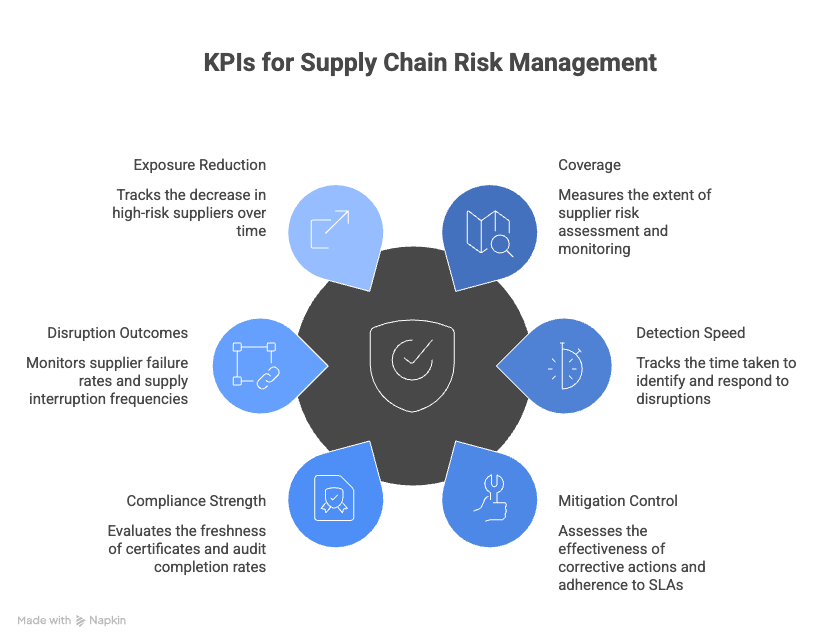
- Supplier risk intelligence feeds integrating internal performance data with external risk signals
- Multi-domain risk scoring across financial, operational, cyber, ESG, and regulatory areas
- Tiered monitoring cadences based on supplier criticality
- Automated risk alerts and escalation routing tied into supplier records
- Mitigation workflow orchestration with corrective action tracking
- Compliance document management (certifications, audits, attestations)
- Dashboards and audit trails supporting procurement governance
Platforms aligned with Merlin Risk Radar enhance these capabilities by adding continuous adverse media and sanctions monitoring directly into supplier risk workflows.
Key Terms in Supply Chain Risk Management Software
- Risk Scoring — Quantified supplier risk rating based on multi-signal inputs
- Supplier Tiering — Governance depth based on supplier business criticality
- Early Warning Signals — Leading indicators of disruption before impact
- Adverse Media Monitoring — Tracking negative supplier events across news and intelligence
- Sanctions Screening — Ensuring suppliers aren’t linked to restricted entities
- Mitigation Workflows — Structured corrective response processes for supplier risk
- Residual Risk — Remaining exposure after mitigation actions are applied
- Audit Trail — Immutable record of supplier risk events and governance actions
Examples of Supply Chain Risk Management Software
- Zycus Supplier Risk Management + Merlin Risk Radar — Continuous external risk monitoring with tiered supplier governance workflows
- SAP Ariba Supplier Risk — Integrated supplier scoring and compliance monitoring
- Coupa Risk Aware — Supply chain risk visibility with scenario-based insights
- GEP SMART Risk — Supplier risk intelligence embedded across sourcing and S2P
- Ivalua Risk Management — Supplier governance and compliance workflows across lifecycle
- Jaggaer Supplier Risk — Risk controls integrated with sourcing and supplier management
FAQs
Q1. What is supply chain risk management software?
It is a procurement system that continuously monitors supplier risk signals and helps prevent disruptions through alerts, mitigation workflows, and governance controls.
Q2. What risks does supply chain risk software cover?
It covers financial, operational, cyber, compliance, ESG, geopolitical, and supplier performance risks across the procurement lifecycle.
Q3. How does supplier tiering improve risk management?
Tiering ensures critical suppliers receive deeper monitoring while transactional suppliers remain governed with lighter controls, making risk scalable.
Q4. How does software reduce supply chain disruption?
By detecting early warning signals, triggering escalation workflows, and enforcing mitigation actions before disruption impacts operations.
Q5. Why is auditability important in supplier risk governance?
Because compliance, mitigation actions, and supplier accountability must be traceable for internal controls, regulatory exposure, and supplier oversight.
References
- Supplier Management–Benefits, Process, & Best Practices
- 8 Stages of Supplier Lifecycle Management Every Business Should Know
- Unlocking Efficiency: The Pros and Cons of Supplier Managed Inventory
- 5 Key Elements of Effective Supplier Quality Management
- Catalyzing Success with Supplier Management Strategies in 2024










