


A Vendor Performance Scorecard is a structured evaluation framework used by procurement teams to consistently measure, track, and compare supplier performance against predefined criteria.
It translates day-to-day supplier interactions—delivery, quality, service, compliance—into measurable performance indicators that support informed decision-making.
Read more: A Complete Guide to Vendor Management – its Benefits, Challenges, Process & Best Practices
Rather than relying on anecdotal feedback or periodic reviews, a scorecard creates a single, objective view of supplier performance that can be used across sourcing, contract renewals, risk management, and supplier development initiatives.
Why Vendor Performance Scorecards Matter in Procurement
Supplier performance directly impacts cost, continuity, compliance, and customer satisfaction. Without a standardized scoring mechanism, performance issues often surface too late—after delays, defects, or service failures have already occurred.
A well-designed scorecard enables procurement to:
- Detect performance issues early and act proactively
- Compare suppliers objectively across categories and geographies
- Tie performance outcomes to sourcing, renewals, and preferred supplier status
- Create accountability while maintaining collaborative supplier relationships
In mature procurement organizations, scorecards are not reporting tools, they are governance mechanisms.
The Vendor Performance Scorecard Framework
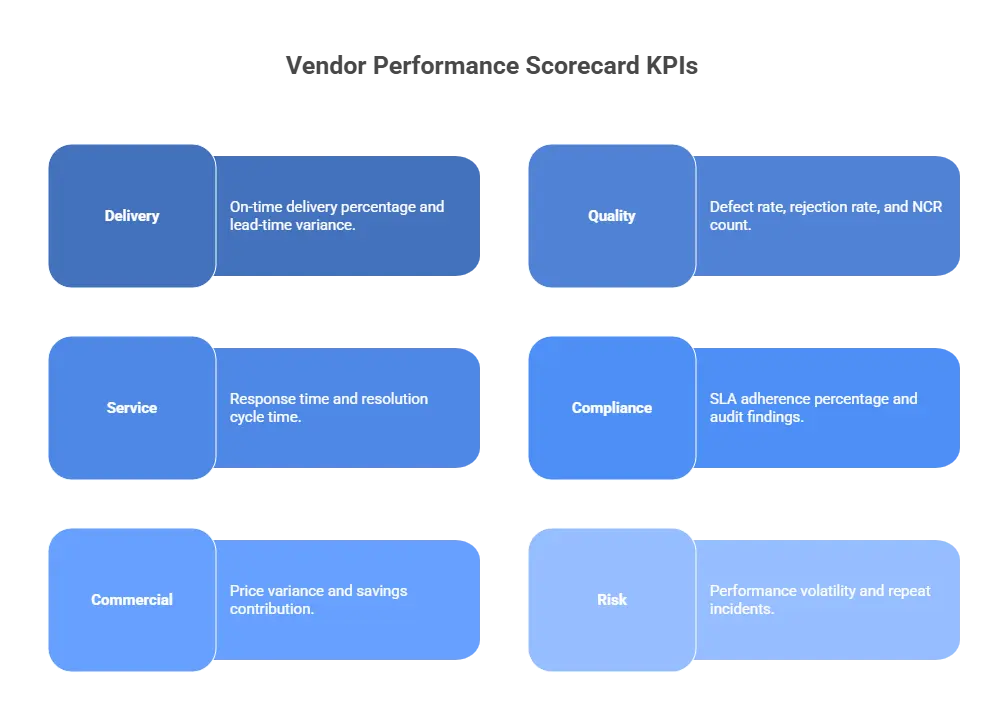
Vendor performance scorecards are built around a balanced set of dimensions that reflect both operational execution and strategic alignment.
1. Delivery and Reliability Performance
This dimension evaluates whether suppliers deliver what was promised, when it was promised.
It typically measures on-time delivery, adherence to quantities, lead-time consistency, and responsiveness to changes.
Persistent delays or fulfillment gaps often signal deeper capacity, planning, or process issues that require intervention.
2. Quality Performance
Quality metrics assess whether supplied goods or services meet agreed specifications and standards.
This includes defect rates, rework incidents, returns, non-conformance reports, and acceptance failures.
For services, quality may include accuracy, completeness, or service rework frequency.
Quality performance is often the strongest indicator of long-term supplier viability.
3. Service and Responsiveness
This dimension captures how effectively a supplier engages beyond delivery.
It includes response times, issue resolution speed, communication effectiveness, escalation handling, and overall service experience.
Strong service performance reduces operational friction and improves internal stakeholder satisfaction.
4. Compliance and Contract Adherence
Compliance metrics ensure suppliers operate within contractual, regulatory, and policy boundaries.
This includes adherence to SLAs, pricing compliance, documentation accuracy, certification validity, and audit outcomes.
Non-compliance directly contributes to financial leakage and regulatory exposure.
5. Cost and Commercial Performance
This dimension evaluates whether the supplier delivers expected commercial value over time.
It may include price stability, cost competitiveness, adherence to negotiated terms, and contribution to cost-reduction initiatives.
This ensures performance is assessed beyond initial sourcing outcomes.
6. Risk and Resilience Indicators
Modern scorecards increasingly include risk-aligned signals such as delivery volatility, dependency risk, capacity constraints, or recurring operational failures.
This helps procurement proactively manage supplier concentration and continuity risks.
How Vendor Performance Scorecards Operate
Vendor performance scorecards function as a continuous performance loop, not a periodic exercise.
Performance data is captured automatically from procurement, logistics, quality, and finance systems as transactions occur.
These inputs are normalized and mapped to predefined KPIs and weighted based on supplier tier or category criticality.
Scores are calculated at defined intervals—monthly, quarterly, or event-driven—and compared against benchmarks or thresholds.
When performance falls below expectations, corrective action workflows are triggered, enabling structured improvement plans.
Over time, scorecard insights feed directly into sourcing decisions, supplier segmentation, contract renewals, and development initiatives—closing the loop between performance and strategy.
How Scorecards Drive Supplier Improvement
A scorecard is most effective when it is shared, discussed, and acted upon.
High-performing suppliers gain preferred or strategic status.
Underperforming suppliers enter corrective action programs focused on root-cause resolution rather than punishment.
This structured transparency strengthens trust, aligns expectations, and creates a fact-based foundation for continuous improvement.
Key Terms
- Vendor Performance Scorecard – A structured framework for measuring supplier performance using KPIs
- KPIs – Quantitative metrics used to evaluate delivery, quality, service, and compliance
- Supplier Tiering – Classification of suppliers based on criticality and performance impact
- Corrective Action Plan (CAPA) – A formal plan to address and prevent performance issues
- Performance Benchmarking – Comparing supplier scores against peers or standards
FAQs
Q1. What is a vendor performance scorecard?
It is a standardized tool used to measure and compare supplier performance across delivery, quality, service, cost, and compliance metrics.
Q2. How often should supplier performance be scored?
Most organizations score suppliers monthly or quarterly, with event-based scoring for critical incidents.
Q3. Is a vendor performance scorecard the same as supplier evaluation?
No. Supplier evaluation is typically point-in-time, while scorecards provide continuous, ongoing performance measurement.
Q4. How do scorecards improve supplier relationships?
They create transparency, align expectations, and enable structured, data-driven improvement conversations.
Q5. Can performance scorecards influence sourcing decisions?
Yes. Scorecard results are often used to determine supplier renewals, preferred status, and future award eligibility.
References
- Vendor Landscape: Supplier Risk And Performance Management
- Technology Sourcing, Procurement and Vendor Management Need a Center of Excellence to Be Digital-Business-Ready
- Supplier Risk Management Framework: A Comprehensive Approach to Mitigating Supplier Risks
- A Quick and Effective Guide to Supplier Performance Evaluation Criteria
- Zycus Recognized as a Leader in IDC MarketScape: Worldwide AI-Enabled Procure-To-Pay Application 2025 Vendor Assessment
- A Complete Guide to Vendor Management – its Benefits, Challenges, Process & Best Practices